Modern SEO in 2026: The Complete Framework for Ranking, AI Visibility, and Topical Authority
If your SEO strategy still revolves around keyword rankings and backlink counts, you’re operating with a 2018 playbook in a 2026 landscape. The fundamentals haven’t just evolved—they’ve fundamentally restructured.
Over the past five years, Google has moved away from matching keywords to matching intent, then away from intent to matching entities, and now toward building topical authority—a system where search engines reward deep, interconnected knowledge clusters over scattered keyword targeting. Simultaneously, generative AI has created a parallel ranking economy where inclusion in AI-generated answers (through Google SGE, Perplexity, and ChatGPT Search) now determines visibility as much as traditional SERP position.
This article presents a genuine strategic framework—not a listicle of tips. It’s designed for Australian business owners and marketing leaders who need to understand not just what to do, but why the old approach fails and how the five pillars of modern SEO actually work together.
If you’re serious about competing in 2026, you need a system that integrates generative engine optimisation, semantic SEO, information gain, E-E-A-T credibility, and technical foundations into one coherent whole. This is that system.
Why the Old SEO Playbook Is Dead (And What Replaced It)
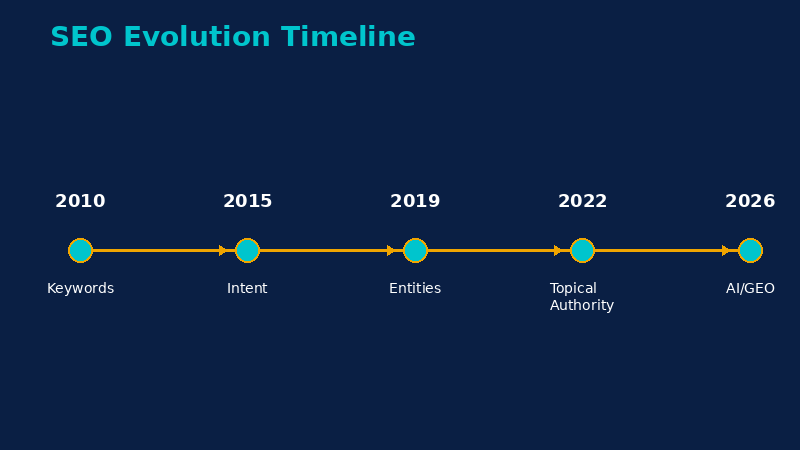
Between 2010 and 2018, SEO was fundamentally a keyword-matching exercise. You identified a keyword with search volume, optimised a page for that keyword, built backlinks to it, and watched it rank. It was mechanical, predictable, and—crucially—it worked. Thousands of Australian small businesses ranked for their core keywords using this exact method.
Then Google changed.
Hummingbird (2013) introduced semantic understanding. BERT (2018) taught Google to understand context within sentences. MUD—Multitask Unified Model—added multimodal understanding. And then came MUM (Multitask Unified Model, 2021), which could understand information across text, images, and video in new ways. Each update moved the needle away from keyword-exact matching and toward understanding what someone actually needs.
But the seismic shift came with the Search Generative Experience (SGE) and the emergence of generative engines as first-class ranking properties. Google no longer just returns links—it generates answers. Perplexity doesn’t have a traditional index in the SERP sense; it pulls cited sources from wherever it can find them. ChatGPT Search added retrieval that weights both traditional SEO relevance and AI-model quality.
For Australian businesses, this meant something stark: a company that ranked #1 for “occupational hygiene QLD” in 2020 by keyword-optimisation alone found itself invisible in 2024 when those same keywords now trigger AI-generated summaries that never mention their site.
What replaced keyword optimisation?
Entity-first thinking. Google now sees websites as entities with properties: what you sell, what you’re known for, your geographic footprint, your team, your industry relationships. It maps those entities to its knowledge graph. Content strategy changed from “rank this page for this keyword” to “establish this entity as the authoritative source for this topic cluster.”
Topical authority. Rather than scattering blog posts across different topics, you build semantic clusters—30 deeply linked articles around a core topic, each addressing a specific subtopic, all reinforcing a central entity. Google rewards this structure with dramatically higher rankings across the cluster.
Information gain. Simply being longer or more comprehensive no longer cuts it. Google now measures whether your content teaches something new. That means proprietary data, original research, first-hand experience, or angles competitors haven’t published.
Credibility multipliers. E-E-A-T (Experience, Expertise, Authoritativeness, Trustworthiness) moved from a nice-to-have to a ranking signal. Author entities, verified credentials, external citation, review signals, and industry recognitions now carry measurable weight.
Technical foundation. All of this—every pillar—collapses if the technical foundation is broken. Core Web Vitals, crawl efficiency, JavaScript rendering, schema markup for AI consumption: these are no longer “nice-to-have optimisations.” They’re the container everything else lives in.
This framework synthesises all five into a system. And it works because it matches how search engines actually evaluate content in 2026.
The 5 Pillars of Modern SEO in 2026
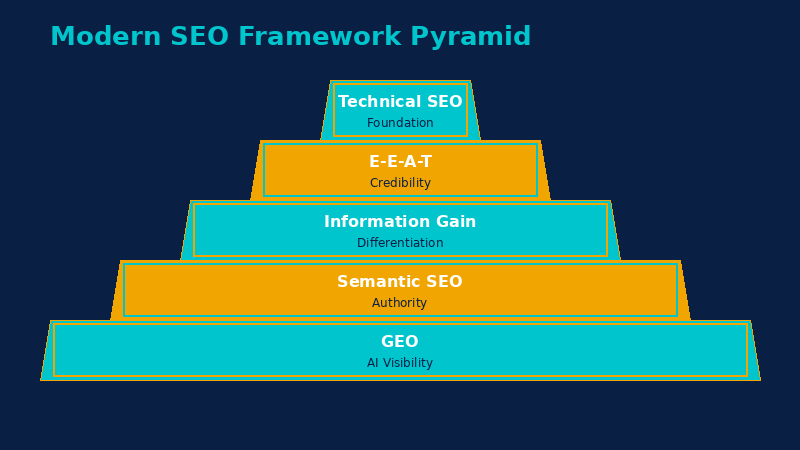
Think of modern SEO as a building. Each pillar supports the others; remove one and the structure weakens.
Pillar 1: Generative Engine Optimisation (GEO). The explicit optimisation of your content, structure, and citation patterns for inclusion and prominence in AI-generated answers. This is what “SEO for AI search” actually means.
Pillar 2: Semantic SEO & Topical Authority. The strategic architecture of your content around entity relationships and topic clusters, designed so Google recognises you as a topical authority—not just as a holder of pages.
Pillar 3: Information Gain & Content Differentiation. The creation of content that teaches something new—research, data, frameworks, or angles that your competitors haven’t published. This is what makes your content rank above others on the same topic.
Pillar 4: E-E-A-T & Credibility Architecture. The systematic construction of authority signals—author profiles, external citations, review signals, industry memberships—that Google uses to evaluate whether you’re trustworthy enough to appear in high-stakes niches.
Pillar 5: Technical SEO Foundation. The infrastructure: site speed, crawlability, JavaScript rendering, Core Web Vitals, schema markup, and canonicalisation that allows all other pillars to function.
These aren’t steps to take sequentially. They work together. But understanding each one separately helps you audit where your weaknesses are.
Pillar 1: Generative Engine Optimisation (GEO)
Generative Engine Optimisation is a new category of work, but it’s worth understanding clearly: it’s the practice of optimising content for inclusion and prominence in AI-generated answers.
When you search “what is a risk register” on Google today, you get a generative panel that synthesises information from multiple sources. That panel has citations. Some sources are weighted more heavily than others. If your site isn’t cited at all, you’ve lost visibility that would have been yours if you ranked in the top 3 organic results. If your site is cited but poorly summarised, you get traffic that doesn’t convert because the AI summary already answered the user’s question.
GEO changes content strategy in three ways:
First, clarity and answerability. AI models reward content that directly answers questions. If you bury the answer in prose, the AI model has to infer it. If you state it clearly—ideally with a definition, framework, or data summary near the top—the AI model is more likely to cite you and include your summary.
Second, structured data. Schema markup (JSON-LD) tells AI models and search engines exactly what information is where. A FAQPage schema lets Google know you’ve answered common questions. A Product schema tells it about pricing and specifications. The more machine-readable your content is, the more likely AI systems cite it as an authoritative source.
Third, citation patterns and source diversity. AI models like Perplexity and ChatGPT Search are trained to cite multiple sources and show their working. If your content references and cites the same sources competitors do, you’re indistinguishable. If your content cites unique sources, original research, or primary sources other competitors haven’t found, you stand out.
For Australian businesses, this is particularly relevant in compliance, health and safety, and industry-specific niches where regulatory frameworks and government guidance are central. A blog article on occupational hygiene requirements in Queensland that directly cites the Queensland Legislation Library and Queensland Industrial Relations Commission gets more AI visibility than one that paraphrases the requirements without citations.
Practical GEO tactics:
– Lead with definitions and frameworks. Don’t bury the core answer in the third paragraph. – Use structured data. At minimum: Article schema with author and publication date; FAQPage for Q&A sections; BreadcrumbList for navigation; and domain-specific schema (Product, Service, etc.). – Cite original sources. Government legislation, academic research, primary data—cite specific sources and link to them. – Create answer-first sections. A Q&A format or definition box near the top increases the chance of AI inclusion. – Optimise for “common questions.” These are the questions AI models are explicitly trained to answer.
This ties directly into Generative Engine Optimisation, where we cover the mechanics in detail.
Pillar 2: Semantic SEO & Topical Authority
Semantic SEO is a profound departure from keyword-optimisation. Instead of optimising a single page for a single keyword, you build a topical map—a network of interconnected articles that collectively teach Google that you’re the authoritative entity on a topic.
Here’s how it works in practice: instead of writing one article titled “Best Risk Register Software,” you build a cluster of 20–30 articles: – A pillar page: “GRC Software Buyer’s Guide” – Cluster articles: “Risk Management Software vs Compliance Software,” “How to Choose a Risk Register,” “Risk Register Vendor Selection Criteria,” “Risk Register Software ROI,” “Risk Register Implementation,” etc.
Each article links to the pillar and to 2–3 other cluster articles. They’re topically related but address different angles and search intents. They’re written for humans (never keyword-stuffed), but they’re architecturally designed.
Google crawls this network and recognises you as an entity with deep knowledge. You rank not because you’ve optimised a single page, but because your entire cluster signals authority. The result: all 20 articles rank higher than they would individually, and the cluster collectively captures dozens of keyword variations.
Why does this work? Because Google’s ranking systems (RankBrain, BERT, MUM) are fundamentally based on entity understanding and relationship mapping. Your cluster is a map of entity relationships—software entities, buyer-journey entities, use-case entities—all reinforcing your brand entity’s knowledge.
For Australian businesses, topical authority is particularly valuable because it allows smaller organisations to compete with larger, national competitors. A QLD-based occupational hygiene firm might not win “meth testing” (too broad, national), but it can own “meth testing Queensland” by building a 40-article topical cluster that covers every region, industry, and regulation in Queensland. That cluster becomes a defensible competitive advantage.
The topical authority model requires:
– A pillar page. This is your main, comprehensive article on the core topic. It’s designed to rank for the primary keyword and link to the cluster. – A strategic cluster. 15–30 articles, each addressing a specific subtopic or search intent within the topic. – Deliberate interlinking. The pillar links to all cluster articles. Cluster articles link to the pillar and to 2–3 related cluster articles. – Topical coherence. Every article in the cluster should clearly relate to the core topic. Don’t mix topics.
This is covered in detail in Semantic SEO & Topical Authority.
Pillar 3: Information Gain & Content Differentiation
For the past five years, the advice was simple: create “10x content.” Make it longer and more comprehensive than competitors. This worked in 2019. In 2026, it’s insufficient.
Google now explicitly measures information gain—whether your content teaches something new. This is measured through:
Novelty. Does your content contain information not widely available online? Original research, proprietary data, first-hand case studies, or frameworks competitors haven’t published.
Usefulness. Does the information actually solve a problem or answer a question better than existing content? This isn’t about length; it’s about clarity, organisation, and relevance to actual user needs.
Originality. Even if the information exists elsewhere, does your angle, explanation, or framework feel fresh and substantially different from competitors?
For Australian businesses, information gain is the most actionable pillar because it’s not about resources—it’s about perspective and expertise.
An occupational hygiene firm writes about “meth testing processes.” That’s not information gain; thousands of firms have written similar articles. But the same firm writes “Meth Contamination Risk Assessment: A Framework for Queensland Landlords,” including a proprietary assessment tool, region-specific regulatory mapping, and case studies from real Queensland properties. That’s information gain because it’s original, specific, and useful in a way competitors’ content isn’t.
Information gain sources:
– Primary research. Survey your customers, conduct original studies, publish findings. – Proprietary data. If you have access to datasets others don’t (client case studies, industry benchmarks), publish analysed versions. – Frameworks and tools. Create original frameworks, assessment tools, or templates that competitors haven’t built. – First-hand experience. Your team’s experience and perspective are assets. Case studies, lessons learned, and behind-the-scenes breakdowns are information gain. – Local expertise. For Australian businesses, documenting local regulations, case law, or market conditions creates information gain for local audiences.
The strategic approach: before writing, ask “what will make this article teach something our competitors’ articles don’t?” If you can’t answer that clearly, the article won’t rank as well regardless of length.
Detailed tactics are in Information Gain & SEO Strategy.
Pillar 4: E-E-A-T & Credibility Architecture
E-E-A-T has become a ranking factor, not just a guideline. Google uses signals related to Experience, Expertise, Authoritativeness, and Trustworthiness to evaluate content, particularly in high-stakes niches (health, finance, legal, workplace safety).
For Australian occupational hygiene, safety, and compliance businesses, E-E-A-T is a major ranking signal because these topics affect user safety and livelihoods.
How Google evaluates E-E-A-T:
Experience. Does the author have hands-on experience with the topic? A blog post on risk registers written by someone who’s actually built risk registers ranks higher than one written by a content writer with no background in risk management.
Expertise. Are the authors recognised experts? Do they have relevant qualifications, certifications, or published work? An article by an AIOH-accredited hygienist ranks higher than one by a generalist writer.
Authoritativeness. Is the organisation known for this topic? External signals matter: industry memberships, case studies, media mentions, speaking appearances, industry partnerships.
Trustworthiness. Is the organisation transparent? Do they have clear contact information, author bios, a visible company address? Do they cite sources? Do they disclose conflicts of interest?
For Australian businesses, E-E-A-T signals are particularly powerful because local authority carries weight. An article on Queensland workplace compliance written by a Queensland-based occupational hygiene firm that’s recognised by Queensland government agencies ranks higher than the same article from a Sydney-based firm with no Queensland presence.
E-E-A-T architecture:
– Author profiles. Create detailed author pages with qualifications, experience, credentials, and a professional photo. Link the author to articles they’ve written. – About page. Make it detailed, not a boilerplate paragraph. Include team members, their expertise, company history, and credentials. – External citations. When other authoritative sites mention or cite your firm, that’s a credibility signal. Build relationships with industry organisations, government agencies, and media. – Reviews and testimonials. Client testimonials, case studies, and review site ratings (Google, Trustpilot) are credibility signals. – Industry recognitions. Certifications, memberships (AIOH, industry associations), awards, and speaking appearances all contribute to E-E-A-T. – Content citations. Cite authoritative sources (government guidance, academic research, industry standards). This signals you’re well-researched.
This is detailed in E-E-A-T & Authority in Australian SEO.
Pillar 5: Technical SEO Foundation
Technical SEO is unglamorous, but it’s the container everything else lives in. If your site is slow, poorly structured, or crawled inefficiently, none of the other pillars matter much.
Core technical areas:
Core Web Vitals. Google measures Largest Contentful Paint (LCP, how fast your page becomes interactive), First Input Delay (FID, how responsive it is), and Cumulative Layout Shift (CLS, visual stability). Pages that fail Core Web Vitals rank lower, particularly on mobile. For Australian mobile-first audiences, this matters: over 70% of Australian internet users access content on mobile.
Site structure and crawlability. Google must be able to crawl and understand your site structure. This means: logical URL hierarchies, internal linking that’s discoverable, a sitemap, and no unnecessary crawl barriers (no-index tags, robots.txt blocks on important pages).
JavaScript rendering. Many modern websites are JavaScript-heavy. If Google can’t fully render your JavaScript, it won’t understand your content. This is particularly relevant for single-page applications, but even traditional blogs should test JavaScript rendering.
Schema markup. For modern SEO, structured data is essential. At minimum: Article schema with author, publication date, and featured image; FAQPage for Q&A sections; and domain-specific schema (Service, Product, LocalBusiness, etc.). For AI consumption, this is even more critical—AI models parse structured data more reliably than prose.
Canonicalisation. If you have duplicate content (version control, pagination, parameter tracking), proper canonical tags prevent Google from being confused about which version to rank.
Mobile optimisation. Google prioritises mobile-first indexing. Your site must work flawlessly on mobile.
Technical SEO audit and remediation is covered in Technical SEO Audit & Foundation.
How to Apply This Framework to Your Australian Business
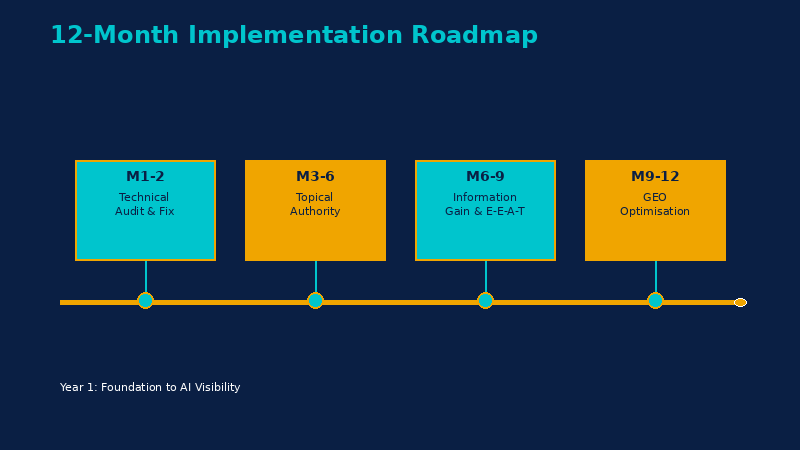
Understanding the five pillars is one thing. Applying them is another. Here’s a realistic implementation roadmap:
Phase 1: Technical Foundation Audit (Weeks 1–4)
Audit your existing site against Core Web Vitals, crawlability, schema markup, and mobile performance. Tools: Google Search Console, Google PageSpeed Insights, Screaming Frog. Fix immediate blockers (site speed, mobile rendering, crawl errors).
Expected impact: 15–20% traffic increase from indexing and rendering improvements alone.
Phase 2: Topical Authority Architecture (Weeks 5–12)
Audit your existing content. Identify your core topics (for an occupational hygiene firm: risk assessment, compliance, industry-specific niches). Design a topical cluster for your strongest opportunity: 20–25 articles addressing different angles of one topic.
Write or update your pillar article. Map cluster articles. Set up interlinking. Begin writing cluster articles.
Expected impact: 3–6 months to meaningful rankings as the cluster depth increases.
Phase 3: Information Gain & E-E-A-T (Weeks 13–20)
As you write cluster articles, systematically add information gain: primary research, case studies, proprietary data, original frameworks. Strengthen author profiles with credentials and expertise signals. Update your about page. Build external citations and media mentions.
Expected impact: Cluster articles begin ranking for secondary keywords. Dwell time and engagement increase due to unique content.
Phase 4: Generative Engine Optimisation (Weeks 21+)
Retrofit existing cluster articles with structured data, answer-first sections, and GEO-optimised formatting. Create FAQ sections explicitly designed for AI retrieval.
Expected impact: Increased citation in AI-generated answers; secondary click channel from generative engines.
This is a 6–9 month roadmap for one topic cluster. For a full topical authority strategy (5 clusters across your business), expect 18–24 months of sustained effort.
Frequently Asked Questions
Q: What is the most important SEO factor in 2026?
A: Topical authority—the systematic structure of interconnected, high-quality content around a core topic—is the highest-leverage SEO signal. It compounds over time, whereas individual keyword optimisations plateau quickly. A well-structured topical cluster outranks higher-DA sites that don’t have semantic coherence.
Q: How long does it take for modern SEO to work?
A: Realistic timelines: technical SEO improvements (site speed, crawlability) show impact within 4–8 weeks. Topical authority takes longer—3–6 months to see meaningful rankings as the cluster grows, and 9–12 months for competitive keywords. Information gain compounds over time as you publish differentiated content. Expect 6–9 months to see measurable ROI from this framework; 18–24 months to see full potential.
Q: Is SEO still worth it in 2026 with AI search engines?
A: Yes, but it’s changed. AI search engines (Perplexity, ChatGPT Search, Google SGE) are increasing the value of high-quality, cited content. If anything, SEO is becoming more important because citation in AI-generated answers is now a traffic channel. The businesses losing visibility are those with low-quality content; the businesses gaining visibility are those with expert, original content. Modern SEO aligns perfectly with what AI search engines reward.
Q: What is GEO and how is it different from SEO?
A: GEO (Generative Engine Optimisation) is the explicit optimisation of content for inclusion in AI-generated answers. Traditional SEO optimises for organic SERP rankings. In 2026, you need both. The tactics overlap (clarity, structured data, citations) but GEO explicitly targets AI retrieval and inclusion, whereas SEO targets algorithmic ranking. Think of GEO as “SEO for the AI layer” sitting on top of traditional SERP rankings.
Q: Do I need all 5 pillars or can I focus on one?
A: You need all five, but you don’t build them simultaneously. Start with the technical foundation (Pillar 5) because weakness here undermines everything else. Then build topical authority (Pillar 2) around your core business topics. Layer in information gain (Pillar 3) as you write. Strengthen E-E-A-T signals (Pillar 4) continuously as you build content. Finally, retrofit GEO (Pillar 1) across your published articles. They work as a system; skipping any one leaves significant ranking potential on the table.
Conclusion
Modern SEO in 2026 is not harder than SEO in 2016—it’s different. The businesses that struggle are those trying to apply 2018 tactics in 2026. The businesses that thrive are those that’ve built SEO systems aligned with how Google (and AI search engines) actually evaluate content.
The five-pillar framework isn’t theory. It’s the system Anitech uses with Australian clients across occupational hygiene, compliance, software, and professional services — the same framework that underpins our SEO services for Australian businesses. It works because it’s not built on guesswork; it’s built on how search engines actually rank content.
If you want a partner who builds your SEO strategy around this framework—not surface-level tips or guesswork—talk to Anitech. We only take clients we can genuinely move the needle for, and we build every strategy around topical authority, information gain, and AI visibility.
The future of ranking is semantic, cited, and expert. This framework gets you there.