The game has changed. If you're still just trying to match keywords to get your pages ranking on Google, you're playing yesterday's game—especially in the competitive Aussie market. By 2026, a solid on-page SEO framework for semantic SEO won't just be an advantage; it'll be the price of entry for any business serious about real, lasting growth. This guide moves beyond simple keyword matching to optimize for meaning, context, and user intent.
Think of it like this: old SEO was like a library catalogue that only listed book titles. Semantic SEO is like a librarian who has read every book, understands the author's intent, and knows exactly how each one connects to the others on the shelf. It's about meaning, context, and what the searcher really wants.
Why Semantic SEO is the New Standard for On-Page Optimization
Welcome to the next evolution of search optimisation. For Aussie small businesses and e-commerce stores, the days of obsessing over single keywords and cramming them into your pages are well and truly over. To survive and thrive now, you need to think smarter. This guide lays out a definitive on-page SEO framework for semantic SEO in 2026, built to help you establish genuine topical authority and attract traffic that actually converts.
From here on out, success is all about getting to the "why" behind every search. We need to stop acting like old-school SEOs and start thinking like content architects, carefully constructing a web of interconnected, meaningful information.
This framework is your blueprint to:
- Master the Core Concepts: Get your head around entities, user intent, and topical authority.
- Build a Semantic Architecture: Learn how to structure your content so both people and search engines love it.
- Implement a Powerful Content Workflow: Create content that completely solves your audience's problems.
- Measure What Actually Matters: Track the KPIs that show you're making a real business impact.
The Big Shift: From Keywords to Topics
Old-school SEO was a simple, one-to-one match. You had one page, and you aimed it at one keyword. Semantic SEO flips that on its head. It’s a one-to-many strategy, where a single, powerful page can comprehensively cover a core topic and all its related questions and subtopics.
This shift is crucial because it mirrors exactly how modern search engines like Google think. They're no longer just matching words; they're looking for content that proves deep expertise and gives searchers the most thorough answer possible.
To get a fuller picture of how this works in practice, it’s worth exploring different strategic approaches to Semantic SEO. It's also vital to connect this strategy with a solid technical foundation; our guide on technical SEO for AI discovery dives into how to get your site's backend ready for this new reality.
The Aussie Data Doesn't Lie
This isn't just theory; the numbers from right here in Australia back it up. Local data shows that businesses who commit to building out comprehensive topic coverage are seeing incredible results.
Sites with a clear, structured content strategy brought in an average of 60,276 sessions per year. That's a massive 326% uplift compared to the 14,143 sessions for sites without one. They achieve this by aligning their content with clusters of user intent and clearly defining the core concepts—the very heart of our 2026 framework.

The Three Pillars of Modern Semantic SEO
To get your head around our on-page SEO framework for 2026, the first thing we need to do is let go of the old-school obsession with keywords. That mindset is a relic. Today, Google thinks in much more sophisticated ways, and to succeed, we need to speak its language.
This new language is built on three core pillars: entities, intent, and topical authority. Getting these right is the first, and most crucial, step in building a website that Google sees as a genuinely helpful and credible resource for its users.
Let's use an analogy. If your website is a library, keywords are just the titles on the book spines. But semantics is the expert librarian who knows precisely what each book is about, why someone would want to read it, and how it connects to every other book on the shelves. That's the level we need to operate on.
Pillar 1: What Are Entities?
Think of entities as the "nouns" of the internet. They aren't just words; they are real-world objects, people, places, or concepts that Google can clearly identify and understand. An entity is a thing with known properties and relationships.
For example, "Sydney" isn't just a six-letter word to a search engine. It's an entity with a rich web of associated data:
- Type: City
- Location: New South Wales, Australia
- Population: Over 5 million
- Related entities: Sydney Opera House, Harbour Bridge, Bondi Beach
When you mention "Sydney" on your website, Google doesn't just see a keyword. It connects that text to its vast Knowledge Graph about the city. This is why optimising for entities is so much more powerful than basic keyword targeting—it cuts through ambiguity and tells search engines exactly what you're talking about.
For an Aussie e-commerce store, an entity could be a specific product like the 'Breville Barista Express' or a physical location like your flagship store in 'Melbourne, Victoria'. By clearly defining these on your site, you help Google connect your digital content to tangible, real-world things, which builds incredible trust and relevance.
Pillar 2: Why User Intent Is Everything
If entities are the "what," then user intent is the "why." It’s the fundamental reason someone typed a query into the search bar in the first place. By 2026, satisfying user intent isn't just a part of the game; it is the entire game. If you fail to match the intent behind a search, your page will struggle to rank, no matter how perfectly written it is.
We can generally break down search intent into four main categories:
- Informational: The user is looking for information ("how to choose a mountain bike").
- Navigational: The user is trying to get to a specific site ("Anitech blog").
- Commercial Investigation: The user is weighing up their options before making a decision ("best SEO agencies in Brisbane").
- Transactional: The user is ready to make a purchase or take action ("buy hiking boots online Australia").
Your content has to be laser-focused on solving for the specific intent behind a query. A detailed blog post explaining different bike types simply won't rank for a transactional query where the searcher clearly wants to see product pages and add something to their cart. The easiest way to decode a query's intent? Just look at what's already ranking on page one.
The image below gives a great visual representation of how search engines connect concepts (entities) to understand the real meaning behind a search.
This shows how a search engine can figure out that a search for "capital of Australia" is really looking for the entity "Canberra" by understanding the relationship between the concepts of 'capital city' and 'country'.
Pillar 3: How to Build Topical Authority
The final piece of the puzzle is topical authority. This isn't something you can achieve with a single, perfectly optimised page. It’s the expertise and credibility your website earns by covering a subject comprehensively.
Let's say you run a website about gardening in Australia. To build real topical authority, you wouldn't just write one article about "how to plant tomatoes." You'd build out a whole ecosystem of content that answers every related question a gardener might have:
- Best tomato varieties for different Australian climates
- Preparing the right soil conditions
- Dealing with common Aussie pests and diseases
- Proper pruning and staking techniques
- Guides on companion planting for tomatoes
When you strategically link these pieces of content together, you create a "topic cluster." This sends a powerful signal to Google that you aren't just dabbling in the topic—you're a genuine authority. This depth of coverage is what separates the top-ranking sites from everyone else and is an absolute cornerstone of semantic SEO in 2026.
How to Build a Semantic On-Page Architecture
Alright, let's move from the 'what' to the 'how'. This is where our on-page SEO framework for 2026 really starts to take shape. A winning semantic strategy isn't just about scattering the right keywords on a page; it’s about building a smart, interconnected structure that search engines can actually understand. Think of it as the blueprint for your website, guiding both people and search crawlers through your expertise with ease.
To build this architecture, we’re going to focus on two core components: content silos (you’ll often hear these called topic clusters) and structured data (specifically, Schema.org markup). A simple analogy? Content silos are like organising your bookstore into clear sections—fiction, history, cooking. Structured data is like putting a clear, universally understood barcode on every single book that explains what it is, who wrote it, and what it’s about.
Structuring Content with Topic Clusters
A topic cluster is really just a way of organising your website's content around a central theme, using a hub-and-spoke model. You have one main "pillar" page that gives a broad, comprehensive overview of a core topic. Then, you have several "cluster" pages that branch off, diving deep into specific subtopics.
Pillar pages are your big, cornerstone guides—the definitive resource on a subject. The cluster pages are where you get granular, answering very specific questions and often targeting those longer, more detailed search queries. Crucially, every cluster page links back to the main pillar page, creating a powerful web of internal links that screams expertise to Google.
Let’s imagine you’re an Australian e-commerce store that sells hiking gear. A topic cluster might look something like this:
- Pillar Page: "The Ultimate Guide to Hiking in Australia"
- Cluster Page 1: "Best Hiking Boots for Victorian Trails"
- Cluster Page 2: "How to Choose a Backpack for Multi-Day Treks"
- Cluster Page 3: "Waterproofing Your Gear for Tasmanian Weather"
See what’s happening here? This setup signals to Google that you have a deep, well-rounded knowledge of "hiking in Australia." You're not just another online shop; you're a genuine resource. Of course, this all relies on good structure in writing to ensure every piece is logical and genuinely adds to the bigger picture.
The image below shows how the three pillars of semantic SEO—Entities, Intent, and Authority—are the bedrock of this entire approach.
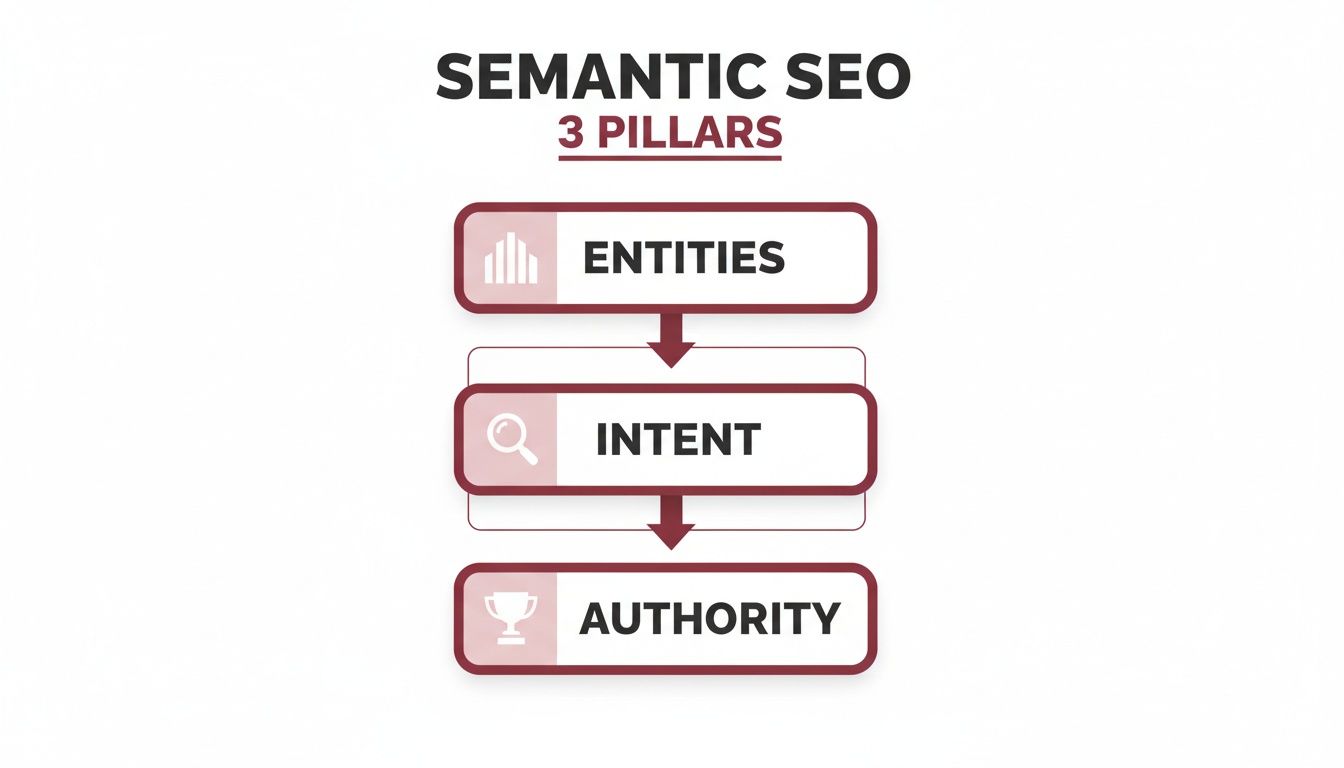
This hierarchy makes it clear: by defining your business entities and getting to the heart of user intent, you build the kind of topical authority that a rock-solid content architecture can properly support.
Translating Your Content with Schema Markup
While topic clusters organise your content for people and signal broad relevance to search engines, Schema markup gets into the nitty-gritty, machine-readable details. It's essentially a special vocabulary of code you add to your website to tell search engines exactly what your content means. No guessing required.
Think of it as a direct translator. Instead of Google’s algorithm trying to figure out if a string of numbers is a product ID or a phone number, or if "Melbourne" means the city in Victoria or the one in Florida, you can explicitly tell it. This clarity is what helps you nab those valuable rich snippets in search results—the ones with star ratings, prices, and FAQs right there on the page.
For any Australian small business, this is a game-changer. You can use specific Schema types to define your business and what you offer with absolute precision.
Key Insight: Schema markup is your direct line to Google. It lets you define your business as a unique entity with specific attributes like its location, services, and even its Australian Business Number (ABN), which can massively boost your local search visibility.
Take a local plumber in Sydney. Without Schema, their website is just a collection of words and images. With Schema, it becomes a structured, data-rich profile:
- Schema Type:
LocalBusiness(and more specifically,Plumber) - Property:
name-> "Sydney Emergency Plumbing" - Property:
address-> "123 Pitt Street, Sydney NSW 2000" - Property:
telephone-> "+61299998888" - Property:
areaServed-> "Sydney CBD, Eastern Suburbs" - Property:
taxID-> "Your ABN Here"
By implementing this markup, you stop leaving things to chance. You are clearly defining your entity, what it does, and where it operates—a foundational piece of modern, semantic on-page SEO. It’s this kind of precision that helps you win that all-important screen real estate in the search results.
Your Content Optimisation Workflow for Semantic SEO
Having a solid on-page architecture is the blueprint, but now we need the construction plan. This section lays out a repeatable workflow for creating and optimising content that fits perfectly into our definitive framework for semantic SEO in 2026. This process is a huge leap from old-school keyword research, guiding you from high-level topic modelling all the way to publishing content that genuinely builds authority.
The whole point is to have a system. A system that makes sure every single piece of content—from a detailed blog post to a critical landing page—serves a clear purpose. It needs to nail user intent, cover its topic from all angles, and strengthen the web of connections across your entire site.
To show how far we've come, let's quickly compare the old way of thinking with this modern, semantic approach.
Traditional vs. Semantic On-Page Optimisation
This table highlights the fundamental shift from simply targeting keywords to understanding and serving user intent through comprehensive topic coverage.
| SEO Element | Traditional Keyword-Based Approach | Modern Semantic Framework Approach |
|---|---|---|
| Primary Goal | Rank for a specific, high-volume keyword. | Satisfy the user's entire journey and intent around a topic. |
| Research Focus | Finding keywords with good search volume and low competition. | Mapping out all related entities, questions, and sub-topics. |
| Content Strategy | Create one page per keyword variant (e.g., "shoes sydney," "sydney shoes"). | Create a comprehensive pillar page that covers the core topic, supported by specific articles. |
| On-Page Tactic | Achieving a target "keyword density." | Naturally including relevant entities and answering user questions. |
| Internal Linking | Using exact-match anchor text to the target page. | Linking contextually to related concepts and supporting pages. |
| Success Metric | Ranking position for a single keyword. | Topical authority, visibility for a broad range of related queries, user engagement. |
The difference is clear: one is a rigid, formulaic tactic, while the other is a flexible strategy focused on meaning and value. Now, let's walk through how to put this into practice.
Step 1: From Keyword Research to Topic Modelling
The first and most important mental shift is to stop thinking about isolated keywords and start thinking in terms of whole topics. Traditional keyword research gives you a shopping list of phrases; topic modelling gives you a detailed map of the entire conversation your audience is having. It's about finding the central theme and then charting all the related subtopics, questions, and entities that orbit around it.
Start with a broad "seed" topic that's central to your business—say, "home loans" for a mortgage broker in Australia.
From there, you’ll use a mix of tools and good old-fashioned research to build out your topic map:
- Google Search: Seriously, just look. The "People Also Ask" and "Related searches" boxes are Google telling you exactly what users are looking for next. It's a goldmine.
- AnswerThePublic: This tool is brilliant for visualising all the questions people are asking. It breaks them down into who, what, where, when, why, and how, giving you a ready-made list of content ideas.
- Competitor Analysis: Check out the top-ranking pages for your seed topic. What subheadings are they using? What specific questions do they answer? This shows you what Google already considers to be a comprehensive resource.
Your goal isn't just a list of keywords. You're building a rich map of concepts, questions, and related entities. For our "home loans" example, this map would include entities like 'fixed-rate mortgages', 'variable-rate mortgages', 'offset accounts', and 'Lenders Mortgage Insurance (LMI)'. It would also include crucial questions like "how much deposit do I need?" and "what are the current interest rates in Australia?".
Step 2: Develop an Intent-Focused Content Brief
With your topic map fleshed out, the next step is to create a detailed content brief. Think of this as the architectural drawing for your writer. It's the single source of truth that ensures the final piece is strategically sound before anyone starts writing. It’s how you translate all that semantic research into clear, actionable instructions.
An effective semantic content brief absolutely must include:
- Primary Target Topic & User Intent: Be crystal clear about the main concept (e.g., "choosing a first home loan") and the main reason someone is searching for it (most likely informational or commercial investigation).
- Key Entities to Mention: List the non-negotiable concepts from your topic model that have to be in there, like 'stamp duty', 'First Home Owner Grant', and major Australian banks.
- Core Questions to Answer: Pull out the most important questions from your research that the content must directly address.
- Internal Linking Opportunities: Pinpoint existing pages on your site (like a page on 'mortgage calculators' or 'understanding interest rates') that you should link to. This weaves your content together and builds that all-important contextual relevance.
This brief acts as a guardrail. It prevents content from becoming a rambling, unfocused article and ensures it is a purpose-built asset designed to satisfy a specific set of user needs and search intents.
Step 3: Write for Concepts, Not Keywords
Finally, it’s time to write. The key here is to completely forget about "keyword density" or trying to shoehorn awkward phrases into your sentences. Instead, focus on explaining concepts and answering questions as naturally as possible.
If you’ve built a solid brief, the important entities and related terms will flow into the content organically as you explain the topic from top to bottom.
Concentrate on these three things:
- Clarity and Depth: Explain each subtopic simply and clearly. Use analogies and real-world examples that make sense for your Australian audience.
- Logical Structure: Use descriptive headings (H2s and H3s) for each major question or subtopic. This is great for user readability, but it also gives search engines a clear roadmap to the structure and hierarchy of your information.
- Natural Language: Just write like a human being explaining the topic to a customer. This conversational style naturally brings in synonyms and related phrasing, which are powerful semantic signals for Google.
Once the draft is done, check it against your brief. Did you answer all the core questions? Did you define all the key entities? This final check ensures your content isn't just well-written but is also strategically complete, actively contributing to your site’s topical authority.
How to Measure Semantic SEO Success
So, you've put in the hard work and built a sophisticated semantic SEO strategy. But how do you actually know if it's working? If you're still obsessively tracking a single keyword's ranking, you're looking in the wrong place. An effective on-page SEO framework for 2026 needs a modern set of Key Performance Indicators (KPIs) that prove you're making a real impact on the business, not just chasing vanity metrics.
Let's move past those tired, keyword-centric reports. The goal here is to measure your site's growing authority and relevance across entire topics. You're not just trying to rank for one phrase anymore; you're aiming to own the whole conversation. This means we need to think differently about what success looks like and how we report on it.
From Keyword Rankings to Topical Visibility
The first big change is to stop measuring success one keyword at a time. It’s time to start tracking your performance across whole topic clusters. When you create comprehensive content around a central theme, you’ll naturally start to rank for hundreds—sometimes thousands—of related long-tail queries.
Think of it this way: instead of just tracking your rank for "hiking boots," you should be monitoring your overall visibility for the entire "hiking gear in Australia" topic. This gives you a far more accurate and meaningful picture of your actual authority in the space.
Here are the metrics that really matter:
- Topic Cluster Rankings: Forget single keywords. Track a basket of 20-50 related keywords that make up your topic cluster. Is the average position for the whole group trending upwards? That's progress.
- Organic Visibility Score: Tools like Semrush or Ahrefs have visibility scores that estimate the percentage of clicks you're getting from your tracked keywords. A rising score shows you’re capturing more of the search traffic for your target topics.
- Number of Ranking Keywords Per Page: A semantically rich page doesn't just rank for its primary keyword. A great sign is seeing a single pillar page start ranking for hundreds of different, but related, search queries.
Analysing User Engagement and Intent Fulfilment
At its core, semantic SEO is all about satisfying user intent. If your content is genuinely helpful and relevant, your user engagement signals will prove it. Google pays very close attention to how people interact with your pages—it’s one of the strongest indicators of quality content.
Key Takeaway: High user engagement tells search engines that your content did its job and fulfilled the searcher's intent. Metrics like a long time on page and a low bounce rate aren't just for the UX team anymore; they are critical semantic SEO KPIs.
Start focusing on these engagement-focused metrics:
- Time on Page / Dwell Time: Are people actually sticking around to read your content? If they're spending a good amount of time on the page, it suggests the information is valuable.
- Bounce Rate: A low bounce rate is a fantastic sign. It means users found what they needed and didn't immediately hit the back button to find a better answer on the search results page.
- Click-Through Rate (CTR) from Rich Snippets: If you’ve gone to the trouble of implementing Schema markup, keep a close eye on the CTR for your enhanced search results. A high CTR here proves your structured data is grabbing attention and doing its job.
Using Google Search Console for Deeper Insights
Google Search Console (GSC) is your best friend for measuring semantic success, and it’s completely free. It goes way beyond simple rankings to show you the actual concepts and queries your site is becoming known for.
Just head to the "Performance" report in GSC. Here, you can dig into the specific queries driving impressions and clicks to your pages. Look for the patterns. Is your page about "home loan refinancing" starting to get impressions for questions like "what are the costs of refinancing?" or "best banks for mortgage refinancing?" This is hard evidence that Google understands your page’s topical relevance and sees you as an authority. It’s a concrete way to report on the real-world impact of your on-page SEO framework for 2026.
Your Semantic On-Page SEO Audit Checklist
Alright, let's bring all this theory back down to earth. The final piece of the puzzle in this on-page SEO definitive framework for semantic SEO in 2026 is turning knowledge into action. This checklist is built specifically for Aussie small businesses, giving you a straightforward way to see how your website stacks up.
Forget the intimidating jargon. This is a practical audit, organised around the core ideas we've covered, designed to help you spot opportunities and get your strategy sorted.

Here's a simplified table to track your progress as you work through the key areas. Just copy it into a spreadsheet and mark each item as you go.
| Semantic SEO Audit Checklist |
| :— | :— |
| Audit Area | Checklist Item |
| Content & Intent | Page comprehensively answers user questions. |
| | Primary user intent is clearly met. |
| Entity & Keyword Optimisation | Key entities are defined in headings. |
| | Main topic is in the first 100 words. |
| Technical & Structure | Relevant Schema markup is present and valid. |
| | Internal links build contextual relevance. |
| | Image alt texts are descriptive and relevant. |
Once you've run through the checklist, you'll have a much clearer picture of where your semantic SEO is strong and where it needs a bit of a tune-up. Now, let's dive into the specifics of what to look for.
Core Content and Intent Audit
First things first: we need to check if your content is actually hitting the mark. This is all about quality, depth, and making sure you’re giving people what they came for.
-
Does the page comprehensively answer the user's questions? The whole point of search is to find answers. If your page provides a complete solution, it tells Google you're an authority and stops people from clicking the back button to look elsewhere.
- How to check: Search your main topic. What questions pop up in the "People Also Ask" box? Look at the subheadings your competitors are using. Does your content cover all those angles, but better?
-
Is the primary user intent clearly met? This is a huge one. If someone wants to buy a pair of boots (transactional intent) and you serve them a 2,000-word article on the history of leather (informational intent), they’re gone.
- How to check: Have a look at what’s already ranking on page one for your target phrase. Are they product pages, blog posts, or category pages? Your page format needs to line up with what Google already knows its users want to see.
Entity and Keyword Optimisation Audit
Next up, let's make it dead simple for search engines to understand the main concepts—or entities—on your page.
-
Are key entities defined in your headings (H1, H2s)? Your headings are like a table of contents for both readers and search bots. They signal what's important and create a logical structure.
- How to check: Is your main topic clearly stated in your H1 tag? Are related sub-topics and specific entities (like product features, service types, or locations) used naturally in your H2 and H3 subheadings?
-
Is the main topic mentioned in the first 100 words? Google pays more attention to what it sees first. Mentioning your core topic early on confirms what the page is about right from the get-go.
- How to check: Just read your opening paragraph. Does it introduce the subject without sounding clunky or like you've just jammed keywords in there?
Technical and Structural Audit
Finally, let's look at the behind-the-scenes signals that help search engines connect the dots and understand the meaning of your content.
-
Is relevant Schema markup present and valid? Think of Schema as a direct translator for Google. It explicitly defines entities like your business info, products, or reviews, which is essential for earning those eye-catching rich snippets in the search results.
- How to check: Run your URL through Google's Rich Results Test. It’ll tell you if your page is eligible and whether your structured data has been implemented correctly.
-
Do your internal links build contextual relevance? Good internal linking creates a web of related topics on your site. It helps spread authority around and shows Google how all your different pieces of content fit together.
- How to check: Look at the links on your page. Do they point to other helpful articles using descriptive anchor text (e.g., "read our guide to DIY deck staining" instead of just "click here")?
-
Are your image alt texts descriptive and relevant? Alt text isn't just for accessibility; it gives search engines another clue about the page's content, adding an extra layer of context.
- How to check: Review your images. Does each one have alt text that describes what's in the picture and, where it makes sense, includes relevant entities or keywords?
Got Questions About Semantic SEO? We’ve Got Answers.
Making the leap to a semantic approach often brings up a few practical questions. Let's tackle some of the most common ones we hear from Australian business owners and marketers, so you can feel confident putting this modern on-page SEO framework for 2026 into action.
How Is Semantic SEO Actually Different from Old-School SEO?
The core difference is a shift in focus from words to ideas. Traditional SEO was all about keywords – trying to get one page to rank for one specific phrase. Semantic SEO is all about topics. The goal is to become the go-to authority on a whole subject by understanding how different concepts (entities) connect and what your user is really trying to achieve.
Here’s a simple way to think about it:
- Traditional SEO: You're a librarian trying to find a book based on its exact title. If the user gets the title slightly wrong, they might not find it.
- Semantic SEO: You're the expert librarian who understands the entire genre. You know the author, the themes, and can recommend five other brilliant books the reader will love. You’ve become their trusted guide.
So, Do Keywords Still Matter in 2026?
Yes, absolutely. But how we use them has changed completely. Keywords are no longer the target; they’re clues that help us understand the broader topic we need to cover.
Forget about old metrics like "keyword density." Your focus should now be on weaving your main topic and its related concepts into your content in a natural way. The aim is to produce a comprehensive, genuinely helpful resource. Google is incredibly smart now—it gets synonyms and context, so writing naturally is always the best way forward.
A semantically optimised page doesn't just rank for one keyword. It naturally starts ranking for hundreds of long-tail variations because it covers the topic so thoroughly. You're aiming for complete topical relevance, not just matching a few phrases.
How Long Until I See Results from This?
Semantic SEO is about building real, lasting authority, which means it’s a long game, not a quick hack. You might see some encouraging signs early on, like better user engagement metrics within a few weeks of publishing great, intent-focused content.
However, seeing significant lifts in your topical authority and rankings usually takes three to six months, and sometimes longer.
Your results will depend on a few things:
- Your website’s current authority and reputation.
- How competitive your industry is.
- How consistently you create and optimise your content.
Can a Small Business Really Do This?
Not only can you do it, but you might even have an advantage. As a small business owner, you have deep, first-hand knowledge of your customers' problems and the questions they ask every day. That’s gold. It's the perfect foundation for building out topic clusters.
You don’t need a huge budget or fancy tools to get started. Begin by simply mapping out your customer journey and all the questions that pop up. Use free tools like Google’s "People Also Ask" to find more ideas and structure your content plan. By focusing on a niche topic you know inside and out, you can build authority much more effectively than a larger, more generic competitor.
Ready to move beyond guesswork and implement an on-page SEO framework that drives real growth? The expert team at Anitech specialises in building semantic strategies tailored for Australian businesses. We help you dominate search rankings and achieve sustainable results. Start your journey with a free consultation today!