On-page SEO has evolved. It’s no longer about a race to the #1 spot; it’s about becoming the trusted source for the answer itself. This master guide is your roadmap to optimising content for answer engines, ensuring your Australian business becomes the voice behind the AI in this new era of conversational search and AI Overviews.
The Great Shift From Keywords To Conversations
Welcome to the new frontier of search, where getting the right answer is far more important than just finding the right link. For years, the core of SEO was straightforward: find the right keywords, build content around them, and climb your way to that coveted top spot on Google. Search engines were like a gigantic library index, pointing you to different shelves where you might find what you were looking for.
That model is being completely rewritten.
Today's search engines, supercharged by sophisticated AI like Google's Gemini, are transforming into answer engines. Instead of a library index, picture a very knowledgeable librarian. You ask a question, and they give you the answer directly—often without you needing to click a single link. This is the reality of conversational search.
Understanding The New Goal: Structuring Pages for AI Overviews and ChatGPT
This evolution has huge implications for Australian businesses. Features like Google’s AI Overviews, not to mention the explosion of conversational tools like ChatGPT and Gemini, are changing what users expect from search. The new goal of on-page SEO for answer engines isn’t just to rank high. It’s to become the definitive source cited within those AI-generated answers. To achieve this, you must learn how to structure pages for AI Overviews and other conversational AI platforms.
The core challenge has moved beyond simple keyword matching. Success now hinges on how well your content directly addresses user intent and provides clear, authoritative, and easily digestible information that an AI can understand and trust.
Think of this guide as your complete roadmap through this new territory. We'll break down exactly how to adapt your on-page SEO strategy, shifting your focus from being keyword-centric to being truly conversation-focused.
What This Guide Will Cover
To succeed here, you need a strategy built on clarity, structure, and authority. Here’s a look at what we’ll explore:
- How Answer Engines Think: We'll pull back the curtain on how AI processes language and connects concepts to figure out which information is the most reliable.
- Structuring Pages for AI Overviews: You’ll learn the 'Answer-First' model for formatting your pages to snag featured snippets and show up in AI Overviews and answers from models like ChatGPT.
- The Power of Schema: We’ll show you how to use structured data to speak the language of search engines directly, leaving no room for misinterpretation.
- Building Topical Authority: It's time to move beyond single pages. We'll cover how to create a web of expert content that cements you as the go-to source in your niche.
- Local and Conversational Queries: You'll get specific tactics designed for Australian businesses to capture all that valuable 'near me' and voice search traffic.
The following sections will give you actionable steps, clear examples, and the technical know-how to position your website not just as another result, but as the answer itself.
How Answer Engines Actually Make Sense of Your Content
If you want your content to appear in AI-generated answers, you need to stop thinking like a traditional SEO and start thinking more like the AI you're trying to reach. These systems don't just scan your page for keywords. They're built to actually understand the meaning, the context, and the relationships between the ideas you're writing about. It's a whole lot more complex than just matching a search query to a word on a page.
It all boils down to something called Natural Language Processing (NLP). You can think of NLP as the engine's brain for reading. It’s what lets it understand human language with all its quirks—the slang, the messy sentence structures, and the different ways we ask for the same thing. NLP is how a search engine knows that "best flat white Fitzroy" and "top-rated cafes near me" are probably coming from someone with the exact same goal.
It's All About Connections: Entities and Knowledge Graphs
Answer engines go a step further than just understanding words; they map out how concepts connect to each other. They do this using a knowledge graph, which is basically a giant digital web of relationships between people, places, concepts, and things. In this world, these are all called entities.
Take 'Sydney', for example. The engine doesn't just see a word. It understands 'Sydney' as an entity—a city in Australia. It also knows this entity is linked to other entities like the 'Harbour Bridge', the 'Opera House', and 'New South Wales'. When your content makes these connections obvious, you're essentially handing the AI a perfect map of your topic, making it incredibly easy for it to grasp the full context.
This is the new game for on-page SEO. Your job is to structure your content so these relationships are impossible to miss.
Sending the Right Signals: Building Trust and Authority
So, how does an answer engine decide your content is the right one to serve up as a definitive answer? It hunts for signals that scream authority and clarity. These aren't just technical tricks; they're about the quality of your content itself.
The big ones it looks for are:
- Factual Accuracy: Is what you're saying backed up by other trusted sources on the web?
- Content Clarity: Is your content easy to follow? Think clear headings, short paragraphs, and a logical structure.
- Demonstrated Expertise: Does your content feel like it was written by someone who actually knows their stuff, or is it just a surface-level rehash of other articles?
This is exactly why getting your technical SEO for AI discovery right is so important. A solid technical foundation sends the initial trust signals that give your brilliant content a fighting chance to be properly understood and ranked by these smart systems.
You can see this shift happening right here in Australia. The latest SEO thinking is moving away from pure keyword focus and towards entity optimisation and structuring content around questions. Local experts are pointing out that Australian businesses are now competing in an “AI-first, zero-click search environment.” Generative AI is summarising content directly on the results page, so to be the source it chooses, your on-page content needs to be built around clear questions and answers, use natural language, and prove its expertise.
To really win in this new era, you need to embrace strategies for AI engine search optimization. This means leaving old habits like keyword-stuffing behind and focusing on a new model where clarity, structure, and semantic meaning are king. Once you understand how these systems think, you can create content they don't just understand, but actually prefer to use.
Structuring Your Content For AI Overviews And Snippets
If you want to win a spot in AI Overviews and featured snippets, you have to throw the old blogging rulebook out the window. Remember how we used to write? A long, rambling intro, a slow build-up of arguments, and the big reveal saved for the very end. Answer engines have no time for that. They’re on a mission to find the answer, and they want it now.
This is exactly why the ‘Answer-First’ model is so crucial. Sometimes called the ‘Inverted Pyramid’, this approach completely flips the traditional content structure. You start with the most direct, concise answer to a user's question, then you flesh it out with supporting details, and finally, you zoom out to provide the broader context. It’s the perfect recipe for what AI Overviews and snippets are designed to find and feature.
Adopt The Answer-First Model
Put yourself in the shoes of the search engine. When someone asks a question, its AI wants to grab the most direct, satisfying response it can find. If that answer is buried 2,000 words deep in your article, the AI is far more likely to pick a competitor's page that puts the goods right at the top.
The goal is to make your content incredibly easy to scan for both people and machines. The AI needs to be able to parse your page and instantly pinpoint the core answer to a specific query. This means a complete rethink of how you write your opening paragraphs and use headings.
This diagram shows how an AI breaks down content, moving from a high-level understanding right down to the specific facts and entities it needs to construct an answer.
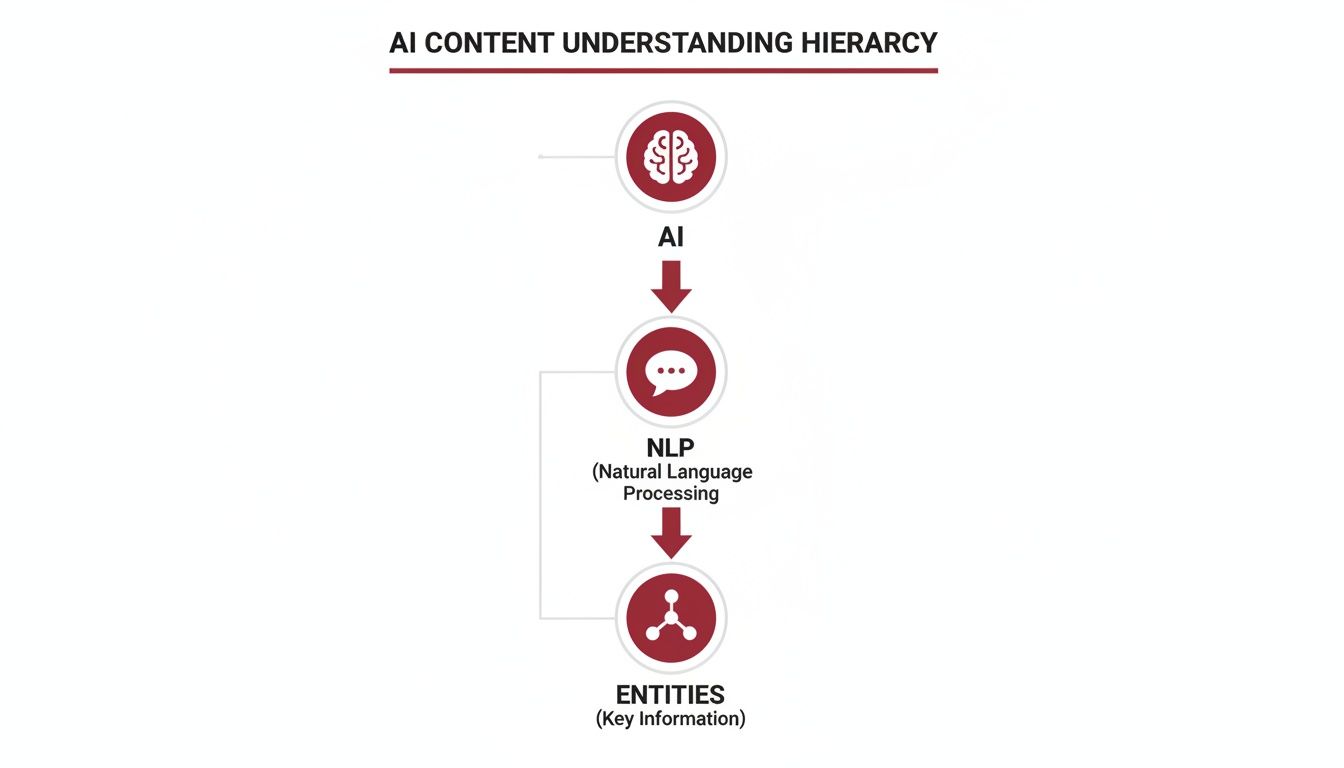
As you can see, for your content to even be considered, it needs to be simple enough for Natural Language Processing (NLP) to deconstruct into clear, factual pieces.
The table below breaks down the practical differences between the old way of writing and the new, answer-first approach.
Traditional Content Structure vs. Answer Engine Optimized Structure
| Element | Traditional SEO Approach | Answer Engine SEO Approach |
|---|---|---|
| Opening Paragraph | A long introduction to "hook" the reader, often delaying the main point. | A direct, concise answer to the primary question, often 40-60 words long. |
| Headings (H2s, H3s) | Broad, thematic titles like "Marketing Strategies" or "Local Business Tips". | Specific questions that users are asking, such as "What Are The Best Marketing Strategies for Cafes?". |
| Content Flow | Builds up to a conclusion, saving the key takeaways for the end of the article. | Follows an inverted pyramid: Answer first, followed by supporting details, then broader context. |
| Formatting | Often uses long, dense paragraphs to explore a topic in-depth. | Relies on short paragraphs, bullet points, and numbered lists for maximum scannability. |
| Tone | Can be narrative or storytelling, weaving a path to the final point. | Factual, direct, and authoritative. The primary goal is to inform quickly and clearly. |
Making this shift might feel unnatural at first, but it's essential for signalling to search engines that your page contains the best, most accessible answer to a user's query.
Turn Headings Into Questions
One of the most powerful and immediate changes you can make is to turn your H2 and H3 headings into the exact questions your audience is typing into Google. So instead of a generic heading like "SEO for Melbourne Suburbs," you reframe it as a direct question: "What Are The Best Suburbs For Local SEO In Melbourne?"
This simple switch does two critical things:
- It perfectly mirrors the conversational queries people use in search bars or with voice assistants.
- It acts as a massive signpost for the AI, clearly marking the section that follows as the direct answer to that specific question.
Then, the very first paragraph under that heading needs to be a short, sharp summary that answers the question head-on.
Pro Tip: Your first paragraph under a question-based heading should be able to stand alone as a complete answer. A great test is to ask yourself: "If someone only read this one paragraph, would they have their answer?" If not, rewrite it.
Break Down Information Into Digestible Chunks
Huge walls of text are a killer for answer engines and human readers alike. AI systems much prefer content that's logically broken down into smaller pieces because it’s far easier to parse for specific facts, stats, and data points.
- Short Paragraphs: Keep every paragraph to 2-3 sentences max. This improves readability and helps the AI isolate individual concepts.
- Bullet Points: Use bullet points to list features, benefits, examples, or key takeaways. This highly structured format is easy for algorithms to interpret.
- Numbered Lists: For any kind of step-by-step instructions or processes, numbered lists provide a clear, sequential flow that answer engines love for 'how-to' style snippets.
As you get into the nitty-gritty of restructuring your content, this Practical Guide to Ranking in Google AI Overviews offers some excellent, in-depth strategies. By reformatting your old blog posts into this modular, answer-first structure, you're turning your pages into prime real estate for Google's most valuable features.
Using Schema Markup to Speak the Language of Search Engines
If structuring your content is about organising information for your human readers, then schema markup is about translating that information into a language that search engines understand perfectly. Think of it as the technical backbone for modern on-page SEO, removing all the guesswork for Google's AI.
Imagine your webpage is a recipe for a great lamington. The content itself—your headings, paragraphs, and lists—lays out the ingredients and the steps. Schema markup is like adding a perfectly formatted nutrition label on the side. It explicitly tells the search engine: "This is a recipe, the cook time is 30 minutes, it has 450 calories, and here are the exact ingredients." This extra layer of context is what allows an AI to trust and use your information with absolute confidence.
Why Schema Is Non-Negotiable for Answer Engines
Without schema, a search engine is left to guess what your content actually means. It might see a string of numbers on your contact page and have to wonder, "Is that a phone number or an ABN?" Schema gets rid of that ambiguity. You can explicitly label that number as a telephone, giving the AI the certainty it needs to feature it in an answer.
This structured data is your ticket to unlocking those eye-catching rich results in search—things like star ratings, event listings, and pricing, which all make your listing stand out. For AI Overviews, this unambiguous data is even more critical. It provides the factual, verifiable "chunks" of information that AI models are designed to find and use.
The Most Impactful Schema Types
While there are hundreds of schema types out there, you don't need to know them all. A handful are particularly powerful for Australian businesses trying to get ahead in answer engines. The best way to implement it is using JSON-LD, a script you pop into the <head> section of your page's HTML. It’s the preferred method because it doesn't mess with the content your users actually see.
The official Schema.org documentation shows the vast library of options available.
This list gives you a sense of just how much you can define, from a simple Article to something as complex as a MedicalCondition. You can label almost any piece of information on your site.
Let’s zero in on the most practical types you can implement today.
FAQPage Schema
This one's a no-brainer for any page with a question-and-answer format. It explicitly tells search engines, "This is the question, and this is the direct answer," making it prime real estate for featured snippets.
- Example Use Case: A service page for a plumber in Sydney answering common questions like "How much does it cost to unblock a drain?"
HowTo Schema
If your content gives people step-by-step instructions, HowTo schema is your best friend. It breaks down the process into a clear sequence that an AI can easily follow and present to users.
- Example Use Case: A blog post on an accounting firm's website titled "How to Lodge Your BAS Statement in 5 Easy Steps."
Article Schema
This schema helps search engines get the full story on your blog posts or news articles. It covers details like the author, publication date, and headline, which reinforces the E-E-A-T (Experience, Expertise, Authoritativeness, Trustworthiness) signals of your content.
- Example Use Case: A detailed guide on "Choosing the Right Business Structure in Australia" written by a financial expert.
LocalBusiness Schema
For any Aussie business with a physical shop or a service area, this is absolutely essential. It clarifies your business name, address, phone number (NAP), opening hours, and what you do. This information feeds directly into local search results and Google Maps.
- Example Use Case: An auto repair shop in Melbourne using it to specify their services, address, and link to customer reviews.
Crucial Tip: Always, always validate your schema markup before you set it live. Use Google’s Rich Results Test tool to check for errors. Broken code is worse than no code at all because it can just confuse the search crawlers.
By implementing the right schema, you’re no longer just publishing content; you're providing a structured, machine-readable dataset. This precise communication is fundamental to becoming a trusted source for the AI-powered answer engines that are now shaping the search landscape.
Becoming the Go-To Expert by Building Topical Authority
Getting a single page to rank is one thing, but if you want to truly dominate in the age of answer engines, you need a bigger game plan. AI is looking for more than just one good answer on a page; it's searching for genuinely authoritative sources—websites that have proven they know a subject inside and out. This is where building topical authority shifts from a "nice-to-have" to a core part of your on-page SEO strategy.
Think of it this way: instead of chasing individual keywords, you start owning entire subjects. It’s the difference between being a one-hit-wonder and an artist with a whole back catalogue of hits. When an answer engine sees your website thoroughly covers a topic from every conceivable angle, it starts to see your whole domain as a trusted source for that niche.
Get On Board With the Topic Cluster Model
One of the best ways to build this kind of authority is by using the topic cluster model. Let's say you're a plumber based in Perth. Instead of just firing off random blog posts, you'd organise your content like a spider's web, with a strong, central hub.
The model is built on two key parts:
- Pillar Page: This is your big, comprehensive guide that covers a broad topic. For our Perth plumber, this might be "The Ultimate Guide to Blocked Drains." It touches on all the important subtopics but doesn't get bogged down in the tiny details of each one.
- Cluster Articles: These are shorter, more focused articles that go deep on one specific subtopic mentioned on your pillar page. Think articles like, "How to Unclog a Shower Drain Yourself," "5 Telltale Signs of a Collapsed Pipe," or "What to Expect from a CCTV Drain Inspection in WA."
Every cluster article links back up to the main pillar page, and the pillar page links out to all its supporting cluster articles. What you end up with is a powerful, interconnected web of content.
This structure sends a crystal-clear signal to answer engines: you don't just know about one tiny aspect of blocked drains; you're an authority on the entire subject.
The Magic of Semantic SEO
This interconnected strategy is supercharged by semantic SEO. This is all about optimising for topics and concepts, not just isolated keywords. When you build out a topic cluster, you naturally start covering a huge range of related terms and questions that real people are asking.
For example, your "Blocked Drains" pillar page would organically include phrases like "drain clearing," "hydro-jetting," "plumbing emergencies," and "tree root intrusion." The AI sees these related concepts, understands the depth of your expertise, and views your content as a much more reliable source for crafting complex, helpful answers.
This isn't just theory—it gets real results for Australian businesses. A recent study that tracked 36 local businesses found that those with a structured on-page content strategy (publishing at least two new pages a month) saw a massive 326% increase in average organic sessions. It shows just how much answer engines reward sites with deep, consistently updated content. Even more telling, businesses that targeted multiple locations with this structured approach drove 557% more traffic, proving the model works at scale. You can read more about these local SEO findings to see how this pays off.
By creating a dense network of internal links between semantically related pages, you are essentially building a private knowledge graph on your own website. This makes it incredibly easy for answer engines to navigate your expertise and verify the connections between different concepts you cover.
Ultimately, building topical authority is a long game. It transforms your website from a random collection of pages into a cohesive library of expert knowledge. This depth and structure are exactly what AI models are built to find and reward, cementing your place as the expert whose content is trusted enough to become the answer.
Optimising For Local And Conversational Queries
If you're running a local or service-based business in Australia, the shift to conversational search isn't some far-off trend—it's happening in your neighbourhood right now. When a potential customer uses voice search or types "plumbers near me" into their phone, they aren't casually browsing. They need a solution, and they need it fast.
To win in this new game, you need to structure your digital presence to meet this urgent, local intent head-on. This is where your on-page SEO needs to get a whole lot smarter. It's time to stop thinking of your service pages as just digital brochures and start turning them into powerful, question-answering resources that own the local search results.

Nail Your Local On-Page Essentials
Before you can even think about winning conversational queries, you have to get the basics right. Your foundational local signals need to be absolutely flawless. When it comes to local SEO, inconsistency is your worst enemy, creating confusion for both customers and search engines.
It all starts with your NAP (Name, Address, Phone number). This core information must be identical everywhere it appears—on every page of your site, in your Google Business Profile, and across any local directories you’re listed in. Even a tiny variation, like "St" versus "Street," can chip away at your authority.
Next, you need to weave local trust signals directly into your website's content. Think of these as digital signposts that prove you're a legitimate local operator.
- Embed a Google Map: Pop an interactive map on your contact page or service area page. It's a simple, visual way to confirm you are where you say you are.
- Mention Local Landmarks: Weave well-known suburbs, streets, or landmarks into your copy. For example, "servicing homes near the Gabba in Brisbane" creates powerful geographic relevance that Google understands.
- Feature Local Reviews: Showcasing testimonials from local customers, especially if they mention their suburb, builds incredible social proof and reinforces your connection to the community.
Transform Service Pages Into Answer Hubs
A standard service page just lists what you do. An answer-engine-optimised service page, on the other hand, answers the questions your customers are actually asking. This means structuring your content to tackle their most common queries directly.
Use your H3 headings to frame these questions, just like a customer would ask them:
- What Are Your Call-Out Fees?
- Which Suburbs Do You Service?
- How Long Does a Standard Installation Take?
Beneath each heading, give a clear, concise answer right in the first sentence or two. This structure is gold for voice search, as devices are programmed to read out the most direct response they can find.
This strategy is absolutely crucial. In Australia, around 46% of all Google searches have local intent. With 92% of consumers choosing a business from the first page, the competition is intense, and your on-page signals are what will make or break your chances. You can discover more insights about Australian search behaviour to get a clearer picture of the landscape.
By anticipating and answering these practical questions, you align your content directly with conversational purchase intent. You're not just describing a service; you're solving a customer's immediate problem, which is precisely what answer engines are designed to do.
This approach closes the gap between abstract SEO theory and the real-world need to get the phone ringing. It’s a practical way to turn any local service page into a magnet for 'near me' queries and voice searches, ensuring you are the definitive answer when a local customer asks for help.
Got Questions About Answer Engine SEO? We've Got Answers
Even with a solid plan, stepping into the world of answer engine optimisation can feel a bit daunting. We get it. This is where we tackle the most common questions we hear from Australian businesses, clearing up any lingering uncertainties you might have. Think of this as your quick-reference guide to help you get moving.
How Long Does It Take to See Results From All This?
Look, anyone who promises you instant top rankings is selling you snake oil. While a simple tweak like a title tag update might give you a small, quick bump, seeing real, meaningful results from answer engine optimisation is a long game. Realistically, you're looking at a timeline of several weeks to a few months.
This isn't an overnight fix. It depends a lot on how competitive your industry is and what your website's authority looks like right now. You're fundamentally building trust with search engines, proving over time that you're a genuine expert on your topic. Consistency is everything.
Is Keyword Research Still a Thing With AI Search?
Absolutely, but the game has changed. We've moved past just stuffing high-volume keywords into a page. Today, it’s all about getting inside your customer's head and understanding the questions they're asking, the problems they're trying to solve, and the conversational phrases they use every day. The focus has shifted from keyword density to query intent.
Think about the full, natural questions someone would type into Google or ask their smart speaker. These longer, more specific queries are gold. They're the bedrock of content that AI search actually wants to feature in an answer snippet.
Your keyword strategy needs to become a question-and-answer strategy. Start with the user's problem, and build your content backward from there. That's how you become the perfect match for an answer engine.
Should I Just Get AI to Write My SEO Content?
AI writing tools are brilliant for getting the ball rolling. They can help you brainstorm topics, flesh out an outline, or even speed up some of the initial research. But—and this is a big but—letting an AI write your final, published content is a gamble that rarely pays off. Answer engines are getting incredibly sophisticated at spotting content that shows genuine E-E-A-T (Experience, Expertise, Authoritativeness, and Trustworthiness).
For your content to really perform, it needs a heavy human touch. You need to inject your own unique insights, add real-world examples from your business, and let your brand's voice shine through. This is how you build the kind of authority that AI is designed to look for. Let the AI build the frame, but you need to be the one to build the house.
What's the Single Most Important Thing for Answer Engine Optimisation?
If you only remember one thing from this whole guide, make it this: clarity is king. Your content has to be structured in a way that gives a direct, unambiguous, and super easy-to-understand answer to a specific question.
How do you do that? By putting everything we've talked about into practice:
- Use clear, question-based headings.
- Write short, sharp paragraphs that get straight to the point.
- Use lists and tables so people (and bots) can scan the information easily.
- Add schema markup behind the scenes to tell search engines exactly what your content is about.
When an answer engine can look at your page and understand it with zero confusion, it’s far more likely to trust your content and serve it up as the definitive answer.
Ready to make your website the definitive answer in your industry? The expert team at Anitech specialises in data-driven SEO strategies that deliver measurable growth for Australian businesses. We transform your on-page SEO to dominate in the age of answer engines. Find out how we can help your business.