An on-page SEO: entity-first content strategy is about making a fundamental switch in how you think about content. Instead of chasing individual keywords, you focus on building a rich, interconnected web of concepts, or "entities." This approach helps search engines like Google understand your brand's expertise on a much deeper level, building an online presence that's both authoritative and resilient for long-term growth.
Moving From Keywords to Concepts in Modern SEO
The world of search engine optimisation has undergone a significant transformation. The old days of stuffing a page with keywords to grab a top spot in search results are well and truly over. Today, the focus has shifted entirely to proving you're an expert with genuine topical authority, a cornerstone of any effective on-page SEO: entity-first content strategy.

Think of the old keyword-stuffing model as a simple dictionary. You look up a word and get a flat, one-dimensional definition. It’s a very basic one-to-one relationship that's completely missing any real-world context or semantic understanding.
An entity-based model, on the other hand, is like a detailed encyclopaedia. It doesn't just define a term; it understands the "thing" itself—a person, a product, a place, an idea—and, crucially, it grasps the complex web of relationships connecting it to everything else. This is the heart of an on-page SEO: entity-first content strategy.
Why This Shift Matters for Your Business
This isn't just technical SEO jargon; it's a strategic shift that directly affects how customers find you. Search engines are becoming incredibly sophisticated, striving to satisfy a user's intent with the most complete and authoritative answer possible. When your content is structured around entities, you’re sending a clear signal to Google that you are a go-to source of information in your niche.
This change is critical for a few key reasons:
- It Aligns With User Intent: People don't search in rigid keywords anymore. They ask complex, conversational questions, and an entity-first approach helps you answer them completely.
- It Builds Topical Authority: Covering a topic from every angle and linking related concepts proves your deep expertise, something Google actively rewards. This builds a semantic network that search algorithms can easily understand and trust.
- It Future-Proofs Your SEO: Because it’s built on a foundation of genuine value and clear communication, this strategy is far less likely to be derailed by the next algorithm update. It focuses on building a resilient knowledge base.
Adopting this mindset means you stop chasing individual keyword rankings and start building a digital brand knowledge graph—a robust, interconnected web of content that establishes your authority. This blueprint for organizing content around unique, identifiable "things" rather than just phrases is the future of on-page SEO.
The Impact on Modern Search
This conceptual shift is becoming even more critical with the rise of AI-driven search experiences like Google's AI Overviews. To really get a handle on this, it's essential to understand the new ranking factors and how to get your content featured. For a deeper dive, learning How to Rank in Google AI Overviews provides fantastic insights into this new frontier. The focus is less on outdated tactics and more on becoming a trusted entity whose knowledge graph is clear and comprehensive.
What Is an Entity-First Content Strategy?
Let's cut through the jargon. At its heart, an on-page SEO: entity-first content strategy means you stop thinking about keywords first. Instead, you build your content around "things" – the core concepts, people, products, and places that define your business and its expertise.
It’s a fundamental shift. We move away from simply targeting a phrase like ‘coffee shop Sydney’ and start building a rich, interconnected web of information. The goal is to prove to Google that you’re not just relevant for a search term; you’re an authority on the entire topic, establishing deep semantic relevance.
So, what exactly is an "entity"? Think of it as anything that’s a unique, well-defined concept Google can recognise and connect to other information. It could be a person, a product, a specific location, an organisation, or even an abstract idea. These are the puzzle pieces Google uses to build its massive Knowledge Graph.
Imagine you're building with LEGOs. The old way was like having a messy pile of random bricks (keywords). An entity-first approach is like having organised, clearly defined pieces—a blue 2×4 brick, a red roof tile, a specific minifigure. You know exactly what each piece is and how it connects to the others to build something bigger and more impressive.
The Anatomy of an Entity
To really get your head around this, let's break down a real-world example. Say we have a popular cafe in Sydney. In an entity-first model, the cafe itself is the main "thing." But it's connected to a whole network of other related entities and details that create a complete picture.
- The Primary Entity: "The Surry Hills Brew Bar" (a
LocalBusiness). - Associated Entities:
- Its signature "flat white" coffee (a
Product). - Its head barista, Jane Doe (a
Person). - Its physical location at "123 Crown Street, Surry Hills" (a
Place). - Its Australian Business Number (ABN) (an
identifier).
- Its signature "flat white" coffee (a
Every one of these details helps Google construct an accurate, high-confidence profile of the business. This deep understanding means Google can confidently serve up your cafe as the best answer for a huge range of searches, from "best flat white near me" all the way to "who is the head barista at The Surry Hills Brew Bar?" This process leverages semantic keywords to build a strong associative network.
How This Differs from Traditional Models
This way of thinking is a huge step up from older SEO models, even the popular pillar-and-cluster strategy. While organising content into topic clusters is a great practice, it often still starts with a broad keyword as the foundation.
The entity-first approach digs a level deeper. It starts by defining the core "nouns" of your business before you even start mapping out content. This creates a far more sophisticated and interconnected content ecosystem that actually mirrors how Google’s Knowledge Graph works, building genuine authority from the ground up.
This strategic shift is particularly vital here in Australia. Google absolutely dominates the local market, holding about 93% of the search engine market share. If your brand isn't a clearly understood entity within Google's ecosystem, you're at a massive disadvantage.
Consider this: 75% of users never click past the first page of search results. A strategy that fails to build clear relevance around your core business entities makes you practically invisible to most potential customers. And with search queries getting more specific—around 50% are now four words or longer—people are describing the very entities they’re looking for. To see more data on this, you can explore the latest SEO trends in Australia.
Why This Is the Future of On-Page SEO
Ultimately, an entity-first strategy is about speaking Google's native language. You’re no longer just dropping keyword clues and hoping for the best. You are explicitly defining who you are, what you do, and how you connect to the wider world of information through a structured knowledge graph.
This creates a powerful, long-term SEO advantage. When Google understands your brand as a definitive entity, your content becomes more resilient to algorithm updates. You also become eligible for prime real estate in the search results, like rich snippets, knowledge panels, and AI-generated summaries.
It's a move from renting visibility with keywords to owning your authority as a recognised entity.
Building a Digital Brand Knowledge Graph: A Blueprint for Content
Moving to an on-page SEO: entity-first content strategy needs a proper blueprint. This isn't about randomly throwing content ideas at the wall and seeing what sticks; it's about methodically mapping out your business's entire world of expertise. This map is your digital brand knowledge graph—it’s the architectural foundation that will guide every single piece of content you create. This blueprint provides a framework for organizing content around unique, identifiable "things" rather than just phrases.
Think of it like designing a city grid before you start putting up buildings. Instead of just dropping content (the buildings) anywhere and hoping people find their way, you’re creating a logical, organised system of streets and zones (your entities and their relationships). This structure makes it incredibly easy for both search engines and actual people to navigate your expertise.
Identifying Your Core Business Entities
First things first, you need to define the "main characters" in your business's story. These are your core entities—the unique, identifiable concepts that sit at the very heart of your brand. Don't overcomplicate it. Start with the most obvious and important things.
Your core entities will almost always include:
- Your Brand Name: The top-level entity, like "Anitech" or "The Surry Hills Brew Bar."
- Key Products or Services: The main things you actually sell, such as "Technical SEO Audits" or "Local SEO Services."
- Founders or Key People: The important individuals behind your brand.
- Physical Locations: Your office addresses or the specific areas you service.
- Your ABN/ACN: A unique business identifier that anchors your identity in the real world.
This initial list creates the central hubs of your knowledge graph. From here, every other piece of information will connect back to one of these core concepts, strengthening your authority and clarifying your semantic network for search engines.
Mapping Sub-Entities and Their Attributes
Once your core entities are locked in, the next layer is all about mapping out the related sub-entities and their specific attributes. This is where you add the rich detail and nuance that search engines absolutely love. An attribute is simply a property or characteristic of an entity. This process of expansion builds out the full scope of your digital brand knowledge graph.
Let's walk through a practical example for an Australian financial planning service:
- Core Entity: "Melbourne Wealth Planners" (the service provider)
- Sub-Entities (Related Services):
- SMSF (Self-Managed Super Fund) Advice
- Retirement Planning
- Investment Strategy
- Estate Planning
- Attributes (Properties of these Services):
- Fee Structure (e.g., fee-for-service, commission-based)
- Industry Certifications (e.g., Certified Financial Planner®)
- Target Client (e.g., high-net-worth individuals, small business owners)
- Service Area (e.g., serving clients across Victoria)
Each sub-entity and attribute adds another connection point to your graph. You end up with a dense network of related information that proves you know your stuff inside and out.
This simple infographic nails the concept. It shows how a primary entity (a cafe) is directly connected to what it sells (a flat white) and the person who makes it (a barista).
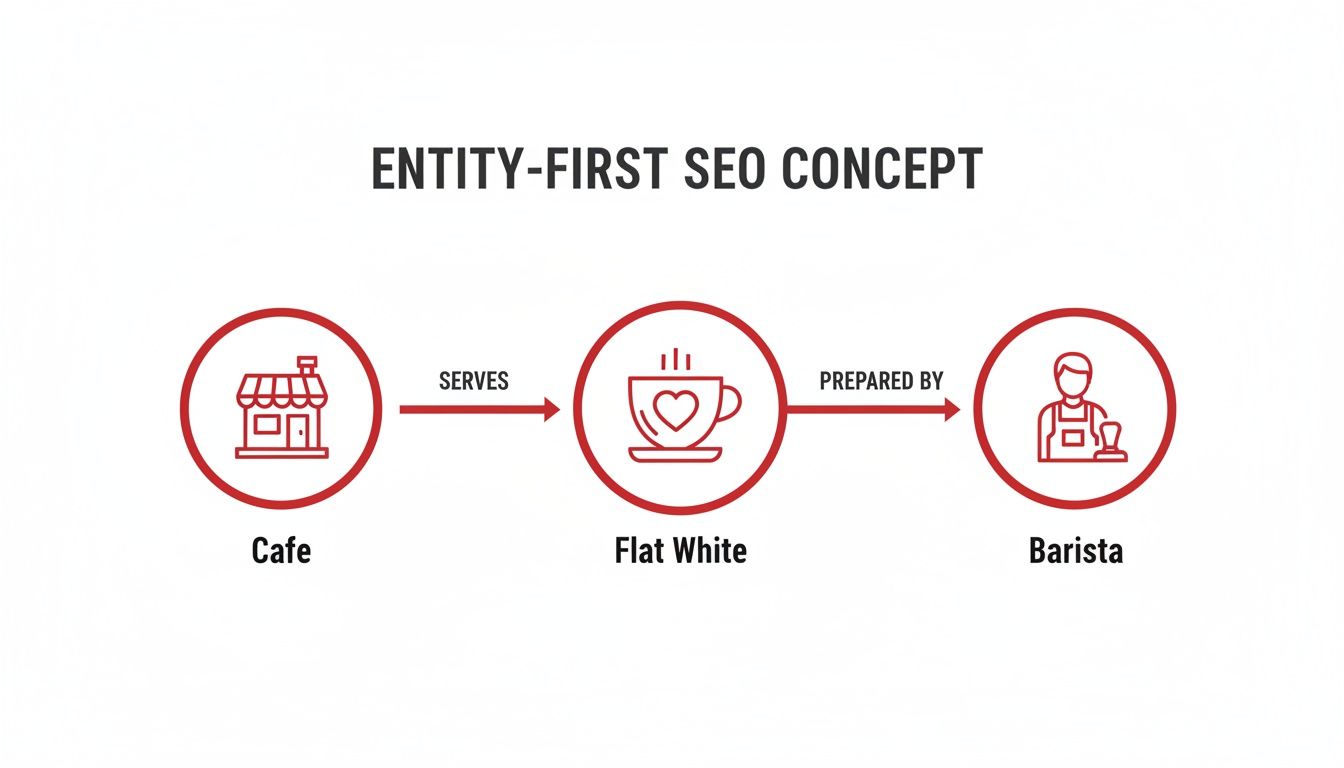
This is exactly how Google learns to associate distinct concepts. It builds a crystal-clear picture of what your business does and how all the pieces fit together.
A Framework for Organising Your Knowledge Graph
Mapping all this information requires a structured approach. You don't need fancy, expensive software to get going—a simple spreadsheet or a mind-mapping tool will do the job perfectly. The goal is just to create a visual and logical representation of your business knowledge.
Here’s a step-by-step framework to get you started:
- Choose Your Tool: Use a spreadsheet (like Google Sheets) or a visual tool (like Miro or XMind). Spreadsheets are great for structured data, while mind maps are brilliant for visualising relationships.
- List Core Entities: In your tool, create a central node or a primary column for each core entity you identified earlier (your brand name, key services, etc.).
- Branch Out with Sub-Entities: For each core entity, create branches or sub-columns for all the related sub-entities. For a service like "Technical SEO," your sub-entities could be "Site Speed Optimisation," "Schema Markup," and "Crawl Budget Management."
- Add Attributes: Now, for every entity and sub-entity, add descriptive attributes. For "Site Speed Optimisation," attributes might include "Core Web Vitals," "Image Compression," and "Browser Caching."
- Identify Relationships: This is the crucial part. Look for connections between different branches. Does your "Schema Markup" service directly impact your "Local SEO" service? Draw a line connecting them. This step is vital for planning your internal linking strategy down the track.
This organised map becomes your single source of truth for content strategy. It dictates what pages you need to create, how they should be structured, and how they must interlink to demonstrate your authority to both users and search engines.
To dig deeper into how these digital representations are being built with modern tech, check out this piece on GraphRAG: Leveraging LLMs to Build Knowledge Graphs for Advanced RAG Systems. Following this process ensures every content asset you produce has a clear purpose: to strengthen a specific part of your brand's knowledge graph.
On-Page SEO Tactics for an Entity-First World
You’ve done the hard work of mapping out your brand's knowledge graph. Now comes the fun part: bringing that blueprint to life on your website. This is where your on-page SEO: entity-first content strategy stops being a concept and starts delivering real results, turning your site from a random collection of pages into a connected web of expertise.
The goal here is simple but powerful: send crystal-clear signals to Google about who you are, what you offer, and how all your ideas and services connect.

It means being deliberate with every single on-page element—from your headings and copy to your images and internal links. Each piece must work together to prove your authority on the topics that matter most to your business.
Structuring Content with an Entity Mindset
The way you structure your page is your first, and arguably most important, chance to show Google how your concepts fit together. Your headings (H2s, H3s, and so on) should act like a family tree for your ideas, guiding both people and search engine crawlers through the information logically.
Think of your H1 as the main character—the core entity of the page. All the other headings should explore its different facets, attributes, and related concepts.
Let's look at an example:
- H1 (Core Entity): "SMSF Advice for Australian Small Business Owners"
- H2 (Key Attribute/Topic): "Understanding SMSF Compliance and Regulations"
- H3 (Specific Detail): "Annual Audit Requirements for Your SMSF"
- H2 (Related Sub-Entity): "Investment Strategies Within an SMSF"
- H3 (Specific Detail): "Investing in Commercial Property with Your Super"
This structure instantly communicates that "Annual Audit Requirements" is a specific detail of "SMSF Compliance," which is a key part of the main "SMSF Advice" entity. It’s like handing Google a clean, easy-to-read outline of your expertise.
Implementing Schema Markup for Explicit Clarity
If headings are the outline, then schema markup (or structured data) is how you speak Google's native language. It lets you explicitly label your content, removing all guesswork and telling search engines exactly what they’re looking at.
Schema is basically a special vocabulary you add to your site’s code. Instead of hoping Google figures out you’re a business in Victoria, you can use
LocalBusinessschema to declare it as an undeniable fact.
This screenshot from Schema.org shows the LocalBusiness type and just some of the properties you can define to give search engines the specifics.
As you can see, you can lock in details like your address, phone number, and opening hours, turning vague information into structured, machine-readable facts.
To build a solid foundation, start with these essential schema types:
Organization: This defines your business as a whole—your official name, logo, ABN, and contact details.LocalBusiness: Absolutely critical for any Aussie business with a physical shopfront or service area.Product: Use this to spell out the details of what you sell, like price, stock availability, and customer reviews.Service: Clearly defines the services you offer, whether it's "Digital Marketing" or "Financial Planning."
Getting structured data right is a non-negotiable part of a modern entity strategy. To make sure your site is speaking the right language, check out our guide on technical SEO for AI discovery, which dives deep into the signals search engines need to see.
Weaving a Web of Strategic Internal Links
Internal links are the threads that tie all your entities together, transforming separate pages into an interconnected knowledge graph. An entity-first approach requires you to think beyond just linking to a "related post." Every link should have a purpose, creating a logical journey for both users and search crawlers.
The trick is to use descriptive anchor text that names the entity you’re linking to. This strengthens the topical connection between the two pages.
Don't do this: "Find out more here."
Do this instead: "Our guide to SMSF investment strategies covers this in detail."
This tiny change has a huge impact. The first example gives Google zero context. The second explicitly tells it the destination page is an authority on the entity "SMSF investment strategies." Over time, this builds a dense, meaningful network of connections that cements your expertise.
Writing Semantically Rich Content
Finally, the words on the page need to reflect your deep expertise. This isn't just about stuffing in your main keyword. It's about naturally weaving in the related terms, synonyms, and concepts that Google already associates with your core entity. These are your semantic keywords, and they provide context and depth.
For instance, if you're writing about "car insurance," your content should naturally include related concepts like:
- Comprehensive cover
- Third-party property
- No-claim bonus
- Excess payment
- PDS (Product Disclosure Statement)
When you include these terms, you're showing a complete understanding of the topic. It signals to Google that your page isn’t just a flimsy article trying to rank for a keyword; it's a genuinely authoritative resource covering the entire subject.
Measuring the Success of Your Entity-Driven Content
So, you've made the switch to an on-page SEO: entity-first content strategy. Great! But how do you know if it's actually working? Your old metrics just won't cut it anymore. Staring at a handful of high-volume keywords on a rank tracker is a thing of the past. Now, we need to look at a wider set of signals that show Google truly sees you as an authority on a whole topic, not just a single search term.
This isn't about just hitting number one for a single keyword anymore. It’s about becoming the go-to answer for an entire concept, and that requires a more sophisticated way of measuring success.
Moving Beyond Simple Keyword Rankings
First things first, you need to zoom out. Stop obsessing over individual keyword positions and start looking at the performance of your topic clusters as a whole. Are you starting to show up for a whole host of related, long-tail searches that all point back to your main entity pages? If the answer is yes, that's a brilliant sign Google is connecting your brand with that entire area of expertise.
Here’s what you should be tracking instead:
- Topic Cluster Visibility: Look at the total impressions and clicks for groups of related keywords. A steady climb here is a clear indicator of growing topical authority.
- Long-Tail Query Growth: Keep an eye on your rankings for those longer, more conversational search terms. When you start ranking for these, it proves you're nailing user intent on a much deeper level.
- User Engagement on Core Pages: Metrics like time on page and a low bounce rate on your main pillar pages are gold. They tell Google that visitors are sticking around because they've found exactly what they were looking for.
Using Search Console to Read the Signals
Your best friend in all of this is Google Search Console. It gives you a direct line into how Google is interpreting your site’s entities. The real magic happens when you dive into the Performance report and filter it to show only the URLs of your core entity pages.
By looking at the queries these specific pages are ranking for, you can see if Google is connecting the dots. If your page about "SMSF Advice" suddenly starts ranking for hundreds of related questions and very specific informational searches, you know your entity-first strategy is firing on all cylinders.
This isn’t guesswork; it's tangible data telling a story. You can draw a straight line from building out your site’s internal knowledge graph to being rewarded with more visibility for the high-intent searches that really matter.
Connecting Your Strategy to Business Growth
At the end of the day, any SEO effort has to impact the bottom line. The good news is that when Australian businesses rebuild their on-page SEO around entities, the results can be massive and long-lasting. One agency reported a staggering 217% increase in monthly website sessions and an 85% increase in overall monthly leads after making the shift.
For local businesses, this is especially crucial. With local search driving around 28% of total search traffic for Australian SMBs—and converting at nearly three times the rate of general organic—getting your location entities right is non-negotiable. You can dive deeper into the data and see how this approach delivers real results at ContentFirst.com.au.
It just goes to show that building a strong entity foundation isn't just a technical SEO exercise. It translates directly into more organic traffic, better leads, and a stronger, more resilient presence in the search results.
Your Entity SEO Questions Answered
Making the switch to an entity-first content strategy can feel like a pretty big leap, so it’s completely normal to have a few questions. This approach really asks you to rethink content from the ground up. Let's tackle some of the common hurdles and questions that pop up when businesses first get started.
How Is This Different From a Topic Cluster Model?
It's easy to see why these two get mixed up, but an entity-first strategy is really the foundation upon which a great topic cluster model is built. A topic cluster is all about organising your content around a central "pillar" page and then supporting it with related "cluster" articles. It's a fantastic way to structure your site.
An entity-first approach, however, takes a step back. It starts by defining the core "things" that make up your business—your brand, your products, key people, and the services you offer—before you even think about writing content. This detailed map of your entities, your digital brand knowledge graph, then becomes the blueprint for building a much stronger and more connected topic cluster strategy.
Think of it this way: your entities are the fundamental nouns of your business. Your topic clusters are the chapters you write about them, making sure every piece of content strengthens what you're known for.
Can a Small Business Realistically Implement This?
Absolutely. In fact, it's a huge advantage for small businesses. Instead of getting caught up trying to compete for broad, fiercely competitive keywords, you can focus on building deep, unshakeable authority right in your own backyard.
Start small by defining your most important entities. For a local business, this could be:
- Your business name (e.g., "Marrickville Plumbing Pros").
- Your main service (e.g., "residential plumbing services").
- Your specific service area (e.g., "Inner West, Sydney").
From there, you create content that thoroughly explains these entities and what they're all about. You could build out pages on "blocked drain repair" or "hot water system installation," making sure they all link back to your core service pages and are marked up with LocalBusiness schema. This is so much more powerful than just chasing generic keywords.
What Are the Most Important Tools for This Approach?
Good news—you can get started without splashing out on expensive software. The most critical work is done in the planning and thinking stage.
You can use a simple spreadsheet or a mind-mapping tool like Miro to start building out your brand's own little knowledge graph. When it comes to the technical side, Google's own tools are brilliant. Jump into Google Search Console to see what entities and search queries Google already associates with your site, and use the Rich Results Test to check that your schema markup is doing its job correctly.
How Long Does It Take to See Results?
Entity-based SEO is a long game, not a quick hack for rankings. Because you're building genuine, foundational authority, it takes a bit of time for search engines to catch on and reward what you're doing.
You should start seeing some positive signals within 3-6 months as Google gets a clearer picture of your site's expertise. The real payoff, like durable rankings for entire topic areas and better visibility in things like featured snippets, will build and compound over time. The whole point is to create a content asset that grows in authority, making your organic traffic much more resilient to the inevitable algorithm updates.
So, How Do You Become the Definitive Answer?
Let's be honest, modern SEO has moved far beyond simply snagging the top spot for a few keywords. The real goal, the one that builds lasting value, is to establish your brand as the definitive, most trusted answer in your space. When someone asks a question about what you do, you want your brand to be the first one Google thinks of.
This guide has laid out the blueprint for doing just that with an on-page SEO: entity-first content strategy. We’ve covered everything from the crucial first step of shifting your mindset away from keywords to the practical nitty-gritty of building out your digital presence.
The Path to Becoming The Answer
This isn't about chasing quick wins or gaming the algorithm. It's a deliberate, structured process of building a powerful digital asset that stands the test of time.
To recap, here are the core steps we walked through:
- Defining Your Core Entities: Pinpointing the fundamental "things" that define your business—your brand, your services, your products, and your key people.
- Building a Knowledge Graph: Systematically mapping the connections between those entities to create a strategic content blueprint.
- Implementing On-Page Tactics: Turning that blueprint into reality with logical headings, smart internal linking, and, most importantly, precise schema markup.
- Measuring True Success: Looking past basic rank tracking to focus on topic cluster visibility and user engagement—the real indicators that your authority is growing.
An entity-first content strategy is a serious investment in your brand's future. You’re building a resilient content ecosystem that proves your authority, day in and day out, to both search engines and your customers.
Why This Strategy Is Built to Last
By putting concepts before keywords, you're effectively future-proofing your SEO. This approach is perfectly in sync with where search engines are heading—they’re getting better at rewarding genuine expertise and a deep understanding of what users actually want. It gets you off the hamster wheel of chasing algorithm updates and puts you on the path to building a lasting digital legacy.
When you successfully build your brand as an entity, you stop just optimising pages and start becoming the answer. You create a content foundation that drives sustainable growth, pulls in better-quality leads, and cements your position as a leader in your industry for the long haul. That’s how you win.
Ready to transform your SEO and establish your brand as the go-to authority in your industry? At Anitech, we specialise in creating data-driven SEO strategies that deliver measurable growth for Australian businesses. Schedule your free consultation today and let's start building your long-term success.