TL;DR: Effective on-page SEO hinges on understanding search intent—the "why" behind a user's query. This comprehensive roadmap guides you through mapping keywords to four core intents: Informational, Navigational, Transactional, and Commercial. By aligning page elements like titles, content, and schema with specific user goals, you can improve rankings, engagement, and conversions.
Before you can even think about optimising a single page, you have to get inside the head of the person searching. That's the real starting point for any successful on-page SEO strategy. It’s not about finding loopholes or "tricks" to rank; it’s about understanding the why behind a search query and delivering on it.
This process is called search intent mapping, and it's all about aligning your content with one of the four core user goals: Informational, Navigational, Transactional, or Commercial. Get this right, and you're building something valuable for both your audience and the search engines.

Why Search Intent Is The Absolute Cornerstone of On-Page SEO
Let's be clear: modern on-page SEO has moved far beyond just stuffing keywords into your text. It's now entirely focused on fulfilling the purpose behind a search. Every time someone types something into Google, they have a mission. Your job is to figure out that mission and build the perfect landing page to help them complete it.
The whole game revolves around mastering search query analysis to figure out precisely what people are looking for.
Think of it this way. If someone walks into a Bunnings and asks, "How do I fix a leaky tap?", a good employee wouldn't immediately try to sell them a whole new kitchen sink. They'd point them to the right washers, maybe a wrench, and offer some solid advice. That's exactly what Google is trying to do online—reward the pages that offer the most direct, helpful solution to the problem at hand.
The Four Pillars of Search Intent: Informational, Navigational, Transactional, and Commercial
To build out your roadmap, you first need to understand the fundamental types of intent. Each one signals a different user mindset and demands a completely different type of content and on-page optimisation. Identifying and satisfying Informational, Navigational, Transactional, and Commercial intents is the key to a successful content strategy.
Here’s a quick breakdown of what they look like in the real world.
| Intent Type | User Goal | Common Australian Keyword Examples |
|---|---|---|
| Informational | The user wants to learn something or find an answer to a question. | "what is negative gearing", "how to lodge a tax return", "best time to visit the Whitsundays" |
| Navigational | The user is trying to get to a specific website or physical location. | "mygov login", "qantas", "woolworths near me" |
| Transactional | The user is ready to buy a product or sign up for a service. | "buy blundstone boots online", "jb hi-fi iphone 15 price", "book sydney harbour bridge climb" |
| Commercial | The user is in the research phase, comparing options before a purchase. | "best coffee machines australia", "xero vs myob review", "telstra vs optus 5g coverage" |
Nailing the intent behind a keyword is the single most important step. It dictates the kind of content you create, the angle you take, and how you structure the page.
Once you can accurately classify a keyword into one of these four categories, you can build a page that perfectly matches what the user expects to see. This alignment is the foundation of every successful on-page SEO strategy, leading to lower bounce rates and, ultimately, more conversions.
Decoding Search Intent in the Australian Market
To get on-page SEO right, you first have to get inside the head of the Australian searcher. A generic, one-size-fits-all approach to mapping search intent just doesn't cut it here. The way Aussies look for information, products, and services has its own rhythm, and your strategy needs to match it.
It starts with the local lingo. A search for "best thongs for summer" means something completely different in Australia than it does in the US. Likewise, knowing the difference between "footy" and "soccer," or that "brekkie" means breakfast, is crucial. These aren't just quirks; they're powerful signals of intent that can make or break how well your content connects.
How to Read the Australian SERP Like a Pro
The search engine results page (SERP) is your single best source of truth for figuring out user intent. Think of Google's features as direct clues telling you what people actually want. For Australian queries, you need to become an expert at reading these signals.
Start by looking at what kind of results are dominating the page for your target keywords.
- Featured Snippets: See that answer box sitting at the top? That’s a massive sign of high informational intent. People want a quick, straight-to-the-point answer.
- 'People Also Ask' (PAA) Boxes: These expanding question boxes are a goldmine for understanding the user's learning journey, revealing all the secondary questions they have.
- Local Pack Results: That map with three business listings is a dead giveaway for local intent. Searches like "cafe near me" or "plumber Richmond" trigger this, showing the user wants to go somewhere or hire someone nearby, right now.
- Shopping Ads and Product Carousels: These are blatant signals of commercial and transactional intent. If the SERP is plastered with products, you know users are in a buying mood.
When you analyse these features, you stop guessing and start making smart, data-backed decisions about the type of content you need to create.
Uncovering the Real Questions Your Audience Is Asking
Tools like Google Search Console are brilliant for seeing the actual queries that bring people to your site. Jump into the Performance report and filter for question-based keywords—think terms like "how," "what," "why," or "where." This process shows you exactly what people are trying to find out, allowing you to align your H2s and H3s with their genuine questions.
The secret to successful on-page SEO in Australia is simply decoding what the SERP is already telling you. Every feature is a clue from Google about what users want. Your job is to read those clues and create content that gives them the most direct and satisfying answer.
The data paints a very clear picture of how Aussies use search. Recent stats show that informational queries make up a massive 63% of all searches, dwarfing transactional (11%) and commercial (4%) queries. This means most Australians start their journey with a question, not with their credit card out. If your website only targets "buy now" keywords, you're ignoring the vast majority of your potential customers.
At the same time, Australians now conduct an average of 127 searches per month—a 15% jump from last year—which means more touchpoints and more nuanced intent stages to optimise for. With Google holding a commanding 93.95% market share in Australia, its SERP features are the ultimate guide. It's also worth noting that 60–65% of Australian searches end without a click, thanks to AI summaries and answer boxes. This means your on-page SEO has to be sharp enough to win "SERP visibility" even if you don't get the visit. This is where crafting concise answer paragraphs and using schema markup becomes non-negotiable. You can explore more detailed search engine usage statistics for Australia on SearchScope to dig deeper into these trends.
This reality demands a layered on-page structure. A solid search intent mapping roadmap needs to cover all bases:
- FAQ Sections and Blog Posts: Perfect for capturing those broad informational queries.
- Comparison Tables and Reviews: Ideal for satisfying users in the commercial investigation stage.
- Optimised Service or Product Pages: Essential for converting high-intent transactional searches.
By decoding these local nuances and aligning your content with how people really search, you lay the groundwork for an on-page SEO strategy that truly resonates with the Australian market and drives real growth.
How to Build a Powerful Keyword to Intent Map
This is where the theory stops and the real work begins. Building a keyword-to-intent map is how you turn all that research into a practical playbook for your content. Think of it as your single source of truth—a document that stops you from accidentally creating duplicate content or publishing pages that just don't hit the mark.
A solid map ensures every keyword you're chasing has a specific home on your site, one that’s perfectly matched to what the searcher actually wants.
Start with Your Existing Keyword List
First things first, you need to round up all your keywords. Pull everything you have from tools like Google Search Console, Ahrefs, or Semrush and dump it into one master list. Don't stress about making it tidy just yet; the aim here is simply to get all your assets in one place.
Once you’ve got your master list, it’s time to start classifying. In a spreadsheet, create columns for the keyword, its monthly search volume, and the most important one: its primary intent.
Classify Keywords into the Four Intent Categories
Now, the fun part. Go through your list one keyword at a time and assign one of the four core intents: Informational, Navigational, Transactional, or Commercial. This takes a bit of a trained eye, but you're really just looking for clues in the language.
Pay close attention to keyword modifiers—those extra words people tack onto their searches that reveal what they’re really trying to do.
- Informational Modifiers: Words like "how to," "what is," "guide," "tips," and "tutorial" are dead giveaways that someone is looking for information.
- Commercial Modifiers: When you see "best," "review," "comparison," "vs," or "alternative," you know the user is in research mode, weighing up their options before they buy.
- Transactional Modifiers: Terms like "buy," "price," "cost," "for sale," or "near me" are massive signals that someone is ready to pull the trigger.
- Navigational Modifiers: These are usually just brand names, like "Anitech login" or "Bunnings opening hours." The searcher already knows exactly where they want to go.
Spotting these clues is the foundation of mapping intent correctly. It's a simple process of finding the clues, figuring out the question behind the query, and then checking the SERPs to confirm you're on the right track.
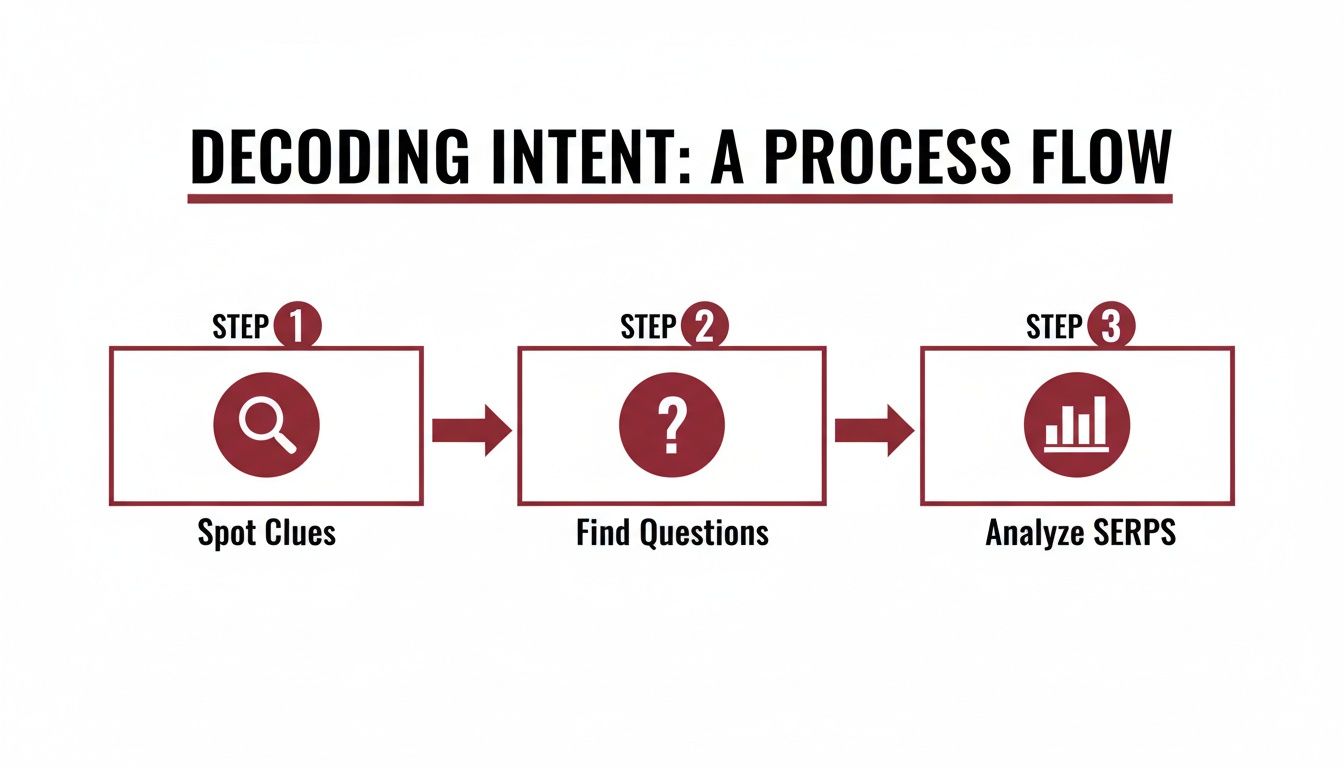
This methodical approach—spotting clues, finding the underlying question, and analysing the SERPs—is how you move from guessing to knowing what your audience needs.
Group Keywords into Topic Clusters
As you sort your list, you'll start to see patterns. Keywords will naturally fall into groups around a central theme. For example, "how to fix a leaking tap," "leaking tap causes," and "what tool to fix a tap" are all part of the same informational topic cluster.
On the other hand, "plumber Sydney," "emergency plumber Sydney cost," and "24/7 plumber near me" clearly form a transactional cluster. Grouping your keywords like this is a crucial step to prevent keyword cannibalisation, where you have multiple pages on your site fighting each other for the same terms.
A well-organised keyword map means each topic cluster gets its own dedicated, authoritative page. This sends a crystal-clear signal to search engines about which page is your primary resource for that topic, massively boosting your site's topical authority.
Align Keyword Clusters with Page Types
The final, and most important, piece of the puzzle is matching each keyword cluster to a specific page type on your website. This is where you directly connect user intent to your site's structure.
The rule here is beautifully simple: match the content format to the user’s goal.
- Informational Clusters belong on blog posts, how-to guides, and FAQ pages. Someone searching "how to fix a leaking tap" needs a detailed, step-by-step article, not a sales pitch.
- Commercial Clusters are perfect for comparison pages, in-depth product reviews, or "best of" listicles. If they're searching "Xero vs MYOB review," give them a page that puts the two head-to-head.
- Transactional Clusters should point directly to your service or product pages. A query like "plumber Sydney cost" needs to land on a page that outlines pricing and has a clear call-to-action.
- Navigational Clusters should take the user to the most obvious destination, which is almost always the homepage or a specific login page.
To bring this all together, here is a simple framework you can adapt. It shows how a local Aussie plumbing business might approach this.
Keyword to Page Mapping Framework
This table provides a practical template, showing how you can classify your keywords by intent and map them to the most suitable page type to satisfy what your user is looking for.
| Keyword/Topic Cluster | Primary Intent | Keyword Modifiers | Ideal Page Type | On-Page SEO Focus |
|---|---|---|---|---|
| fix leaking tap | Informational | how to, guide, DIY | Blog Post | Question-based headings, video tutorial, step-by-step instructions |
| best hot water systems | Commercial | best, review, compare | Comparison Guide | Feature comparison table, expert reviews, pros and cons lists |
| emergency plumber Sydney | Transactional | emergency, cost, near me | Service Page | Clear call-to-action, pricing info, location details, trust signals |
| company name login | Navigational | login, contact | Homepage / Contact Page | Easy navigation, clear branding, accessible contact information |
By going through this process, you effectively turn a messy list of keywords into a strategic content roadmap. This on-page SEO framework for search intent mapping becomes the blueprint for your entire strategy, making sure every single page you create or update has a clear purpose and a much higher chance of ranking well.
Putting Your On-Page Elements to Work for Each Intent Type
Alright, you’ve done the strategic heavy lifting and have your keyword-to-intent map ready to go. Now comes the fun part: execution. This is where we take that blueprint and translate it into on-page SEO that clicks with both your audience and the search engines. We’re talking about tailoring every single element on the page—from the title tag right down to the call-to-action—to line up perfectly with what that searcher is looking for.

This alignment is really the heart and soul of good on-page SEO. It isn't some secret formula; it’s about methodically giving people what their search query tells you they want. A page targeting an informational search needs to feel genuinely helpful and thorough. On the other hand, a page aiming for a transaction has to be all about efficiency and trust.
Crafting Content for Informational Intent
When someone makes an informational query, they're in learning mode. They have a question and they want an answer. Your job is to be the best, clearest teacher in the room. Every on-page element needs to support this goal.
First up, your titles and headings need to sound like the user's question.
- Title Tag: Start it with a "how-to" phrase or the question itself. "How to Fix a Leaking Tap: A DIY Guide for Australians" is miles better than a generic title like "Plumbing Tap Services".
- H1 Heading: Your H1 should be a direct, punchy statement of what the page is about, usually a slight variation of your title tag.
- H2/H3 Subheadings: Use these to break the topic down into logical, bite-sized chunks. Think "Tools You’ll Need," "Step-by-Step Instructions," and "Common Mistakes to Avoid." It makes the content scannable and far less intimidating.
The content itself then has to deliver on the promise of those headings. Use short paragraphs, bullet points, and numbered lists to make complex information easy to digest. If you can, throw in some images or a short video to show, not just tell.
For informational content, think of yourself as the expert teacher. Answer the main question thoroughly, but don't stop there. Anticipate the next three questions they'll have and answer those too. This is how you build real trust and establish topical authority.
Optimising Pages for Commercial Intent
A user with commercial intent is getting close to a decision. They’re no longer just learning; they're actively weighing up their options and looking for that final bit of guidance to help them choose. Your on-page SEO needs to make this process easier for them and build their confidence in the options you present.
Focus on content that helps people compare and evaluate.
- Comparison Tables: These are absolute gold for commercial queries. A simple table comparing "Xero vs. MYOB" with columns for key features, pricing, and user ratings is incredibly useful.
- Expert Reviews: People are looking for detailed, unbiased reviews that cover the good and the bad. Authenticity is everything here.
- Feature Lists: Don't just list features. Break them down into digestible bullet points and explain the benefit of each one. Why should they care about it?
Your language is also crucial. Titles should use words like "Best," "Review," or "Comparison" to instantly connect with what the user is looking for. A title like "The 5 Best Coffee Machines in Australia (2024 Review)" is a perfect match for someone in that commercial investigation mindset. This is also where an on-page SEO entity-first content strategy can give you a serious edge, making sure you cover all the features and details that search engines (and users) expect to see.
Driving Action on Transactional Pages
When the intent is transactional, the user has their wallet out (metaphorically, at least). They're ready to buy, book, or sign up. Your page has one job and one job only: make it as easy and secure as possible for them to take that action.
Every element on the page needs to scream trustworthiness and simplicity.
- Clear Calls-to-Action (CTAs): Use big, obvious, action-focused buttons. "Buy Now," "Get a Quote," or "Book an Appointment" leave no room for doubt.
- Product-Specific Keywords: Get granular. Your title, headings, and copy need the exact keywords, including model numbers, brand names, and colours. For example, "Buy Blundstone 500 Boots Online – Free Shipping".
- Trust Signals: Plaster your page with them. Security badges, customer reviews, clear return policies, and easy-to-find contact info all help reduce anxiety and nudge the user toward converting.
Once you know exactly what your user wants to do, you can fine-tune the page to make it happen. You can learn how to optimize landing pages for higher conversions by ensuring your design and copy work together to meet user expectations and guide them smoothly to your goal.
The Role of Schema Markup in Intent Mapping
Schema markup is a bit like leaving a cheat sheet for Google. It's structured data you add to your site's code to explicitly tell search engines what your content is about. Using the right kind of schema is the final, crucial step in locking in your intent optimisation.
Different schema types are built for different intents:
- FAQPage Schema: Perfect for those informational pages. This can help your Q&A content show up as a rich result directly in the SERPs.
- Product Schema: An absolute must for transactional pages. This feeds Google details like price, stock availability, and review ratings, which can then be displayed in search results.
- LocalBusiness Schema: Critical for any local search with transactional intent. It tells search engines your address, opening hours, and what you offer.
- Review Schema: Ideal for your commercial investigation pages. It's what allows those little star ratings to show up in the SERPs, which can be a massive boost for your click-through rates.
Adding the correct schema reinforces all the other signals you've built with your content, titles, and structure. This complete approach to search intent mapping makes sure that both your users and the search engines are crystal clear on what your page offers and why it's the absolute best result for their query.
Advanced Intent Strategies for Aussie Local Businesses
If you run a business with a physical address in Australia, getting your head around local search intent isn't just a nice-to-have—it's the single most important thing you can do to get people through your door. All the usual on-page SEO rules still apply, of course, but winning in local search comes down to nailing a few specialised tactics that capture the very specific, high-value intent of someone searching nearby.
Think about it. When someone types "plumber near me" or "best coffee Richmond VIC," they're not just browsing. They have a problem that needs solving right now, and they're looking for a solution close by. This is where your website and, crucially, your Google Business Profile (GBP) need to be working in perfect sync.
Dialing in on Hyper-Local Transactional Intent
For many local businesses, your Google Business Profile is the first handshake you have with a potential customer. It’s your digital shopfront, and it has to be perfectly tuned to catch anyone with transactional intent. Simply having your name and address listed isn't going to cut it.
- Fill out everything: Be obsessive. List every service, every product, your exact opening hours, and all the attributes that apply. This data is what Google uses to directly answer user queries.
- Chase and answer reviews: Reviews are a massive signal of trust. You need to actively ask customers for them and always take the time to reply. It shows you're a real, engaged part of the local community.
- Use Google Posts and Q&A: Get in the habit of sharing regular updates, special offers, and answering common questions right there on your profile. You can address commercial and informational queries before a person even thinks about clicking through to your site.
When someone fires up Google Maps, they're showing clear navigational and transactional intent. They’re ready to go somewhere.
This view isn't just about location; it's packed with reviews, photos, and key details that heavily influence whether someone decides to visit. The map-based layout naturally favours proximity and social proof, making a well-oiled GBP essential for grabbing this "ready-to-go" audience.
Building Unique Landing Pages for Each Location
Here’s a classic mistake I see all the time: a business with multiple locations trying to make one single service page work for every suburb or city. If you want to properly align with local search intent, every single one of your physical locations needs its own dedicated, uniquely optimised landing page.
And I don't mean just copying the same page and swapping out the suburb name. These pages have to offer genuine, unique value that’s relevant to that specific area.
A great local landing page feels like it was written for the local community, not just about your business. Talk about nearby landmarks, mention a project you completed in the area, or feature testimonials from customers down the road. That’s how you build a real connection.
The data backs this up, too. Recent Australian research shows that multi-location businesses that align their on-page SEO with specific local intent pull in an average of 557% more traffic than their single-location counterparts. This incredible result is built on the back of unique location pages, detailed service descriptions, and FAQs that match those hyper-local queries.
In Australia, 93% of consumers use Google Maps to find a business, and 56% of actions on GMB listings are website visits. Your optimised landing pages are the final stop where local intent turns into a customer. You can learn more about these vital Australian local SEO statistics and see how they can inform your own strategy.
Answering Questions in the Age of Voice Search
Voice search is no longer a gimmick; it's changing how people look for local businesses. People don't talk to their smart speakers in keywords—they ask questions. "Hey Google, where's a good spot for a flat white near me?" or "What's the best-rated mechanic in Fitzroy?" are the new normal.
To capture this kind of conversational traffic, your on-page content needs to sound more like a real person. One of the most effective ways to do this is by structuring your content in a question-and-answer format.
- Create a hyper-local FAQ: Add a dedicated FAQ section to each of your location pages.
- Get specific with your answers: Tackle real questions people might have, like where to park, which bus to catch, or what your most popular services are in that particular suburb.
- Write conversational headings: Instead of a generic heading like "Our Services," try something like, "What Services Do We Offer in the Parramatta Area?"
This approach does more than just optimise for voice search. It delivers immediate value to the user, answering their questions directly and building the trust you need to encourage them to take that next step. By combining a perfectly tuned Google Business Profile with unique, conversational, and hyper-local landing pages, you build a powerful system for mastering the on-page SEO roadmap to search intent mapping and turning local searchers into loyal customers.
Got Questions About Search Intent Mapping?
As you start getting into the nitty-gritty of search intent mapping, you’re bound to have some questions. It’s a pretty detailed process, and honestly, the devil is in the details. This is where most people get stuck, so let’s clear up a few of the most common roadblocks I see.
What if a Keyword Has Mixed Intent?
Ah, the classic mixed-intent keyword. This is probably the number one question I get asked. You’ll find plenty of keywords, especially the broader ones, that don’t fit neatly into one box. A great example is "electrician Sydney". Is someone looking for a specific company? Comparing local options? Or do they have a blown fuse and need someone right now? It could be any of the three.
So, how do you figure it out? Simple: look at the search results page (the SERP). Google pours billions into understanding what people want, so the SERP is your ultimate cheat sheet.
- If you see a big local map pack and a bunch of service pages with "Book Now" buttons, the primary intent is clearly transactional.
- Seeing lots of "Top 10 Electricians" articles and review sites? That leans heavily commercial.
- If one specific company’s homepage is sitting at number one, there's a good chance a lot of searchers have a navigational intent.
Your job is to build a page that nails the dominant intent while still giving a nod to the secondary ones. For "electrician Sydney," this would likely be a strong service page that also features customer testimonials (hitting the commercial angle) and an embedded map with clear contact details (covering the navigational side). You're basically creating a one-stop-shop.
My advice? Don't guess. The SERP has all the answers. Aim to satisfy the main reason people are searching, but layer in elements to help those with other needs. It makes for a much stronger, more authoritative page.
How Often Should I Update My Intent Map?
Look, your search intent map isn't something you can just set and forget. People’s search habits change, new competitors pop up, and Google’s algorithm is always evolving. As a general rule, I recommend giving your map a proper review and refresh at least twice a year.
That said, some things should make you drop everything and check it immediately:
- Major Algorithm Updates: After a big Google update rolls out, you need to check if the goalposts have moved for your most important keywords.
- Sudden Ranking Drops: If a page that was crushing it suddenly tanks, a shift in how Google perceives user intent is a very likely suspect.
- New Products or Services: When you launch something new, you need to go back to the drawing board and map out the intent for a whole new set of keywords.
Keeping your map current ensures your on-page SEO work is aligned with what your audience and Google are looking for today, not what they wanted six months ago.
How Do I Measure the ROI of Intent Mapping?
This is where the rubber meets the road. Measuring the impact of your intent mapping is all about tracking the right metrics for the right pages. ROI isn't just about the final sale; it's about seeing if each page is actually doing the job you designed it for.
- Informational Pages: For your blog posts and guides, you'll want to look at things like time on page, scroll depth, and clicks to other related articles on your site. Success here is all about engagement and building trust.
- Commercial Pages: With comparison guides or "best of" lists, you should be monitoring click-through rates to product pages, affiliate links, or quote request forms. Did your page successfully help someone make a decision?
- Transactional Pages: This one’s the most straightforward. You're tracking the bottom line: conversion rates, leads, and sales. Is the page turning visitors into customers?
When you line up your KPIs with the specific intent of each page, you get a much clearer, more honest picture of your ROI. It takes you beyond just looking at overall traffic and shows how your comprehensive roadmap to search intent mapping is actually delivering real business results at every stage.
Ready to stop guessing and start building an SEO strategy that truly connects with your customers? The expert team at Anitech specialises in data-driven on-page SEO and search intent mapping for Australian businesses. We build comprehensive roadmaps that deliver measurable growth. Book your free consultation with us today!