Quick Summary: Strategic link building is the art of earning high-quality backlinks to build website authority. Engineering link equity involves using this authority—or "link juice"—and channeling it through your site via smart internal linking. This "circulatory system" boosts your most important pages, improving search rankings, traffic, and revenue.
Let's cut to the chase. Strategic link building is the art of getting high-quality backlinks to your website to build its authority. Engineering link equity is about taking that authority—that 'link juice'—and channelling it through your own site with smart internal linking, pushing your most important pages higher up the search results.
Think of link equity as your website’s reputation in the online world. If a well-respected industry leader gives you a shout-out, your credibility soars. In the same way, a backlink from a trusted, authoritative website tells Google your content is the real deal. This guide isn't just about collecting links; it’s about becoming an architect of authority. You’ll learn how to systematically earn powerful external links and then build an internal 'circulatory system' that pumps that power to the pages that actually make you money.
For Australian SMEs and e-commerce brands, this is where the magic happens. It's how you turn a backlink from a simple hyperlink into a measurable asset that directly translates to better rankings, more traffic, and ultimately, more revenue.
What Is Strategic Link Building and Link Equity?

At its heart, strategic link building is the intentional process of earning backlinks from other websites to your own. This isn't a numbers game where more is always better. The focus is on quality over quantity—getting high-quality endorsements from sources that are relevant and carry authority in your field.
Link equity, on the other hand, is the actual "ranking power" or authority that flows from one page to another through a link. Each backlink is essentially a vote of confidence. A link from a major industry publication like the Australian Financial Review is a massive endorsement, while one from a brand-new, unknown blog just doesn't carry the same weight. The goal is to collect this equity to build your site's credibility in Google's eyes.
Why Engineering Link Equity Matters
The real power move is shifting from just getting links to actively engineering link equity. This is where you take control. Instead of letting that hard-earned authority just pool on whatever page got the link, you build a deliberate internal structure to funnel that power to your most valuable pages—the ones that drive your business, like your product pages, service pages, and key category pages.
Think of it like a dam and a system of aqueducts. Your backlinks build a huge reservoir of authority (the dam). Your internal linking strategy is the network of aqueducts that directs that powerful resource exactly where it's needed to make things grow.
This methodical approach turns link building from a hopeful tactic into a reliable, predictable system for growth.
The Impact on Australian Businesses
For Australian small and medium-sized businesses, getting this right is a genuine game-changer. In the crowded Aussie market, a smart link strategy can set you apart. It's not just theory, either. One survey found that 57.1% of Australian businesses see tangible results from high-quality backlink campaigns within just one to three months.
Of course, putting these strategies into action takes skill, time, and a lot of persistence. While it’s crucial to understand the principles, the day-to-day work often benefits from expert help. Many agencies offer professional SEO services that specialise in acquiring high-value external links and optimising a site's overall online presence.
Acquiring High-Value External Link Equity
So, how do you actually build your website’s authority? It starts with getting powerful external links pointing to your site. Forget the old-school approach of just getting as many links as possible. These days, it’s about a calculated process of earning endorsements that search engines genuinely respect.
Think of these high-value backlinks as the foundational ingredients. You need this raw material before you can even think about sculpting and directing that link equity across your own website. Let’s dive into the proven, practical tactics that actually work for Australian businesses.
The Art of Digital PR
Digital PR is less about asking for links and more about creating something so good that journalists and industry publications want to link to you. It's about becoming the source.
So, what does this look like in practice?
- Original Research: Imagine commissioning a survey on Aussie online shopping habits and publishing the results. Journalists love fresh data.
- Expert Commentary: You could offer your unique take on breaking news within your industry, making yourself the go-to expert.
- Creative Campaigns: This could be an interactive tool, a compelling video, or a stunning infographic that tells a story people want to share.
The whole point is to create something genuinely valuable or interesting. When you do that, a journalist linking to your content feels like a natural part of their story, not a favour to you. This is how you land those game-changing links from major news sites and top-tier industry blogs.
Strategic Guest Posting
Guest posting is a classic for a reason, but its success hinges entirely on how you do it. The days of churning out cheap articles for any website that would take them are long gone.
Today, it's about being strategic. You're aiming to secure a spot on a reputable, relevant blog and deliver massive value to their readers.
Here's the modern approach:
- Prospecting: Use a tool like Ahrefs to find high-authority blogs in your niche that have a real, engaged audience and are open to guest posts.
- Pitching: Forget generic templates. Write a personal pitch showing you’ve actually read their blog and have a specific topic idea that will solve a problem for their readers.
- Writing: Deliver an absolutely killer article. It should be something you'd be proud to put on your own website. Within the content, you place a natural, contextual link back to a relevant page on your own site.
A great guest post isn't just a backlink delivery system. It’s a chance to build your brand’s credibility, get in front of a new audience, and forge a meaningful connection in your industry.
Efficient and Effective Tactics
Digital PR and high-end guest posting are brilliant, but they can take a lot of time and effort. Luckily, other tactics offer a more direct route to quality links, often by making the most of content and opportunities that already exist.
Broken Link Building
This one is a classic win-win. You find a broken link (a 404 error) on a relevant website and then reach out to the site owner, politely pointing it out and suggesting your own content as a handy replacement. You’re not just asking for something; you’re helping them fix their website. It’s a brilliant way to build goodwill and earn a solid backlink at the same time.
Niche Edits (Or Link Insertions)
This tactic involves finding a relevant, established article on another site and simply asking the author to add a link to your content where it adds genuine value. It’s incredibly effective because the link goes onto a page that Google has already indexed—one that might already have its own authority and traffic.
For Australian small businesses, getting a handle on these tactics is a must. But the number one rule is always quality over quantity. In fact, research shows that high-equity links from reputable sources like .edu.au domains and top media sites deliver a 78.1% satisfying ROI, even though they cost more to acquire. This really drives home the importance of investing in links that will actually move the needle for your business.
To help you decide where to focus your efforts, here’s a quick comparison of the most common link-building methods.
Link Acquisition Method Comparison
| Tactic | Effectiveness Score (1-5) | Resource Intensity | Best For |
|---|---|---|---|
| Digital PR | 5 | High | Brands looking for top-tier media mentions and foundational authority. |
| Guest Posting | 4 | Medium-High | Building topical authority and reaching new, relevant audiences. |
| Broken Link Building | 4 | Medium | Efficiently acquiring links by providing value and fixing web errors. |
| Niche Edits | 3 | Medium | Gaining contextual links on established, already-ranking pages. |
| Directory Listings | 2 | Low | Building foundational local citations and trust signals (especially for new sites). |
As you can see, there's no single "best" method—it's about building a balanced approach. A solid strategy for an Australian e-commerce site might blend a major Digital PR campaign with ongoing niche edits and guest posts to create a diverse and powerful backlink profile.
Speaking of a diverse profile, don't overlook the basics. Exploring proven directory strategies to boost domain authority can be a simple but effective way to round out your toolkit. Each tactic has its place in building a backlink profile that’s both strong and resilient.
Building Your Internal Authority Distribution System: The Circulatory System
So, you’ve landed some fantastic external links. That's like capturing a lightning bolt of ranking power for your website. But what do you do with it? Just letting that power sit on one page is a massive missed opportunity. To get the most out of your link-building efforts, you need to think like an engineer, designing a "circulatory system" of internal links to pass that external PageRank to your most critical content.
This is where your internal linking strategy becomes your secret weapon. A smart network of internal links takes the raw power from those high-value backlinks and channels it directly to the pages that actually make you money—your product pages, service pages, and critical conversion points. Without this deliberate distribution system, even the strongest backlink profile won't do much to lift the pages that drive your business forward. You get to play architect, making sure every last drop of link equity is put to work.
Mastering The Hub-and-Spoke Model
One of the most effective ways to structure this flow of authority is the hub-and-spoke model, which you might also hear called 'topic clusters'. It’s a beautifully simple and logical way to organise your content and internal links that both your visitors and Google will absolutely love.
Here’s the breakdown:
- The Hub Page (Pillar Content): This is your big, comprehensive guide that covers a core topic central to your business. If you run an Australian outdoor gear shop, your hub page might be a definitive piece like "The Ultimate Guide to Hiking in Tasmania." This page is designed to attract high-quality external links.
- The Spoke Pages (Cluster Content): These are more focused articles that dive deep into the subtopics you touched on in the hub. Following our hiking guide example, your spokes could be articles like "Best Day Hikes Near Hobart," "What to Pack for the Overland Track," or a "Review of the Top 5 Hiking Boots for Muddy Trails."
The magic happens when you link all the spoke pages up to the central hub page, and the hub, in turn, links out to all its supporting spokes. This creates a tightly-knit cluster of content. When an external link hits the Hub Page, its PageRank flows through the internal links to every connected Spoke Page, lifting the authority of the entire topic cluster.
This is all powered by the initial link equity you bring in from external sources, which are often acquired through a few key methods.
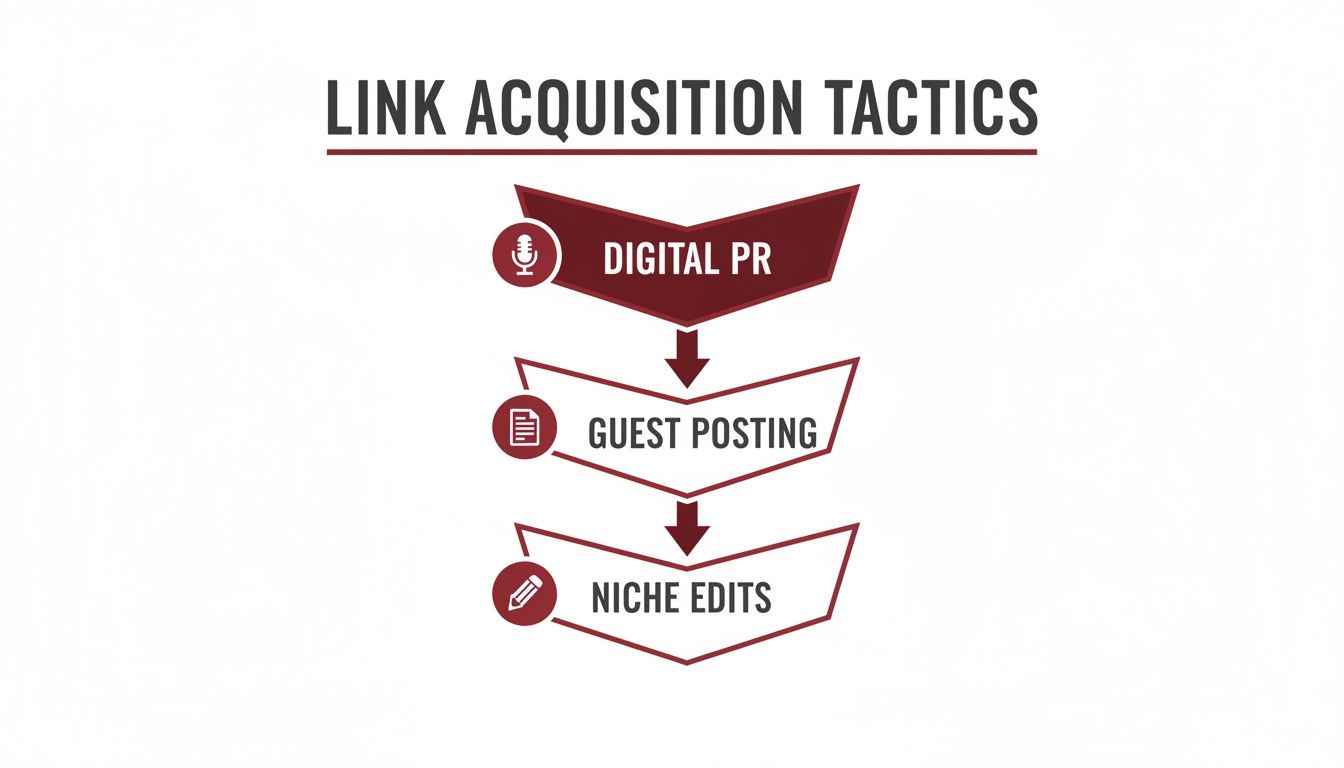
This kind of planned hierarchy shows how different tactics work hand-in-hand to build a strong external link profile, which then becomes the fuel for your internal linking engine.
Tactical Implementation of Authority Flow
With the hub-and-spoke model as your blueprint, it's time to get into the nitty-gritty. The small details of how you link internally can be the difference between a system that works and one that fizzles out.
Optimise Your Anchor Text
The anchor text is simply the clickable text in a link. It’s a huge clue for search engines, telling them what the page you're linking to is all about.
- Ditch the Generic Anchors: Phrases like "click here" or "read more" are useless. They provide zero context.
- Get Descriptive: Your anchor text should clearly describe the destination page. Instead of a lazy "click here," link the full phrase "explore our range of waterproof hiking jackets." This tells Google precisely what to expect on the other side of that click.
Link from Your Power Pages
Not all pages on your website are created equal. Some pages—like your homepage, a viral blog post, or a major resource guide—will naturally attract more backlinks and accumulate more PageRank. These are your "power pages."
Think about it: by strategically linking from these power pages directly to your most important service or product pages, you create an express lane for link equity. It’s a direct injection of ranking power where it can make the biggest commercial impact.
Conduct Audits to Find Orphan Pages
An orphan page is exactly what it sounds like: a page on your site with no internal links pointing to it. From Google's point of view, if you don't even link to it from your own site, it can't be that important. These pages are effectively invisible, starved of any internal link equity.
Running regular crawls with tools like Screaming Frog or Ahrefs' Site Audit will quickly uncover these forgotten pages. Once you find them, you can weave them back into your internal linking structure, giving them the authority they need to become visible and start contributing. This bit of digital housekeeping is a non-negotiable part of maintaining an efficient authority distribution system.
Measuring and Managing Your Link Equity Flow
Great SEO isn't about guesswork. It’s about engineering. When it comes to link equity, this means shifting from simply collecting links and hoping they work to actively measuring, managing, and directing the flow of authority throughout your website.
Think of yourself not just as a link builder, but as a link equity architect. Your job is to make deliberate, data-backed decisions that create predictable growth. To do that, you need a clear picture of what you’re starting with, which is where a proper audit comes in.
Performing a Comprehensive Link Audit
A link audit is basically a health check for your entire backlink profile. The goal is twofold: first, to find and get rid of any toxic links that are holding you back, and second, to spot untapped opportunities.
This is where you’ll need some serious tools. Powerful crawlers like Screaming Frog and Sitebulb are brilliant for mapping out how your internal and external links create your site’s authority network.
The audit itself involves a deep dive into every single link pointing at your site. You’re looking for red flags like:
- Links coming from low-quality, spammy, or completely irrelevant websites.
- Anchor text that looks unnatural or is stuffed with the same exact keyword over and over.
- Links from obvious private blog networks (PBNs).
When you find these toxic links, you can tell Google to ignore them using their Disavow Tool. This tidies up your profile and helps protect you from penalties. But an audit isn't all about defence—it’s also about offence. You’ll often find chances for link reclamation, like fixing broken links that used to point to your site, which can instantly reclaim lost equity.
Defining the Metrics That Truly Matter
To really get a handle on your link equity, you need to track the right numbers. Forget vanity metrics; you need data that actually shows the impact of your work on your business goals.
The aim here is to turn link building into a predictable system. By tracking the right key performance indicators (KPIs), you can measure your return on investment, prioritise your efforts based on real data, and make strategic decisions that drive consistent, sustainable growth.
The following data table outlines the essential metrics to track, what they mean, and the go-to tools for measuring them.
Key Metrics for Measuring Link Equity Impact
| Metric | Description | Primary Tool(s) |
|---|---|---|
| Domain Rating/Authority (DR/DA) | A score from tools like Ahrefs or Moz that estimates a site's overall backlink strength. A rising DR/DA is a great sign that your authority-building is on the right track. | Ahrefs, Moz |
| URL Rating/Authority (UR/PA) | This metric measures the backlink strength of a single page. Watching the UR/PA of your key pages shows if your internal linking is successfully pushing equity where it needs to go. | Ahrefs, Moz |
| Organic Keyword Rankings | The most direct measure of success. Are your target pages climbing the search results for your most important keywords? This is the ultimate test. | Ahrefs, Semrush, SE Ranking |
| Referral Traffic | Don’t forget that links also drive real visitors. An increase in referral traffic from new backlinks shows they are on relevant, high-traffic pages and delivering value beyond just SEO. | Google Analytics, Matomo |
By keeping a close eye on these KPIs, you can move beyond just "building links" and start strategically engineering your website's authority for maximum impact.
Turning Data Into Actionable Strategy
Tracking these metrics is what allows you to connect the dots. If a guest post on a high-DR site doesn't seem to budge the UR of your target page, you know you’ve likely got an internal linking problem to solve. If your rankings for a crucial service page are stuck, that's your cue to funnel more internal authority its way.
The sheer complexity of this work is why so many businesses turn to experts. In fact, recent data shows 56% of businesses outsource link-building tasks to specialised agencies. This really highlights the challenge of navigating a space where real success comes from sophisticated, white-hat strategies. Discover more insights about link building trends.
By committing to measuring and managing your link equity, you build a robust, data-backed system that consistently delivers results.
Real-World Examples for Australian Businesses

Alright, we've covered the theory. Now, let's get our hands dirty and see how this all works in the real world. This is where the concepts of strategic link building really start to click.
To bring the idea of engineering link equity to life, we'll walk through two familiar scenarios: an Aussie e-commerce retailer and a local B2B service provider. These examples will show you how to move past just collecting links and start deliberately pointing all that SEO power towards the pages that actually make you money.
E-commerce Scenario: The Melbourne Outdoor Gear Retailer
Picture an online store based in Melbourne, specialising in top-shelf hiking and camping gear. Their big goal? Sell more high-margin products, specifically hiking boots and backpacks. Just getting a few random links to their homepage isn't going to cut it.
Here’s how they can strategically engineer their link equity to hit that sales goal:
-
Create a "Link Magnet": They go all-in on building the definitive online guide to "Hiking in the Grampians National Park." This isn't just another blog post. It's a true pillar piece of content, complete with downloadable trail maps, packing checklists, advice for every season, and professional-grade photography. It's genuinely the best resource out there.
-
Attract Authoritative Links: With this incredible asset in hand, they can now approach Victorian tourism boards, popular outdoor adventure bloggers, and travel writers. Because the guide is so useful, they start earning high-quality backlinks from trusted sites. This is how they fill up their ‘authority reservoir’.
-
Distribute the Equity with Precision: Now for the magic. Inside their Grampians guide, they don't just vaguely mention their gear. They strategically link to their specific product and category pages using keyword-rich anchor text.
For example, a section on navigating rocky trails might say, "For this kind of challenge, you'll need a pair of durable, ankle-supporting hiking boots," where that bolded text links directly to their main hiking boots category page.
This clever move turns a helpful, top-of-funnel article into a powerful tool for bottom-of-funnel sales. They're funnelling all that hard-earned authority from a general topic straight to the pages where people actually buy things.
B2B Scenario: The Sydney IT Support Company
Let's switch gears to a B2B provider—an IT support company in Sydney. Their main objective is to get qualified leads for their core offerings, like managed IT support and cybersecurity, from other businesses in their local area.
Here’s a tailored game plan for them to engineer link equity and own their local market:
-
Build Local and Topical Authority: The first step is to get links from reputable local sources. This means getting listed in the NSW Business Chamber directory, being featured on a well-known Sydney tech blog, or contributing an expert article to a local business journal. It's about building trust where it counts.
-
Funnel Authority to the "Money Pages": Many of these external links will probably point to their homepage or a specific blog post. That's fine. The real work happens with their internal linking. The homepage needs to have prominent links to their key service pages, using clear, descriptive anchor text like "Managed IT Services for Sydney Businesses" or "Advanced Cybersecurity Solutions."
-
Create a Supporting Content Cluster: To reinforce this, they create a series of blog posts that answer common customer questions, like "How Much Do IT Support Services Cost in Sydney?" Critically, every one of these posts links back to the main service pages.
This methodical approach ensures that the authority from local and industry backlinks doesn't just get stuck on the homepage. Instead, it’s purposefully channelled to boost the specific service pages they need to rank for high-intent, local search terms. When a business owner in Sydney searches for the exact solutions they offer, they’ll be right there at the top.
Building a Sustainable Link Equity Engine for Long-Term Growth
Think of link building less as a series of one-off campaigns and more as the careful construction of a core business asset. It's not about a frantic scramble for links with a clear start and end date. Instead, it’s about creating a systematic process for acquiring, auditing, and directing authority for predictable, long-term growth.
The whole concept is powerful because it's so simple. First, you consistently earn high-value external links through great content and genuine outreach. Second, you cleverly distribute that hard-won authority throughout your own site with a smart internal linking strategy. Get this right, and you build a sustainable competitive advantage that’s incredibly tough for your rivals to copy.
The Cycle of Continuous Improvement
Engineering link equity is never a "set and forget" job. It's a constant cycle of refinement. You need to be regularly auditing your backlink profile, getting rid of any toxic links that have crept in, and checking your internal links to make sure authority is flowing to your most important pages. This continuous loop is what makes your site grow stronger over time.
This disciplined approach really does require a shift in mindset. You're no longer just chasing quick, short-term ranking boosts; you're building a foundational marketing asset that will pay dividends for years.
Treat your link equity like a financial investment. Each high-quality link is a deposit, and your internal linking strategy is how you allocate those funds to generate the highest possible return for your business.
Unlocking Your True Online Potential
When you start treating link equity management as a core part of your digital infrastructure, you lay the groundwork for sustained dominance in the search results. This engineered approach is the secret to moving past temporary gains and achieving scalable, predictable growth online.
For any Australian business serious about building a lasting presence, this methodical system is how you unlock your true potential. It turns your website into a powerful engine that consistently drives traffic, leads, and revenue, building on its own momentum year after year.
Got Questions? We've Got Answers
Diving into the nitty-gritty of link building often brings up a few questions. Let's tackle some of the most common ones we hear from business owners trying to get their heads around link equity.
How Long Until I See Results from Link Building?
It's the question on everyone's mind! While every website and industry is different, you'll likely start seeing some positive signs—like shifts in keyword rankings or a bump in organic traffic—within 1 to 3 months.
But think of it like building a house. The initial foundation work happens relatively quickly, but constructing a solid, storm-proof home takes time. The truly game-changing results, where you're consistently outranking competitors for valuable terms, typically materialise after 6 to 12 months of dedicated, high-quality effort.
What’s the Difference Between Link Equity and PageRank?
Great question. PageRank was Google's original, famous algorithm for scoring a page's authority based on who linked to it. It was groundbreaking, but the game has evolved since then.
Link Equity, or 'link juice' as it's often called, is the modern, more comprehensive version. It still considers the raw authority of a link (the PageRank part), but it also layers in other crucial factors:
- Topical Relevance: Is the linking site in a similar industry? A link from a local plumbing supplier is gold for a plumber in Melbourne.
- Anchor Text: Does the clickable text of the link actually describe what the page is about?
- Site Trustworthiness: Is the linking website a respected voice in its field, or is it a spammy, low-quality site?
So, you can think of PageRank as the basic technical score, while link equity is the total real-world value that backlink passes on to your site.
Is One Great Link Better Than Lots of Average Ones?
Without a doubt, yes. In modern SEO, quality absolutely trumps quantity.
A single, highly relevant link from a trusted, authoritative website is worth more than hundreds of links from low-quality, irrelevant blogs. That one powerful link acts as a genuine vote of confidence in your business, passing on significant trust and authority that can make a real difference to your rankings.
How Does Internal Linking Help My Backlink Strategy?
Think of your internal links as the plumbing system for your website. You work hard to earn a fantastic backlink that points to a new blog post—that's like installing a massive water tank on your roof.
Without internal links (the pipes), all that valuable 'link equity' just sits there, trapped on that one page.
A smart internal linking strategy creates pathways to channel that authority from your high-performing blog post to the pages that actually make you money, like your product and service pages. It ensures every drop of value from your link building efforts is spread effectively across your entire site, maximising the return on your investment.
At Anitech, we specialise in building powerful link equity that drives real growth for Australian businesses. Our approach is all about earning high-value links that build lasting authority for the pages that matter most. Ready to lay a rock-solid foundation for your SEO? Explore our tailored digital marketing solutions.