Quick Summary: For finance, health, and legal sectors, E-E-A-T (Experience, Expertise, Authoritativeness, Trustworthiness) is non-negotiable for YMYL (Your Money or Your Life) content. This guide provides a strategic framework for navigating compliance, focusing on demonstrating real-world experience, building author credibility, meticulous sourcing, and leveraging technical SEO to establish digital trust and authority.
If you're operating in a high-stakes industry like finance, health, or law, you're not just creating content. You're offering advice that can genuinely change someone's life, for better or worse. This is why proving your Experience, Expertise, Authoritativeness, and Trustworthiness (E-E-A-T) isn't just a good idea—it's essential for survival and a core pillar of your digital strategy. Building E-E-A-T & credibility: navigating YMYL compliance for high-stakes content is the foundation for success in sectors where trust is paramount.
Understanding The New Rules of E-E-A-T and YMYL
Google coined the term "Your Money or Your Life" (YMYL) to classify topics where bad information could have disastrous consequences. Think financial advice, medical diagnoses, or legal guidance. Naturally, content in these areas is scrutinised far more heavily, making E-E-A-T the benchmark for quality and user safety.
To assess this content, Google's quality raters (the humans who review and provide feedback on search results) use the E-E-A-T framework. Think of it as the ultimate checklist for credibility and quality online, a critical tool for any strategic hub in the finance, health, or legal sectors.
The Four Pillars of E-E-A-T Explained
Getting a handle on each part of E-E-A-T is the first real step toward creating a compliant and successful site. Let's break down what each letter actually means for your day-to-day content strategy.
| Pillar | What It Means for Your Content | Why It's a Game-Changer |
|---|---|---|
| Experience | Does the author have real, first-hand experience with the subject? They've walked the walk, not just read the map. | It separates theoretical knowledge from practical wisdom, offering users insights they can't get from a textbook. |
| Expertise | This is about formal qualifications. We're talking degrees, certifications, and professional credentials that prove the author's knowledge. | It provides a baseline of credibility, assuring users that the information comes from a trained and qualified professional. |
| Authoritativeness | Is your brand or author recognised as a go-to source by others in the industry? This is shown through mentions, links, and citations. | It demonstrates that your peers respect your knowledge, which is a powerful signal to both users and search engines. |
| Trustworthiness | This is the bedrock. It covers site security (HTTPS), clear contact info, transparent policies, and positive reviews. | Without trust, the other pillars crumble. It's the ultimate measure of whether a user feels safe engaging with your content and brand. |
Understanding these pillars isn't just a box-ticking exercise; it's about fundamentally building a brand that users and search engines can rely on.
In Australia, E-E-A-T became a non-negotiable part of the rulebook with the December 15, 2022, Quality Rater Guidelines update. For Australian businesses dealing in YMYL topics, getting this right is crucial, especially since earlier algorithm updates had already begun to penalise sites that couldn't demonstrate strong credibility signals.
Why "Experience" Changed The Game
Before the "E" for Experience was officially added, it was often enough for an expert to write an article. A journalist, for example, could research a complex medical topic and produce a piece that was factually sound.
But Google's priorities have shifted. Now, they're looking for content from people who have actually lived what they're writing about.
A review of sophisticated accounting software written by a general tech writer is one thing. But a review from a certified accountant who uses that exact software to manage client books every single day? That’s a whole different level of value. Their hands-on experience provides practical tips and unique warnings that research alone could never uncover.
This means your content needs to go beyond just reciting facts. It must weave in personal stories, offer unique takeaways, and prove the author has genuine, in-the-trenches experience. This is especially true where nuanced, real-world advice is paramount.
Building and protecting this credibility is a core part of your strategy, and understanding what is online reputation management is foundational to establishing the trustworthiness that holds E-E-A-T together. For any business in the YMYL space, it’s simply not optional.
How to Pinpoint Credibility Gaps in Your YMYL Content
Waiting for a ranking drop to fix your E-E-A-T is a recipe for disaster. The only way to win is to get on the front foot and proactively audit your existing content for any cracks in its credibility. This isn’t a theoretical exercise; it’s a hands-on, systematic process for finding and fixing the weaknesses that could be sabotaging your reputation and search visibility.
The most effective way to tackle this is to break the audit down into four key areas: digging into your authors, stress-testing your sources, checking your on-page signals, and evaluating user trust factors. By working through each one, you’ll build a solid framework to keep your YMYL content authoritative and compliant.
Do Your Authors Have Real-World Clout?
The first place to look is at the author. For any YMYL topic, an anonymous or vaguely qualified author is a massive red flag. You need to show that a real, experienced human being is standing behind the information you publish.
Start by going through every single author bio on your site. Is it just a name and a generic title, or does it actually build trust? A strong author bio isn't just a nice-to-have; it's a critical piece of your entire E-E-A-T puzzle.
Here's what a bio needs to truly demonstrate expertise:
- Full Name and Professional Title: No ambiguity. State who they are and what they do.
- Verifiable Credentials: List their degrees, certifications, and professional memberships (e.g., "Certified Financial Planner," "Registered Nurse"). This is non-negotiable.
- Links to Professional Profiles: This is where you prove it. Link out to their LinkedIn profile, official registration body, or relevant industry association page. It lets both people and search engines verify their background.
- A Snapshot of Relevant Experience: Briefly outline their hands-on experience. Don't just say "has experience in finance." Be specific: "spent 15 years as a mortgage broker helping first-home buyers secure their loans."
Think about it this way: a financial advice article absolutely must be written by someone who can prove they have real-world financial planning experience. Linking to their official planner registration or a detailed LinkedIn profile provides undeniable proof of their expertise.
Are Your Sources and Citations Rock-Solid?
Next up, put your sources under the microscope. Every claim, every statistic, and every bit of data in your YMYL content has to be backed by an authoritative source. Relying on old studies, sketchy websites, or worse, no sources at all, is a fast track to getting penalised.
The goal here is simple: prioritise information from respected institutions and attribute everything correctly. That means linking out to primary sources—think government reports, peer-reviewed scientific journals, and well-known industry organisations.
Here in Australia, E-E-A-T compliance for YMYL content is taken very seriously. Just look at the enforcement reports from bodies like the Australian Energy Regulator; they highlight the strict actions taken against non-compliance. This mirrors exactly the kind of penalties search engines apply to sites with low credibility, making meticulous sourcing absolutely essential. You can see what I mean in the AER's latest compliance and enforcement report.
This level of rigour shows a commitment to accuracy that both users and search engines will reward.
What On-Page Signals Are You Sending?
The design and structure of your website send powerful trust signals, often before someone even reads a single sentence. If a user can't easily figure out who you are, how to contact you, or what your editorial standards are, their trust plummets.
Make sure these key pages are not just present, but prominent and comprehensive:
- About Us Page: Tell your brand's story. Who's behind it? What’s your mission?
- Contact Information: Give them a physical address (if you have one), a phone number, and a professional email address.
- Editorial Policies: Be transparent. Explain your fact-checking process and how you guarantee the accuracy of your content.
- Privacy Policy and Terms of Service: Show users you respect their data and are transparent about how you operate.
Running a comprehensive web accessibility audit is another fantastic way to identify and fix credibility issues. A site that’s built to be accessible for everyone is seen as more professional, thoughtful, and trustworthy.
Finally, don't forget the more direct trust factors, like case studies, client testimonials, and site security (HTTPS). These elements offer the social proof and technical assurance needed to show your brand is legitimate and that your visitors are safe, cementing the foundation of your E-E-A-T.
Alright, you’ve finished the audit. Now comes the real work: creating new content that’s built for credibility right from the start. This isn’t about just ticking boxes or slapping on trust signals after the fact. It’s about weaving E-E-A-T into the very fabric of your content creation process, from the initial brief to the final publish.
For any YMYL topic, every article, guide, or post you create has to be a rock-solid testament to your authority and your unwavering commitment to getting it right.
Start with Who, Not Just What
The foundation of any piece of credible YMYL content isn't the keyword research or the structure—it's the author. You simply can't afford to have articles written by generalist writers or, worse, anonymous contributors. You need to actively find and feature authors with legitimate, real-world experience who are proud to put their name to their work.
This is probably the single most important decision you'll make. Think about it: a financial advice blog post written by a Certified Financial Planner who can draw on decades of client experience carries immediate weight. In the same way, a health website offering advice on managing a specific condition is infinitely more trustworthy when it’s written by a registered doctor or specialist nurse.
Your job is to make their expertise obvious and impossible to ignore. A simple byline just doesn't cut it anymore.
- Detailed Author Bios: Every single article needs to link out to a comprehensive author page. This page should detail their qualifications, accreditations, years of experience, and include links to their LinkedIn profile or official industry registration pages.
- Unique, Human Insights: Encourage your experts to add personal anecdotes or little "in my experience" takeaways. These are the golden nuggets that AI can't replicate, and they provide genuine value to the reader.
- Direct Attribution: Make it clear who is saying what. Use blockquotes or specially designed "Expert Insight" call-out boxes to highlight specific advice from your author, directly tying their credentials to the claims being made in the text.
This flowchart maps out a straightforward process for making sure your content audit—and creation—hits these critical points.
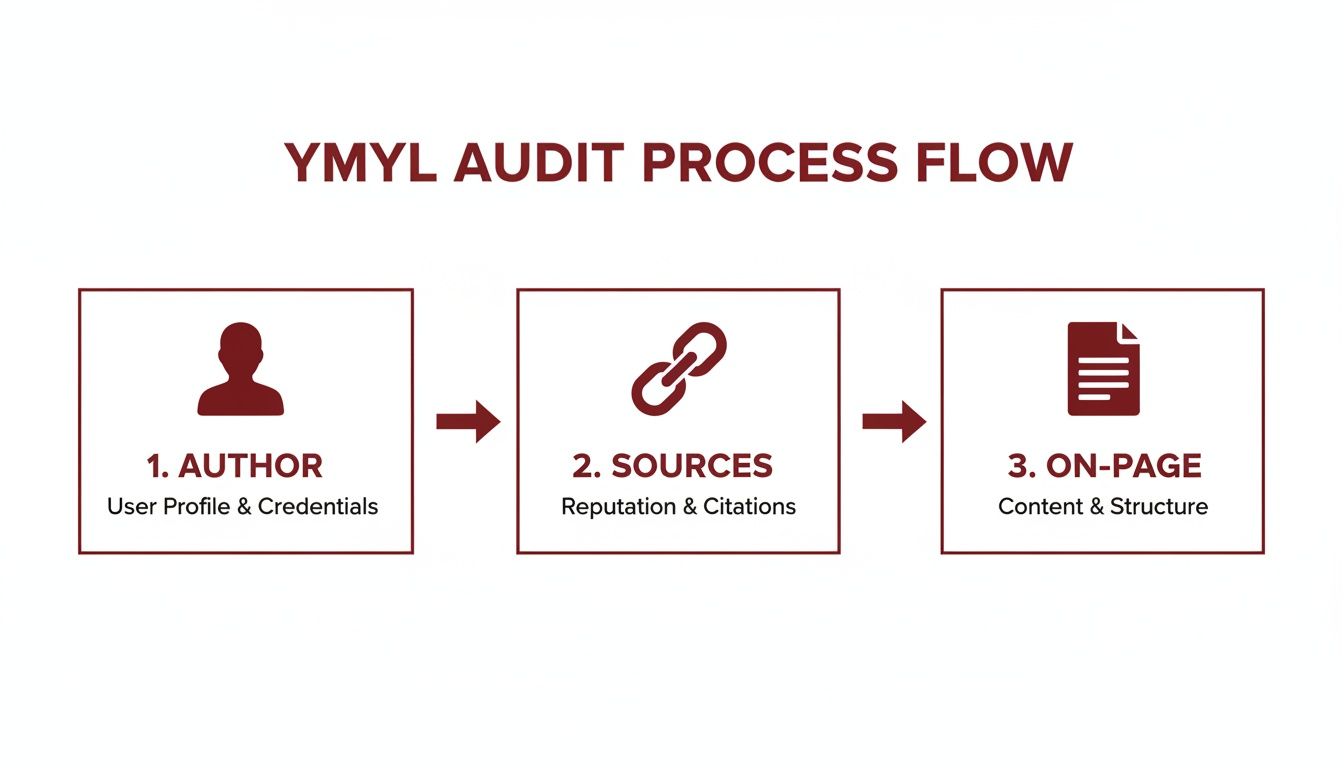
As you can see, validating the author, checking their sources, and ensuring the on-page elements support this are foundational, sequential steps. You can't skip one and expect the others to hold up.
Back It Up: Using Data and Research to Solidify Claims
Beyond the author, the actual substance of your content needs to be bulletproof. Vague claims and unsupported statements are absolute poison for YMYL content. Every major point you make must be backed by authoritative, verifiable sources.
This means you need to get into the habit of prioritising primary sources. Don't just link to another blog that mentioned a study; hunt down the original study and link directly to it. Go to the source.
A powerful trust signal, especially for Australian audiences, is using local, authoritative data. Quoting statistics from the Australian Bureau of Statistics, citing research from the CSIRO, or referencing reports from government bodies like the Department of Health instantly makes your content more relevant and credible.
Speaking of the CSIRO, Australia's national science agency is a perfect example of a gold-standard source. Their research and data add undeniable weight to your claims.
Choosing Formats That Naturally Showcase E-E-A-T
The way you structure your content can either obscure your expertise or put it front and centre. Some formats are just inherently better at demonstrating E-E-A-T.
Content Formats That Build Credibility:
- Expert Roundups: Get multiple recognised experts in your niche to answer a single, pressing question. This approach allows you to borrow authority from established names and gives your audience a rich, diverse set of perspectives.
- Data-Driven Reports: If you can, conduct your own original research—even a simple customer survey—and publish the findings. This positions you as a primary source of new information and a leader in your industry.
- In-Depth Case Studies: Show, don't just tell. Detail a client's problem, the strategy you implemented, and the successful outcome, using anonymised data to prove your point. It’s concrete proof of your real-world experience.
- Comprehensive How-To Guides: Create incredibly detailed, step-by-step guides that walk a user through a process. Use original screenshots, photos, or videos to demonstrate a practical depth of knowledge that simply can't be faked.
By being strategic with your authors, meticulous with your sourcing, and clever with your formatting, you can create YMYL content that doesn't just pass a Google quality check—it earns genuine trust from your audience. This proactive approach is the only sustainable way to succeed with high-stakes content.
Building Authority That Extends Beyond Your Website
Getting your on-site E-E-A-T signals right is a massive part of the puzzle, but it’s really only half the story. True authority isn't just about what you say about yourself; it’s about what the rest of the internet says about you. Google places enormous weight on your off-page reputation when it sizes up your credibility, making it a non-negotiable for any YMYL site.
The mission here is to build a digital footprint that screams expertise and trustworthiness across the web. You want to create a powerful echo chamber of credibility, where every external mention, link, and review validates the claims you’re making on your own site.
The New Era of Strategic Link Building
Let’s be clear: the old days of chasing link quantity are long gone. For YMYL content, the quality and relevance of your backlinks are everything. Seriously, a single link from a top-tier, respected industry publication is worth more than a hundred low-quality links from random directories.
Think of your link-building strategy as a direct extension of your E-E-A-T work. Each backlink should be a vote of confidence from a credible third party, essentially telling search engines, "Yep, this mob really knows their stuff."
So, how do you get these kinds of links? Focus on tactics that naturally attract them:
- Contribute to Major Industry Publications: Writing a guest article for a well-respected journal or trade magazine in your field is a game-changer. It’s not just about the referral traffic; it places your name and expertise on a platform that Google already sees as an authority.
- Get Cited in Official Reports: This is the gold standard. When your original research, data, or expert commentary gets referenced by government bodies, universities, or major industry reports, you've hit the jackpot. It creates an incredibly powerful and trustworthy backlink.
- Build Genuine Media Relationships: Ditch the mass email blasts to journalists. Instead, build real relationships. Position yourself as a go-to expert source they can call on for a quote in your niche. A mention in a major news article gives you both a high-quality link and a massive authority boost.
A financial planning firm that gets its lead planner quoted in an article on a major Australian financial news site has gained more than a link. It has secured a third-party endorsement of their expertise that resonates with both potential clients and search algorithms.
Managing Your Digital Footprint and Reputation
Your brand's authority is also being shaped right now by conversations happening about you all over the web. Proactively managing this digital footprint is a core part of demonstrating trustworthiness for YMYL compliance.
This goes way beyond your own blog or website. It demands you monitor and engage with your community and customers wherever they hang out online. A strong off-page reputation is built on transparency and genuine interaction, not just broadcasting your own message.
Cultivating Positive External Signals
You need to be active on platforms where your expertise can be seen and validated by the public. This involves more than just collecting positive mentions; it requires you to roll up your sleeves and get involved.
Key Areas for Off-Page Reputation Management:
- Online Reviews and Testimonials: Actively encourage happy clients to leave reviews on trusted third-party sites like Google Business Profile, Trustpilot, or other industry-specific review platforms. These genuine testimonials provide the social proof of your real-world experience that Google loves to see.
- Meaningful Community Participation: Don't just lurk in professional forums or social media groups. Jump in and provide genuinely helpful answers to questions in your area of expertise. When you become a recognised expert in a niche community, it builds both your personal and brand authority.
- Showcasing Client Success: Share de-identified case studies or powerful testimonials not just on your site, but through press releases or on platforms like LinkedIn. This shows tangible proof that you can deliver results.
By strategically building high-quality links and actively managing your reputation across the web, you create a cohesive and powerful narrative of credibility. This web of external validation reinforces every on-site signal, forming a rock-solid foundation for E-E-A-T & credibility: navigating YMYL compliance for high-stakes content.
Using Technical SEO to Signal Trust and Security

Long before a visitor reads your first sentence, their brain is already forming an opinion about your credibility. The technical health of your website acts as your digital handshake—it can either build immediate confidence or send them clicking the back button. For any YMYL site, that first impression is everything.
A slow, clunky, or insecure website screams unprofessionalism. It actively undermines all the hard work you’ve poured into your content. This is where technical SEO moves beyond just rankings and becomes a foundational part of building trust and meeting YMYL standards.
The Non-Negotiables of Site Security
The most fundamental—and powerful—technical trust signal is site-wide security. In high-stakes areas like finance or health, users are often sharing sensitive data, even if it’s just through a basic contact form.
Your website absolutely must have an active SSL certificate, enabling HTTPS on every single page. This simple step encrypts the connection between the user's browser and your server, protecting their information. A browser flashing a "Not Secure" warning next to your URL is the digital equivalent of a broken front door; it shatters trust instantly.
Just as important is a transparent and easy-to-find privacy policy. This document should clearly explain what data you collect and how you use it, showing you respect user privacy and comply with Australian regulations.
How User Experience Builds Perceived Trust
A smooth, professional user experience is a powerful stand-in for trustworthiness. A website that looks and feels legitimate is far more likely to be seen as a source of legitimate advice.
Think about these key factors:
- Professional Design: An outdated or amateurish design makes your whole operation look suspect. A clean, modern layout signals that you take your work, and your audience, seriously.
- Fast Page Load Speeds: Nobody waits for a slow site. It’s frustrating for users and suggests you haven’t invested in your platform. People associate speed with efficiency and professionalism—both crucial for credibility.
- A Flawless Mobile Experience: With most of your audience likely visiting on their phones, a responsive, easy-to-use mobile site isn't a luxury; it's essential. A site that’s a nightmare to navigate on a phone reflects poorly on your brand and will drive people away.
Think of it this way: if a financial advisor's office was messy, disorganised, and had flickering lights, would you trust them with your life savings? Your website's technical performance and design create that same initial impression online.
Using Structured Data to Explicitly Communicate Expertise
Beyond what your users see, you can use technical SEO to talk directly to search engines about your credibility. The best way to do this is with structured data, also known as Schema markup.
Schema is essentially a vocabulary of code you add to your site that helps search engines understand the context of your content. For YMYL sites, certain Schema types are incredibly valuable for reinforcing your E-E-A-T signals.
This table outlines the essential technical and trust-building elements every YMYL website should prioritise.
Essential YMYL Technical and Trust Checklist
| Element | Implementation Priority | Impact on E-E-A-T |
|---|---|---|
| HTTPS (SSL Certificate) | Critical | Instantly establishes a baseline of security and trust. Non-negotiable. |
| Professional & Responsive Design | High | A clean, modern design signals professionalism and builds perceived trustworthiness. |
| Fast Page Load Speed | High | A fast site provides a good user experience, which is a strong proxy for credibility. |
| Clear Privacy Policy & ToS | High | Demonstrates transparency and respect for user data, a key trust factor. |
Person Schema for Authors |
High | Explicitly connects content to a real, qualified expert, boosting E-E-A-T. |
Organization Schema |
High | Verifies your business as a legitimate entity to search engines. |
| Clear Contact Information | Medium | Makes it easy for users (and Google) to see you're a real, contactable organisation. |
| Domain-Specific Schema | Medium | Types like FinancialService or MedicalEntity add another layer of specific expertise. |
By implementing these elements, you're not just improving your SEO; you're building a foundation of digital trust that supports every piece of content you publish.
Key Schema Types for YMYL Sites:
PersonSchema: Use this on author pages to clearly state an author's name, job title, qualifications, and links to their professional profiles (like LinkedIn or an official industry registry). This directly connects your content to a verifiable expert.OrganizationSchema: Implement this site-wide to define your business's legal name, address, phone number, and logo. This helps Google confirm your identity as a legitimate organisation.MedicalEntityorFinancialServiceSchema: If you're in a relevant niche, using these more specific schema types can further clarify the nature of your expertise to search engines.
When you add this markup, you leave no room for guesswork. You are explicitly telling Google, "This content was written by this qualified person, who works for this legitimate organisation," providing verifiable data that backs up your claims of expertise. This technical clarity is a vital piece of the puzzle for E-E-A-T & credibility: navigating YMYL compliance for high-stakes content.
Answering Your Burning Questions About E-E-A-T and YMYL
As you get deeper into aligning your content with Google's E-E-A-T principles, a few common questions always seem to pop up. It’s totally normal. Navigating the world of YMYL compliance is a constant cycle of auditing, creating, and tweaking your approach, so it’s smart to seek clarity.
Let's dive into some of the most pressing questions we hear from businesses in high-stakes industries. Getting straight answers is the key to turning abstract guidelines into a real-world strategy for building lasting credibility.
How Often Should I Be Auditing My YMYL Content?
For content where the stakes are high, an audit isn't a "one and done" task—it's baked right into your content lifecycle. As a solid baseline, plan for a full, comprehensive E-E-A-T audit at least once per year. This gives you a systematic way to review your entire content library against the latest standards.
But some things just can't wait for the annual review. Certain events should trigger a much faster, more focused check-up.
-
After a Major Google Core Update: These updates are often Google’s way of refining how it assesses quality and E-E-A-T. When a big one rolls out, you need to analyse what’s changed and immediately re-evaluate your key YMYL pages to make sure they still meet the mark.
-
When Laws or Industry Regulations Change: This is a big one for legal, financial, or medical content. Outdated information isn't just poor quality; it can be actively harmful. A blog post about tax law from three years ago could be giving legitimately dangerous advice today. You need a system in place to review content the moment relevant legislation or professional best practices evolve.
-
For Your Top-Performing Pages: Your heavy hitters—the pages driving the most traffic, leads, or sales—deserve special attention. A quarterly check-in on these critical assets is a smart move to protect your rankings and your reputation.
A "set it and forget it" mindset is the absolute enemy of YMYL compliance. Think of your content as a living library. It needs constant curation to stay accurate and trustworthy. This ongoing vigilance is what underpins long-term credibility.
Can I Use AI for YMYL Content? What Are the Risks?
The explosion of generative AI has created a tempting shortcut for creating content, but let's be blunt: for YMYL topics, the risks absolutely dwarf the benefits. Relying on an AI to write about finance, health, or legal matters without intense human oversight is a recipe for disaster.
AI models are trained on massive amounts of data, but they lack genuine understanding and, crucially, real-world experience. This opens up some pretty serious vulnerabilities.
The Biggest Risks of Using AI for YMYL:
-
Factual Inaccuracies and "Hallucinations": An AI can confidently state something that is completely wrong. It might invent legal citations, misrepresent medical data, or give flawed financial advice. For a person relying on that information, the consequences could be severe.
-
A Complete Lack of "Experience": AI simply cannot replicate first-hand experience, which is now a core pillar of E-E-A-T. It can't share a personal story about navigating a complex financial decision or offer the subtle, nuanced perspective of a doctor who has treated a specific condition for 20 years.
-
Ethical and Compliance Blind Spots: AI has no concept of the strict advertising rules set by the Australian Health Practitioner Regulation Agency (AHPRA) or the ethical guidelines for marketing a law firm. It can easily and unintentionally generate content that breaches these regulations, putting your entire business at risk.
The only safe way to bring AI into a YMYL workflow is as a support tool for a qualified human expert. Use it for brainstorming ideas, creating an outline, or summarising research. But the final content must be written, or at the very least, substantially rewritten and rigorously fact-checked by a person with verifiable, real-world expertise.
What's the Single Most Important E-E-A-T Factor for a Local Business?
For a local business like a health clinic, a financial planning firm, or a suburban law office, all the E-E-A-T factors matter. But one consistently stands out as the most critical for building trust within the community: demonstrating genuine, local experience and trustworthiness.
Expertise (the degrees on the wall) and Authority (mentions in the local paper) are definitely valuable. But it’s the signals of real-world success and deep community connection that truly resonate with local customers.
For a local health clinic, this means going way beyond just listing a doctor's credentials. The most powerful factor is showcasing verifiable patient outcomes and completely transparent staff credentials. This is where trust is built.
-
Genuine Patient Testimonials: Feature detailed, authentic reviews and stories (with full permission, of course) that talk about the actual patient experience. These stories are incredibly powerful social proof that your clinic delivers excellent care.
-
Transparent Staff Profiles: Build out detailed bio pages for every single practitioner. Include their qualifications, specialisations, and a direct link to their AHPRA registration. This kind of transparency makes your team's expertise undeniable.
-
Community Involvement: Make sure your website shows your clinic’s participation in local health fairs, school programs, or community events. It proves you’re an active, trusted part of the neighbourhood, not just a business in it.
For a local YMYL business, your reputation is built one client, one patient, one success story at a time. Proving your value within that local context is the ultimate expression of E-E-A-T & credibility: navigating YMYL compliance for high-stakes content.
Ready to build a rock-solid foundation of credibility for your business? The team at Anitech specialises in data-driven SEO strategies that elevate your authority and drive measurable growth. We help Australian businesses dominate search rankings by building the trust signals that matter. Schedule your free consultation today!