Quick Summary: E-E-A-T (Experience, Expertise, Authoritativeness, and Trustworthiness) is the framework search engines like Google use to assess your content's quality. To become a go-to source, your business must demonstrate real-world experience, showcase genuine expertise through credible authors, build industry recognition, and establish a secure, trustworthy website.
The intersection of E-E-A-T & content credibility is where lasting brand authority is built. Don't think of it as just another marketing buzzword; see it as the very architecture of your digital presence. It's how you shift your website from being a simple online brochure to becoming the recognised "go-to" source in your industry—a source that both people and search engines implicitly trust.
Decoding the Blueprint for Digital Authority
In the competitive Australian market, just having a website isn't enough to get noticed. To really cut through the noise, you need to build a reputation for credibility that can stand up to scrutiny. This is exactly where the principles of E-E-A-T come into play. They aren't just abstract ideas; they are the load-bearing pillars holding up your brand's entire digital structure.
Think about building a house. You wouldn't just start throwing up walls without a detailed architectural plan. Building brand authority works the same way. It requires a deliberate strategy where every piece of content you publish, every backlink you earn, and every technical tweak on your site contributes to a solid, trustworthy whole. This isn't about chasing algorithms; it's about proving you offer genuine value and transforming your website into a recognized industry "go-to" source.
This diagram shows how Brand Authoritativeness sits at the top, supported by the foundation of E-E-A-T, which itself is built on high-quality content.
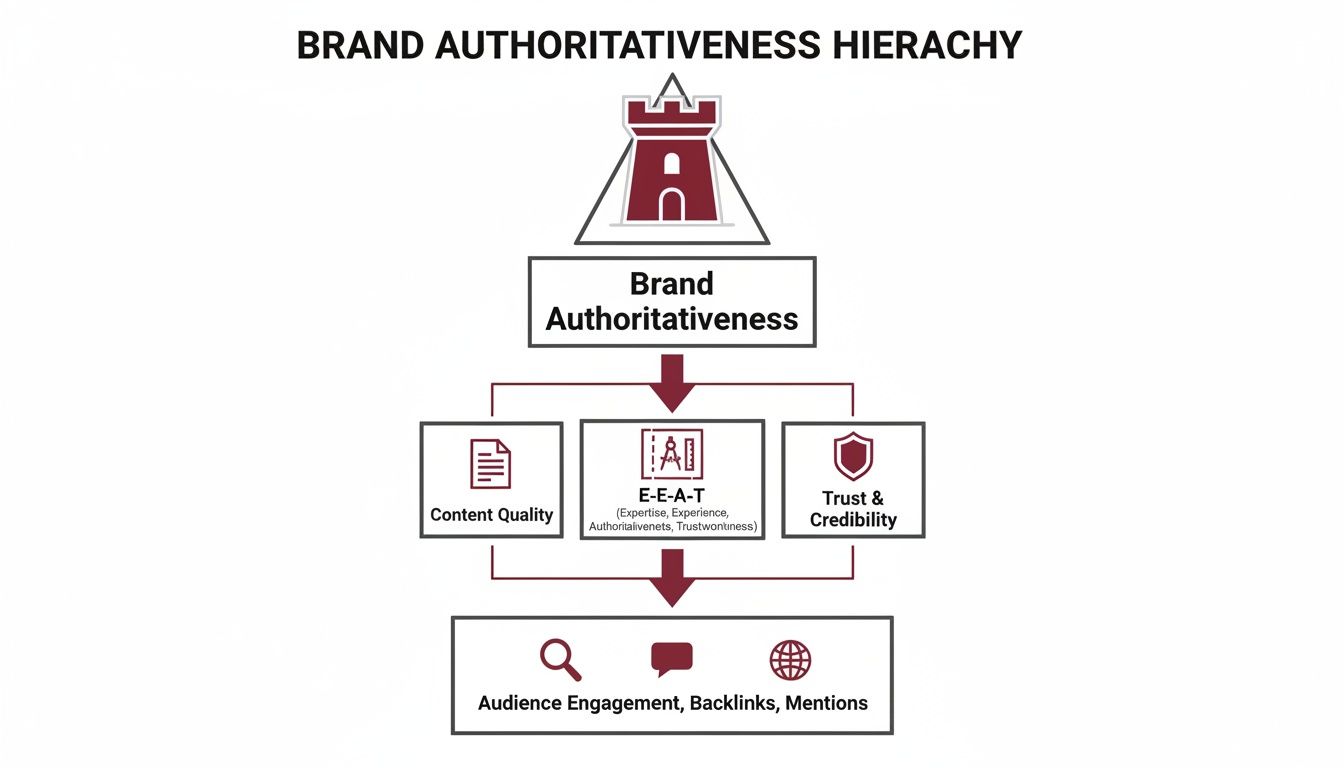
The real takeaway here is simple: you can't achieve genuine brand authority without first laying the groundwork of E-E-A-T through credible, well-crafted content.
Why This Matters for Australian Businesses
The investment in this space is already huge and climbing. SEO spending in Australia is on track to hit a massive $1.5 billion, a clear sign that businesses are serious about building online authority. Find out more about Australian SEO spending habits. This surge shows a strategic shift. Brands—from small-to-medium enterprises and e-commerce stores to local service providers—realise that just being visible isn’t the end goal. They need that solid architecture of authoritativeness to truly dominate Google's rankings and become the go-to source for their audience.
E-E-A-T is not something you can just 'optimise for' like a keyword. It's something you have to prove—with every article you write, every author page you create, and every mention of your brand online. It’s about demonstrating your credibility in every way possible.
Throughout this guide, we'll break down this framework into practical, actionable steps. You'll learn how to:
- Showcase Experience: Move beyond generic advice by sharing real, first-hand knowledge.
- Demonstrate Expertise: Use credentials, in-depth analysis, and data to prove you know your stuff.
- Build Authoritativeness: Earn mentions and links from other respected players in your industry.
- Establish Trustworthiness: Use both technical signals and clear content to make your audience feel secure.
By adopting this architectural approach to E-E-A-T & content credibility, you can build a brand presence that isn’t just visible, but deeply respected.
Understanding the Four Pillars of E‑E‑A‑T
To build a brand with real, lasting authority, you need to get your head around the four pillars that form its very foundation: Experience, Expertise, Authoritativeness, and Trustworthiness. Think of these not as fuzzy marketing buzzwords, but as tangible qualities that Google's algorithms are actively designed to find and reward.
For any Australian business, properly demonstrating these pillars is how you prove your worth and begin building that crucial architecture of brand authority.

Let's unpack each component. We're moving beyond simple definitions to give you concrete, locally relevant examples. The goal here is to show, not just tell, both your audience and search engines that you are a credible source they can rely on.
Experience: The “Been There, Done That” Pillar
Experience is all about demonstrating your first-hand, real-world involvement. It's the proof that your content stems from actually doing the work, not just reading about it in a textbook. Google wants to see that you’ve genuinely used the product, delivered the service, or lived the situation you're writing about.
A Melbourne-based plumber, for instance, doesn't just write another generic "how to unblock a drain" post. Instead, they showcase real experience by publishing a detailed case study of a complex drainage solution they implemented for a heritage-listed terrace in Fitzroy. This would include their own photos, notes on the specific challenges they faced, and the exact methods they used. It's powerful because it's authentic and impossible to fake.
Expertise: The “Know Your Stuff” Pillar
While experience is about doing, expertise is about knowing. This pillar is where your credentials, deep knowledge, and command of the subject matter truly shine. It’s about proving that your organisation or author is a highly qualified source of information.
Take a financial planner in Sydney. They demonstrate expertise by publishing an in-depth guide on navigating the latest changes to Australian superannuation laws. Their articles would cite specific legislation, use clear financial modelling, and be written by a planner with their qualifications (like a CFP® designation) clearly displayed. This depth signals to both people and search engines that the information is coming from a genuine professional.
Key Takeaway: Expertise isn't something you can just claim; you have to demonstrate it. The depth of your content, the credentials of your authors, and the accuracy of your information all work together to build a strong signal of expertise.
Authoritativeness: The “Industry Recognition” Pillar
Authoritativeness is essentially your reputation. It’s about how others in your industry and niche see you. When other respected experts, websites, and organisations reference you, it validates your standing as a go-to source. This is where off-page signals like backlinks and mentions become absolutely critical.
Imagine a software company based in Perth. They build authority when their new platform gets a glowing review on a major national tech blog like Gizmodo Australia or is featured in Lifehacker Australia. Every mention, link, or citation from another authoritative source acts as a powerful vote of confidence, reinforcing their position as a recognised leader.
Trustworthiness: The “Be Reliable and Secure” Pillar
Trust is the bedrock of the entire E-E-A-T framework. It’s non-negotiable. If users don't trust you, the other three pillars will quickly crumble. Trust is built through a combination of on-page signals and technical elements that make visitors feel safe and confident engaging with your brand.
A local Brisbane e-commerce store earns trust by nailing the fundamentals:
- Transparent Pricing: No hidden fees or nasty surprises at checkout.
- Clear Contact Details: An easily found physical address, phone number, and ABN.
- Positive Reputation: A healthy number of genuine, positive Google Reviews from local customers.
- Secure Website: Using HTTPS encryption to protect all user data.
These signals, when combined, tell both Google and potential customers that you are a legitimate, reliable business that stands behind its promises.
To help tie all this together, here’s a practical breakdown of how each pillar translates into real website elements.
E-E-A-T Pillars and Website Signals
| Pillar | Core Concept | Primary Website Signal | Action for an Australian Business |
|---|---|---|---|
| Experience | Demonstrating direct, first-hand involvement. | Detailed case studies, original photography/videos, and first-person accounts. | A Gold Coast builder publishes a project gallery with before-and-after shots and a detailed narrative for each build. |
| Expertise | Showing deep knowledge and qualifications. | Author bios with credentials, citing official sources, in-depth articles. | A financial advice firm includes detailed author pages with each advisor's qualifications, AFS licence number, and industry awards. |
| Authoritativeness | Being a recognised leader in your field. | Backlinks and mentions from reputable industry sites, media features, and positive reviews. | A WA-based winery actively seeks reviews in national food & wine publications and gets links from tourism websites. |
| Trustworthiness | Being reliable, secure, and transparent. | Clear contact information (ABN, address), HTTPS, transparent policies, and customer reviews. | An online retailer displays their ABN in the footer, has a clear returns policy, and uses a secure payment gateway. |
Ultimately, these four pillars of E‑E‑A‑T & content credibility don't work in isolation. They form a complete, interconnected framework for building a brand that can not only compete but truly lead its industry online.
Creating Content That Builds Credibility
Alright, let's move from theory to action. Your content is the raw material you’ll use to build your brand’s authority. Think of every article, case study, and guide as another brick in the wall of your reputation. Creating content that screams credibility isn’t about luck; it’s a deliberate strategy grounded in proving your E-E-A-T.

This means you have to go deeper than surface-level posts. You need to produce assets that prove you’ve actually got dirt on your hands and know what you're talking about. It’s about laying an unshakeable foundation of trust with every single piece you publish.
Navigating High-Stakes YMYL Topics
Google is particularly tough on topics it calls 'Your Money or Your Life' (YMYL). As the name suggests, these are subjects that can seriously affect someone's health, financial stability, safety, or happiness. For Australian businesses, this radar is constantly pinging over:
- Financial Advice: Content covering investments, superannuation, home loans, or insurance policies.
- Health and Wellness: Any information about medical conditions, treatments, nutrition, or mental health.
- Legal Guidance: Articles that touch on legal rights, obligations, or processes in Australia.
- Major Purchases: Guides for big-ticket items like buying property, a new car, or other significant investments.
If your content steps into these arenas, the E-E-A-T bar is set incredibly high. Generic advice isn't just a waste of time—it can get you penalised. You have to prove, beyond a shadow of a doubt, that you're qualified to give that advice and that your information is spot-on.
Showcasing First-Hand Experience
The single most effective way to build credibility is to show you’ve "been there, done that." This is the ‘Experience’ pillar in action. The flood of generic, AI-generated content online makes this more important than ever, because it's the one thing a machine can't fake.
To make your mark, create content that only you could possibly produce:
- Detailed Product Teardowns: Don't just review a product from the outside. Film your team taking it apart, piece by piece, to analyse its build quality. This is unique, high-value content that proves you’ve actually got the product in your hands.
- Authentic Case Studies: A simple testimonial isn't enough. Walk readers through the specific problem a client had, the exact steps your team took to fix it, and the real, measurable results you delivered. Use hard data and direct quotes from the client.
- Behind-the-Scenes Walkthroughs: Pull back the curtain and show people how you work. A manufacturing business could do a photo essay of its production line. A digital agency could detail its exact process for a complex technical SEO audit.
Content born from genuine, hands-on experience is incredibly difficult for others to replicate. It acts like a protective moat around your brand, setting you apart from competitors who just rehash what everyone else is saying.
This kind of content builds trust organically because it’s tangible proof of what you can do. It transforms your brand from just another voice in the crowd to a demonstrated authority.
The Crucial Role of Author Bios
In an age of faceless content, putting a real name and face to your information is a massive trust signal. For Google, an author is an entity it can look up and verify. This makes comprehensive author bios absolutely non-negotiable.
A strong author bio needs to be more than just a name. It should function as a mini-CV, validating the author’s expertise on the spot.
Essential Elements of a Credible Author Bio:
- Full Name and Role: Be clear about who the author is and their position in your organisation.
- Credentials and Qualifications: List relevant degrees, industry certifications (like CFP® or CPA), and any awards they’ve won.
- Relevant Experience: Briefly mention their years in the field and the specific niches they specialise in.
- Links to Professional Profiles: Always include a link to their LinkedIn profile or other recognised industry pages.
- Links to Other Publications: If they’ve been published on other well-regarded sites, link to that work. This reinforces that others in the industry also see them as an expert.
By connecting your content to real, verifiable people, you're making a direct claim about its quality and reliability. It’s a foundational piece in building the E-E-A-T & content credibility that holds up the entire structure of your brand’s authority.
Fortifying Your Foundation with Technical SEO
You can have the most brilliant, insightful content in the world, but if it’s built on a shaky foundation, nobody will trust it. A website that’s slow, confusing, or feels insecure can kill your credibility before a visitor reads a single word. This is where technical SEO comes in—it's the structural engineering that holds up the ‘Trustworthiness’ pillar of E-E-A-T.

Think of it this way: technical SEO isn't just for Google's bots. It's about sending direct trust signals to real people. A fast, secure, and logically organised site makes visitors feel safe and confident in your brand. It’s the digital equivalent of a clean, well-lit shopfront with clear signage and a solid front door.
Establishing Non-Negotiable Trust Signals
Before someone even starts reading your content, their browser and their gut are already making a snap judgement about your site’s credibility. There are a few technical features that are absolutely non-negotiable in this first impression.
These foundational elements prove you take your users' safety and your business seriously:
- HTTPS Security: That little padlock icon in the browser's address bar is a universal symbol of safety. Enabled by an SSL certificate, it encrypts the data flowing between your site and the user, protecting their information. For any Australian business—especially e-commerce sites handling payments—HTTPS is an absolute must.
- Clear Privacy Policy: Having a privacy policy that’s easy to find isn't just good practice; it's a legal and ethical requirement. It tells people exactly how you collect, use, and protect their data, showing transparency and respect.
- Easily Accessible Contact Information: If a user has to dig around to find out how to contact you, it immediately raises red flags. A dedicated 'Contact Us' page with a physical address (if you have one), phone number, and email shows there’s a real, accountable business behind the website.
Getting these basics right is the low-hanging fruit of building digital trust. Ignoring them is like leaving your shop door unlocked—it practically invites suspicion and sends potential customers straight to your competitors.
The User Experience as a Credibility Factor
Beyond the basics of security, the overall feel of using your website directly impacts how credible you seem. A clunky, slow, or confusing site creates friction and frustration, which quietly eats away at trust. Both people and search engines reward websites that are a breeze to use.
Think about the powerful, unspoken message sent by these user-focused technical details:
- Site Speed: Nobody likes to wait. A slow-loading page tests a visitor’s patience and suggests a poorly maintained, unprofessional operation. A fast site respects their time.
- Mobile-Friendliness: With a huge chunk of web traffic now coming from mobile devices, a responsive design is non-negotiable. A site that looks and works beautifully on a smartphone shows you care about your audience’s real-world needs.
- Logical Site Structure: An intuitive navigation menu and a sensible internal linking strategy help people find what they’re looking for without getting lost. This clear organisation also helps search engines understand what your content is about and which pages are most important.
A seamless user experience is a quiet but powerful endorsement of your brand's credibility. It tells users that you are professional, considerate, and have invested in making your digital presence as helpful as possible.
Using Structured Data to Communicate Expertise
While your users see the polished front-end of your site, technical SEO also lets you speak directly to search engines in their native language. Structured data (often called schema markup) is a specific vocabulary of code that you add to your site to give Google explicit context about your content. It helps the search engine understand who you are and why you're an authority.
To really drive home your E-E-A-T & content credibility, two types of schema are especially powerful:
- 'Organization' Schema: This markup explicitly tells Google your business name, logo, address, and contact information. It’s like handing Google your business card, connecting your website to your real-world entity and solidifying your identity.
- 'Author' Schema: This type of schema connects a piece of content directly to the person who wrote it. By linking to an author’s bio page—which should list their qualifications, credentials, and experience—you’re telling Google exactly who is behind the information and why they are qualified to give it.
Implementing structured data is the final technical layer that fortifies your digital foundation. It helps Google connect the dots between your great content and the real-world expertise behind it, locking in the authority you’ve worked so hard to build.
Expanding Your Influence with Off-Page Signals
True authority isn't just about what you say on your own website; it's about what others say about you. The real test of your brand's credibility happens out there on the wider web, far beyond your own domain. This is where off-page signals come in, acting as powerful, third-party endorsements that validate your expertise.
Think of these signals as votes of confidence. When authoritative Australian industry sites, news outlets, or respected partners link to or mention your brand, they're essentially vouching for you. This tells both your audience and search engines that you're a trusted and recognised player in your field, which is a massive component of your E-E-A-T & content credibility.
Earning High-Value Mentions and Backlinks
We need to move past the old-school idea of just collecting links. The aim isn't to get any link, but to earn high-value mentions from sources that have genuine authority themselves. It's like building a professional network—the company you keep says a lot about your own reputation.
A single backlink from a highly respected national publication can easily be worth more than a hundred links from low-quality, spammy directories. It’s a clear signal that your content is so valuable, industry leaders are willing to reference it.
Strategic Approaches to Earning Authority
To build this kind of external validation, you have to focus on creating genuine value for others. You want to create content and opportunities that make them want to talk about and link to your work.
- Become a Source for Journalists: Position your brand's experts as the go-to people for commentary on industry trends. When a journalist from a major Australian publication quotes your expert, the resulting mention and backlink are pure gold.
- Publish Original Research: Conduct your own surveys or analyse data relevant to the Australian market. When you become the primary source for a unique statistic, others in your industry will naturally link back to your findings when they cite it.
- Foster Strategic Partnerships: Team up with non-competing businesses in your sector. Co-host a webinar, create a joint report, or run a collaborative project. This exposes your brand to a new audience and generates natural cross-promotion and links.
For a deeper look into how to execute these ideas, you can explore proven strategies for acquiring high-quality backlinks. This will give you a solid understanding of the mechanics behind building a backlink profile that truly supports your E-E-A-T goals.
Reputation Management as a Core E-E-A-T Activity
Off-page signals are about more than just backlinks. Your online reputation, especially customer reviews, is a huge part of the 'Trustworthiness' pillar. Platforms like Google and the Australian-focused ProductReview.com.au have an immense impact on how potential customers see your brand.
Every review, good or bad, is a public signal of your credibility. Proactively managing this reputation isn't just a customer service task; it's a critical SEO activity that directly builds trust.
Your response to a negative review is often more telling than the review itself. It’s a public opportunity to demonstrate transparency, accountability, and a genuine commitment to your customers.
Turning Reviews into Trust Signals
A proactive approach can turn online reviews from a potential headache into one of your most powerful assets. It all comes down to encouraging feedback and engaging with it professionally and transparently.
Practical Methods for Managing Your Online Reputation:
- Encourage Positive Feedback: After a great customer experience, make it simple for them to leave a review. A polite, well-timed email with a direct link can significantly boost the number of positive reviews you receive.
- Address Negative Comments Promptly and Professionally: When a bad review pops up, act fast. Acknowledge the customer's issue, show empathy, and offer to take the conversation offline to find a solution. This shows everyone watching that you take feedback seriously and are committed to making things right.
- Monitor Your Brand Mentions: Use tools to track mentions of your brand across the web, not just on review sites. This lets you jump into conversations and reinforce your authority wherever your brand is being discussed.
By actively cultivating a strong backlink profile and carefully managing your online reputation, you complete the architecture of brand authoritativeness. This ensures your credibility is rock-solid, both on and off your site.
Measuring the Growth of Your Brand Authority
Building brand authority isn't a quick win; it's a long-term play. So, how can you tell if all the hard work you're putting into your E-E-A-T & content credibility is actually moving the needle? It’s about looking past simple traffic numbers and focusing on the metrics that show a real change in how the market perceives you.
The aim here is to find signals that prove you're becoming the go-to source in your niche. This goes beyond just climbing up the search rankings. It’s about finding tangible proof that your audience, and even your competitors, are starting to see you as a credible leader.
Key Performance Indicators for Authority
To turn this abstract idea into something you can actually track, you need a straightforward dashboard. You don’t need fancy software to start—free tools like Google Analytics and Google Search Console are more than powerful enough to show you the real-world impact of your strategy.
Zero in on these core metrics, as they link directly to growing authority:
- Improved Keyword Rankings: Keep an eye on your positions for those high-intent, informational keywords. As your authority builds, you'll naturally start to rank for the competitive terms your ideal customers are searching for when they need genuine expert advice.
- Increase in Branded Organic Searches: This one is a massive tell. When you see more people specifically searching for "[Your Company Name] + topic," it's a clear sign your brand is becoming synonymous with expertise in that field.
- Growth in Referring Domains: Track the number of unique, quality websites linking to your content. A steady climb in backlinks from other authoritative sites is a direct endorsement of your credibility.
Interpreting Qualitative Signals
Not every sign of growing authority is going to show up neatly on a chart. The qualitative signals, while a bit trickier to measure, are often just as powerful. They give you the story behind the numbers and show how people are talking about your brand out in the real world.
Pay close attention to these less tangible but incredibly valuable indicators:
Unsolicited social media mentions, positive comments in forums, and getting cited in industry articles are all gold. These organic shout-outs prove that your content isn't just being seen; it's being used, trusted, and shared within your community.
To truly connect the dots and prove the value of building brand authority, it's crucial to understand how to effectively measure Marketing ROI. This helps tie your content efforts directly to business results, making it much easier to justify the investment in building a brand that lasts.
Frequently Asked Questions About E-E-A-T
Let's cut through the noise. When it comes to E-E-A-T and content credibility, there's a lot of chatter out there. Here are some straight answers to the questions we hear most often from Australian businesses.
How Long Does It Take to See E-E-A-T Results?
Building real authority is a long game, not an overnight fix. Think of it as a marathon, not a sprint. You'll likely need to be patient for the first few months.
Typically, you might start seeing some positive movement—like a lift in keyword rankings or more people searching for your brand name—within 6 to 12 months of putting in consistent, focused effort. This isn't a guarantee, of course. The timeline really depends on how competitive your industry is and how thoroughly you weave these principles into your content, technical setup, and brand reputation.
Can a Small Business Compete with Big Brands on E-E-A-T?
Yes, one hundred percent. In many ways, E-E-A-T is the great equaliser, giving smaller players a real shot at competing with the big fish.
The secret weapon for small businesses is often the 'Experience' part of E-E-A-T. A massive corporation can't easily fake the genuine, hands-on knowledge of a niche specialist who lives and breathes their craft every single day.
Play to your strengths:
- Show, don't just tell. Use detailed case studies to prove you've actually done the work.
- Put a face to the name. Your 'About Us' page should be more than a stock photo; feature your team and their real-world experience.
- Lean into your local roots. Customer testimonials and local reviews are incredibly powerful trust signals that big, faceless brands often struggle to get.
While big brands have deeper pockets, small businesses can win on authenticity. Your genuine, first-hand experience is a unique selling point that a corporate giant can't replicate.
Is E-E-A-T a Direct Ranking Factor?
This is a common point of confusion. No, E-E-A-T isn't a single "score" or a direct ranking factor you can tweak like a title tag.
It's better to think of E-E-A-T as a conceptual framework. Google's algorithms use countless signals to figure out which content is high-quality and credible, and many of these signals happen to align perfectly with the principles of E-E-A-T.
For instance, getting a link from a respected industry publication is a well-known ranking signal, but it also serves as proof of your Authoritativeness. Likewise, having a secure website (HTTPS) is a small ranking signal that also contributes to your Trustworthiness. You don't optimise for E-E-A-T; you improve the tangible signals that demonstrate it.
Building a brand that both customers and search engines trust is a strategic endeavour. At Anitech, we specialise in crafting the architecture of brand authority for Australian businesses, helping you become the recognised go-to source in your field. Book a free consultation with our SEO experts today and let's start building your digital legacy.