Quick Summary: Generative Engine Optimisation (GEO) is the definitive guide to ranking in the era of synthesized answers. It moves beyond traditional SEO by focusing on making your content the primary, citable source for AI tools like Google's AI Overviews. The master framework for GEO in 2026 prioritizes entity mastery, authoritative sourcing, multimodal content, and conversational intent to ensure your brand is the answer, not just a link. This approach is critical for visibility and growth in an AI-driven search landscape.
Let's cut straight to it. Generative Engine Optimisation (GEO) is where search marketing is headed, and it’s a world away from the SEO you’re used to. It's all about making your content the go-to source for AI-powered answer engines.
Think less about keywords and more about becoming the definitive, citable authority that AI tools like Google's AI Overviews or Perplexity trust to answer their users' questions. That’s the heart of the master framework for GEO in 2026. It's about being the answer, not just another link on the page.

Understanding the New Search Reality: A Definitive Guide
For the last two decades, SEO has been a simple game: get your website to the top of the search results, win the click, and pull the user into your world. But generative AI has completely flipped the board. Users aren't just getting a list of blue links anymore—they’re getting direct, pre-packaged, synthesized answers.
This shift means your old SEO playbook is losing its power. If your content isn't feeding these AI-generated answers directly, you're at risk of being completely bypassed. Your brand becomes invisible. GEO is the strategy built for this new reality, providing a definitive guide to ranking in this new era.
From Keywords to Concepts
Traditional SEO lives and dies by keywords. You figure out what people are typing into Google and create content targeting those exact phrases. GEO operates on a higher level, focusing on entities and concepts.
Instead of just aiming for a keyword like "best running shoes for flat feet," a proper GEO strategy involves building a deep, interconnected web of knowledge around the entire concept of running shoes.
This means you’d cover things like:
- Defining what flat feet are and explaining how they impact a runner's form.
- Breaking down the different types of shoe support, like stability vs. motion control.
- Detailing the materials and technologies that go into making supportive footwear.
- Linking all these ideas to specific products, real customer reviews, and expert opinions.
When you do this, you’re not just answering a single question. You're giving the AI a comprehensive knowledge base it can draw from to answer hundreds of different but related questions.
Why This Isn't Tomorrow, It's Today
The push to adopt GEO isn't just future-proofing; it’s about surviving right now. The data is already rolling in, and it's compelling. Early adopters of integrated SEO and GEO programs have achieved significant increases in referrals from AI-driven platforms.
Think of it less like trying to rank a webpage and more like coaching an expert witness. Your job is to give the AI 'judge' such clear, authoritative, and easily verifiable information that it has no choice but to feature your insights in its final summary.
This isn't a theoretical change on the horizon; it’s already here. To get a real handle on how these new systems work, it's worth understanding the fundamentals of What is Prompt Engineering?, which dictates how users get information from these AI engines. The businesses that build their authority and adapt now will be the ones who own the search landscape of tomorrow.
Why GEO Is No Longer a Choice—It's a Market Reality
Let's be clear: this whole conversation around Generative Engine Optimisation isn't about some shiny new marketing tactic. We're talking about a fundamental, permanent shift in how people find information. Traditional SEO is still part of the puzzle, but it’s just not enough when your customers are getting direct, ready-made synthesized answers instead of a list of blue links. Choosing to ignore this is choosing to become invisible.
And this isn't some far-off problem for big corporations. The pivot to an AI-first approach is happening right now, driven by businesses of all shapes and sizes. In fact, small and medium businesses are the ones leading the charge, making GEO the new battleground for competition, whether you're a local shop or a national brand.
The Money Tells the Story
If you need proof of the urgency, just follow the money. Here in Australia, spending on SEO software is exploding as businesses gear up for a world dominated by AI search. The local market hit a staggering USD 2.1 billion in 2024 and is on track to reach USD 5.2 billion by 2030. That’s a blistering 16.8% compound annual growth rate.
This isn't just random spending. It's a direct response to the rise of generative engines like Perplexity and Google’s AI Overviews, which are completely rewriting Australian search habits. You can explore the complete analysis of this market explosion to see just how powerful these forces are.
It all points to one critical realisation spreading through Australian businesses: the old rulebook is officially obsolete. This is why adopting the master framework for GEO in 2026 has become the core strategy for businesses that want their content synthesised by AI, not just ranked for a keyword.
If you don't adapt to GEO, you risk being completely left out of the AI-generated answers that are already resolving a huge chunk of user queries. You're not just losing a click; you're losing your spot in the customer's mind altogether.
The Unfair Advantage of Moving First
While the risk of sitting on the sidelines is massive, the opportunity for those who act now is even bigger. Businesses that build a solid GEO strategy today are creating a competitive moat that will be incredibly difficult for laggards to cross later on.
This is especially true for Australian businesses that live and breathe local. By getting your GEO in order, you can:
- Own Your Local Turf: Become the default AI answer for high-intent local searches like "best plumber in Richmond" or "best coffee near Flinders Street."
- Build Real Authority: Cement your brand as the undeniable expert in your field, making you the go-to source for both AI engines and actual people.
- Create Predictable Growth: Stop chasing algorithm updates and start building a foundation of authority that delivers consistent, long-term visibility.
At the end of the day, Generative Engine Optimisation is more than just reacting to new tech. It's about proactively securing your brand's future in a world where being the most citable, authoritative, and helpful source is the only thing that matters.
The Core Pillars of a GEO Master Framework
To really get ahead with Generative Engine Optimisation, you can't just throw random tactics at the wall and see what sticks. You need a repeatable system. It's all about building a solid structure that consistently tells AI models that your content is the most reliable, comprehensive, and citable source out there. This is where the master framework for GEO in 2026 comes into play, built on four essential pillars that turn your content from a simple webpage into a powerhouse of knowledge.
Think of it like building a bridge. If any of the four main support pillars are weak or missing, the whole structure becomes unstable. It just won't reliably carry traffic from an AI engine over to your business.
This map here shows how investing strategically in GEO helps manage the risks that come with AI-driven search, turning potential threats into genuine market opportunities.
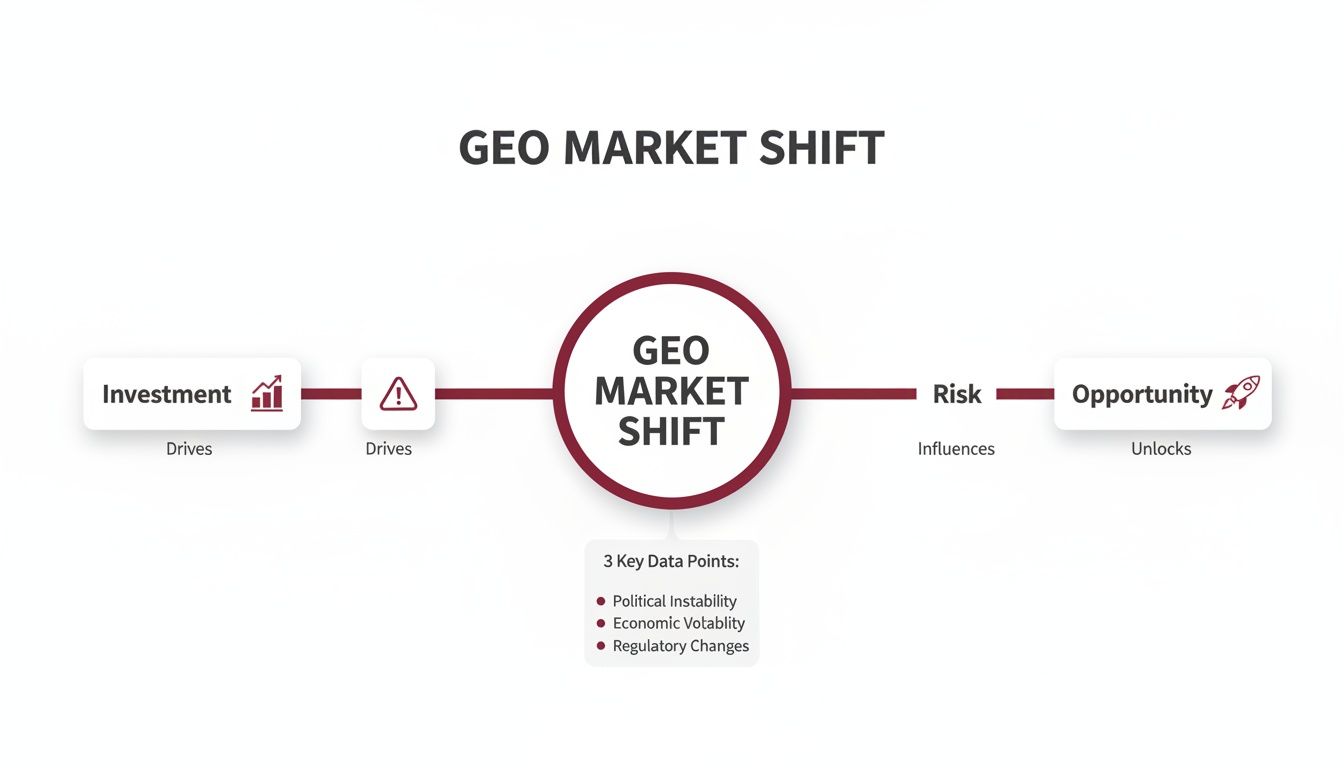
As you can see, embracing GEO isn't just a defensive move; it's a direct path from calculated investment to future growth and a real competitive edge.
Pillar 1: Entity and Semantic Mastery
The first pillar is a big shift away from just chasing keywords. With Entity and Semantic Mastery, we’re moving into the world of concepts. It's about building a rich, interconnected web of information around your key topics. An AI doesn’t just read words; it understands entities—the people, places, things, and ideas—and how they all relate to one another.
A great way to think about this is to imagine you’re building a Wikipedia-style entry for your niche. You aren't just defining a single term; you're explaining its history, its different parts, how it's used, and how it connects to everything else around it.
For instance, a plumbing business in Australia wouldn't just create a page for "hot water system repair." They would build out a complete knowledge hub covering:
- The different types of hot water systems (gas, electric, solar, heat pump).
- Common problems and their tell-tale signs (like low pressure or strange noises).
- The brands they service and the specific parts for each.
- Relevant Australian plumbing codes and state-based regulations.
This kind of deep, connected content makes your brand's expertise impossible for an AI to ignore.
Pillar 2: Authoritative and Citable Sourcing
Generative engines are built to pull information together and present it as a cohesive, factual answer. To do that, they have to trust their sources implicitly. That's why Authoritative and Citable Sourcing is our second pillar. Your content must be built from the ground up to be the definitive, referenceable answer on a subject.
This means you need to back up every claim you make. Don't just say something is true—show it. Present your data, cite statistics clearly, and reference established facts.
The ultimate goal is to make your content so trustworthy that an AI feels confident citing your brand by name in its generated answers. This is how you win in a world of zero-click searches.
To get there, you need to format your content to be easily citable. Use crystal-clear headings, bullet points with verifiable facts, and summary boxes an AI can lift directly. Think of every article as a source document for a research paper—it has to be accurate, well-organised, and easy to reference.
Pillar 3: Multimodal Content Integration
Search isn't just about text anymore. Multimodal Content Integration means optimising all your content formats—images, videos, audio, and infographics—so that AI can understand and use them. Generative models are getting incredibly good at interpreting the content within these files, not just the text that happens to be around them.
This pillar gets a bit more technical. For example:
- Images: Use descriptive file names and detailed alt text that explain exactly what’s in the image.
- Videos: Provide full, accurate transcripts and use structured data to mark key moments or chapters.
- Audio: Make sure podcasts or audio clips have clear descriptions and full transcripts available.
When you make all your content formats machine-readable, you give the AI multiple ways to verify your expertise and feature your assets in its answers.
Pillar 4: Conversational Intent Alignment
Finally, Conversational Intent Alignment makes sure your content directly answers the natural language questions your audience is really asking. People don't talk to AI assistants with robotic keywords; they ask questions just like they would to another person.
Your content needs to reflect this conversational style. Try to anticipate the follow-up questions a user will have and build the answers right into the flow of your content. A page answering "What is GEO?" should naturally lead into "Why is GEO important?" and "How do I get started with GEO?"
By structuring your content as a dialogue, you align perfectly with how modern answer engines think. This makes it far more likely your information will be the one chosen to answer a user's question.
The move from old-school SEO to GEO isn't about throwing away what works. It's about evolving those foundational skills to meet the demands of a new, AI-driven search world. This table breaks down how traditional tactics are being upgraded for the GEO Master Framework.
The Evolution from Traditional SEO to the GEO Framework
| Pillar | Traditional SEO Tactic | GEO Master Framework Approach |
|---|---|---|
| Entity & Semantics | Keyword Research & Targeting | Building comprehensive knowledge graphs and topic clusters around entities. |
| Authority & Sourcing | Backlink Building & Domain Authority | Creating citable, data-backed content with clear provenance and expert attribution. |
| Multimodal Content | Image Alt Text & Video SEO | Full-spectrum optimisation of all media with transcripts, structured data, and descriptive metadata. |
| Conversational Intent | Long-Tail Keyword Optimisation | Structuring content as a dialogue that answers a chain of likely user questions. |
As you can see, the core ideas remain, but their application becomes much deeper and more sophisticated. GEO builds on the shoulders of SEO, preparing your strategy for the future of search.
How to Implement Your GEO Framework
Jumping into a Generative Engine Optimisation (GEO) framework isn't something you do overnight. It’s a methodical shift in how you think about and create content, specifically to feed the new AI-driven search engines. The best way to get there is with a clear roadmap, one that’s built for your specific business.
Whether you're a local Aussie SMB, a national ecommerce store, or a business with dozens of locations, the journey always follows three core phases: Audit, Strategy, and Execution.

The trick is knowing where to focus your energy in each phase, because what works for a retailer is different from what a local plumber needs.
Roadmap for Australian SMBs
For small-to-medium businesses, GEO is your secret weapon. You can't outspend the big players, but you can out-expert them. Your advantage is your deep local knowledge and the trust you've built in your community.
-
Phase 1: GEO Audit
Start by looking at your existing content through a local lens. Are you really answering the questions your specific community is asking? Check your Google Business Profile to make sure it's 100% complete and audit your local citations for any inconsistencies. -
Phase 2: Strategy
Your whole strategy should be built around becoming the go-to expert in your service area. Plan content that solves hyper-local problems. Think titles like "Choosing the Right Air Conditioner for a Melbourne Summer" or "Navigating Victorian Building Codes for a Deck Extension." -
Phase 3: Execution
Now it's time to create. Build content that screams local credibility. This means detailed case studies of local jobs, testimonials from clients in your neighbourhood, and guides that mention local landmarks or council regulations.
Roadmap for E-commerce Retailers
Online stores live and die by the quality of their product information. For ecommerce, GEO is all about making your product data so clean, detailed, and trustworthy that AI assistants can confidently recommend your products for shopping queries.
-
Phase 1: GEO Audit
Dig into your product pages, category descriptions, and customer reviews. Is your data structured in a way an AI can easily understand and compare? You're looking for gaps in product specs, messy review data, and thin descriptions. -
Phase 2: Strategy
Your plan is to enrich your product information. This means creating a master data schema for every product, mapping out detailed buying guides, and building a system to encourage and structure user-generated content like reviews and Q&As. -
Phase 3: Execution
It's go-time. Implement structured data (Schema.org) across every single product page. Write product descriptions that go way beyond the manufacturer's specs and create comparison articles that help both AI and human customers make the right choice.
As SEO costs climb and AI rewrites the rules, Generative Engine Optimisation (GEO) is quickly becoming an essential framework in Australia. With typical SEO services costing a minimum of $1200 per month for SMBs and $2000+ for national campaigns, a smarter, authority-first model isn't just nice—it's necessary.
Roadmap for Multi-Location Businesses
If you're running a franchise or a chain of stores, your GEO focus is all about hyper-local dominance. The goal is simple: own the high-intent 'near me' searches by making each of your locations a standout authority in its own right.
-
Phase 1: GEO Audit: You'll need to conduct a full audit of each location's digital footprint. That means checking individual landing pages, Google Business Profiles, and local directory listings to ensure they are accurate, unique, and complete.
-
Phase 2: Strategy: Your strategy has to be decentralised. Create a content template that can be easily localised for each branch, focusing on things like local team members, community sponsorships, and services unique to that location.
-
Phase 3: Execution: Start rolling out unique, hyper-local content for every location. This could be anything from blog posts about local events your branch is sponsoring to case studies featuring clients in that specific suburb or city.
To help you visualise this, here’s a breakdown of the key priorities for different Australian businesses as they step into the world of GEO.
GEO Implementation Roadmap by Business Type
| Business Type | Phase 1 Audit Focus | Phase 2 Strategy Focus | Phase 3 Execution Focus |
|---|---|---|---|
| Australian SMB | Local authority signals, Google Business Profile completeness, local citation consistency. | Becoming the #1 local expert; content planning for hyper-local problems. | Creating detailed local case studies, customer testimonials, and guides. |
| E-commerce Retailer | Product data structure, gaps in specifications, quality of customer reviews and UGC. | Enriching product entities with master data schemas; planning buying guides. | Implementing structured data (Schema.org), writing in-depth descriptions. |
| Multi-Location Business | Digital presence audit for each location (landing pages, GBP, directories). | Decentralised content strategy; creating templates for easy localisation. | Rolling out unique, hyper-local content for each branch and community. |
This table provides a starting point, helping you direct your resources to where they'll make the biggest impact first.
As Aussie businesses face rising marketing costs and a completely new search landscape, GEO offers a more sustainable way forward. We know that 46% of local searches lead to a conversion within a day, so optimising for these high-intent moments is crucial—whether you're a local service provider in Victoria or an online store selling to customers in Melbourne and Perth. To get a better feel for the investment required, you can explore current SEO costs in Australia and see for yourself why the GEO model delivers a much stronger long-term return.
Measuring Success in the GEO Era
Let's be blunt: your old metrics are becoming obsolete. Clicks and rankings still have a pulse, but they don't paint the full picture when an AI can deliver a synthesized answer, completely bypassing your website. Measuring success with Generative Engine Optimisation (GEO) means building a new dashboard—one that shows how you're influencing those AI-crafted results.
This isn't about just tracking organic traffic anymore. It’s about proving your GEO work connects to actual business goals. We're now measuring authority, not just visibility.
Moving Beyond Clicks to Citations
The biggest change you need to make is tracking how often your brand is the source of truth for an AI. While traditional rank trackers are scrambling to adapt, the real focus needs to be on a new set of metrics that prove your influence inside the generative engine itself.
A huge part of GEO is understanding the AI speed accuracy trade-off. Generative AIs need to provide answers that are both fast and confident, and they do that by relying on sources they already trust. Getting your brand cited is the ultimate proof of that trust.
Here are the modern KPIs that need a permanent spot on your GEO dashboard:
- Answer Engine Presence (AEP): This is your new North Star. It’s a simple measure of how often your brand, content, or data gets cited directly in AI Overviews and other answer engine results.
- Knowledge Graph Dominance: This KPI looks at how deeply your brand’s key information—your products, services, people—is woven into Google's Knowledge Graph and other semantic databases. Are you just a name, or are you a connected, authoritative entity?
- Implied Brand Authority: This metric is a bit more nuanced. It tracks queries where your brand is seen as the go-to solution, like searches for "[your brand] vs competitor" or "is [your brand] good for [problem]". It shows you've become a recognised leader in your space.
Essential Tools for the New Landscape
To track any of this, you’ll need to upgrade your toolkit. Sticking with old-school analytics and basic rank trackers will leave you flying blind in this new environment.
The goal is no longer just to win the click but to become the click. When an AI cites your brand, you have bypassed the traditional sales funnel and established immediate credibility with a user at their point of need.
To build a dashboard that actually means something, you’ll need to combine a few different types of tools:
- Advanced Rank Trackers: Look for platforms that can specifically show you your visibility within AI Overviews, featured snippets, and all the other SERP features that feed the AI.
- Semantic Analysis Software: You need tools that can scan your content and tell you how well you're building your entity profile. These are critical for understanding how you’re building out your own knowledge graph.
- Brand Monitoring Tools: These have become indispensable. They track unlinked mentions of your brand across the web, which act as powerful signals of authority to AI models.
By putting this new measurement framework in place, you can finally show the real ROI of your generative engine optimisation (GEO) strategy. It gives you clear, undeniable proof that your work isn't just about ranking pages—it’s about building lasting brand authority and shaping customer decisions in this new era of search.
So, What's Your Next Move in Mastering GEO?
We’ve covered a lot of ground here, laying out the principles, roadmaps, and metrics that underpin Generative Engine Optimisation. But knowing the theory is one thing; putting it into practice is where the real work—and the real reward—begins. Getting on board with GEO isn't about jumping on the next shiny trend. It's a critical move for securing your organic growth and building a brand that can stand its ground in an AI-first world.
The good news? You don't need to tear down your entire marketing strategy and start from scratch. The path forward starts with a single, foundational step: figuring out where you stand right now.
Kick Things Off with a Simple GEO Audit
Before you do anything else, conduct a basic GEO audit of your existing content. This isn't some highly technical, spreadsheet-heavy task. It's a strategic review. Pull up your most important pages—your key service pages, best-performing blog posts, or top-selling product pages—and ask yourself a few honest questions.
- Is it Citable? Is your content packed with verifiable facts, stats, or data points that an AI would see as a credible source to cite?
- Is it Conceptually Rich? Does it move beyond just hitting keywords and actually explain the core concepts, entities, and the relationships between them in your niche?
- Does it Answer Questions Directly? Is it structured in a way that’s easy to digest, with clear headings, lists, and summaries that tackle common questions head-on, almost conversationally?
This quick audit gives you an essential baseline. It'll show you the low-hanging fruit and help you decide which content needs a GEO-focused tune-up first to align with the master framework for GEO in 2026.
Think of it this way: GEO is about shifting your brand from being just another result on a page to being an active, authoritative voice in the user's journey. Your goal is to become the go-to source that AI models trust and rely on to craft their answers.
Frame GEO as an Opportunity, Not a Threat
It's easy to look at GEO and see a daunting, complex challenge. But that’s the wrong way to think about it. This is a massive opportunity to build deeper authority and connect with your audience more meaningfully than ever before. When you start structuring your expertise for an AI, you naturally create clearer, more valuable content for your human readers, too.
Making this shift is how you set your business up for lasting success in this new era of search. The next logical step is to take what you learned from your audit and build a simple action plan. Pick one piece of content, apply the GEO pillars we've discussed, measure what happens, and then build from there. Taking it one step at a time makes mastering GEO feel less like an overwhelming challenge and more like an achievable goal.
Got Questions About GEO? We've Got Answers.
As Generative Engine Optimisation goes from a "what if" concept to a "right now" reality, it's natural to have a few questions. Let's clear up some of the most common ones so you can get started with confidence.
Is GEO Just SEO in a New Hat?
Not at all – it’s a genuine evolution. While GEO absolutely stands on the shoulders of good SEO fundamentals like a technically sound website and strong authority, its goal is fundamentally different.
Traditional SEO is all about getting your webpage to rank in a list of blue links. GEO, on the other hand, is about getting your content woven directly into the AI-generated synthesized answer as a citable source. Think of it as moving from being listed in the library catalogue to being quoted in the textbook itself.
How Is This Different from Optimising for Voice Search?
There's some crossover, but GEO is a much bigger fish. Voice search optimisation usually zeroes in on simple, direct questions for smart speakers – "what are the trading hours for…?"
Generative Engine Optimisation is far more sophisticated. It involves prepping your complex information, data, and expertise so advanced AI models can understand it, connect the dots, and use it to build answers for nuanced, multi-part questions.
The real difference is in the final output. A voice search will typically find one direct answer. GEO positions your content to be a key ingredient in a brand-new, synthesised answer, often pulling from several different pieces of your knowledge base.
What's the Single Most Important First Step to Take?
Start with a content audit, but look at it through a GEO lens. Before you write a single new word, go through your most important existing pages.
Ask the tough questions: Is this content truly citable? Does it scream expertise? Is it structured to give a direct, unambiguous answer? This audit gives you a starting point and instantly shows you where the low-hanging fruit is.
Can a Small Business Actually Compete in This Space?
Absolutely. In many ways, GEO can be a great equaliser. Sure, big companies have big budgets, but small businesses often have something far more valuable: deep, authentic, on-the-ground expertise.
By focusing on becoming the undeniable authority in a specific niche or local area, SMBs can build the kind of trust and credibility that AI engines are actively looking for. GEO rewards real expertise, not just big marketing spend.
How Long Until I See Any Results from GEO?
For certain queries, you might see results from GEO faster than you would with traditional SEO. Building that deep, foundational topical authority is still a long game, often taking 6-12 months, much like SEO.
However, you can get cited in an AI answer much faster if you perfectly nail a specific informational gap. We often see early wins within 90 days of launching a focused GEO content strategy on a particular topic. This is precisely why following a roadmap like the master framework for GEO in 2026 is so crucial for getting a timely return on your investment.
Ready to stop chasing clicks and start being the answer? The expert team at Anitech builds data-driven GEO strategies that position Australian businesses to win in the new era of search. Book your free consultation today and let's talk about securing your future visibility.