Quick Summary: Generative Engine Optimisation (GEO) is the strategy of creating content so clear and authoritative that AI models, like Google's AI Overviews, feature it directly in generated answers. As search engines evolve into answer engines, GEO focuses on becoming the citable source, moving beyond traditional SEO's goal of just earning a click.
Think of Generative Engine Optimisation (GEO) as the new frontier for getting your business noticed online. It’s all about creating content specifically designed to be picked up and featured directly in AI-generated answers. As search engines evolve into answer engines, GEO is what ensures your brand's expertise is the one AI models, like Google's AI Overviews, use to respond to queries. This guide explores the shift from keyword matching to intent-based answer retrieval.
We'll dig into why your old SEO playbook won't be enough when your customers are looking for instant answers, not just a list of links to sift through.
Here's a simple way to think about it: the internet is like a massive library. Traditional SEO was the art of getting your book onto the most prominent, eye-level shelf. GEO, on the other hand, is about writing your book so clearly and authoritatively that the AI librarian reads a passage from it aloud to the person asking the question. This is a fundamental change, and this guide is your blueprint for navigating it.

Understanding The Shift From Search Engines To Answer Engines
For the longest time, the game was simple: get to number one on Google. Search Engine Optimisation (SEO) was a battle for the top of the list. But the ground is shifting beneath our feet as we move from search engines to answer engines. This new world demands a new strategy: Generative Engine Optimisation (GEO).
People don’t want a list of homework anymore; they expect a direct, neatly packaged answer, right now. This is precisely where AI-powered summaries come in, pulling information from various websites to create a single, authoritative response that sits above everything else. The core of this AEO (Answer Engine Optimisation) revolution is the transition from simple keyword matching to understanding and fulfilling complex user intent.
Why Traditional SEO Is Not Enough
Your old SEO toolkit—focused on keywords, backlinks, and technical tweaks—was designed to earn a click. While those elements still have a place, they aren't enough on their own anymore. GEO has a different goal: to become the source material for the AI's answer, whether it leads to a click or not.
This pivot is absolutely critical. In Australia, where Google holds a massive 94.1% combined market share across all devices, ignoring this shift isn't an option. As AI answers become standard, businesses clinging only to old-school SEO tactics are going to find themselves completely invisible. You can get a better sense of the local landscape by exploring the latest Australian search behaviour and statistics.
Generative Engine Optimisation isn't about throwing away SEO. It's about building on top of it for a new era—one where being the clearest, most trustworthy, and most citable source matters more than just being the highest link on a page.
The New Digital Battlefield
This move from search to answer engines completely redefines what "visibility" means. It's no longer just a competition for rankings; it's a battle to influence the information that AI models serve up to users. This means we need to get much more serious about creating content that is:
- Explicitly Clear: Answers questions directly, with no fluff or ambiguity.
- Highly Authoritative: Grounded in genuine expertise, backed by evidence, and demonstrating trustworthiness (E-E-A-T).
- Structurally Sound: Formatted with clear headings and schema markup that machines can easily read and understand.
Ultimately, winning in this new environment means optimising your content to be consumed, understood, and trusted by artificial intelligence. Let's walk through exactly how to do that.
What Exactly Is Generative Engine Optimisation?
Let's cut through the buzz and get straight to what Generative Engine Optimisation (GEO) really is. Think of it as the next evolution of our craft—a strategic shift in how we build and present content. It's about optimising not just for human eyeballs and keyword algorithms, but for the AI models that now power search.
GEO doesn't mean throwing out everything you know about SEO. Far from it. It actually builds on that solid foundation, adapting the core principles for a new reality where users often want a direct answer, not just a list of links to click.
Simply put, GEO is the art and science of making your content the most citable, trustworthy, and machine-readable source on a topic, so AI-driven "answer engines" choose you to feature in their results.
The Core Pillars of GEO
This isn't about one single trick; it's a holistic approach that rests on three main pillars. If you get these right, you'll be well-positioned for visibility in this new AI-powered search world.
-
Undeniable Authority (E-E-A-T): This is the bedrock. AI models are being trained to hunt for signals of Experience, Expertise, Authoritativeness, and Trustworthiness. Your content must be factually sound, incredibly detailed, and clearly backed by credible authors and sources.
-
Meticulous Data Structure: An AI can't infer context the way a human can. You have to spell it out. This is where technical SEO elements like schema markup and a logical heading structure (H1, H2, H3) become non-negotiable. Structured data acts like a neat set of labels, telling the AI precisely what each piece of information is and how it relates to the whole.
-
Conversational Relevance: GEO is about creating content that answers questions directly, using natural language. The aim is to build ‘answer-first’ content that gets straight to the point, anticipates the user's next question, and answers that too.
How AI Consumes and Prioritises Information
To really wrap your head around GEO, you have to understand how these new technologies see the world. Tools like AI Search Visibility Tools are changing the game because the Large Language Models (LLMs) behind them don’t "read" a webpage like we do. They ingest colossal amounts of data, breaking it down to identify patterns, entities, and connections.
When an LLM scans your page, it’s looking for signals of quality and reliability.
Your content's new job is to be so clear, well-structured, and authoritative that an AI model has absolute confidence in using it as a source for its own generated answer.
This is why just stuffing in keywords is a dead strategy. The AI is judging the entire package: the author's credentials, the site's overall reputation, how clearly the information is presented, and whether it’s marked up with structured data. It’s no surprise that Gartner predicts traditional search volume will drop by 25% by 2026, as AI chatbots and answer engines take over. The time to adapt is now.
An Example of GEO in Action
Let's imagine a local plumbing business in Australia wants to rank for "how to fix a leaking tap." Here’s how the old and new approaches stack up.
-
The Traditional SEO Approach: They might write a blog post called "5 Tips for Fixing Leaky Taps." It would be loaded with keywords, have a few backlinks, and its main goal would be to land in the top three results to earn a click from the user.
-
The GEO Approach: The content is now titled "How to Fix a Leaking Tap: A Step-by-Step Guide for Australian Homes." The entire structure is more purposeful:
- It leads with a direct, simple answer right at the top.
- It uses a clear, numbered list for the step-by-step instructions.
- It's wrapped in
HowToschema markup, which explicitly tells machines that this is a process. - It includes a helpful FAQ section at the end (using
FAQPageschema) to answer related questions like "What tools do I need?" or "When should I call a professional plumber?"
In this comparison, the GEO-optimised page is built to be the answer. It's designed to be pulled directly into an AI Overview, providing the instructions right there in the search results. It wins not by being another link in a list, but by being the most helpful and machine-readable resource available.
From Search Engines to Answer Engines: Navigating the AEO Revolution
The way people search has completely changed. Gone are the days of just typing a few keywords into a search bar. Now, people ask real, detailed questions, almost as if they're talking to a person. This shift from simple keyword matching to understanding and answering complex, conversational queries is what we mean by the "AEO revolution." We're seeing a massive change in behaviour, moving from short queries like 'best marketing agency' to something much more specific, like, 'What strategies help a local service business improve Google ranking?'
This isn't just a minor tweak; it demands a whole new way of thinking for marketers and content creators. The old game was about getting your page to rank for a term. The new game is about becoming the answer. It’s no longer enough to be on the list of results; your content needs to be so good that it’s picked as the definitive result itself.
This new reality is hitting home hard here in Australia. Some projections suggest that by 2026, encounters with Google's AI Overviews could jump to 64%, and zero-click searches might reach 58%. For marketing managers and startups trying to stay visible, this is a clear signal to move from traditional SEO towards Generative Engine Optimisation (GEO). You can get a sense of the current Australian search market share on gs.statcounter.com to see why this matters.
Dissecting Conversational Queries and Intent-Based Retrieval
To stay ahead, you need to get inside your audience's head and really pull apart the conversational questions they're asking. These aren't just strings of words; they're expressions of a specific problem or a deep-seated need. Answer engines excel at intent-based answer retrieval, meaning they look past the keywords to understand the goal behind the query.
Let’s take that earlier example: "What strategies help a local service business improve Google ranking?" There’s a lot packed into that question:
- The User: Almost certainly a local business owner or their marketing person.
- The Goal: They want to rank higher on Google, simple as that.
- The Need: They're after practical, actionable strategies—not just high-level theory.
- The Context: The key word here is local. This means they need advice on things like Google Business Profile, local citations, and geotargeting.
Creating content that methodically addresses every single one of these layers is the heart of optimising for answer engines.
Structuring Content For Direct Answers
Once you've figured out what your user is really asking, the next job is to structure your content to give them a clear, direct answer. This is where your formatting choices become a powerful strategic tool.
Your goal is to make your content so incredibly easy for an AI to read and understand that it has no choice but to use your information as the most credible source for its generated answer.
To pull this off, you need to build these structural elements into your content strategy:
- Q&A Formats: Frame your headings (H2s and H3s) as actual questions. Then, in the very first paragraph, provide a straight-to-the-point answer before you dive into the details. This makes it incredibly easy for AI models to pull out the key information.
- Concise Language: Ditch the jargon and overly complicated sentences. Write simply and naturally, almost like you're explaining it to a colleague over coffee.
- Logical Flow: Organise your articles like a conversation. Think about what the user’s next question will be and answer it in the following section. This creates a smooth, satisfying journey from their initial problem to a complete solution.
Auditing Your Content's Answerability
Adapting to this new world means taking a hard look at what you've already got. You need to audit your existing content to see how well it actually answers questions. Think of it as an 'answerability audit'.
Start by running each piece of content through this simple checklist:
- Does it directly answer a specific question? If not, can you reframe it so it does?
- Is the most important information right at the top? Or have you buried the lead halfway down the page?
- Is the content structured well with clear headings and lists? Or is it just a giant wall of text?
- Is the language simple and conversational? Or is it loaded with corporate buzzwords that no real person would ever use?
By running this audit, you'll quickly spot the gaps in your content. Every gap is an opportunity for your brand to step up and become the go-to, authoritative source for AI-generated answers in your space. It's a fundamental shift from obsessing over keywords to truly focusing on user intent.
Rethinking Your Content and Technical SEO
To get ahead in this new world of answer engines, you need to forge a powerful link between what your content says and how your website is technically built. They’re not separate jobs anymore; they're two sides of the same coin in a smart Generative Engine Optimisation (GEO) strategy. It's all about crafting content that’s genuinely useful for people and crystal clear for machines.

This modern approach demands a two-pronged attack. First, you need ‘prompt-aware’ content—writing that doesn't just answer the first question but cleverly anticipates the next one. Second, you absolutely must have a solid technical foundation of structured data. This acts like a cheat sheet for AI models, helping them understand, trust, and cite your information.
Crafting Prompt-Aware Content
The whole point of prompt-aware content is to become the most complete and satisfying answer on a topic. This means ditching the old habit of writing thin articles focused on a single keyword. Instead, we need to build deep, interconnected topic clusters that create a web of information so thorough an AI has no choice but to see your site as the authority.
Think about the user’s journey. If someone asks, "What is GEO?", their next thoughts will likely be, "How is GEO different from SEO?" and then, "What are the first steps to get started?". A single piece of great, prompt-aware content walks them through this entire conversation in one logical flow.
Getting this right involves a few key changes:
- Use Conversational Language: Write how people speak. Your headings and subheadings should sound like the actual questions your audience is typing or asking.
- Embed Verifiable Data: AI models are trained to find facts. Back up your claims with stats, data points, and links to credible studies to show you’ve done your homework.
- Anticipate Follow-Up Questions: Map out the user's journey. Structure your content to answer related queries before they even have to ask, keeping them (and the AI) engaged.
The Critical Role of Structured Data
If great content is the heart of GEO, structured data is the brain. It’s the behind-the-scenes code you add to your site to explicitly tell answer engines what your content is about. Without it, you’re forcing the AI to guess. With it, you’re handing them a perfectly labelled and organised file.
This technical language is known as schema markup. It’s no longer a 'nice-to-have' for a bit of an SEO boost; it's an essential signal that helps AI models understand and prioritise your content. For Generative Engine Optimisation (GEO): from search engines to answer engines, some types of schema are especially powerful.
Think of schema as the detailed labels on a moving box. You could just scribble "Kitchen Stuff" on the side, or you could list exactly what's inside: "Plates, Bowls, Cutlery, Mugs." The second approach means anyone—or any AI—knows precisely what’s in the box without having to rummage through it.
By pairing your on-page message with this strong technical backbone, you build a complete system that boosts your visibility and authority for AI-powered search.
Essential Schema Types For GEO Success
Getting started with schema doesn't have to be a massive technical headache. By focusing on a few key types, you can give answer engines the clarity they need to favour your content. Here’s a quick guide to the most impactful schema markups, what they do, and when to use them.
Essential Schema Types For GEO Success
| Schema Type | Primary Purpose | Ideal For Content Type |
|---|---|---|
| Article | Provides essential details like headline, author, and publication date, establishing your content as a credible published work. | Blog posts, news articles, and any in-depth informational pages. |
| FAQPage | Clearly marks a question-and-answer format, making it extremely easy for AI to extract direct answers for snippets and overviews. | Dedicated FAQ pages, or FAQ sections within a larger article. |
| HowTo | Structures step-by-step instructions for a process, signalling a clear, actionable guide that AI can present in a numbered or sequential format. | Tutorials, DIY guides, and process documentation. |
| Organization | Establishes your brand as a recognised entity, connecting your content to your company and boosting overall authoritativeness. | Your homepage, About Us page, and Contact page. |
By using these schema types strategically, you aren't just tweaking a webpage for search engines. You are actively engineering your content to become a trusted, citable source for the answer engines of today and tomorrow.
Measuring Success in the Age of Answer Engines
How do you measure success when a click is no longer the main prize? As search evolves into a world of answer engines, the old SEO rulebook is being torn up. To get ahead with Generative Engine Optimisation (GEO), we need a whole new way of thinking about Key Performance Indicators (KPIs).
Traditional metrics, especially Click-Through Rate (CTR), are starting to lose their star power. In a world where AI-generated summaries and zero-click searches are the norm, success isn't just about traffic. It's about how much influence your brand has directly within the search results.
Moving Beyond the Click
The entire way we measure search performance is being flipped on its head. For years, the logic was simple: a high ranking gets a click, and a click gets you a website visit. But now, someone can ask a question and get a perfect answer from an AI Overview—built using your content—without ever landing on your page.
At first, that sounds like a loss, right? But it's actually a massive win at the top of the funnel. When your brand becomes the trusted source for an AI-generated answer, you build incredible authority and awareness. The real challenge is figuring out how to track and value this new kind of visibility.
New KPIs for the Answer Engine Era
To get a real sense of how your GEO efforts are paying off, you need to start tracking metrics that actually matter in this new context. These KPIs are all about visibility, influence, and your brand's share of voice inside AI-powered results.
Here are the new vital signs you should be monitoring:
- Brand Mentions in AI Overviews: This is the big one. It's a direct count of how often your brand is named as the source in an AI-generated answer. Think of it as the new number one ranking—it proves the engine sees your content as a definitive source.
- Featured Answer Prevalence: Keep a close eye on how often your content is used for featured snippets and "People Also Ask" sections. These smaller answer formats are often the foundational building blocks for the bigger AI summaries.
- Share of Voice in Generative Results: This metric goes beyond simple mentions. It analyses how much of the conversation your brand owns for a specific topic within the answer engine results, stacking your visibility up against your competitors.
We need a mindset shift here. Success isn't just about getting people to your website anymore. It's about becoming the go-to, cited expert right inside the answer engine's ecosystem. That's what builds the brand trust that leads to direct visits and conversions down the track.
Using Old Tools for New Tricks
The good news is you don't need a completely new set of tools to start measuring GEO success. Familiar platforms like Google Search Console are still incredibly powerful, as long as you know where to look. Use it to watch your visibility on the long-tail, conversational questions that are most likely to trigger an AI Overview.
Try filtering your performance reports to zero in on question-based searches—queries that include words like "how," "what," or "why." Pay special attention to the impressions for these terms, even if the clicks seem low. A high impression count is your signal that you're showing up in these answer-focused results. This visibility is a crucial top-of-funnel win that establishes your brand as a helpful, authoritative resource, driving more valuable, high-intent traffic later on.
Your Actionable GEO Roadmap
Okay, let's get practical. Moving from theory to action is what really counts when adapting to answer engines. We've broken down the journey into four distinct, manageable phases to help you build out a solid Generative Engine Optimisation (GEO) strategy.
Think of this as your toolkit—a clear, structured path that takes you from where you are now to where you need to be. It’s designed to give your marketing team the clarity and confidence to get started.
Phase 1: Audit Your Current Position
Before you can chart a course forward, you need to know your starting point. The audit phase is all about taking a hard look at your existing content and technical foundation to see how "answer-ready" you are. It's essentially a health check to diagnose how well an AI can understand and trust your information.
The main goal here is to pinpoint what you're already doing well and, more importantly, where the gaps are. A proper audit stops you from wasting time and money, making sure you put your effort where it will make the biggest difference.
Start by asking these questions:
- Content Answerability: Does our content actually give direct, clear answers to real questions, or is it just fluffy marketing speak?
- Technical Readiness: Is our website’s technical setup solid? Do we have the right schema markup on important pages to help machines make sense of our content?
- Conversational Gaps: What are the crucial conversational questions our audience is asking that we aren't even trying to answer?
Phase 2: Strategise for Answer-First Content
Once you've got the lay of the land, it's time to plan your attack. This phase is about looking ahead and defining exactly how you're going to become the go-to source in the answer engine world. You'll take the insights from your audit and turn them into a real game plan.
This means mapping out your key topic areas and figuring out which conversational queries are most valuable to your audience. A strong strategy ensures every piece of content you create and every technical tweak you make has a clear purpose tied to your business goals.
Phase 3: Execute Your GEO Plan
This is where your strategy comes to life. Execution happens on two fronts at the same time: creating new content designed for GEO and rolling out the technical fixes you identified back in the audit.
For content, it's about developing a "prompt-aware" mindset—structuring articles around Q&A formats and making sure any claims you make are backed up by data that can be easily verified. On the technical side, you’ll be implementing or cleaning up schema markups like Article, FAQPage, and HowTo, which give search engines the context they need. It's this one-two punch of great messaging and clean structure that wins.
Phase 4: Measure and Refine
Finally, you need to track what's working and what isn't. As we've covered, the metrics for GEO look different from old-school SEO. This last phase is about setting up a way to monitor the new KPIs that truly matter in an era of AI-driven answers.
The process flow below gives you a sense of how to approach tracking these new GEO metrics.
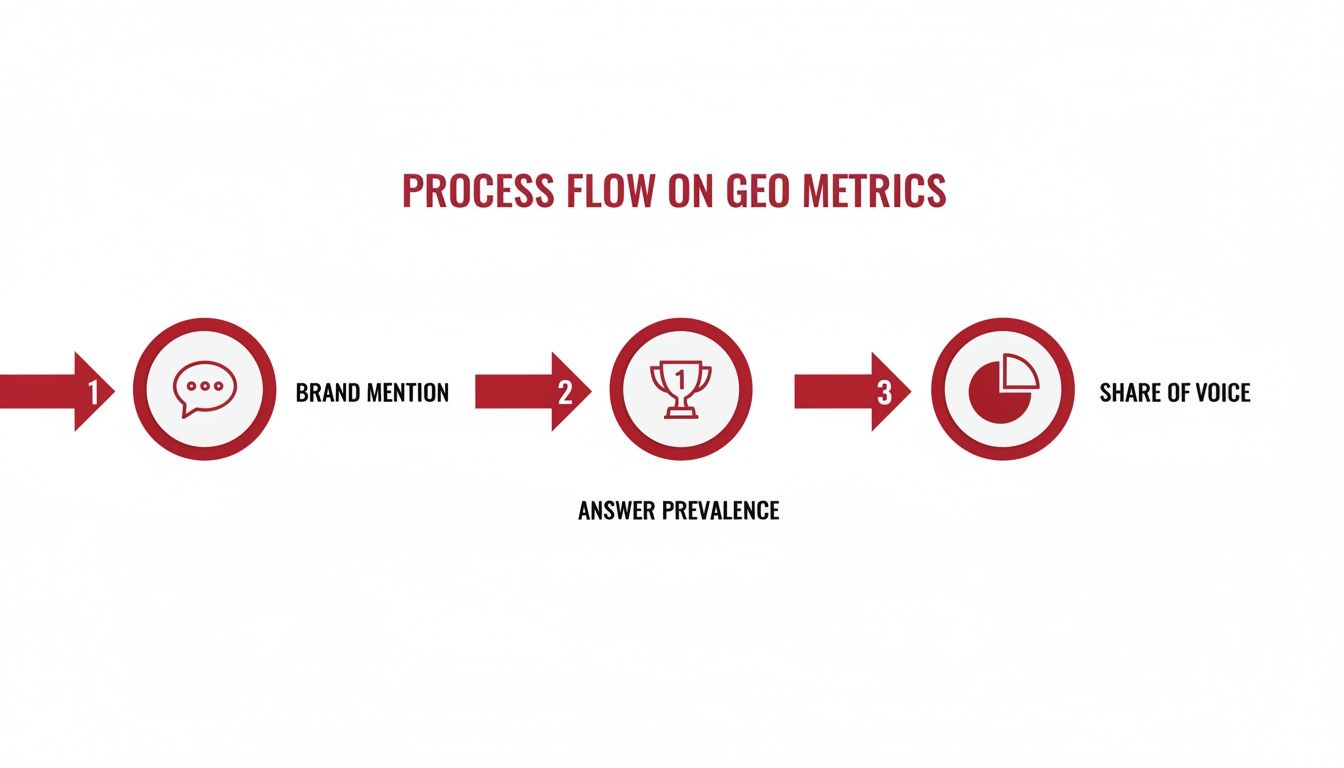
Success is no longer just about clicks and rankings. It's about your influence within the AI's generated response. You’ll be tracking things like brand mentions, answer prevalence, and your overall share of voice. This ongoing cycle of measuring, learning, and adjusting is the key to long-term success with GEO.
Your Top Questions About GEO, Answered
Jumping into a new way of thinking about search always brings up a few questions. It’s a big shift, after all. Let’s tackle some of the most common ones we hear about Generative Engine Optimisation (GEO) to give you a bit more clarity.
Is GEO Just a Fancy New Name for SEO?
Not quite. It’s better to think of it as the next evolution of SEO.
For years, traditional SEO has been about getting your website to rank in that list of blue links, all in the hope of earning a click. Generative Engine Optimisation (GEO), on the other hand, is about making your content so clear and authoritative that AI models choose your information as the direct source for the answers they generate. The goal is to be the answer, whether a click happens or not.
GEO still relies on the solid foundations of good SEO—things like keyword research and a technically sound website. But the ultimate prize has changed. It’s no longer just about ranking high; it's about directly influencing the AI-generated result itself.
How Long Until We See Results from GEO?
This is a long game, not a quick win. Unlike switching on a pay-per-click campaign and seeing traffic the same day, GEO takes time to build momentum.
You can often start seeing some early signs of progress, like better visibility for conversational, long-tail search queries, within 3-6 months. This happens as search engines recrawl your optimised content and start to understand its value.
However, becoming a trusted, consistently cited source in AI-generated answers and overviews is a bigger hill to climb. This can often take 6-12 months or more. Your timeline will really depend on how competitive your industry is, the quality of your content, and the overall authority of your website.
What’s the First Step for a Small Business?
Before you write a single new word, the most powerful first step is to conduct an answerability audit on your existing content. Look at your most important pages and ask a straightforward question: "Does this page give a clear, direct, and trustworthy answer to a specific question someone would ask?"
This is a really practical process. It involves:
- Pinpointing the one main question each page is meant to answer.
- Shifting the most critical information right to the top, so it’s seen immediately.
- Rewriting subheadings to be more like the questions people actually ask.
- Breaking down walls of text into easy-to-scan lists or short, sharp sentences.
Getting this groundwork done first means your current website assets are properly primed for answer engines, giving you a solid foundation to build on.
Ready to adapt your strategy for the age of answer engines? We provide expert, data-driven SEO and GEO services tailored for the Australian market. We help businesses like yours achieve measurable growth and dominate search results. Start your journey with a free, no-obligation consultation.