Quick Summary: Ditch keyword stuffing for a smarter approach. Semantic SEO focuses on understanding user intent and the relationships between concepts (entities). By mapping your business's core entities and using Natural Language Processing (NLP), you build topical authority, making your content more relevant to search engines like Google and driving significant organic growth.
Let's be honest, the days of just stuffing a page with keywords and hoping for the best are well and truly over. Modern search is a much smarter game, one that’s all about context, what your user is really looking for, and the intricate connections between ideas. Understanding how machine learning vectors influence topical authority is the new frontier.
Search engines like Google don't just read words anymore; they understand concepts. This is why getting your head around semantic SEO and entity mapping isn't just a "nice-to-have"—it's a non-negotiable for any Australian business that's serious about growth.
This big shift is all about moving from "strings to things." In the past, SEO was about matching the literal keyword string, like "best coffee shops in Melbourne." Now, it's about understanding the things—or entities—that query represents. Google knows you're talking about the entity Melbourne (a location), the entity coffee shops (a type of business), and the concept of best (which implies reviews, quality, and popularity).
Google’s brain, powered by sophisticated Natural Language Processing (NLP), builds a massive web of understanding called a Knowledge Graph. This is how it connects the dots, delivering results that are genuinely relevant, not just a list of pages that happen to contain the right words.
For Aussie SMBs and e-commerce stores, this is a massive opportunity. It lets you compete on your actual expertise and authority, not just the size of your marketing budget. When you clearly define what your business is about and how your products, services, and knowledge all link together, you send incredibly powerful signals to Google that you're a definitive source.
The Journey from Keywords to Concepts
This change didn't happen overnight. It’s been a steady evolution, driven by huge algorithm updates like Hummingbird, RankBrain, and BERT, all designed to make search feel more human.
These updates gave Google the smarts to:
- Understand synonyms and related ideas: It gets that "car repair," "auto mechanic," and "vehicle servicing" are all talking about the same thing.
- Interpret conversational questions: It can handle long, natural queries from voice search, like "Where can I find a pet-friendly cafe near South Yarra?"
- Grasp the context of a whole page: Instead of just counting keywords, it analyses all your content to figure out the main topic and its nuances.
This is precisely why mastering Natural Language Processing for search is so crucial today. Your content needs to be structured in a way that machines can easily understand its meaning and all the connections within it.
Why This is a Big Deal for Your Business Right Now
The impact of this shift is already here. As AI Overviews and conversational search become more common, websites that give clear, context-rich information are the ones getting rewarded. If you don't adapt, you risk becoming invisible.
"The core of modern SEO is no longer about trying to trick an algorithm with keywords. It's about clearly communicating your expertise in a way that both humans and machines can understand. Entity mapping is the blueprint for that communication."
The proof is in the results we're seeing right here in Australia. For instance, recent findings show that in early 2026, Australian businesses that truly mastered semantic SEO saw a staggering 300% average increase in organic traffic. This wasn't just luck; it was driven by Google's expanded E-E-A-T-G framework, which now includes 'Genuine' user experience. It actively prioritises sites with clean, structured data and semantic depth over those still stuck in the keyword-stuffing era. You can discover more about these crucial SEO ranking factors and see how they impact local businesses.

To really drive this point home, let’s look at the core differences between the old way and the new.
Traditional SEO vs Semantic SEO
| Aspect | Traditional SEO | Semantic SEO |
|---|---|---|
| Primary Focus | Keywords and backlinks. | Topics, entities, and user intent. |
| Content Strategy | Create one page per target keyword. | Build clusters of content around a core topic. |
| Measurement | Keyword rankings for specific phrases. | Overall topic visibility and organic traffic growth. |
| Technical Side | On-page basics (titles, meta descriptions). | Structured data (Schema) and entity relationships. |
| Approach | Reactive and often formulaic. | Proactive and strategic, building authority. |
Ultimately, the table shows a move away from a narrow, tactical approach to a much broader, more strategic way of thinking. Semantic SEO isn't just about ranking for a term; it's about owning a topic and becoming the go-to authority in your niche.
Figuring Out the Core Entities That Define Your Business
This is where the rubber meets the road. Before you can map anything, you need to get crystal clear on what your business is actually about in the eyes of a search engine. Think of it as creating a structured blueprint of your brand that Google can instantly grasp. This is the absolute foundation of a solid semantic SEO strategy.
Forget just rattling off a list of your products or services. We need to go deeper and start thinking like a machine that’s trying to connect all the dots. The aim here is to build a clear hierarchy of concepts—a taxonomy—that maps out your entire operation.
It's More Than Just Products and Services
The first step is to zoom out. A classic mistake I see businesses make is limiting their thinking to the things they sell. While your products and services are obviously crucial, they're just one part of a much bigger picture. A complete entity list for an Australian business has to include a few other key ingredients.
Think about it this way:
- Key People: Who are the faces of your company? Your founder, lead experts, or award-winning team members are powerful entities. They're gold for demonstrating your Expertise, Experience, Authoritativeness, and Trustworthiness (E-E-A-T).
- Brand Concepts: What are the unique ideas or frameworks your brand is known for? Maybe you have a proprietary process like "Anitech's 5-Step Growth Framework." That’s a distinct entity you own.
- Locations & Service Areas: This is a non-negotiable for any local business. 'Plumber in Ballarat' or 'Cafe in Fitzroy' isn't just a keyword; it's the connection of a service entity to a location entity. That’s a seriously powerful signal for local search.
- Niche Lingo: Every industry has its own language. If you're a financial advisor, entities like 'Self-Managed Super Fund (SMSF)' or 'Franking Credits' are essential for proving you're an authority in that space.
When you start mapping out these different elements, you begin to tell a much richer, more connected story. And that kind of clarity is exactly what Google’s natural language processing algorithms are built to find and reward.
A Practical Way to Uncover Your Entities
Alright, let's make this real. Grab a whiteboard or open up a blank document and let’s run a quick brainstorming exercise. We'll use a hypothetical Aussie e-commerce store that sells high-end coffee equipment as our example.
Example Business: "Bean Brilliance" – an online retailer based in Melbourne.
Start jotting down ideas under these headings:
Core Offerings (Products/Services): This is the easy bit.
- Products: Espresso Machines, Coffee Grinders, Milk Frothers, Coffee Beans.
- Services: Machine Repair Services, Barista Training Courses.
Brands & Suppliers: What other entities are you associated with?
Features & Attributes: What are the defining characteristics of what you sell?
- Machine Features: Automatic Tamp System, Dual Boiler, PID Controller.
- Coffee Attributes: Single Origin, Fair Trade Certified, Arabica Beans.
People & Expertise: Who’s behind the curtain?
- Founder: Jane Doe (recognised Barista Champion).
- Head Technician: John Smith (certified Breville repair expert).
Locations & Concepts: Where are you and what ideas do you "own"?
- Physical Location: Showroom in Richmond, Melbourne.
- Unique Concept: "The Perfect Pour" brewing guide (a branded content series).
Once you're done, you'll have a rich web of interconnected concepts. You're no longer just a shop that sells "coffee machines"; you are a Melbourne-based retailer founded by an expert, stocking specific high-end brands, and offering unique educational content. See the difference?
Nailing this identification process is the bedrock of effective entity mapping. It gives you all the raw material you need to build a logical structure that search engines can not only understand but also trust. Once these core entities are locked in, we can get into the really interesting part: using NLP tools to extract and connect them, building a powerful knowledge graph for your business.
How to Use NLP Tools for Entity Extraction and Mapping
Right, you’ve got your business taxonomy mapped out. Now it's time to bring in the tech. This is where we move from scribbling on a whiteboard to automated analysis, using powerful Natural Language Processing (NLP) tools to pull out entities and map their connections at a scale you just can't manage by hand.
Think of it like this: all that content on your website—blog posts, product descriptions, about pages—is basically unstructured text. NLP tools read it, make sense of it, and turn it into structured, machine-readable data that search engines like Google can properly understand.
These tools are trained to read and comprehend language in a surprisingly human-like way. They use complex machine learning models to pinpoint the key entities in your content, understand the context they appear in, and even gauge the sentiment around them. For you, this means you can finally get a data-driven look at your own website, your competitors' content, and even what customers are saying in reviews.
This isn't just a fancy way to do keyword research. We're digging deeper to find the fundamental 'things' that matter to your audience and figuring out how they all relate to one another. This is the heart of semantic SEO & entity mapping: mastering natural language processing for search.
Accessible NLP Tools for Your Business
The good news is you don't need a data science degree to get started. Plenty of powerful NLP tools are available through simple interfaces or easy-to-use APIs.
Here are a few I've found particularly useful for Australian businesses:
- Google Cloud Natural Language API: An absolute powerhouse. It's fantastic for pulling entities, analysing syntax, and figuring out sentiment from any chunk of text you feed it. I often use it to see which entities my competitors are focusing on.
- OpenAI API: Most people know it for ChatGPT, but its underlying models are brilliant at entity extraction. You can literally prompt it to "identify all the 'locations', 'products', or 'concepts' in this document," and it will spit them out.
- spaCy (for the more technical crowd): If you're comfortable with a bit of code, spaCy is an open-source Python library that gives you incredible flexibility to build your own custom extraction and analysis workflows.
The diagram below gives you a simple way to think about your core business entities. NLP tools are designed to find and connect these very things.
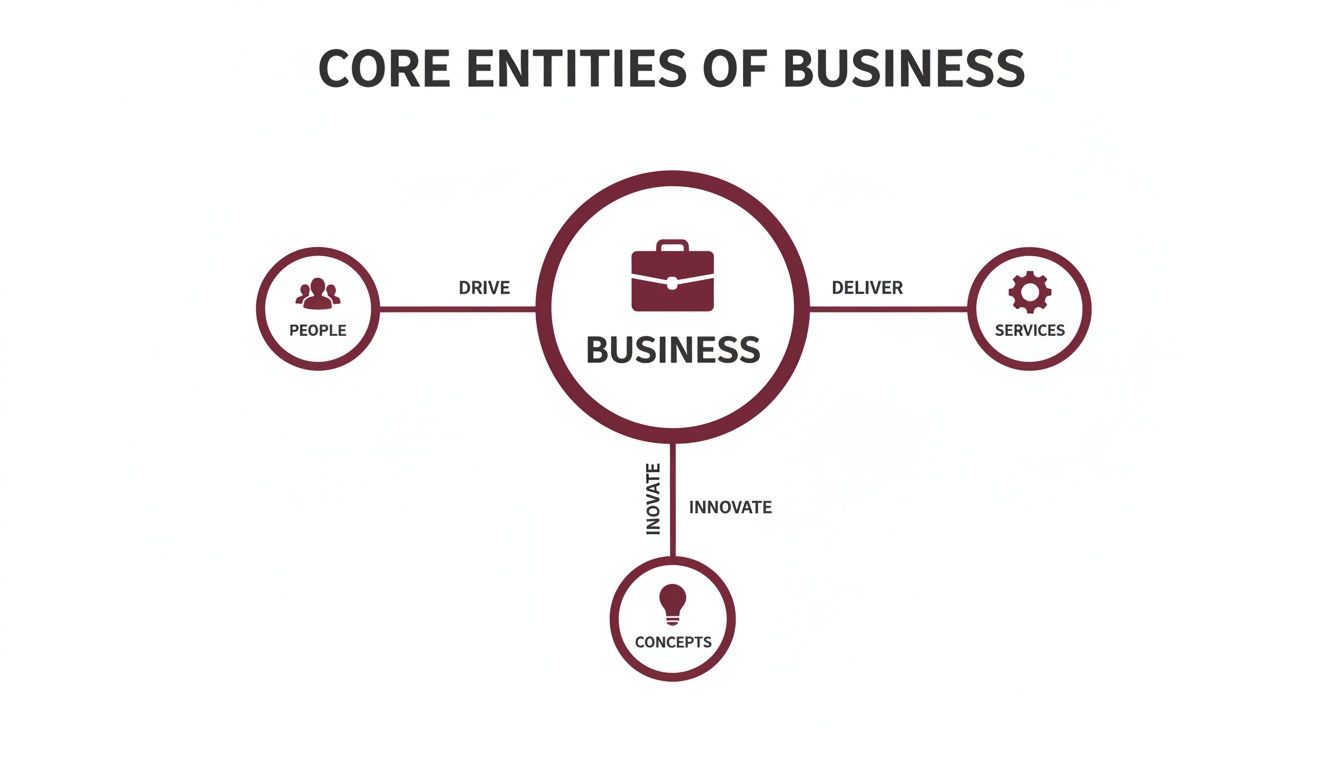
It’s a great reminder that your business is more than just what it sells. Your people are entities with expertise, and your unique concepts build your brand identity. All of these are critical for establishing real topical authority.
Putting It Into Practice: An Aussie Tourism Example
Let's make this real. Imagine you run a tour company out of Melbourne, specialising in trips along the Great Ocean Road. To build authority, you’d take the text from your main tour page and feed it into one of these NLP tools.
The tool would scan the text and start extracting the key entities. You’d likely see a list like this:
- Locations: 'Great Ocean Road', '12 Apostles', 'Melbourne', 'Torquay', 'Loch Ard Gorge'.
- Organisations: Your own business name.
- Events: 'Full-day tour', 'Sunset tour'.
- Things/Products: 'Luxury coach', 'Guided walk', 'Morning tea'.
By automating this process, you instantly get a structured list of the most important concepts on your page. This isn't based on a gut feeling; it's hard data derived directly from your own content.
But here’s where it gets really powerful. The next step is to run the same analysis on your top competitors' pages. This quickly shows you which entities they're hammering home and—more importantly—which ones they might be missing. This kind of insight is pure gold for spotting content gaps and finding unique angles to set yourself apart.
By repeating this process across your site, competitor sites, and even customer reviews, you can build a comprehensive map of your topic cluster. You might discover that 'Melbourne departure' is a critical entity for your customers, or that 'wildlife spotting' is a concept that keeps popping up in reviews, signalling that you should feature it more prominently.
This transforms a simple list of words into a custom-built knowledge graph for your business, giving you a clear, data-driven roadmap to owning your niche.
Putting Your Entity Map to Work with Technical SEO
Having a well-defined entity map is a fantastic start, but on its own, it's purely strategic. If search engines can't actually see and understand this structure on your website, all that hard work remains invisible. This is where we bridge the gap between your high-level strategy and the technical nuts and bolts of your site.
We need to explicitly tell search engines like Google what your entities are and how they relate to one another. This is done through a combination of structured data and smart on-page optimisation, turning your conceptual map into machine-readable code and content.
This technical layer is what solidifies your authority and directly supports Google's E-E-A-T (Expertise, Experience, Authoritativeness, and Trust) guidelines. Think of it as adding clear signposts for search engine crawlers. Instead of asking them to guess what your page is about, you’re handing them a detailed, structured blueprint.
Translating Entities into Schema Markup
The most direct way to communicate your entities to search engines is through structured data, specifically using the vocabulary from Schema.org. This code snippet, added to your site's HTML, acts as a clear label for your content, leaving absolutely no room for ambiguity.
For Australian businesses, getting a few key schema types right can be a game-changer. It’s what powers those enhanced search results, known as rich snippets, which can make a huge difference to your click-through rates.
By implementing structured data, you're not just optimising a webpage; you're contributing your business's specific information to the global Knowledge Graph. This is how you move from being a simple result to becoming a recognised entity in your industry.
Here’s a quick-reference table of the schema types I see making the biggest impact for Aussie businesses right now.
Essential Schema Types for Australian Businesses
| Schema Type | Who It's For | Key Benefit |
|---|---|---|
| LocalBusiness | Any brick-and-mortar store or service-area business. | Feeds your address, hours, and service area directly into Google Maps and local search, making you more visible to nearby customers. |
| Product | Any e-commerce website. | Marks up price, availability, and reviews, making your products eligible for rich snippets in search results, which can drive more qualified traffic. |
| Service | Service-based businesses (e.g., consultants, tradies). | Clearly defines what you do and where you do it, helping you rank for specific queries like "SEO services in Melbourne." |
| FAQPage | Any site with a Q&A section. | Can make your questions and answers appear directly in search results, capturing more screen real estate and answering user queries instantly. |
Focusing on these schema types is a practical first step that provides a solid foundation for more advanced structured data implementation later on.
Weaving Entities into Your On-Page Content
Schema is only half the battle, though. Your on-page content—the actual words your visitors read—must also reflect and reinforce your entity map. This is a core part of mastering natural language processing for search, as algorithms analyse your text to validate the claims you're making in your structured data.
A great place to start is with your headings (H1, H2s, H3s). These carry significant weight and should be optimised with semantic keywords that reflect your core entities. For example, instead of a generic H2 like "Our Services," a more semantically rich heading would be "Data-Driven SEO Services for E-commerce Growth." This heading immediately connects the entity 'SEO services' with the attribute 'data-driven' and the audience 'e-commerce'.
This is becoming even more critical in the Australian market. We're seeing 33% of Aussies now using voice search daily, mostly for local queries. This trend demands a better grasp of conversational language to capture this booming channel. On top of that, with 51% of organic searches featuring four or more words, sites that embrace these long-tail, semantic strategies are seeing 3-5% higher click-through rates. You can explore more about these key digital marketing statistics to get a feel for the local landscape.
Powering Up with Internal Linking
Finally, your internal linking strategy is the glue that ties everything together. It’s how you demonstrate the relationships between different entities on your own site. Every link is a vote of confidence and a pathway that builds context for both search engines and your users.
A powerful, entity-led internal linking strategy should:
- Connect related entities: Your service page for 'Link Building' should naturally link to a blog post about 'Measuring Domain Authority'.
- Reinforce location signals: A case study about a client in Sydney should always link back to your primary 'Sydney SEO Services' page.
- Use descriptive anchor text: Ditch generic text like "click here." Instead, use anchor text that describes the linked page, such as "explore our technical SEO audits."
This deliberate approach to your technical and on-page SEO creates a powerful, interconnected web of content. It’s how you clearly communicate your expertise and authority, making it easy for Google to understand exactly what you’re about and why you deserve to rank.
Building a Content Strategy Around Topic Clusters
It's time to ditch the old "one keyword, one page" mentality. That way of thinking is dead. Instead, we're going to use your entity map to build a genuine content fortress, architecting a strategy based on topic clusters that establishes your website as the authority in its field.
This isn't about writing random, disconnected blog posts anymore. We're building a web of interconnected content where every single piece answers a specific user question while reinforcing your expertise on a bigger topic. The end goal? To cover a subject so thoroughly that Google has no choice but to see you as the go-to resource.

This approach doesn't just keep users happy; it also creates an internal linking structure that search engines absolutely love. It screams topical relevance and authority, which is a core principle of semantic SEO & entity mapping: mastering natural language processing for search.
From Entity Map to Content Plan
Think of your entity map as a treasure map leading to content gold. Start by examining your core entities and the relationships between them. This is where you'll spot the most valuable content gaps and find brilliant ideas for new topic clusters.
A topic cluster is built around a central "pillar" page, with multiple "cluster" articles supporting it and linking back to it.
- Pillar Page: This is your comprehensive, cornerstone guide on a broad topic, like a primary service or product category. It targets a high-level, high-value keyword.
- Cluster Content: These are more detailed articles, guides, or FAQs that dive deep into specific, long-tail questions related to your pillar topic.
This structure results in a clean, logical site architecture that helps search engines immediately grasp the hierarchy and depth of your knowledge.
A Real-World Australian Example
Let's take a financial services firm in Australia. A core entity for them is 'Self-Managed Super Fund (SMSF)'. Instead of just creating a single service page, they can build an entire content hub around this entity.
Their content plan could look something like this:
- Pillar Page: "The Ultimate Guide to Self-Managed Super Funds in Australia"
- Cluster Content (Blog Posts):
- "What Are the Setup Costs for an SMSF?"
- "Understanding SMSF Compliance Rules for 2024"
- "Can I Use My SMSF to Buy Investment Property?"
- "Comparing SMSF vs Industry Super Funds"
Each of these cluster posts links back to the main pillar page. Just as importantly, they link to each other where it makes sense. This creates that dense, interconnected web of information that signals deep expertise on everything SMSF.
This strategy lets you systematically answer every question a potential customer has, from their first inkling of a problem to being ready to make a decision. It’s about being the most helpful resource out there, not just the loudest.
This model is so effective because it mirrors how search engines, driven by natural language processing, now understand information. They're actively looking for sites that cover a topic from every angle, and the cluster model is the perfect way to prove you do just that.
Identifying Content Gaps and Opportunities
Once your pillar topics are locked in, your entity map becomes a tool for systematically finding new content ideas. Look for entities that are closely related to your core topics but don't yet have dedicated content on your site.
For our Aussie finance firm, they might see that the entity 'SMSF audit' is often linked with 'SMSF compliance' but isn't properly covered on their site. That’s an instant content gap—and a perfect opportunity for a new cluster article like, "What to Expect During Your Annual SMSF Audit."
This process turns content creation from a guessing game into a data-backed strategy. As you scale, you can even explore more advanced approaches. Understanding What Is Programmatic SEO and How Does It Work? can open up possibilities for massive content generation, which is ideal for building out large-scale topic clusters. By methodically filling these gaps, you not only capture more long-tail traffic but also strengthen the authority of the entire cluster, giving your all-important pillar pages a serious rankings boost.
Measuring the True Impact of Your Semantic SEO
Alright, so you’ve meticulously built out your entity map, fine-tuned the technical side of things, and started publishing content around your topic clusters. The big question is: how do you prove any of this is actually working?
The old way of just tracking a handful of trophy keywords simply won't cut it anymore. When you're playing the semantic SEO game, you need to measure success differently. We’re moving beyond isolated keyword performance and looking at broader, more meaningful signs of topical authority and organic visibility. This is how you create a feedback loop to refine your strategy and show a real return on your efforts.
Moving Beyond Simple Rank Tracking
First things first, we need to redefine what a "win" looks like. While seeing a specific keyword hit page one is still nice, it doesn't tell the whole story. A truly successful semantic campaign makes you visible for an entire topic, not just one or two search phrases.
Your new key performance indicators (KPIs) should revolve around growth and authority.
- Topic Cluster Visibility: Instead of obsessing over individual keywords, start tracking them in groups. Use a tool to bundle the related keywords that make up a topic cluster. The goal is to see the average rank for that entire basket of terms improve. That's a clear signal Google is starting to see you as an authority.
- Non-Branded Organic Traffic: This one is huge. When you see a lift in traffic from people who aren't searching for your brand name, you know you're succeeding. It means your content is ranking for informational queries and catching people much earlier in their buying journey.
- Impressions for Long-Tail Queries: Get comfortable in Google Search Console. A rising tide of impressions for long-tail, conversational questions shows your content is appearing for the exact kinds of queries that semantic SEO is designed to capture.
The real win isn't just ranking #1 for a single term; it's becoming so authoritative on a topic that your site appears for hundreds of related questions and queries, effectively owning the conversation.
This shift in measurement is all about mastering natural language processing for search from a practical standpoint—it focuses on the concepts and intent behind what people are looking for, not just the specific words they type.
Analysing the Performance of Your Structured Data
Your schema markup isn't just invisible code for search engines; it produces very visible results in the SERPs. Monitoring how these rich results perform is one of the most direct ways to measure the payoff from your technical SEO work.
Google Search Console is your best friend for this. Jump into the 'Performance' report and use the 'Search Appearance' filter. This will show you exactly how pages with specific schema types, like FAQs or Product markup, are performing.
What to Look For:
- Rich Result Clicks and Impressions: Are the pages you’ve marked up with
FAQPage,Product, orLocalBusinessschema actually getting seen and clicked on? A steady increase here is undeniable proof that your structured data is doing its job. - Click-Through Rate (CTR) Improvement: This is a fantastic comparison to make. Pit the CTR of your pages with rich results against those without. You should see a noticeably higher CTR on the enhanced pages because they're bigger, more eye-catching, and just take up more real estate.
This data creates a direct line between a specific action (implementing schema) and a business outcome (more clicks). When you can show a stakeholder that your FAQ schema is driving a 20% higher CTR, that’s a powerful and easy-to-understand win.
Creating a Data-Driven Feedback Loop
Finally, all this data needs to feed back into your strategy. Measuring performance isn't a "set and forget" task you do once a quarter. It should be a constant cycle of analysis, learning, and optimising.
If you spot a topic cluster that's lagging, it's time to investigate. Revisit your entity map and the content itself. Are there content gaps you missed? Is the internal linking between related articles a bit weak?
On the flip side, if a cluster is killing it, double down. Look for related sub-topics and expand that content hub to cement your authority even further. This is the feedback loop that ensures your semantic SEO and entity mapping strategy stays sharp, agile, and continues to drive sustainable growth.
At Anitech, we specialise in transforming complex SEO strategies into measurable business growth. If you're ready to move beyond basic keyword tracking and build true topical authority that drives results, we can help. Schedule a free consultation with our expert team today and let's create a data-driven plan to elevate your online visibility.