Quick Summary: The Skyscraper Technique, once a go-to SEO strategy, is officially dead. This approach, which focused on making longer versions of top-ranking content, no longer works. Search engines have evolved, now favouring genuine 'information gain' and 'originality'. The new game is about providing fresh, unique value, not just rehashing what's already out there. To succeed today, your content needs to be truly different and insightful.
Why 'Better' Is No Longer Good Enough
For a long time, the dominant play in SEO was the Skyscraper Technique. The plan was simple: find an article ranking at the top, create a version that was longer and more "comprehensive," and then throw backlinks at it. The thinking was that a bigger, taller skyscraper must be better. But that model is now fundamentally broken. It led to a sea of bloated, repetitive content that rarely offered anything new to the reader.
This old approach focused on being better in very superficial ways—more words, a longer list, a few extra images. It completely missed the most important ingredient: originality. Today's search algorithms are sophisticated enough to sniff out new ideas and perspectives, a concept we now call information gain. The death of the skyscraper technique isn't just a trend; it's a clear signal that the goal has shifted. It's no longer about being slightly better; it's about being meaningfully different.
The Cracks in the Skyscraper Model
At its heart, the skyscraper method is built on imitation, not innovation. It operates on the flawed assumption that more is always more, that length automatically equals value. This is a dangerous way to think about content today.
Just look at the inherent weaknesses:
- It creates an echo chamber: When everyone just builds on what's already ranking, the search results become a monotonous loop of the same recycled ideas. It's a terrible experience for users.
- It leads to content bloat: The race for a higher word count often means stuffing articles with irrelevant fluff. This dilutes the main point and frustrates anyone looking for a straight answer.
- It ignores how people actually search: A user doesn't always need a 5,000-word dissertation. Sometimes, they just want a quick, accurate answer. The one-size-fits-all "bigger is better" model just can't keep up.
We're seeing the diminishing returns in real-time. In the competitive Sydney SEO scene, for example, the skyscraper technique has completely lost its edge. Some Australian businesses have even reported organic traffic drops of up to 40% by sticking to this outdated playbook. You can find more data on this decline in this analysis from First Page Australia.
The Big Shift to Information Gain
This isn't just speculation; it's baked into how search engines like Google operate. Google’s own patents talk about an "information gain score," which is essentially a measure of how much new knowledge a piece of content adds to a topic, especially for a user who has already seen other search results.
"An information gain score for a given document is indicative of additional information that is included in the document beyond information contained in documents that were previously viewed by the user."
In simple terms, search engines are actively rewarding uniqueness. If your article is just a rehash of what the top three results already cover, it offers zero new information. It won't perform well for long, if at all. This confirms it: the skyscraper technique is no longer a reliable path to SEO success.
Understanding Information Gain and Originality in Practice
Let's get practical. To really see why the old SEO playbook is gathering dust, think about being in a business meeting. Five people present one after another, but they’re all just rehashing the same core ideas with slightly different slides. That’s the Skyscraper Technique in a nutshell—more noise, but no new value.
Then, a sixth person steps up. They show a single slide with fresh, surprising customer data that completely reframes the entire conversation. That, right there, is information gain.

This idea is the absolute core of the shift we're seeing in SEO today. Information gain has nothing to do with how long your content is; it’s all about its net-new contribution to the conversation. It’s the unique, valuable insight that a user simply can't find in the other search results they’ve already clicked.
Google's algorithms are now smart enough to pinpoint and reward content that fills these knowledge gaps. This change has effectively killed the skyscraper technique, which mostly just creates information redundancy.
What Constitutes True Originality
Originality goes way beyond just passing a plagiarism check. It’s about adding something genuinely new to the discussion. If your content is just a remix of what's already ranking, it delivers zero information gain and is on a fast track to nowhere.
So, how do you inject real value and achieve this originality?
- Original Research: This is the absolute gold standard. Run your own surveys, analyse your company's internal data, or commission a study. This creates a powerful, citable asset that no one else has.
- Unique Case Studies: Don't just talk theory. Walk readers through a specific client success story, detailing the real metrics and challenges you overcame. It provides concrete, first-hand proof that can't be copied.
- A Novel Methodology: Have you developed a unique process or framework for solving a common problem? Share it. This positions you as an innovator.
- Fresh Expert Perspectives: Go deeper than the usual generic quotes. Conduct proper interviews with subject matter experts to uncover insights and opinions that haven't been published anywhere else.
Focusing on these pillars is how you transition from being a content aggregator to a content originator. It's the new benchmark for creating high-value content that people—and search engines—actually appreciate.
How Google Measures This New Value
Information gain isn't just some buzzword we're throwing around; it’s baked into how search engines operate. In fact, Google's own patents describe systems for scoring content based on the "additional information" it brings to the table, beyond what a user has already encountered.
A document that offers unique angles, additional insights, or unexplored subtopics is more likely to score high in information gain and have a better chance of winning top rankings.
This means Google is actively watching a user's journey. If someone clicks three results and gets the same tired information, then clicks your article and finds a completely new data point or a different perspective, your content is flagged as more valuable. It has earned a high "information gain score."
And this isn't a one-and-done deal. The algorithm is constantly re-evaluating these scores based on user behaviour and new content hitting the web. Just because a skyscraper article ranks today doesn't mean it will tomorrow, especially once a more original piece enters the fray.
This is the fundamental reason for the death of the skyscraper technique. It was built for a search engine that used proxies like word count and keyword density to guess at value. Today's search engines measure value by understanding context, novelty, and genuine user satisfaction. They are actively designed to penalise redundancy and reward information gain and originality. To succeed now, your entire content strategy must be organised around this new reality.
How AI Search Is Rewriting the Rules of Content
The Skyscraper Technique didn't just fall out of favour; it was pushed. We're seeing a seismic shift in how search engines work, and the force behind it is artificial intelligence. Google no longer just scans for keywords. Its AI systems now read and understand content much like a human would.
This new reality is driven by updates like the Helpful Content system. This isn't just about ticking SEO boxes anymore. The system is designed to ask a fundamental question: does this content give a reader a genuinely satisfying experience? It can figure out the context, the sentiment, and how different ideas connect.
Because of this, trying to game the system with rehashed, unoriginal content is becoming a fool's errand. If your article is just a mash-up of the top three search results with some words swapped around, Google’s AI is smart enough to see it brings nothing new to the table. It's now actively rewarding information gain and originality because that’s what people actually find useful.
The Rise of AI Overviews and Zero-Click Searches
The problem for old-school content strategies doesn't end there. The introduction of AI Overviews (what used to be called the Search Generative Experience, or SGE) has completely flipped the board. These are the AI-powered summaries you now see at the very top of search results, answering a user's question directly. They don't even have to click on a link.
This has some serious implications for anyone creating content:
- Summaries Are Now Automated: If the main value of your content is simply to summarise what’s already out there, an AI can now do that job faster and more efficiently. Your page becomes redundant before anyone even has a chance to see it.
- Zero-Click Searches Are Increasing: When an AI Overview gives a complete answer, why would a user bother clicking through to your site? This means traffic for those top-of-funnel informational queries is getting much harder to win.
- Originality Is Your Only Defence: The only way to get a user to look past the AI summary is to offer something it can't create—genuinely original insights, unique data, or a first-hand perspective that hasn't been said before.
The whole point of an AI Overview is to consolidate existing, public information. If your content is just that, you’re now competing directly with Google’s own AI. That’s a fight you’re not going to win.
We’ve seen this shift hit businesses hard. For example, many Australian SMBs that kept pouring money into the old skyscraper model found their efforts suddenly falling flat. That strategy, which combined decent content with a backlink push, now feels outdated as traffic for purely informational content nosedives in an AI-first search world. You can read more on these trends in this insightful Australian market analysis.
Adapting to an AI-First Search World
Fighting this change is a waste of time. The only way forward is to adapt. The death of the skyscraper technique is a direct result of AI’s new ability to spot and reward real value. This AI-first world demands a whole new approach to creating content, one that’s built on genuine originality from the ground up.
Here’s what that looks like in practice:
- Stop Rehashing, Start Originating: Your main goal should be to add something new to the conversation. It could be a fresh idea, a piece of data you collected, or a perspective nobody else has shared.
- Focus on Experience: Google's algorithms are now looking for proof of real-world experience. Things like case studies, personal stories, and hands-on product reviews carry far more weight than they used to.
- Answer the Next Question: Don't just answer the question the user typed into the search bar. Think ahead. What will they ask next? Provide those comprehensive, original insights that an AI summary will almost certainly miss.
At the end of the day, you can't out-summarise an AI. You can only out-create it. This means making a non-negotiable shift in your thinking, moving from creating "better" content to creating truly "different" content. Your survival and growth in this new era depend entirely on your ability to provide the one thing an AI can't generate on its own: authentic, original value.
A Practical Framework for Creating Genuinely Original Content
Knowing the theory behind information gain and originality is great, but putting it into practice is what really counts. Shifting away from the old skyscraper formula isn't about guesswork; it’s about having a repeatable process to find those insights your competitors keep missing.
The entire goal here is to stop asking, "How can we make this longer?" and start asking, "What new value can we actually contribute?" This approach reorients your entire content process around finding and filling the knowledge gaps in your industry, ensuring every piece you publish is a genuine win for both the reader and the search engine.
Step 1: Identify Knowledge Gaps
The first move in creating truly original content is to find the empty spaces in the current conversation online. A knowledge gap is any question, subtle point, or sub-topic that the top-ranking articles either answer badly or just ignore altogether. Pinpointing these gaps is your ticket to providing real information gain.
Here are three practical ways to hunt them down:
- Critically Analyse Competitor Content: Go and read the top 3-5 articles for your keyword. But this time, don’t just look for what they did well—actively search for what they missed. Are there unanswered questions in their comments section? Do they make big, sweeping claims without backing them up with data or real examples? That's your opening.
- Dive into "People Also Ask" and Related Searches: These Google features are a direct pipeline into what your audience is thinking. They show you the follow-up questions people have after their first search. More often than not, this is where the biggest content opportunities are hiding.
- Listen to Your Actual Customers: Your sales team's call notes, customer support logs, and client emails are absolute goldmines for content ideas. What are the questions they ask over and over again? What specific problems are they trying to solve? These real-world issues are almost always missing from generic, SEO-driven content.
Step 2: Conduct Original Research
The single most effective way to guarantee originality is to create your own data. This doesn't mean you need a university-sized research budget. Even small-scale, proprietary data can become the rock-solid foundation of your content strategy, making your articles uniquely valuable and worth linking to.
Original research acts as a content moat. When you publish proprietary data, you create an asset that cannot be easily replicated, forcing competitors to cite you as the source and solidifying your authority.
Think about these accessible research methods:
- Survey Your Audience: Use free tools like Google Forms or SurveyMonkey to poll your email list or social media followers. Ask them pointed questions about their challenges or industry trends. Even with just 50-100 responses, you can generate unique stats nobody else has.
- Analyse Your Own Internal Data: Your business is already sitting on a mountain of unique data. Look at your sales trends, customer behaviour metrics, or support ticket categories. Imagine an article titled, "We Analysed 1,000 Support Tickets: Here's the #1 Mistake New Users Make." That’s 100% original and incredibly useful.
This is exactly how modern, AI-driven search engines think. They are designed to sift through the noise and find what's new, as this diagram shows.
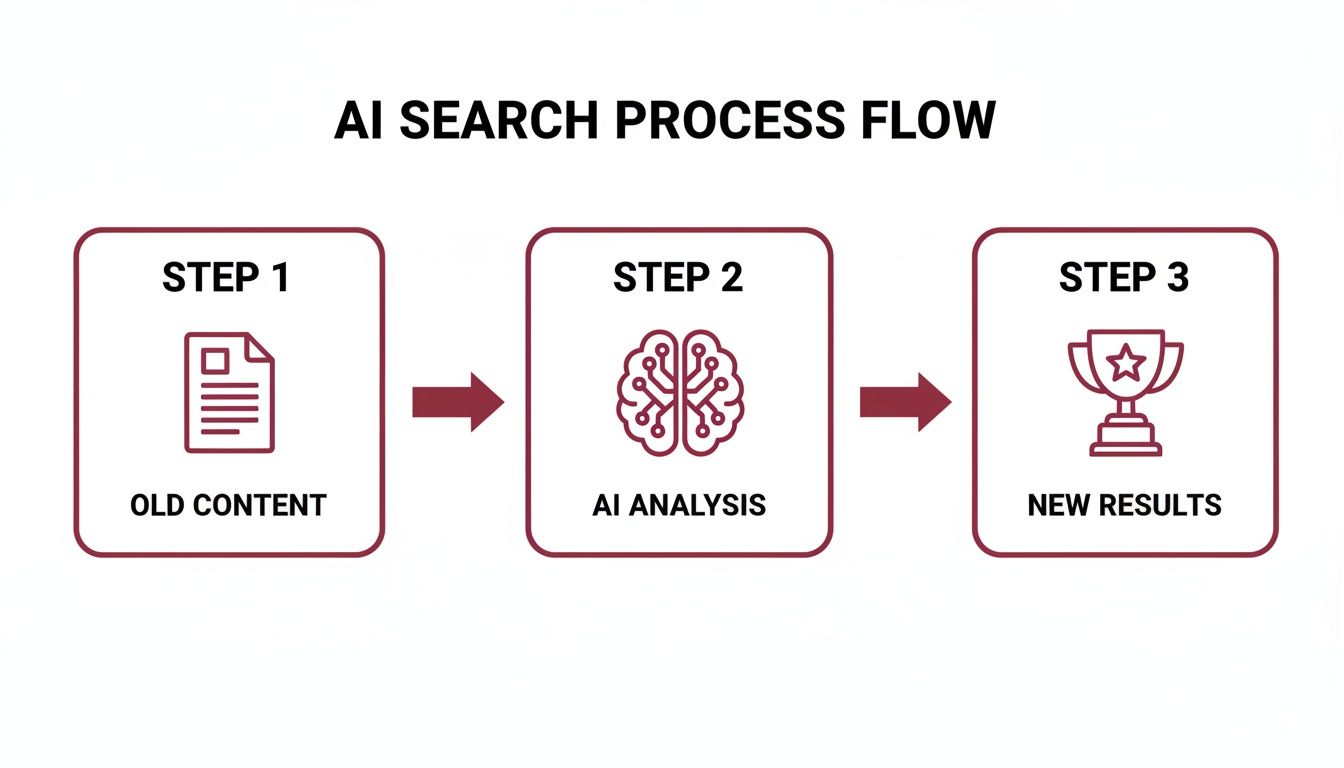
The flowchart makes it clear: AI systems are built to reward new information with better visibility, leaving the repetitive content behind.
Step 3: Source Proprietary Perspectives
If creating brand-new data isn't on the cards right now, the next best thing is to find perspectives that haven't been published before. Those generic expert quotes you see recycled across a dozen different blogs? They add zero information gain. Your job is to find and feature unique voices.
Here’s how you can source fresh insights:
- Interview Your In-House Experts: Your company’s founder, lead engineer, or top salesperson has years of hands-on experience and unfiltered opinions. Sit down with them for a proper interview and turn their knowledge into a cornerstone article. They are your most valuable and easiest-to-access experts.
- Reach Out for Unique Quotes: Don’t ask experts the same tired questions they always get. Instead, ask for a specific story, a controversial opinion, or a bold prediction. Forget "What's the future of SEO?" and try, "What is one common SEO practice you believe will be obsolete in two years?" The answers will be far more interesting.
- Develop a Unique Methodology: Document your team's specific process for solving a common problem. Create a branded framework or a detailed checklist that showcases your company's unique way of doing things. This turns your internal IP into a valuable external asset.
By systematically finding knowledge gaps, creating your own data, and sourcing unique perspectives, you build a reliable framework for creating content that actually works today. This is the practical response to the death of the skyscraper technique—a strategic shift from simply copying to genuinely innovating. For Australian businesses we partner with at Anitech that are serious about growth, this originality-first mindset is the key to getting real, measurable results.
Why Originality Delivers a Higher Return on Investment
Let's be honest, changing a content process that feels familiar can be a tough sell. But the business case for focusing on information gain and originality is just too strong to ignore. The problem is simple: the Skyscraper Technique costs a lot of time and money, and the returns just aren't what they used to be. An originality-first approach, on the other hand, delivers a much healthier return on investment (ROI) by creating assets that genuinely work for you.

Let me paint a picture with a real-world comparison. Imagine two companies aiming for the same goal: more organic traffic. Their methods, however, are polar opposites—and so are their results. This scenario gets right to the heart of the difference between making content "better" and making it truly "different."
The Old Way: A Skyscraper Scenario
Company A sticks to the old playbook. They target a high-volume keyword, see the top result is a 2,500-word "Ultimate Guide," and decide their path to victory is to build a bigger one.
Here’s what their process looks like:
- They scrape information from the top five ranking articles.
- They bulk it up with more sections, stock images, and examples to push the word count.
- They sink a huge amount of time into outreach, begging for backlinks to their new "better" guide.
After a solid 40 hours of team time spent on research, writing, and promotion, they finally publish their 4,000-word beast. The outcome? A disappointing 15% lift in organic traffic over three months. Sure, the article ranks, but it stalls on page one, unable to reach the top three. Why? Because it offers nothing new—it’s just a bloated rehash of what’s already out there.
The New Way: An Originality Scenario
Meanwhile, Company B has realised the game has changed. Instead of just echoing the competition, they set out to create something with real information gain. They notice that while everyone is talking about industry best practices, nobody has any fresh data on what’s actually happening right now.
Their approach is completely different from the get-go:
- They put together a quick, ten-question survey and send it to their customer email list.
- They analyse the results, looking for surprising patterns and unexpected insights.
- They publish their findings in a unique report titled, "5 Surprising Industry Trends Our Customers Revealed."
This entire process took them just 20 hours—half the time Company A spent. The result? A massive 150% increase in organic traffic over the same three-month period. The reason for this huge difference is that their original data acted like a magnet for high-authority backlinks from industry news sites, analysts, and other blogs that wanted to cite their findings.
By prioritising originality, Company B created a citable asset, not just another piece of content. This distinction is the engine of modern SEO ROI, as it earns authority and trust organically rather than trying to build it artificially.
Comparing the ROI
The numbers really do speak for themselves. Company A threw double the resources at the problem for a tiny fraction of the return. Company B’s investment in originality paid off tenfold, delivering 10x the traffic growth with half the effort.
Let's quickly break down why the originality-first model is the clear winner:
- Higher Link Equity: Original research, unique data, and fresh insights are natural link magnets. Authoritative sites would much rather link to a new study than yet another generic guide.
- Greater Longevity: Skyscraper content has a very short shelf life. The moment a competitor builds a slightly longer or shinier version, its value plummets. Original content, however, becomes the primary source, giving it lasting authority for years.
- Stronger Brand Authority: When you publish unique insights, you position your brand as a leader and an expert, not just another content farm. This builds deep trust with both your audience and the search engines.
Ultimately, the death of the Skyscraper Technique isn't just about Google changing its mind. It’s a fundamental shift in business logic. Investing in information gain and originality is no longer just a clever SEO tactic—it’s a smarter, more efficient, and far more profitable way to build a real digital presence. The evidence is clear: creating different is infinitely more valuable than just creating more.
Measuring the True Impact of Your Original Content
So, you’ve moved on from the old skyscraper model. That’s great, but your measurement framework needs to catch up. Judging your new, original content solely on keyword rankings is like judging a gourmet meal by how much it weighs—you’re completely missing the point.
The real payoff from information gain and originality comes from building genuine trust and authority. To see that, you need to look at a much broader set of metrics. A modern measurement plan ditches the vanity metrics and instead tracks things that actually reflect business impact. It’s no longer about counting backlinks; it's about the quality of those links and the authority they bring. This is how you connect your content efforts to results that matter to the bottom line.
Moving Beyond Rankings
Look, tracking your search rankings isn’t totally useless, but it’s a lagging indicator. It tells you what’s already happened. If you want to know if your originality-first strategy is actually working, you need to look at the leading indicators—the early signs that you’re building authority and trust. These are the metrics that show you’re creating a brand that both people and Google respect.
Start keeping an eye on these key performance indicators:
- Unlinked Brand Mentions: This is a huge one. When other authoritative sites mention your brand, your data, or your research without linking, Google still notices. It’s a powerful signal that your brand is becoming part of the conversation in your industry. You can use tools like BrandMentions to keep track of these.
- Backlink Quality Over Quantity: Stop celebrating every single link you get. Focus on where they come from. Seriously, a single, earned backlink from a top-tier industry publication is worth more than a hundred junky links from sites that have nothing to do with what you do.
- Branded Search Volume: Are more people searching directly for your brand name? That’s a fantastic sign. It means your content is building real-world awareness and brand recall. You can easily track this in your Google Search Console account.
Analysing User Engagement Signals
How people behave once they land on your page tells you almost everything you need to know about its quality. When users are deeply engaged, it’s a clear signal that you’ve provided something of real value, which is exactly what Google’s Helpful Content system is designed to reward.
When you create content that is genuinely original, users stay longer, read more deeply, and are more likely to trust your brand. These behavioural signals are powerful ranking factors that cannot be faked with formulaic content.
In your analytics platform, zoom in on these engagement metrics:
- Scroll Depth: How far down the page are people actually getting? If you’ve published a big piece of original research and you see a high scroll depth, that’s gold. It means people are genuinely hooked on your unique findings.
- Time on Page: It’s not a perfect metric on its own, but it’s telling. If you notice that visitors are spending significantly more time on your new, original articles compared to your old skyscraper posts, you know you’ve captured their interest far more effectively.
- Conversion Assists: Your big, original piece of content might not be the last thing someone reads before they buy from you, but it often plays a vital role earlier in their journey. Make sure you’re tracking how often your content shows up in the conversion path.
To tie this all together, build yourself a custom dashboard. Using tools you probably already have, like Google Analytics 4 and Google Search Console, is a great start. By tracking these modern metrics, you can finally demonstrate the true ROI of your content. You’ll be able to prove that shifting towards information gain and originality isn't just a reaction to the death of the skyscraper technique—it's a much smarter and more profitable way to do business.
Your Questions Answered: Moving Beyond Skyscraper SEO
Shifting away from a familiar tactic like the Skyscraper Technique is bound to bring up some questions. It’s a big change. Let’s tackle some of the most common ones so you can feel confident moving forward with a strategy built on information gain and originality.
If the Skyscraper Technique Is Dead, Is Link Building Still Important?
Absolutely. But how you get those links has completely changed. High-quality backlinks are still a massive signal to search engines, but the focus has shifted from building them to earning them.
Instead of mass-emailing hundreds of sites begging for a link to your slightly-better listicle, the modern approach is about creating something genuinely new. Think original research, proprietary data, or a detailed case study packed with unique insights. These kinds of assets attract high-authority links naturally because people in your industry will actually want to cite your original work.
How Can a Small Business Create Original Content on a Tight Budget?
This is a great question, and the answer is simpler than you might think. Originality isn’t about having a huge budget; it’s about tapping into what you already have. Your most valuable assets are often your own expertise and internal data, which don't cost a thing to access.
Here are a few budget-friendly ideas for creating standout content:
- Survey Your Customers: Use free tools to poll your email list or social media followers. You'll uncover trends and opinions that no one else has.
- Analyse Your Own Data: Dive into your sales or customer support records. Are there interesting patterns or surprising stats you can share?
- Interview Your In-House Experts: Your founder, lead technician, or top salesperson has years of experience and unique stories to tell. Record a conversation and turn it into a fantastic piece of content.
- Publish Real-World Case Studies: A detailed breakdown of a successful client project is 100% original and provides concrete proof of your value.
Does This Mean Long-Form Content Is No Longer Good for SEO?
Not at all. The problem was never the word count; it was the lack of new information inside those words.
A 3,000-word article that presents ground-breaking research is gold for SEO because it delivers huge information gain. On the other hand, a 3,000-word article that just stitches together the top five search results adds zero value and is exactly the kind of thing Google's Helpful Content systems are designed to ignore.
So, don't ditch long-form content. Just make sure its length is justified by depth and originality, not just fluff.