Quick Summary: Avoid being flagged as a redundant AI rehash by embedding genuine experience and expertise into your content. This guide provides a manifesto for mastering information gain and originality, moving beyond generic SEO to create content that offers unique value, builds trust, and earns higher rankings in a crowded digital landscape.
Let's be honest: creating content that actually gets noticed feels harder than ever. If you're tired of shouting into the void, you've landed in the right place. This is a manifesto for creators who want to cut through the noise by mastering two critical concepts: Information Gain and Originality.
We're moving beyond simply rehashing what's already out there. The old SEO playbook is broken. This guide is your new framework, built on Google's E-E-A-T principles (Experience, Expertise, Authoritativeness, and Trustworthiness), to help you create content that provides real, unique value. It's time to stop echoing the competition and start offering fresh perspectives that both users and search engines are desperate to find.
The New Mandate for Digital Content: Experience and Expertise

The ground has shifted beneath our feet. For a long time, the path to ranking on Google was pretty straightforward: find a keyword, see what the top results were saying, and then write a longer, more "optimised" version of the same thing. This rinse-and-repeat formula has clogged the internet with a sea of lookalike articles that add very little to the conversation.
But Google has wised up. The addition of "Experience" to its quality guidelines, creating the E-E-A-T acronym, was a massive signal. Search engines are now actively looking for—and rewarding—content that shows genuine, firsthand knowledge and offers something new, effectively flagging redundant AI rehashes.
This is the essence of information gain. It's a simple question: does your content give the reader a piece of information, a new perspective, or a deeper understanding they couldn't get from the other search results? If the answer is no, you're just adding to the noise.
Why E-E-A-T and Originality Matter Now
The pressure to be original is particularly intense here in Australia. We're a nation of early adopters and avid internet users, with over 20.9 million of us on social media—that's 77.9% of the entire population as of January 2025.
This crowded space has seen a 43% surge in professional content creators in just the last two years. You can dig into more of Australia's social media statistics to see just how competitive it's become. Simply put, regurgitating facts from other websites is a strategy doomed to fail.
To actually connect with an audience and rank well today, your content needs to:
- Show, Don't Just Tell: Go beyond stock photos and generic claims. Use your own images, share a real case study, or tell a personal story that proves you've walked the walk. This is how you embed experience.
- Offer a Unique Angle: Find a fresh perspective. Can you provide a contrarian viewpoint that’s backed by evidence? Or maybe a clever solution to an old problem that no one else has thought of?
- Build Authentic Trust: Let people know who is behind the content. Genuine expertise and transparent authorship are no longer optional—they're essential for building credibility and avoiding the AI-rehash label.
This manifesto is more than just a set of tips; it's a declaration of principles. It’s a commitment to creating content with depth and substance, content that respects the user's time by giving them something truly valuable and unique.
Embracing this philosophy isn't just about tweaking a few keywords. It's about fundamentally rethinking how you create content, aligning your entire strategy with what actually works now: authenticity and real-world value.
Understanding Information Gain and Originality

Let’s get real and move past the buzzwords. At the heart of this manifesto are two powerful concepts: Information Gain and Originality. Think of them as the engine that powers truly valuable content—the kind that both search engines and actual humans will reward. They are the crucial difference between content that just takes up space online and content that genuinely makes an impact.
Here’s a simple way to think about it. Imagine you’re planning a trip to Bologna, Italy, and you google “best restaurants”. The first ten articles you click all recommend the same five tourist traps. Then you stumble upon a blog post by a food writer who has clearly spent years eating their way through the city.
This writer doesn't just give you a list. They explain why it's worth the hassle to get a table at Trattoria Via Serra. They describe the one-of-a-kind pasta at Da Serghei and even share a hidden wine bar only the locals know about.
That, right there, is information gain. It’s the fresh detail, the deeper context, or the better solution that a reader simply can't find in the other search results. It’s not about writing more words; it’s about being more helpful.
Defining True Information Gain
At its core, information gain is a measure of the new value your content brings to the table. It answers one critical question: "If someone has already read the top three search results, what will they learn from my article that they don't already know?"
You know your content has high information gain when it:
- Provides a Novel Insight: It might be a unique perspective, a contrarian argument backed up by solid evidence, or proprietary data nobody else has published.
- Connects Disparate Ideas: It synthesises information from different fields to create a richer, more complete picture of a topic.
- Offers a Superior Solution: It presents a faster, cheaper, or more effective way to solve the reader's problem.
Essentially, the goal is to be the most useful result, not just another echo in the chamber. This means you have to stop summarising what's already out there and start contributing something genuinely new.
The Role of Originality and Experience
This is where your originality and the 'Experience' part of E-E-A-T become your superpower. AI models are trained on the internet as it exists. By their very nature, they are masters of rehashing and summarising existing information. What they lack is real, lived experience.
An AI hasn't botched a project and learned a tough lesson from it. It hasn't spent years in the trenches developing a signature process through trial and error.
Originality is so much more than just avoiding plagiarism. It's about injecting your unique voice, perspective, and hard-won wisdom into your content. It’s the difference between a generic, copied-and-pasted recipe and a chef's signature dish that has been tweaked and perfected over hundreds of services.
A manifesto is a public declaration of principles. In content, this means declaring your unique viewpoint. For example, a food blogger might declare a principle: "Respect the name—if you change the essence of a classic dish, change the name to protect its identity." This isn't just a rule; it's an original philosophy that guides their content and signals deep expertise to their audience.
Your personal stories, your case studies, even your failures—these are all data points that AI can't replicate. Learning how to promote your personal brand and build authority is crucial for E-E-A-T because it helps frame these experiences as credible and expert-led. When you share these unique elements, you create content that isn’t just different, but demonstrably better and far more trustworthy.
Putting Real Experience on the Page
In the scramble for authenticity, Google has put "Experience" front and centre. This isn't just a friendly tip; it's a direct response to the flood of generic, AI-spun articles online. To cut through the noise, you have to prove a real person with actual, hands-on knowledge is behind the keyboard.
This is your best defence against being just another rehash of what's already out there. It’s about getting your hands dirty and showing your audience—and the search engines—that you’ve actually done the thing you’re writing about. This creates a powerful layer of authenticity that AI just can't fake.
Ditch the Stock Photos and Vague Claims
The quickest way to signal you've been there and done that? Original visuals. Anyone can grab a glossy stock photo of a product, but only someone who has actually used it can show it in a real-world setting, scuffs, smudges and all.
This applies to everything, whether you're reviewing a new bit of software, a kitchen gadget, or a holiday spot in the Blue Mountains.
- Use Your Own Photos: Show the product fresh out of the box, in the middle of being used, or even what it looks like after six months of wear and tear. These images are undeniable proof of experience.
- Create Your Own Videos: A quick video showing off a key feature or sharing your first impressions is incredibly effective for building trust.
- Annotate Your Screenshots: For software or digital services, mark up your screenshots to walk people through a process you've personally gone through.
A manifesto needs a core belief. One of ours is this: Serve flavour, not photographs. This means putting real-world usefulness and honesty ahead of a picture-perfect presentation. A slightly blurry photo of a real project in motion is almost always more valuable than a flawless stock image.
Taking this approach turns your content from a simple description into a tangible demonstration, instantly making it feel more valuable and trustworthy.
Tell Real Stories, Share Real Numbers
Your own data and personal stories are the bedrock of experience-led content. While AI is great at summarising what already exists, it can't create a brand-new case study or share the subtle lessons you learned when a project went sideways. That's a uniquely human advantage.
And there's huge commercial value in getting this right. Australian businesses are set to spend a massive AU$1.5 billion on SEO in 2025, which is a 12% leap from 2024. With 62.5% of Aussies over 16 using search engines to research brands, generic content is basically invisible. This is precisely why a manifesto championing unique, experience-driven insights isn't just a nice-to-have; it's essential for survival. You can get a clearer picture of the competitive field by exploring the latest Australian social media and search trends.
To weave your own data and stories into your content, try this:
- Get Specific with Outcomes: Don't just say a strategy "improved results." Say it "lifted lead conversions by 17% in three months."
- Share the Wins and the Losses: Talking about what went wrong and what you learned is a powerful way to build trust. It shows you're not just bragging; you've earned your expertise through trial and error.
- Let Your Voice Come Through: Let your personality shine. Are you analytical and data-driven? Funny and relatable? Empathetic and supportive? A consistent authorial voice makes your brand memorable.
An Actionable Checklist for Auditing Experience
Use this quick checklist to go through your content and see if it genuinely shows firsthand experience. The goal is to make it obvious that you were involved.
| Audit Question | Yes / No | Action Item If 'No' |
|---|---|---|
| Does the content include original photos or videos? | Plan to capture visuals the next time you use the product or do the task. | |
| Are there specific, verifiable data points from my work? | Look back at past projects for numbers you can share (e.g., percentages, timelines, financial figures). | |
| Do I share a personal story or lesson learned? | Add a short anecdote about a mistake you made or an unexpected discovery. | |
| Is the author's name and bio clearly visible and credible? | Create or update an author bio that highlights relevant experience and credentials. | |
| Does the content offer insights not found elsewhere? | Pinpoint one unique tip or observation that comes directly from your personal experience. |
By methodically adding these elements, you’re creating content that isn't just informative but deeply authentic. This is the very heart of the information gain & originality: the E-E-A-T manifesto for content creators—proving your insights are earned, not just copied.
A Practical Framework for Your Content Strategy
Theory is one thing, but putting it into practice is what gets results. This is where we translate the manifesto’s principles into a structured, repeatable framework you can weave into your content workflow. It’s a process designed to systematically inject real information gain and originality into every single piece you create, from the first spark of an idea right through to promotion.
This isn't about adding more work to your plate. It's about making the work you're already doing hit harder, guiding you to create content that not only ranks but builds genuine authority and trust with your audience.
Phase 1: The Information Gain Audit
Before you even think about writing something new, you need to understand the current conversation. Kick things off by auditing the top-ranking content for your target keywords. Your mission here is to figure out what's already been said, so you can find out what's missing.
This isn’t just a quick scan. You need to really deconstruct the search results page (SERP) to find the gaps where your unique experience can add value.
- Map Common Talking Points: Make a list of the key themes, stats, and examples that show up across the top five articles. Think of these as the table stakes—it’s the information users can already find anywhere.
- Identify Unanswered Questions: Hunt for the "what about…" or "how do I…" questions that the existing content just glosses over. Pro tip: comment sections and forums like Reddit are gold mines for this.
- Spot Experience Gaps: Pinpoint where the content feels generic or purely theoretical. Does it lack original photos, real-world case studies, or a genuine first-hand account? This is your golden opportunity to swoop in and add real value.
A core principle of this manifesto is to contribute, not just compile. An information gain audit isn't about finding content to rephrase; it's about finding the empty space in the conversation where your unique expertise can truly shine.
Once you’ve done this audit, you'll have a clear roadmap. You’ll know exactly what new information or fresh perspective you need to bring to the table to create the most helpful resource out there.
This simple three-step process shows how to turn your real experience into content that screams originality and delivers a high information gain.
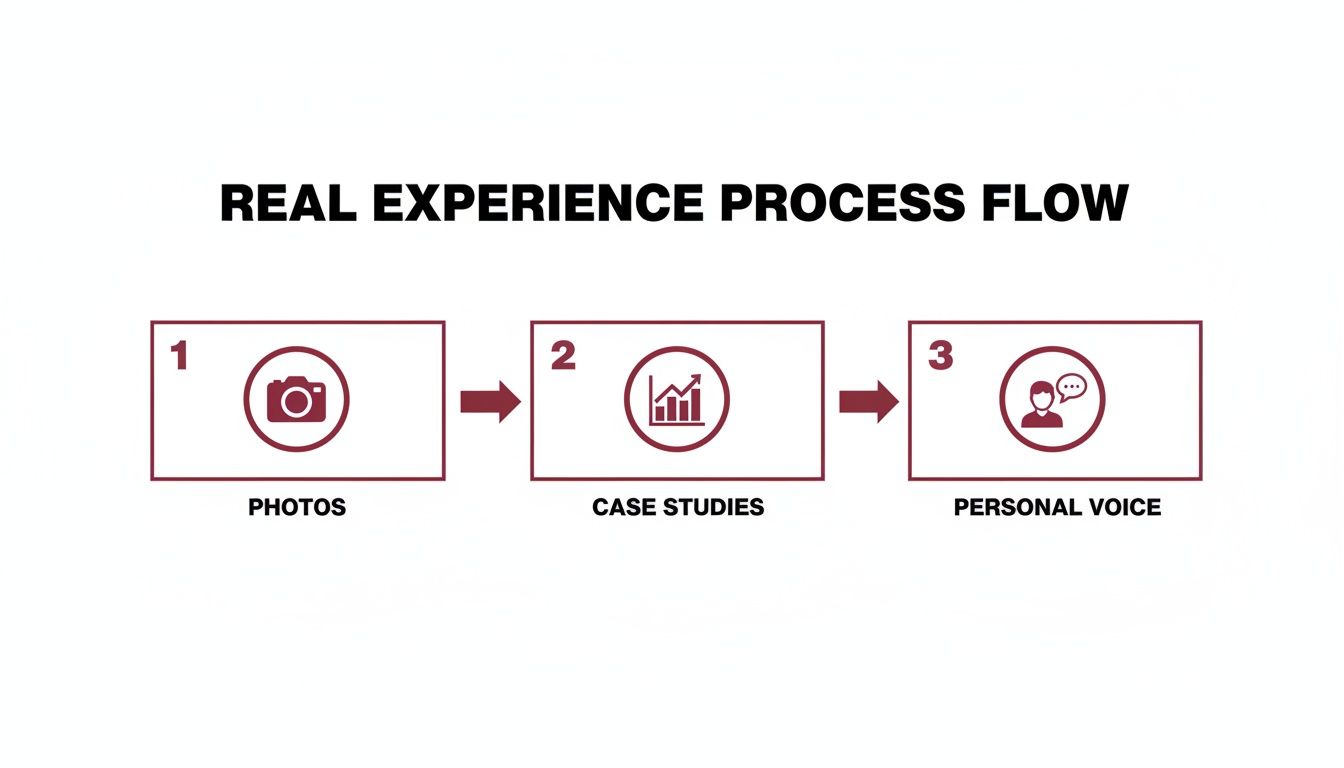
As the diagram shows, it’s a powerful flow: capture original visuals, build them into data-backed case studies, and wrap it all up in your personal, authentic voice.
Phase 2: Building Originality into Creation
Once you’ve found your opening, the next move is to bake originality right into your content creation process. This means you stop summarising other people's research and start generating your own insights.
A solid SEO content strategy is the backbone for delivering high information gain and making this E-E-A-T manifesto work for you.
Here are a few practical ways to do it:
- Interview Subject Matter Experts (SMEs): Your company is filled with experts. Grab 30 minutes with a technician, a sales lead, or a project manager. Their war stories, the common questions they hear from clients, and their on-the-ground insights are pure content gold.
- Leverage Proprietary Data: Do you have internal survey results, customer usage data, or performance metrics? This stuff is completely unique to your business and offers incredible value. Turn it into a chart, a case study, or a benchmark report.
- Experiment and Document: Run your own tests. Whether you’re comparing two software tools or trying out a new marketing tactic, documenting the entire process and sharing the results—the good, the bad, and the ugly—is a seriously powerful form of original content.
Content Audit Checklist for Information Gain and Originality
To keep yourself honest, use this checklist to audit your content before it goes live. It’s a quick way to see if you’re genuinely adding value or just adding to the noise.
| Audit Question | Yes/No | Action Item If 'No' |
|---|---|---|
| Does this content include unique data or insights not found elsewhere? | Conduct an internal interview or data pull. | |
| Are there original images, videos, or graphics included? | Schedule a photoshoot or create custom graphics. | |
| Does the piece answer questions left open by top-ranking articles? | Re-read competitor content; add a new section. | |
| Is a first-hand experience or personal story shared? | Weave in a relevant anecdote or case study. | |
| Does it challenge a common assumption or offer a new perspective? | Reframe the introduction to present a unique angle. | |
| Have you cited specific, real-world examples (not just theories)? | Replace generic examples with a customer story. |
Running through these questions helps you spot weaknesses early and ensures every piece you publish is a strong contributor to your brand's authority.
Phase 3: Choosing High-Impact Formats
Finally, pick a content format that naturally shows off your expertise and originality. Let's be real, some formats are just inherently better at demonstrating E-E-A-T than another standard blog post.
Think about giving these a go:
- The Expert Roundup: Instead of just your voice, bring in other recognised experts to share their take on a topic. This builds authority through association and provides diverse, original insights.
- The Myth-Busting Article: Find a common industry "best practice" and challenge it head-on with your own data or experience. This creates a strong, unique angle that gets people talking.
- The Step-by-Step Case Study: Walk your audience through a project from start to finish. Share the client brief, the process, the roadblocks you hit, and the final results—with real numbers and visuals. It’s the ultimate proof of experience.
By following this practical framework, you shift your content strategy from a reactive, algorithm-chasing chore to a proactive, value-driven process. You’ll stop trying to guess what Google wants and start creating the definitive resources that cement your brand as a true authority.
Measuring the Impact of High-Quality Content
So, you’ve put in the hard work creating content that’s genuinely original and packed with value. That’s fantastic. But how do you prove it’s actually moving the needle? Sure, you can point to keyword rankings and organic traffic, but those metrics don't paint the full picture.
To really understand the success of a strategy built on E-E-A-T, we need to dig into KPIs that show we're earning genuine user trust, not just appeasing an algorithm. This is all about connecting your great content to real business outcomes. When you track the right signals, you can show a clear return on investment and prove that your focus on experience and originality does more than just win clicks—it builds a loyal audience and fuels sustainable growth.
Moving Beyond Surface-Level Metrics
Let's be honest, most standard SEO dashboards are a bit one-dimensional. They shout about rankings and traffic volume, which is fine, but it can be deceptive. A page can hit number one but have a shocking bounce rate if it doesn't actually solve the user's problem. An E-E-A-T-driven approach demands a deeper look.
Start by looking at your Google Search Console data through a new lens. Hunt for queries where your click-through rate (CTR) is surprisingly high, even if you’re not in the top spot. That’s a massive signal that your title and meta description are promising something unique—something users are desperate to see.
A core tenet of our manifesto is this: Measure what matters to the user, not just the algorithm. High engagement, repeat visits, and unsolicited positive feedback are often stronger indicators of success than a fluctuating keyword position.
It’s about shifting your mindset from "Are we ranking?" to "Are we the most helpful result?" That second question is where the real, lasting insights are found.
Identifying Signals of Trust and Authority
True authority isn't something you can just build with backlinks. It’s earned by the way your audience actually interacts with your work. When you deliver real information gain, people respond in ways that send powerful trust signals back to search engines.
Keep an eye out for these indicators:
- Featured Snippet Wins: Nailing a featured snippet is Google’s way of saying it thinks your content is the clearest, most direct answer out there. It's a huge vote of confidence.
- Meaningful Comments and Shares: Forget simple vanity counts. Are people asking smart follow-up questions? Are they sharing your article with comments like, "This is the best explanation I've seen"? That’s gold.
- Branded Search Growth: Start tracking how often people search for your brand name plus a keyword (e.g., "Anitech SEO tips"). This shows you're becoming their go-to resource, the one they trust by name.
These engagement signals give you the qualitative proof that your content is truly connecting, building the kind of credibility that automated tools can never fully measure.
Connecting Original Content to Business Goals
At the end of the day, your content has a job to do for the business. The most powerful way to show its value is to draw a direct line from your E-E-A-T-focused content to conversions and customer loyalty.
The hunger for original, engaging content is massive. Think about it: video content is projected to claim 64% of all digital consumption in Australia by 2025. And it’s no surprise that 89% of marketers say it’s their best-performing asset. But success isn't just about views. Look at platforms like TikTok, where Aussies spend nearly 39 hours a month—they’re rewarding creators who bring a fresh, authentic perspective. You can dive deeper into Australia's marketing landscape and statistics to see just how big this trend is.
Here’s how you can connect your original content to the bottom line:
- Track Lead Quality: Use dedicated tracking URLs or forms on your best articles. Are the leads from your in-depth case studies converting at a higher rate than those from more generic pages? I bet they are.
- Analyse Conversion Paths: Jump into Google Analytics and see which pieces of content people read before they make a purchase or fill out an enquiry form. You’ll often find your most authoritative, experience-led content plays a vital, early role in that journey.
- Monitor Customer Lifetime Value (CLV): For any service-based or subscription business, this is crucial. Check if customers who found you through your best content stick around longer and have a higher CLV. It’s powerful proof you're attracting a more informed, loyal audience right from the start.
By tracking these more sophisticated metrics, you can build a compelling story that shows exactly how the information gain & originality: the E-E-A-T manifesto for content creators translates into real, measurable business success.
Your Questions Answered on the E-E-A-T Manifesto
Putting all this theory into practice is where the real work begins. It’s natural to have questions as you start shifting your content strategy. Let's tackle some of the most common ones we hear from fellow creators and marketers.
Can I Still Use AI in My Content Creation?
Of course. But the trick is to treat AI as a very clever research assistant, not the writer. Let it handle the grunt work—spitballing ideas, structuring an outline, or even summarising dense research papers. It's a brilliant way to get a head start.
Where you come in is to take that raw material and make it human. Your job is to meticulously fact-check everything, weave in your personal experiences, and add a perspective that a machine just can't fake. AI can build the skeleton, but you have to give it a soul.
Think of AI as the tool that frees you up from the tedious stuff. This gives you more time to focus on what truly matters: conducting original research, sharing personal stories, and offering a genuinely expert point of view.
How Much 'Experience' Is Enough to Showcase?
There isn't a hard-and-fast rule here. The real goal is to be demonstrably authentic. You don't need a PhD or ten years in the field to have something valuable to say. Sometimes, just a few months of getting your hands dirty can uncover insights that a complete newcomer would find incredibly valuable.
The key is to focus on what makes your experience distinct. Don't just make broad claims; get specific with your examples.
- Instead of: "I have experience with this software."
- Try this: "After using this software for three months, I found a clever workaround for its most annoying bug. It ended up saving our team about five hours a week."
It's not about the length of your experience, but the genuine, useful insights you pull from it. You have to show it, not just say it.
Does This Manifesto Apply to All Types of Content?
Yes, absolutely. The core ideas behind the Information Gain & Originality: The E-E-A-T Manifesto for Content Creators are universal. How you apply them will change depending on the format, but the philosophy remains the same.
- For a product review: It means taking your own photos, not using stock images, and being honest about the little flaws you found after a week of use.
- For an eCommerce category page: It could be as simple as adding a short buyer’s guide written by an in-house expert explaining how to choose the right product for your needs.
- For a social media post: It’s about sharing a real behind-the-scenes moment or a lesson you learned the hard way, not just another generic motivational quote.
Every single piece of content you publish is a chance to deliver something unique and build a little more trust with your audience.
How Long Before I See Results from This Approach?
Let’s be clear: this is a long-term play, not a quick-win ranking hack. Focusing on E-E-A-T is about building genuine authority, and that takes time. While you might see some encouraging signs early on—like better engagement metrics and longer time on page—you should expect significant ranking improvements to take several months to materialise.
The key is patience and consistency. Keep your focus on creating the single most helpful, original, and experience-rich resource available on a given topic. Eventually, both your audience and the search engines will catch on, rewarding your hard work with better rankings, deeper trust, and the kind of organic growth that lasts.
Ready to stop chasing algorithms and start building real authority? The team at Anitech lives and breathes data-driven SEO that creates content that stands out. Book your free consultation with us today and let's build something great together.