Quick Summary: An SEO audit is a comprehensive health check for your website, analyzing technical, on-page, and off-page factors to identify issues hindering your search engine rankings. This guide details the process, common problems uncovered, typical costs, and how to choose the right SEO audit services for sustainable business growth.
Think of professional SEO audit services as a full diagnostic check-up for your website. It’s designed to figure out precisely what’s stopping you from getting the rankings and traffic you deserve from search engines like Google. Essentially, it’s a deep dive into your site's technical health, the quality of your content, and your overall authority online. The result isn't just a list of problems; it's a clear, actionable roadmap for improvement. For any business serious about growing through search, it’s the non-negotiable first step.
Unlocking Your Website's True Potential with an SEO Audit
Imagine you’ve built a fantastic shop in a busy city. You’ve got great products and a brilliant team, but for some reason, the front door is locked, the signs are confusing, and nobody knows you're even there. That's what it's like having a website with underlying SEO issues. You could have the best-looking site in the world, but if Google can't find it, index it, or understand what it's about, you're invisible to potential customers.
An SEO audit is like hiring a master locksmith, a sign writer, and a town crier all in one. It’s not just about identifying what's broken; it's about finding all the missed opportunities. An audit gives you a detailed, prioritised list of exactly what to fix to improve your website's performance, make your visitors happier, and ultimately, grow your business. It takes the guesswork out of the equation.
The Foundation of Sustainable Growth
Trying to do SEO without an audit is like driving from Sydney to Perth without a map or GPS. You might head in the right general direction for a while, but you’ll inevitably take wrong turns, waste fuel, and probably get hopelessly lost. With over 50% of users finding new companies through search, you can't afford to leave your visibility to chance.
A proper audit brings strategic clarity. It forces you to answer the tough but essential questions:
- Can Google and other search engines actually crawl and understand our pages properly?
- Are we creating content that genuinely helps our target audience?
- Is our website fast, secure, and easy to use on a mobile phone?
- Do other trusted websites link to us, vouching for our authority?
By systematically working through these areas, an audit provides the blueprint to turn your website from a static online brochure into a dynamic, lead-generating asset for your business. It’s the strategic foundation you need to compete and win online.
More Than Just a Report
The last thing you need is a 100-page document filled with technical jargon that leaves you more confused than when you started. A good SEO audit isn't about the report itself; it’s about the actionable strategy that comes out of it—a strategy that's tied directly to your business goals.
Whether you want to drive more organic traffic, get more qualified leads through the door, or boost online sales, the insights from an audit are where it all begins. It’s the most reliable way to get a true picture of where you stand today and build a solid plan for all your future marketing, ensuring every dollar you spend pushes your business forward.
The Three Pillars of a Comprehensive SEO Audit Service
A proper SEO audit isn't just a quick scan; it's a deep, methodical investigation into your website's health, built around three core pillars. Think of it like a thorough building inspection. You need to check the foundations (Technical), the interior layout and function (On-Page), and the building's reputation in the neighbourhood (Off-Page). You can only get a true picture of your site's strength and potential by examining all three.
This flowchart breaks down how these three pillars work together to support your overall website health.
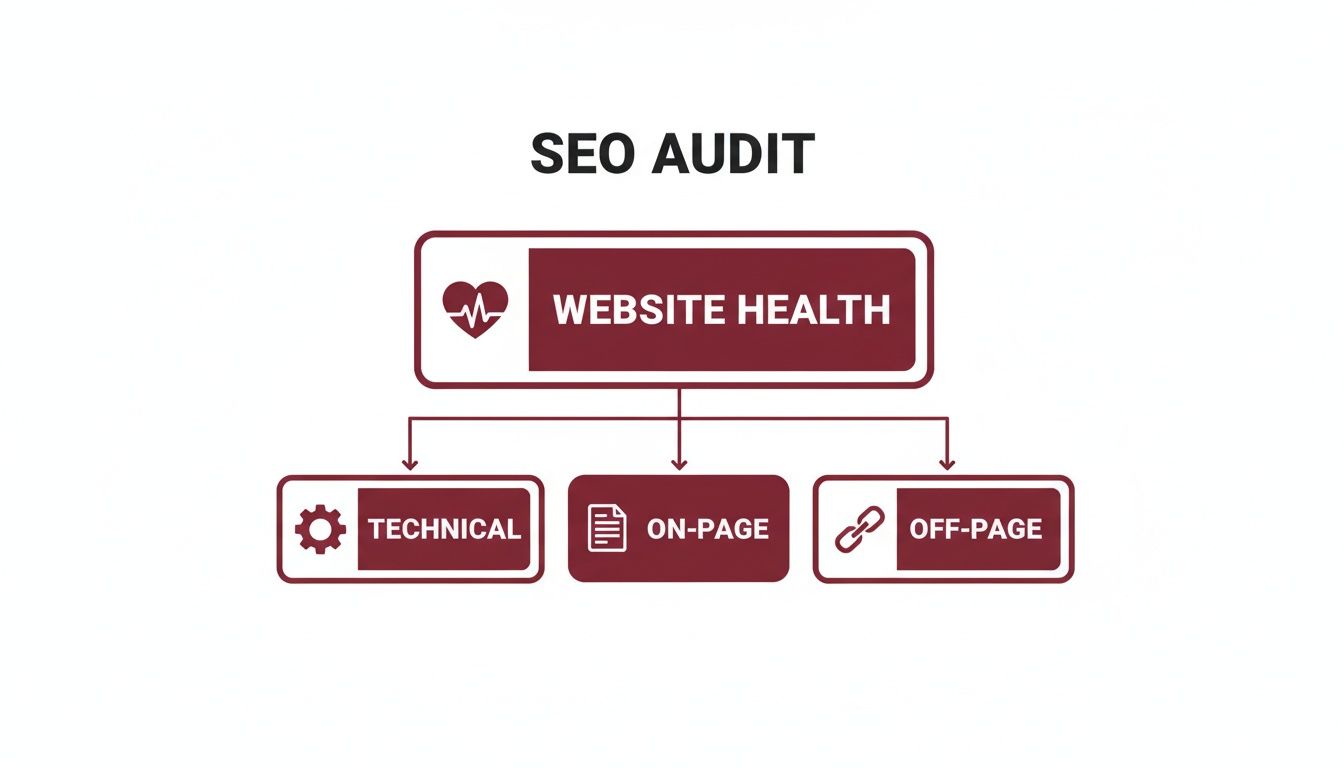
As you can see, a healthy, high-ranking website relies on the seamless integration of technical integrity, relevant content, and external authority. Let's break down each one.
The table below summarises the core focus of each pillar and the specific checks we perform.
Three Pillars of a Professional SEO Audit
| Audit Pillar | Primary Focus | Key Checks |
|---|---|---|
| Technical SEO | How easily search engines can access and understand your site's infrastructure. | Crawlability, indexability, site speed (Core Web Vitals), mobile-friendliness, XML sitemaps, robots.txt, and site architecture. |
| On-Page SEO | The relevance and quality of the content on individual pages. | Keyword strategy, content quality, title tags, meta descriptions, header usage (H1s, H2s), and internal linking structure. |
| Off-Page SEO | Your website's authority and reputation across the wider internet. | Backlink profile health, toxic link identification, competitor backlink gaps, and brand mention analysis. |
Now, let's explore what each of these pillars really means for your business.
Pillar 1: The Technical SEO Audit
The technical audit is the bedrock of your online presence. It’s all about making sure search engines like Google can find, crawl, and index your website without hitting any roadblocks. A professional SEO audit, much like a complete domain health check, digs into the technical foundations of your website to ensure everything is running smoothly behind the scenes.
After all, even the most amazing content will fail to rank if your site has critical technical flaws. An audit here looks for those invisible issues that stop search engine bots in their tracks.
Key areas we investigate in a technical audit include:
- Crawlability and Indexability: Can search engines actually see all your important pages? This means checking your
robots.txtfile, XML sitemaps, and meta tags to ensure you aren't accidentally hiding your best content. - Site Speed and Core Web Vitals: With over 75% of users never scrolling past the first page of search results, a slow website is a conversion killer. We assess loading times, interactivity, and visual stability to make sure your site is fast.
- Mobile-Friendliness: Most searches now happen on mobile, so this is non-negotiable. The audit tests whether your site is truly responsive and offers a great experience on smartphones and tablets.
- Site Architecture: A logical site structure helps both users and search engines find what they need. This check looks at your URL structures, internal linking patterns, and the overall site hierarchy to make sure it makes sense.
A technical audit ensures your website is built on solid ground. Without a technically sound foundation, all your other SEO efforts—from content creation to link building—can be severely undermined.
Pillar 2: The On-Page SEO Audit
While the technical audit checks the engine, the on-page audit inspects the car's interior—the content and structure of your individual pages. This pillar is all about optimising the elements you can directly control to make your content more relevant and understandable to both people and search engines.
The goal here is simple: align your pages with the specific things your target audience is searching for. It’s about ensuring that when someone lands on your page, they know they've found exactly what they were looking for.
An on-page audit typically analyses:
- Keyword Strategy: Are you targeting the right keywords? The audit assesses how you're using keywords, identifies "keyword cannibalisation" (where your own pages compete against each other), and uncovers new opportunities.
- Content Quality: Does your content actually answer the user's question properly? This involves checking for thin or duplicate content and making sure every page provides genuine value.
- HTML Elements: This is about optimising your title tags, meta descriptions, and header tags (H1, H2, etc.) to clearly signal what each page is about to search engines.
- Internal Linking: Smart internal links guide users and search bots to your most important content, spreading authority (or "link equity") throughout your site.
Pillar 3: The Off-Page SEO Audit
The final pillar, off-page SEO, looks beyond your own website to measure its authority and reputation across the internet. It’s almost entirely focused on your backlink profile—the collection of links pointing to your site from other websites.
In Google's eyes, a backlink from a reputable site is like a vote of confidence. A strong backlink profile tells Google that your site is a trustworthy, valuable resource, which directly helps you rank higher.
This audit involves a deep dive into:
- Backlink Profile Analysis: We identify who is linking to you, the quality of those websites, and the anchor text they use.
- Toxic Link Identification: Not all links are good. Links from spammy or low-quality sites can actively harm your rankings. An audit flags these so they can be removed or disavowed.
- Competitor Backlink Analysis: By digging into your competitors' backlink profiles, we can uncover golden opportunities to earn high-quality links from authoritative sources in your industry.
What to Expect During the SEO Audit Process
Signing up for a professional SEO audit can feel a bit like a leap of faith. You're handing over access to your website, but what actually happens behind the scenes? It’s not a mysterious black box. A proper audit is a structured, methodical process that moves from initial discovery to a crystal-clear, actionable strategy.
Understanding the journey helps demystify the entire experience. It’s a collaborative effort designed to ensure the final recommendations are perfectly matched to what your business actually needs to achieve.
Phase 1: Initial Discovery and Goal Alignment
It all starts with a conversation. Long before any fancy tools are fired up or a single line of data is analysed, a good SEO partner needs to get under the hood of your business. This first kickoff meeting is absolutely crucial for setting the audit up for success.
The focus here is entirely on your goals. Are you trying to ramp up e-commerce sales? Generate more qualified leads for your service team? Or maybe you want to completely dominate the local search results in your area. Your answers shape the entire direction of the audit.
During this phase, we'll work through:
- Defining Business Objectives: We go beyond just "we want more traffic." We need to know what that traffic should do for your bottom line.
- Identifying Key Competitors: Sizing up the competition helps us benchmark your performance and spot strategic gaps we can exploit.
- Reviewing Past SEO Efforts: A quick look at what’s worked (and what hasn’t) in the past provides valuable context and helps us avoid repeating old mistakes.
Getting this alignment right from the start ensures the audit is a strategic project tied directly to your business growth, not just a technical checklist.
Phase 2: Deep Dive Data Collection
With clear goals locked in, it’s time to gather the data. And a lot of it. This phase is all about collecting a mountain of information about your website and how it sits within the broader digital ecosystem. Expert analysts use a whole suite of powerful tools to get a complete, 360-degree view of your site's health.
Think of it like a full diagnostic work-up at the doctor's office. Just as a doctor runs blood tests and scans to see what's happening internally, SEO experts use specialised software to uncover problems that are impossible to spot on the surface.
Common tools and data sources include:
- Google Search Console: This gives us direct insights from Google itself on things like indexing status, mobile-friendliness, and clicks from search.
- Google Analytics: This is where we find crucial data on user behaviour, where your traffic is coming from, and how well your site converts visitors into customers.
- Crawling Software (like Screaming Frog): This software crawls your site just like a search engine bot would, quickly flagging technical errors like broken links or messy redirect chains.
- Third-Party Platforms (like Ahrefs or SEMrush): We use these for deep dives into your backlink profile, keyword opportunities, and what your competitors are up to.
A vital part of this process involves setting up robust rank tracking to get a baseline of where you currently stand for your most important keywords. This gives us a clear starting line so we can measure the impact of our work down the track.
Phase 3: Analysis and Strategic Prioritisation
This is where the real expertise comes into play. Raw data on its own is pretty useless; the magic happens during the analysis. This is all about turning that mountain of information into strategic, prioritised actions.
SEO specialists sift through all the data, looking for patterns, diagnosing the root cause of problems, and connecting the dots between a technical issue and its impact on your business.
The goal isn't to find every single tiny flaw. It's to identify the handful of issues that will deliver the biggest positive impact on your performance once they're fixed. Prioritisation is everything.
An analyst will typically sort findings based on two simple factors:
- Impact: How much is this problem hurting your SEO performance and business goals?
- Effort: How difficult or resource-intensive is the fix?
This simple framework helps create a logical roadmap. We can tackle the "quick wins" for an immediate boost while simultaneously planning for the more complex, high-impact projects.
Phase 4: Reporting and Strategy Presentation
The final step is to translate all of those complex findings into a report that is clear, understandable, and most importantly, actionable. The last thing you need is a 100-page document filled with impenetrable jargon. A great audit deliverable is a strategic guide, not just a laundry list of problems.
This is usually presented in a meeting where the agency walks you through the key findings, explains what they mean in plain English, and outlines the recommended next steps. It's your chance to ask questions and make sure you're completely comfortable with the proposed strategy.
This commitment to clear, results-focused work is becoming the standard. The Australian digital agency market is booming, projected to hit USD $165.29 billion by 2030. This incredible growth shows just how critical professional SEO has become for Aussie businesses, where transparency and measurable results are now non-negotiable. Investing in a clear, actionable audit isn't just a good idea—it's essential for staying competitive.
Common Problems an SEO Audit Will Uncover
The real magic of an SEO audit is how it turns confusing, invisible problems into a clear, actionable plan. It’s like switching on a spotlight in a dark room, suddenly revealing all the technical glitches and strategic missteps that have been holding your website back from its true ranking potential.
Think of it as a complete diagnostic report for your website's health. It goes way beyond just looking at symptoms and gets right to the root causes of why you aren't getting the organic traffic you deserve.

So many businesses are shocked to discover their beautifully designed website is actually full of issues that make it incredibly difficult for Google to understand and trust. These problems are almost never obvious to the casual visitor, but to a search engine crawler, they're massive roadblocks. A professional audit systematically finds every single one, turning that vague feeling of "we should be ranking better" into a step-by-step repair manual.
Critical Technical SEO Issues
Technical problems are the silent killers of any SEO campaign. They're the foundation of your website, and if that foundation is cracked, everything else you build on top—great content, outreach, social media—is at risk of collapsing. Here are some of the most common and damaging issues we uncover with our SEO audit services.
- Slow Page Speed: In today's fast-paced world, a slow website is a deal-breaker. If your pages take more than a couple of seconds to load, people will click away in frustration, and you can be sure Google is taking notes. An audit analyses your Core Web Vitals and pinpoints the exact culprits, like massive image files or clunky code.
- Indexation Errors: This one is fundamental but surprisingly common. It’s when Google simply can't find or "index" your most important pages. This could be due to a simple mistake in your
robots.txtfile or a stray "noindex" tag, which essentially makes your key content invisible to anyone searching for it. - Poor Mobile Experience: The majority of searches now happen on a phone, so a clunky mobile site is no longer just an annoyance; it's a liability. An audit will flag things like text that’s too small, buttons that are too close together, or a design that doesn't adapt to different screens—all of which frustrate users and hurt your rankings.
Pervasive On-Page and Content Problems
Once we get past the technical nuts and bolts, a good audit digs deep into your on-page content and the way your site is structured. This is where many well-meaning strategies go wrong, often creating a confusing mess for both people and search engines. An audit tells you exactly where your content efforts are falling flat.
In fact, a lot of businesses have issues that are actively penalising their rankings without them even knowing it.
One of the most common—and most misunderstood—on-page issues is "keyword cannibalisation." This is where you have multiple pages on your own website all competing for the same keyword. You're essentially splitting your own authority and confusing Google about which page it should rank.
Confusing Site Structure and Content Quality
A disorganised website is like a library with no filing system. It’s frustrating for visitors trying to find information and a nightmare for search engines to navigate. An audit carefully assesses your site's architecture to make sure it's logical, intuitive, and easy for everyone to use.
Common structural and content problems we find include:
- Thin or Duplicate Content: Pages with very little unique text offer almost no value and can be flagged by Google. Similarly, having the same content copied and pasted across multiple pages is a big red flag that can damage your site's credibility and rankings.
- Confusing Site Structure: A site structure that is too deep or doesn't follow a logical path makes it hard for search engine bots to crawl all your pages. It also makes it difficult for users to find what they're looking for. We identify ways to create a simpler, more intuitive layout that helps everyone.
- Keyword Cannibalisation: As mentioned, this is a classic self-inflicted wound. You’re fighting yourself for rankings. An audit will pinpoint every instance of this and lay out a clear strategy to fix it, which might involve merging content or re-focusing keywords so that every page has a unique, powerful purpose.
So, What's an SEO Audit Going to Cost?
Let's get straight to the point. One of the first questions on every business owner's mind is, "How much is this going to set me back?" It's a fair question, and understanding the investment is key to planning your budget.
There’s no single price tag for a professional SEO audit. The cost really depends on the depth and complexity of the analysis needed to build a strategy that actually moves the needle.
Think of it like a building inspection. A quick once-over of a small apartment is one thing; a full structural analysis of a massive commercial high-rise is something else entirely. Your website works the same way.
What Drives the Price of an Audit?
A few key factors determine the final quote. It's not just about the hours an expert puts in; it’s about the size and complexity of the digital property they're digging into.
- Website Size and Complexity: This is the big one. A five-page website for a local plumber is a world away from a sprawling e-commerce site with thousands of products, tricky filtering systems, and multiple subdomains. More pages mean more data to crawl, process, and make sense of.
- Depth of Analysis: Are you after a basic health check that catches the most glaring errors? Or do you need a comprehensive deep dive that scrutinises every nut and bolt of your technical, on-page, and off-page SEO? The latter might even involve things like log file analysis and a forensic look at your competitors' backlink profiles.
- Specialised Requirements: Sometimes you need an audit for a specific, high-stakes situation. Getting ready for a complicated site migration or trying to recover from a Google penalty demands a much higher level of expertise and meticulous work, and the price will reflect that.
Typical Price Ranges in Australia
To give you a ballpark idea, here’s what you might expect to see in the Australian market. For foundational optimisation projects in 2026, businesses are often looking at a range of $3,000 to $6,000. For a more intense job like a site migration audit, the investment can be anywhere from $3,500 to $10,000.
After that initial audit and fixing the major issues, many small businesses then budget around $1,400 to $2,500 per month for ongoing SEO to keep their momentum going. You can dig deeper into these Australian market trends to get a better feel for the investment.
See an SEO audit as an investment, not just a cost. The price is tied directly to the value you get: a clear, prioritised roadmap to fix problems that are costing you money and to find new growth opportunities that can deliver a massive return.
Knowing these factors helps you make a smarter decision when you're looking at quotes. You're not just comparing numbers; you're assessing how thoroughly an agency is prepared to investigate your website's potential. A cheap audit that barely scratches the surface might seem like a win now, but it’s the proper, in-depth analysis that gives you the strategic clarity to drive real, lasting growth.
How to Choose the Right SEO Audit Partner
The success of your SEO audit really comes down to one thing: the expertise of the provider you choose. This isn't just about hiring a technician to run a report; it's about finding a strategic partner who can turn a list of findings into a genuine roadmap for business growth.

A top-tier agency won’t try to dazzle you with flashy promises. Instead, they'll focus on what truly matters—proven, measurable results. Your job is to find someone who has a track record of turning audit insights into more traffic, better leads, and higher revenue for businesses just like yours.
Look for Proven Results, Not Vague Promises
Start by digging into their case studies and client testimonials. Don't just give them a quick glance; you're looking for specific data and clear outcomes. A great case study doesn't just say, "we improved rankings." It shows you the before-and-after data for organic traffic, keyword positions, and maybe even conversion rates.
As you look through their work, ask yourself:
- Do their case studies feature businesses in my industry or of a similar size?
- Are the testimonials detailed? Do they mention the specific challenges, the process, and the results?
- Can they clearly explain how the audit findings led directly to business growth?
This evidence-based approach is your best filter. It helps you weed out the agencies that talk a big game but don't have the runs on the board. Proven results are your most reliable indicator of future success.
Ask the Right Questions About Their Process
Once you have a shortlist, it's time to get a feel for their methodology. The right questions will quickly show you whether they offer a tailored strategy or just a generic, one-size-fits-all report. A cookie-cutter approach is a waste of time because every website has its own unique set of problems and opportunities.
A huge differentiator is transparency. A partner you can trust will be completely open about the tools they use, the metrics they track, and how they decide what to fix first. If their process feels like a mysterious "black box," that's a major red flag.
The Australian market for SEO audit services has matured, and a comprehensive audit will typically cost between $2,000 and $5,000. It's a significant investment, but when you consider that up to 43% of vital ranking signals are often missing or misconfigured on a typical website, you can see the huge potential for improvement. You can learn more about the value of professional SEO audits and why a thorough process is so important.
Red Flags to Watch Out For
Finally, keep your eyes peeled for warning signs that you might be dealing with an unreliable or outdated provider. It’s best to steer clear of any agency that:
- Guarantees #1 rankings: This is the oldest trick in the book. No one can guarantee specific rankings on Google, and promising it is a sign they might be using shady tactics.
- Lacks transparency: If they’re secretive about their methods or won’t give you clear, straightforward reporting, you should walk away.
- Focuses only on keywords: Modern SEO is a complex beast. It’s about technical health, user experience, and content quality—not just stuffing keywords onto a page.
- Uses a "one-size-fits-all" package: Your business is unique. Your SEO audit needs to be, too.
Choosing the right partner is what turns your audit from a simple document into a powerful strategic asset. It ensures your investment leads to sustainable, long-term growth.
Got Questions About SEO Audits? We've Got Answers.
Even with a good grasp of the process, it’s completely normal to have a few questions before you commit to a professional SEO audit. We get it. You want to be sure it's the right move for your business.
So, let's tackle some of the most common queries we hear from Australian business owners. The goal here is to clear up any lingering doubts and give you the confidence to take the next step.
How Long Does a Proper SEO Audit Actually Take?
This is a classic "how long is a piece of string?" question, because the answer really depends on the size and complexity of your website. A deep-dive analysis isn't something that can be knocked out in an afternoon; it takes time to gather the data and connect the dots properly.
For a small local business website with maybe 10-20 pages, a solid audit could take one to two weeks. But for a large e-commerce site with thousands of products, intricate filtering, and years of backlink history? You're looking at four to six weeks, or sometimes even longer. That extra time is essential for digging into every corner of the site without missing anything crucial.
A rushed audit is a wasted audit. It'll skim the surface and miss the deep-seated problems that are really holding you back. The aim is to be thorough, not just fast.
Okay, the Audit Is Done. What Happens Next?
Think of the audit report not as the finish line, but as the starting blocks. It’s your strategic blueprint for climbing the search rankings.
Once we’ve finished the analysis, you’ll get a detailed report that lays everything out. A good agency won’t just dump a 50-page PDF on you and disappear. The report should include:
- A complete rundown of every issue we found, from critical technical glitches to missed content opportunities.
- A prioritised to-do list, showing you what to fix first for the biggest impact (the 'quick wins') versus what can wait.
- A clear, actionable roadmap outlining the exact steps to take to fix everything.
Most importantly, any partner worth their salt will schedule a call to walk you through the findings. They'll translate the technical jargon into plain English, answer all your questions, and work with you to figure out the best way to implement the changes—whether it’s with your team, their team, or a bit of both.
Is One SEO Audit a "Set and Forget" Fix?
Definitely not. While that first big audit is incredibly powerful for setting a new foundation, SEO is a moving target.
The online world never sits still. Google rolls out hundreds of algorithm updates every year, your competitors are constantly trying to get ahead, and you're adding new content and making changes to your own site. Treating an SEO audit as a one-and-done task is a surefire way to fall behind again.
A much smarter approach is:
- Start with a comprehensive deep-dive audit to get a clean bill of health and a clear strategy.
- Schedule an annual health check to review your overall progress and adapt to any major shifts in the SEO landscape.
- Conduct regular quarterly check-ups to monitor performance, catch new technical gremlins before they cause real damage, and fine-tune your strategy on the fly.
This ongoing cycle keeps your website in peak condition, competitive, and in line with what search engines want to see. It’s about protecting your investment for the long haul.
Ready to uncover what’s really going on with your website and build a clear plan for growth? Anitech offers comprehensive SEO audit services designed for Australian businesses like yours. Get your free consultation today and let's start mapping out your path to the top of Google.