Quick Summary: This in-depth guide moves beyond theoretical E-E-A-T advice to provide a practical roadmap for engineering first-hand experience into your content. Learn to showcase author credibility, leverage proprietary data, build compelling case studies, and implement an expert-led editorial workflow to boost your content credibility, align with Google's quality guidelines, and achieve measurable SEO growth.
Let's get one thing straight: the old SEO playbook is officially obsolete. For years, we could get away with clever keyword placement and technical box-ticking. But Google's game has changed, and now it wants proof that you actually know your stuff from real, hands-on experience. This shift is central to building E-E-A-T & content credibility, making it a non-negotiable part of modern digital strategy.
This guide is about systematically engineering that 'Experience' factor into your content. We're moving beyond theory and into a practical roadmap for showing, not just telling, your expertise. We'll dig into everything from showcasing author credibility and weaving in real-world evidence to building an editorial process that puts your unique insights right where they belong—front and centre, demonstrating first-hand involvement at every turn.
This isn't just another algorithm tweak. It's a fundamental shift in how Google defines valuable content. The search engine is actively prioritising unique, first-hand perspectives over articles that just rehash what everyone else is saying. This is the new standard for content credibility.
The Rise of the 'Experience' Factor
When Google officially added the first 'E' for Experience to its Search Quality Rater Guidelines, it was a massive signal to all of us in the industry. It means content created by someone who has lived and breathed the topic is now seen as inherently more valuable. This is the cornerstone of engineering experience into content.
For any Australian business, this is a golden opportunity to get ahead.
Your unique business journey, your client success stories, and your hard-won, on-the-ground learnings are no longer just marketing fluff—they are your most powerful SEO assets.
To really nail this, you need to understand how Experience fits into the broader E-E-A-T framework. These four pillars work together to build your digital reputation and prove your credibility.
E-E-A-T Pillars at a Glance
Here’s a quick breakdown of the four pillars that now define content quality in Google's eyes. Think of them as the essential ingredients for building a reputation that both users and search engines will trust.
| Pillar | What It Means | Why It Matters for Australian Businesses |
|---|---|---|
| Experience | The content creator has demonstrable, first-hand involvement with the topic. | It allows you to leverage local knowledge, specific client results, and unique market insights that competitors can't easily replicate. |
| Expertise | The creator possesses the necessary skills and knowledge in the field. | This validates your professional qualifications and positions your brand as a knowledgeable leader in the Australian market. |
| Authoritativeness | The creator or website is widely recognised as a go-to source in the industry. | Building authority through local citations, industry mentions, and backlinks helps you dominate relevant search results in your region. |
| Trustworthiness | The website and its content are accurate, honest, and safe for users. | Trust is paramount for conversions. Clear contact information, secure transactions (HTTPS), and positive reviews build user confidence. |
Getting a handle on how these elements interconnect is the first real step. It’s the foundation for creating content that doesn't just rank, but also resonates with a real audience and builds lasting credibility.
Building Content Credibility with Author and Brand Signals
Long before someone reads the first sentence of your article, they’re already sizing you up. They're asking, almost subconsciously: Who wrote this? What’s their background? And can I really trust this brand? This initial assessment is critical for establishing E-E-A-T & content credibility.
These first impressions are crucial. They set the stage for both user trust and how search engines perceive your content. This is where engineering ‘Experience’ begins—not in the body of a blog post, but in the signals you send about who you are and the first-hand involvement that backs your claims.
The goal is to lay a foundation of trust by showcasing the real people and the genuine journey behind your brand. It’s all about creating an immediate sense of credibility that makes your audience want to lean in and listen.

Crafting Author Bios That Prove Real-World Experience
A generic author bio is a massive missed opportunity. It has to do more than just list a name next to a headshot. Think of it as a compact credibility report that directly answers the reader’s unspoken question: "Why should I listen to you?"
This is your chance to showcase tangible achievements and direct, hands-on involvement. Get specific.
Here’s how to craft a bio with real impact:
- Show, Don't Tell: Instead of a vague "experienced marketer," write "Grew organic traffic by 300% for B2B tech clients." Numbers are proof of first-hand involvement.
- List Relevant Credentials: Include degrees, certifications, or industry awards that directly relate to the topic at hand.
- Quantify Experience: Stating you have "10+ years of hands-on experience in Australian SEO" instantly establishes a deep well of knowledge.
- Link to a Real Person: Always link out to an active, professional LinkedIn profile or a personal portfolio. This validates that a real, verifiable expert is behind the words.
This isn’t just good practice; it gets results. In the Australian SEO space, we see that websites showcasing clear author expertise tend to rank approximately 25% higher on average in Google's search results. It’s a clear signal that E-E-A-T directly impacts organic growth. If you want to dig deeper, you can discover more insights about the E-E-A-T framework from local experts.
Turning Your About Us Page into a Trust-Building Story
Your 'About Us' page is prime real estate, yet so many businesses treat it like a dusty archive. It shouldn’t be a dry, corporate history lesson. It should tell the story of your brand's journey, its mission, and the incredible team making it all happen. This page is a powerhouse for establishing brand-level authoritativeness and trustworthiness. It's your chance to prove you’re a legitimate, experienced, and passionate operation with deep first-hand involvement in your industry.
Your 'About Us' page shouldn't just state facts; it should tell a story. It needs to capture your journey, your values, and the collective expertise that makes your company a credible voice in its field.
To weave a narrative that builds genuine trust, make sure you include these elements:
- The Origin Story: Why did you start the company? What problem in the Australian market did you set out to solve? A relatable founding story creates a powerful connection and demonstrates your long-term involvement.
- Key Milestones: Showcase your growth and big wins. Mentioning major client successes or industry awards provides compelling social proof of your experience.
- The Team Behind the Brand: Feature your key people. Short bios highlighting their collective experience put a human face on your brand and show the depth of your organisation’s expertise.
- Real Customer Wins: Integrate client success stories or powerful testimonials. A direct quote from a happy Australian business is one of the most powerful forms of third-party validation you can get.
By transforming these pages from simple placeholders into rich, evidence-backed narratives, you send incredibly strong E-E-A-T signals. You show that your brand isn't some faceless machine, but a dedicated team of professionals who live and breathe their craft. That’s a powerful foundation for every piece of content you publish.
Infusing Your Content with First-Hand Experience
Strong author and brand signals set the stage, but the real magic of E-E-A-T happens when you embed genuine, first-hand experience directly into the fabric of your content. This is where you stop just saying who you are and start proving what you know. It’s about sharing those unique insights that can only come from being in the trenches. This is the essence of engineering experience into content.
Generic advice is a commodity. Anyone can write it. Your true competitive edge lies in creating content that others simply can't replicate because it's built on your unique business journey. Let's dig into the practical ways to weave your experience into every article, transforming them from theoretical guides into assets backed by hard evidence.

Leverage Proprietary Data and Original Research
One of the fastest ways to signal deep experience is to share data no one else has. You don't need a massive research budget for this, either. Your business is already sitting on a goldmine of proprietary information derived from your first-hand involvement.
Think about the unique data points you collect every single day. This could be anything from customer behaviour trends and internal performance metrics to observations from your service delivery. When packaged correctly, this becomes a powerful signal of credibility.
Here are a few ways to generate original insights without breaking the bank:
- Anonymised Client Data: Pool together and anonymise data from your client work to illustrate a point. For instance, an agency like ours could confidently state that "our Australian e-commerce clients saw an average 35% increase in organic conversions after implementing a targeted local SEO strategy." This is specific, numeric, and based on real work.
- Simple Industry Surveys: Use free or low-cost tools like Google Forms or SurveyMonkey to poll your email list or social media followers on a relevant industry topic. Publishing the results gives you an exclusive dataset to build content around.
- Internal Case Studies: Turn the microscope on your own business. Did you recently overhaul your lead nurturing process? Document the exact steps you took, the tools you used, and the results you achieved. Internal wins make for fantastic public proof of expertise.
Grounding your content in original data instantly makes it a more authoritative resource. Not only does this build trust with your audience, but it also creates an asset that other publications will want to cite and link to, further boosting your authoritativeness online.
"Original research isn't just about big numbers; it's about sharing a perspective that only you can offer. It’s the ultimate proof that you’re a participant in your industry, not just an observer."
Build Compelling Case Studies and Narratives
A well-structured case study is more than just a report; it's storytelling with proof. It’s probably the clearest way to walk a reader from a problem they recognise to a solution you provided, all backed by tangible, real-world results from your first-hand involvement.
Forget those dry, technical documents nobody reads. A truly powerful case study follows a simple, compelling structure that really resonates with potential customers.
The Problem-Action-Result Framework
To make your case studies hit home, structure them around this proven narrative arc. This framework makes your experience feel relatable and is incredibly easy for readers to digest.
- The Problem: Kick things off by clearly defining the challenge the client was facing. Use specific, vivid details that your target audience will immediately identify with. For example, "A Melbourne-based retailer was struggling with low local search visibility, consistently losing foot traffic to the larger chains down the road."
- The Action: Now, detail the specific steps you took to tackle the problem. This is where you get to show off your methodology and expertise. Crucially, explain the why behind your actions, such as, "We conducted a comprehensive GMB audit, cleaned up their citations, and built out location-specific service pages to start targeting valuable 'near me' queries."
- The Result: Finally, quantify the outcome with hard numbers. This is the knockout punch—the undeniable proof that your actions worked. Use concrete metrics like, "Within three months, the retailer achieved a 200% increase in map pack visibility and a 40% rise in in-store visits that originated from organic search."
This storytelling approach does more than just present facts; it showcases your problem-solving skills in a real-world context that a potential client can see themselves in.
Weave In Personal Anecdotes and "In-the-Trenches" Insights
Lastly, never underestimate the power of your personal stories and on-the-job learnings. AI can spit out factual content all day long, but it cannot replicate the nuance, wisdom, and scar tissue that comes from years of hands-on work.
Infusing your content with these human elements makes it far more engaging and authentic.
- Share Lessons from Failures: Talking about what went wrong and what you learned is an incredibly powerful trust signal. It shows humility, vulnerability, and a deep understanding of your craft.
- Use "I" and "We": Don't be afraid to write from a first-person perspective. Simple phrases like, "In my experience…" or "One thing we found that surprised us was…" make the content feel more personal and authoritative.
- Provide Niche, Specific Tips: Go beyond the generic best practices everyone else is repeating. Share that one hyper-specific tip you learned from a particularly tricky client situation. This proves you've dealt with complex, real-world scenarios.
By consistently infusing your content with proprietary data, well-structured case studies, and personal insights, you build a body of work that is deeply credible and impossible to imitate. This is the very foundation of engineering experience into your content and satisfying the core principles of E-E-A-T.
Back Up Your Claims with Hard Evidence
Look, your words and insights are a great start, but they only go so far. To build real, unshakeable trust, you need to show, not just tell. This is where you graduate from simply saying you're an expert to providing the kind of cold, hard proof that makes people believe. This tangible evidence underpins your content credibility.
We're talking about the tangible evidence that validates your content and gives your audience the confidence to trust what you’re saying. It's about creating a rich, multi-layered experience that screams credibility.
Proof They Can See
It's a cliché for a reason: seeing is believing. Visual proof cuts through the noise and makes your claims instantly more compelling. When you do it right, visuals can turn an abstract promise into a concrete reality for your audience.
Here are a few ways this works wonders:
- Show the Numbers: Got impressive results? Share screenshots from tools like Google Analytics or Search Console to prove traffic growth or ranking improvements. Just be sure to blur out any sensitive client data first. This kind of transparency speaks volumes about your first-hand involvement.
- Pull Back the Curtain: A quick video of your team hashing out a strategy or a photo of your process in action helps humanise your business. It offers a genuine peek into the work that goes into getting results, which builds a real connection.
- Visualise Your Data: If you've got unique data, don't bury it in a paragraph. Turn it into a custom-branded infographic. Not only does this make complex info easier to digest, but it also creates a super shareable asset that spotlights your unique insights.
"Tangible proof acts as a bridge between your claims and your audience's belief. Every screenshot, testimonial, and data point reinforces your credibility, making your content not just informative, but trustworthy."
Weave in Social Proof and Client Wins
Social proof is easily one of the most powerful tools you have. When potential customers see that others have already trusted you and had a great experience, their own perceived risk plummets.
But don't just stick all your testimonials on a dedicated page and hope people find it. Weave them directly into your content where they'll have the most impact. For instance, right after you explain a particular strategy, why not embed a video review from a client who saw fantastic results from that exact approach?
For many digital services, building this trust also means demonstrating robust security. Mentioning that you take concrete steps to reduce fraud risk through biometric authentication to protect user data is a powerful way to show you take their safety seriously.
Don't Forget Your Local Aussie Signals
If you're targeting an Australian audience, local trust signals are absolutely essential. These signals confirm you're a legitimate, relevant business right here in the local market, and they can have a massive impact on whether someone chooses you over a competitor.
Think of your Google Business Profile (GBP) as your digital shopfront. A well-optimised profile—packed with recent photos, accurate info, and a steady stream of glowing reviews—is a huge trust signal for anyone searching locally.
In fact, the results speak for themselves. Australian businesses that get their E-E-A-T signals right see incredible gains. A complete and optimised Google Business Profile can pull in up to 7x more clicks and see 32% higher conversion rates. It’s a direct line between engineering experience into your content and seeing real business growth. You can read the full research about local SEO statistics to see the regional breakdown.
By combining solid visual evidence, powerful social proof, and strong local signals, you create an ecosystem of trust that validates every claim you make. This is how you demonstrate true e-e-a-t & content credibility and turn casual readers into loyal customers.
Building an E-E-A-T Focused Editorial Workflow
Credibility doesn't happen by accident. It's the direct result of a deliberate, well-oiled process. If you want to consistently publish content that radiates experience and trustworthiness, you need an editorial workflow designed to build E-E-A-T in from day one. This shifts your content creation from a simple production line into a credibility-building engine.
The heart of this entire process is a fundamental change in how you work with your Subject Matter Experts (SMEs). They can't just be an afterthought, brought in for a quick final check. They need to be genuine partners across the entire content lifecycle, ensuring their first-hand involvement is the core of every piece. This is your best defence against the flood of generic, AI-generated articles, ensuring every piece is packed with authentic, hands-on knowledge.
The Expert-Integrated Content Lifecycle
A truly powerful, E-E-A-T-focused workflow puts your expert right in the driver's seat. Doing this ensures their first-hand experience isn't just sprinkled on top like seasoning; it's baked into the content's DNA. It's a human-centric approach that provides a clear, defensible moat in a ridiculously crowded market.
Here’s a look at what this workflow could look like in practice:
-
SME-Led Ideation: It all starts with your expert. They should be the ones flagging topics based on real questions they're hearing from clients, common industry pain points, or new trends they're seeing on the ground. These are the golden nuggets a keyword tool will always miss.
-
Collaborative Outlining: Next, the writer and the SME get together to map out the article's structure. The SME provides the core "in-the-trenches" insights, the critical data points, and the personal anecdotes that will form the piece's backbone.
-
Writer-Led Drafting: Now, the writer takes this expert-led framework and weaves it into a compelling narrative. Their role is to translate what might be complex, technical ideas into clear, engaging, and SEO-friendly content that’s a pleasure to read.
-
SME Final Review & Approval: Before anything goes live, the SME conducts a thorough final review. This is much more than a quick spell check. They are verifying every single fact, validating every claim, and making sure the final piece is a true reflection of their real-world experience.
This flow chart gives you a simple visual on how layering different forms of proof—like verifiable data, strong visuals, and social validation—works together to build that essential trust.
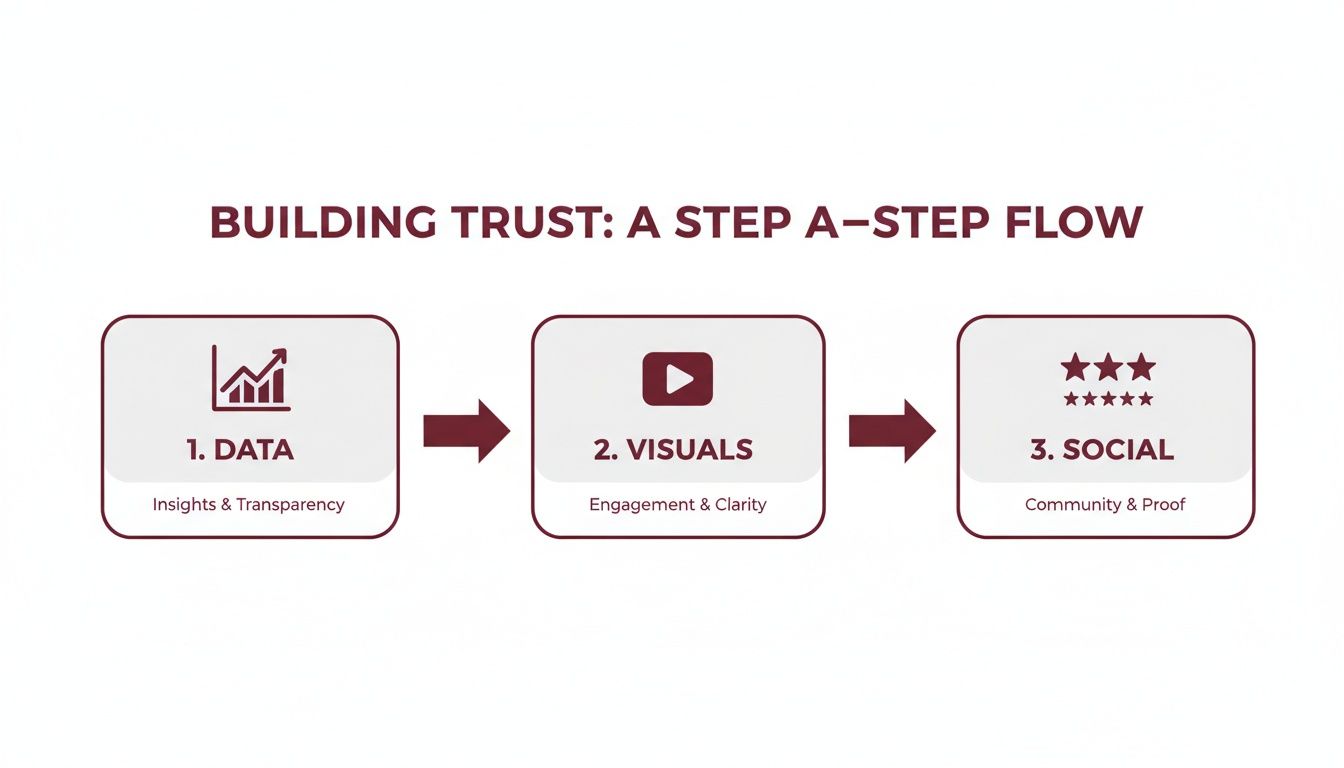
It’s a great reminder that credibility isn't about one single element, but the combined effect of supporting your claims with multiple forms of evidence.
Signalling Credibility Through Transparency
Creating expert-driven content is only half the job. You also have to clearly signal that credibility to your readers and, just as importantly, to search engines. Your best tool for this? Good old-fashioned transparency. Don't make people guess who is behind the information—tell them, loud and clear.
A few simple additions to your articles can make a world of difference:
- 'Fact-Checked by' Line: Pop a small note at the top or bottom, something like "Fact-Checked by Dr. Jane Smith, Lead Engineer," and link it directly to her comprehensive author bio.
- 'Reviewed by' Signal: In the same vein, a line like "Reviewed for accuracy by John Doe, Senior SEO Strategist" immediately validates that a qualified professional has given the content their tick of approval.
- Timestamping Updates: Keeping content fresh is a massive E-E-A-T signal. Adding lines like "Last updated on [Date] to reflect new industry data" shows you’re committed to providing current and trustworthy advice.
By making your verification process visible, you're not just creating content; you're building a verifiable record of credibility. This human-centric approach to e-e-a-t & content credibility is what separates authoritative sources from the noise.
At the end of the day, this workflow isn't about adding more steps just for the sake of it. It’s about adding more meaning and validation to the steps you already take, turning every article into a powerful testament to your brand's genuine expertise.
Measuring the ROI of Your Experience-Driven Content
You’ve put in all this work to engineer genuine experience into your content, which is great. But how do you actually prove it’s moving the needle? Justifying the investment means looking past simple traffic numbers and focusing on the metrics that really signal credibility and contribute to business growth.
It's all about drawing a clear line between your E-E-A-T improvements and tangible, bottom-line results.
Moving Beyond Vanity Metrics
Standard metrics like page views are a decent starting point, but they don't tell you much about trust or real engagement. To measure the impact of all this hard-earned credibility, you need to dive into user behaviour signals that show your audience finds your content genuinely useful.
Here’s what you should be tracking instead:
- Increased Dwell Time: When someone spends more time on your expert-led articles, it’s a massive thumbs-up to Google that your content is valuable and has answered their question thoroughly.
- Lower Bounce Rates: If readers land on your page and stick around instead of bouncing straight back to the search results, it shows your content is relevant and trustworthy. This is absolutely critical for high-stakes 'Your Money or Your Life' (YMYL) topics.
- Higher Pages Per Session: Are people clicking through to read other articles or your case studies? This is a clear sign you’ve established authority and they see you as a source worth exploring further.
The goal here is to spot a direct correlation. As your E-E-A-T signals get stronger, your user engagement metrics should improve right alongside them. This is your first real proof of a positive return.
Tracking Credibility and Authority Signals
Looking beyond on-page behaviour, the true ROI of experience-driven content shows up in how your brand’s overall authority grows over time. These are the big-picture indicators that your strategy is really paying off.
One of the most powerful signals is earning natural, high-authority backlinks. When other reputable sites start citing your content, they're essentially vouching for your expertise. You can monitor this in tools like Google Search Console to see who is linking to your new, experience-rich articles.
Another key metric is a lift in branded search queries—more people searching specifically for things like "your brand reviews" or "your brand case study." This proves your brand is becoming a recognised authority that people seek out directly.
Remember, long-form content packed with E-E-A-T has been shown to generate 2.3x higher traffic than shorter articles, a key finding from Australia's 2025 content marketing benchmarks. If you really want to get granular, you’ll need to delve deeper into the specifics of measuring content marketing ROI.
Got Questions About Weaving Experience into Your Content?
When you start talking about an "experience-first" content strategy, a few practical questions always pop up. Things like, "How much time is this actually going to take?" or "Can our small team really pull this off?" We hear these all the time from Aussie businesses, so let's tackle them head-on.
The whole point is to take the mystery out of engineering experience into your content. It's not some impossible task; it's a smart, achievable way to build real E-E-A-T and make your content genuinely credible.
How Much Time Does This Really Take?
Let's be honest, this is often the biggest hurdle. Creating content that’s rich with real-world experience does take more upfront effort than just pumping out generic blog posts. The time is loaded at the beginning—in the interviews with your experts, in gathering the data, and in structuring that first-hand evidence.
But here’s the trade-off: a single, deeply credible article built from genuine experience can easily outperform ten flimsy ones. It pulls in better traffic, earns organic backlinks without you even trying, and stays relevant for years. It’s less of a short-term task and more of an investment in a long-term asset.
Can Small Teams Actually Compete on Expertise?
You bet they can. In many ways, smaller teams have the upper hand. Your experts are right there, not hidden away in a different department on another floor. It's often much easier to tap into your company's unique stories and client wins when you're all working closely together. You don't need a massive content department—just a smart process.
Here’s how a small team can pack a big punch:
- Go deep, not wide. Instead of trying to cover every topic under the sun, focus on the few core areas where you are the undisputed expert. Own your niche.
- Systemise your expert interviews. Block out short, regular chats with your subject matter experts. A quick 20-minute recorded conversation can be a goldmine, providing more than enough raw material for an entire article.
- Turn your wins into content. Every time you solve a tricky problem for a client or have an internal breakthrough, you’ve got the makings of a brilliant case study or a practical "how-we-did-it" guide.
What's the Smart Way to Use AI?
Think of AI as a very capable assistant, not as the author. Firing up a tool to write an entire article from scratch is the fastest way to create bland, generic content that Google’s E-E-A-T systems will see right through. The goal is to use AI to make your workflow smoother, not to fake your expertise.
AI should do the grunt work—the initial research, the structuring, the summarising. But the final piece must be stamped with your unique, human insights and first-hand knowledge. That's how you stay authentic while being more efficient.
For instance, get AI to help you brainstorm an outline, condense a bunch of research papers, or check your grammar. But the core of the content—the personal stories, the proprietary data, the lessons learned the hard way—that has to come from your team. This hybrid approach protects the very thing that makes your content valuable: content credibility born from real experience.
Ready to stop blending in and start standing out? The team at Anitech specialises in transforming your business's unique experience into a powerful SEO advantage. We build data-driven strategies that showcase your expertise, build unshakable credibility, and deliver measurable growth.
Schedule your free, no-obligation strategy session with our Australian SEO experts today.