Quick Summary: This guide provides a technical blueprint for engineering an LLM-ready site architecture, a critical component of Generative Engine Optimisation (GEO). It details how to structure your domain using hub-and-spoke models, implement advanced schema markup, and format content for Retrieval-Augmented Generation (RAG) so AI crawlers can efficiently discover, index, and cite your expertise in generative answers.
The way people find information is undergoing its biggest shake-up in a decade. We're shifting from the familiar world of keyword-focused search engine optimisation (SEO) into a new reality shaped by artificial intelligence. This isn't just a minor tweak; it calls for a completely new playbook: Generative Engine Optimisation (GEO). This technical blueprint shows you how to engineer an LLM-ready site architecture to ensure AI crawlers can discover and index your expertise efficiently.
For years, the game was straightforward: get to the top of the search results for your target keywords. Now, the goal is to become the source for answers generated by AI, like those you see in Google's AI Overviews or from a ChatGPT query. This requires a much deeper, more structural approach than just matching keywords.
The New Search Landscape of Generative Engine Optimisation
So, what exactly does it mean to make your website 'LLM-ready'? Think of your website as a library.
- Traditional SEO was like organising that library by the first letter of each book's title. It worked, but it was basic. Someone searching for "gardening" would find all the books starting with 'G', but they’d have a hard time telling a beginner's guide from an advanced botanical textbook.
- Generative Engine Optimisation is more like organising your library with the Dewey Decimal System. It’s a sophisticated system that groups books by subject, shows how different topics relate to each other, and uses detailed metadata to summarise what each book is about. An AI entering this library can instantly grasp not just the topic, but also the context, authority, and how it connects to everything else.
This level of organisational clarity is what we're aiming for. LLMs don't just skim content; they're looking for semantic context, structured data, and clear, machine-readable signals that scream expertise, experience, authority, and trustworthiness (E-E-A-T).
Why GEO Matters Now More Than Ever
The move to generative AI isn't some far-off trend—it's happening right now and it's already changing how people search for information. In fact, a recent report showed that 49% of Australians have used generative AI tools in the last 12 months. This huge uptake, particularly for finding information and comparing products, is a clear sign that we need to adapt how our websites are built for this new discovery channel.
This pivot to generative engine optimisation is a piece of a much larger puzzle. To get a handle on the bigger picture and the strategic shifts involved, it’s worth digging into the core principles of AI digital transformation.
GEO isn’t just about being found in search results—it’s about being found in answers. The goal is for your content to be the definitive source that AI models cite, quote, summarise, or link to directly in their responses.
To get there, we need to go beyond surface-level tactics. It's about building a robust, logical, and technically pristine foundation that clearly communicates your expertise to the machines that are fast becoming the gatekeepers of information. This guide is your technical blueprint for doing just that.
Comparing Traditional SEO and Generative Engine Optimisation
To really grasp the shift, it helps to see the two approaches side-by-side. While traditional SEO principles still have their place, GEO introduces a new set of priorities focused on machine-readability and contextual understanding.
| Focus Area | Traditional SEO | Generative Engine Optimisation (GEO) |
|---|---|---|
| Primary Goal | Rank high in a list of blue links for specific keywords. | Become a trusted source cited directly in AI-generated answers. |
| Core Unit | The keyword and the webpage. | The 'entity'—a specific concept, person, place, or thing. |
| Content Focus | Aligning content with user search intent for a keyword. | Creating comprehensive, factual, and clearly structured content around topics. |
| Technical Focus | Crawlability, indexability, page speed, mobile-friendliness. | Structured data (Schema), semantic HTML, API accessibility (RAG), and vector embeddings. |
| Success Metric | Keyword rankings, organic traffic, click-through rates (CTR). | Citations in AI responses, brand mentions, direct traffic from AI prompts. |
| Authority Signals | Backlinks, domain authority, keyword usage. | E-E-A-T signals, author bios, structured citations, data provenance. |
As you can see, GEO doesn't replace SEO entirely but builds on it, demanding a much more rigorous and structured approach to how we present information online. It’s about preparing our content not just for human eyes, but for machine interpretation.
Your Technical Blueprint for an LLM-Ready Information Architecture
Getting your site ready for generative search is about much more than just submitting a sitemap and crossing your fingers. We need to engineer a logical, predictable, and semantically rich structure that AI crawlers can navigate with absolute clarity. Think of this as your guide to structuring your domain to show off your expertise in a way that machines can understand.
The central idea here is to mirror an entity-based understanding of your business through your site's hierarchy. This means you stop thinking just in terms of pages and start organising by concepts. AI models are all about connections and relationships, so your architecture has to make those connections obvious. A well-built site acts like a clean, well-lit path for AI agents, which means less crawl budget waste and a better chance your most important content gets found and understood.
Adopting the Hub-and-Spoke Model
The most effective structure for demonstrating authority to an LLM is the hub-and-spoke model, which you might also know as topical clustering. In this setup, a central "hub" page gives a comprehensive overview of a broad topic, while several "spoke" pages branch out to explore specific subtopics in much more detail.
- The Hub Page: This is your pillar content. It broadly covers a core service, product category, or major theme.
- The Spoke Pages: These are your deep-dive articles, specific product pages, or detailed guides that answer granular questions related to the main hub topic.
- Internal Links: This is crucial. Spokes link back to the hub, and the hub links out to the most relevant spokes. This creates a tight web of context that screams expertise on the subject.
This structure is a game-changer because it helps AI models grasp the depth of your knowledge on a topic, flagging your site as an authoritative source that's worth citing in its responses.
A logical site architecture does more than help users; it translates your business's expertise into a language machines can parse. A clean, hierarchical structure is a fundamental trust signal for LLMs.
Engineering Your URL Structure
Your URLs are a critical—and often completely overlooked—piece of your site's architecture. They need to be clean, readable for humans, and easily parsable for machines, giving clear clues about what's on the page before it's even crawled.
Let’s look at a practical example for a local electrician's website:
- Poor Structure:
anitech.au/services/page-3 - Good Structure:
anitech.au/services/emergency-electrician/
The second example immediately tells everyone, including AI crawlers, what the page is about. The same logic applies to an e-commerce store selling hiking gear:
- Poor Structure:
anitech.au/products/item-872 - Good Structure:
anitech.au/hiking-gear/tents/2-person/
This hierarchical URL path clearly shows the relationship between categories and products, making it incredibly easy for an AI to map out your offerings. When you're putting your technical blueprint together, it's worth looking at models that focus on scalability and being easy to maintain. This is a core part of building an AI architecture for longevity.
This diagram shows how Generative Engine Optimisation (GEO) principles, content goals, and your site architecture all fit together.
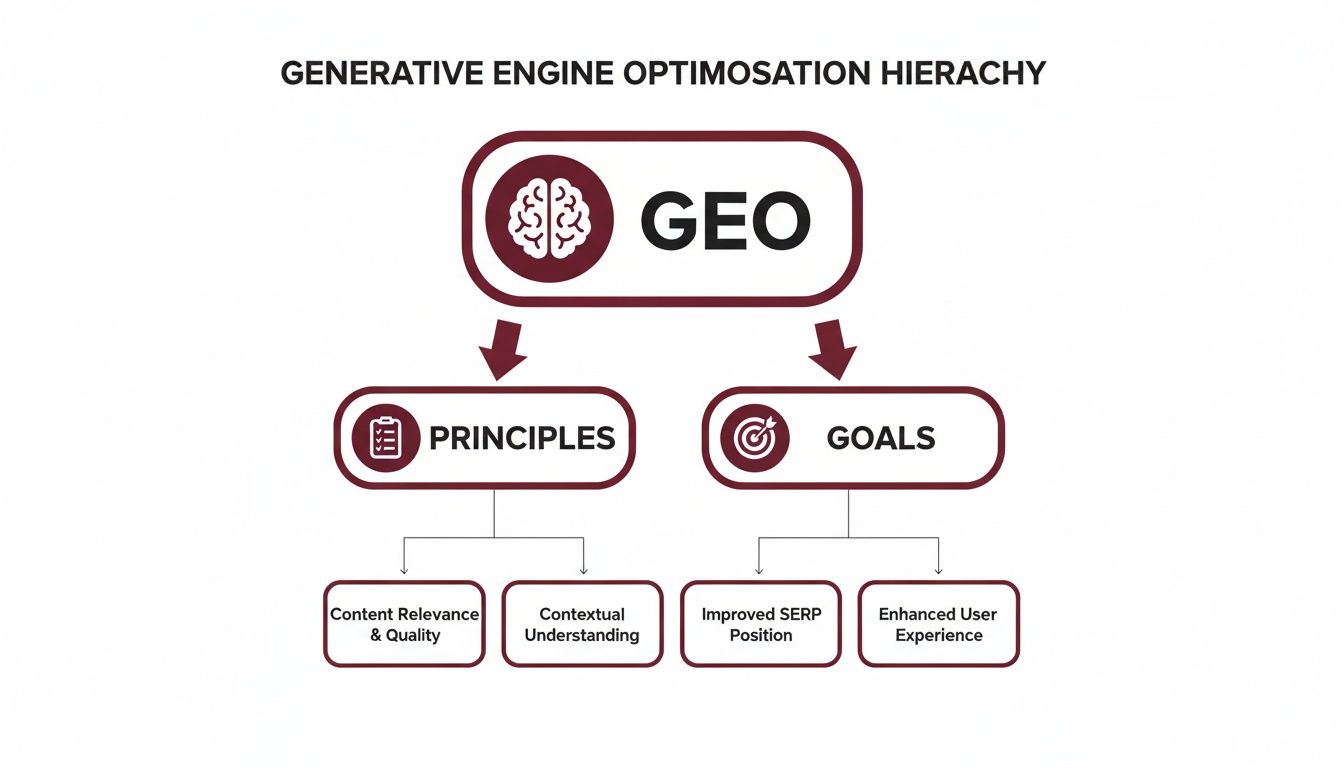
As you can see, a solid information architecture isn't just a nice-to-have; it's the foundation of any serious GEO strategy.
Reinforcing Context with Internal Linking
Smart internal linking is the glue that holds your entire information architecture together. Every single link should have a clear purpose, guiding both users and AI crawlers while reinforcing the semantic context between your pages. This means using descriptive anchor text that accurately tells the story of the page you're linking to.
Ditch generic phrases like "click here" or "learn more." Instead, go for specific, keyword-rich anchors. For instance, when linking from your "emergency electrician" hub page to a specific service spoke page, use anchor text like "24/7 electrical fault finding." It's far more meaningful.
This approach creates a powerful web of meaning that helps AI models understand the nuances of your expertise. It's a simple but effective way to guide crawlers to your most authoritative content, cementing your site's status as a trusted source for LLMs. This is becoming more critical than ever, with even government bodies stepping up their game. In fact, by 2025, Australian government websites are projected to hit a national Digital Government Index score of 69.4, a massive jump from 58.0 in 2022. This signals a wider move towards AI-ready digital platforms that rely on these very same principles of clarity and authority.
Getting Granular with Advanced Structured Data
If your site’s information architecture is the skeleton, then structured data is its central nervous system. It’s the direct line of communication that tells AI models exactly what your content is about, who’s behind it, how it all connects, and why it’s a trustworthy source. When you leave this out, you’re forcing the AI to make educated guesses, and that's a recipe for misinterpretation.
To really get your site ready for generative search, you need to think beyond the basics like Organization and Article schema. While those are certainly foundational, true AI clarity comes from digging deeper and using more specific, nuanced schema types that define the exact purpose of your content.

This level of detail is about answering a critical question for the LLM: What is this page? Is it a step-by-step guide, a product up for sale, an expert profile, or a direct answer to a common problem? Each of these deserves its own specific markup.
Choosing the Right Schema for the Job
The goal here is simple: always use the most specific schema available for your content. Why? Because specificity kills ambiguity. It allows an LLM to process your information with a much higher degree of confidence. Think of it as putting a precise, machine-readable label on every single piece of information you publish.
A few essential schema types deliver huge results for making a site LLM-ready. These are the ones to prioritise:
FAQPage: Absolutely brilliant for pages built around common questions. This schema explicitly formats your questions and answers, making them incredibly easy for an LLM to pull out and use directly in a generative response.HowTo: If your content walks someone through a process,HowToschema is non-negotiable. It breaks down the entire thing into clear, machine-readable steps, complete with any tools needed and even time estimates.Product: For any e-commerce site, this is a must. It lets you define product names, descriptions, pricing, stock levels, and customer reviews in a structured way that AI can easily parse for shopping and comparison queries.Service: This is the equivalent ofProductschema but for service-based businesses. You can define the type of service, your service area, and link it back to your business details, making you far more visible for specific "near me" or "how to" service queries.
Building Your Own Knowledge Graph with Nested Schema
This is where the real magic happens. The power of structured data for generative search is unlocked when you start nesting schema types. This is how you begin to build a mini-knowledge graph right on your own website, showing LLMs how all the different pieces of information relate to each other. You're no longer just marking up isolated items; you're connecting the dots.
Take a single blog post, for example. You could nest multiple schemas to create a rich picture:
- Start with the basics: Use
Articleschema to define the core content. - Add the expert: Nest
Personschema for the author, connecting the content directly to a real person and signalling strong E-E-A-T. - Link the brand: Nest
Organizationschema for the publisher, tying the article back to your main brand entity. - Layer in the details: If the article has a Q&A section, mark that up with
FAQPageschema inside the mainArticleschema.
This creates a dense, interconnected data structure. An LLM no longer sees just an "article." It sees an article, written by a named expert, published by a reputable brand, which also happens to contain direct answers to specific user questions. That level of context is invaluable.
By nesting schema, you turn a flat webpage into a multi-dimensional data asset. This helps LLMs grasp context, relationships, and facts, dramatically boosting the odds of your site being used as a reliable source in generative answers.
To make this practical, it's worth mapping out the most important schema types for your content.
Essential Schema Types for an LLM-Ready Site
Here's a quick reference table breaking down the schema markups most impactful for Generative Engine Optimisation.
| Schema Type | Primary Use Case | Benefit for GEO |
|---|---|---|
Article / BlogPosting |
Core markup for informational content, news, and blog posts. | Establishes the foundational context, author, and publication date. |
FAQPage |
For pages with a list of questions and their corresponding answers. | Allows LLMs to directly extract Q&As for concise, accurate responses. |
HowTo |
Content that provides step-by-step instructions to complete a task. | Breaks down complex processes into machine-readable steps for guides. |
Product & Offer |
E-commerce product pages, detailing price, availability, and reviews. | Provides structured product data for use in comparison engines and SGE. |
Service |
For businesses offering services rather than physical products. | Defines service type, area served, and provider for local/service queries. |
Person & Organization |
Used to define authors, experts, and the publishing entity. | Strengthens E-E-A-T signals by connecting content to real-world entities. |
Thinking through which of these apply to your key pages is the first step toward building a truly robust, LLM-friendly structured data implementation.
Practical Implementation with JSON-LD
While you can implement structured data in a few different ways, JSON-LD (JavaScript Object Notation for Linked Data) is the industry-standard and highly recommended. It’s clean, sits separately from your visible HTML (making it easier to manage), and is the format that search engines like Google prefer.
Imagine you’ve written a "How-To" guide on fixing a leaky tap. Your JSON-LD would be a single, elegant snippet that connects all the dots. It would define the HowTo steps, link to the Person (the expert plumber) who wrote it, and attribute the whole thing to your Organization (the plumbing company). This is the kind of crystal-clear information that AI models need to confidently cite your content.
Optimising Content for Retrieval-Augmented Generation
Getting your site's architecture right is the foundation, but the actual words on your pages are what large language models (LLMs) ultimately work with. This is where Retrieval-Augmented Generation, or RAG, comes into the picture. RAG is the process generative AI uses to fetch fresh, real-time information from external sources—like your website—to ground its answers in facts, rather than just relying on its internal training data.
To make your content a go-to source for RAG, you need to engineer it for easy machine retrieval and comprehension. This means shifting away from long, narrative-style paragraphs and thinking in terms of discrete, self-contained "chunks" of information. Every heading, every list, and every table becomes a potential block of information for an AI to use.

This change in content strategy is becoming mission-critical, especially as Australian businesses embrace AI. By 2025, an impressive 52% of Australian businesses had already adopted AI, with the services sector leading the charge at 56%. This rapid uptake means websites need to be optimised for generative engines, turning them into valuable data sources. You can read more about technology adoption across Australian industry on the Ai Group's website.
The Power of Content Atomisation
Content atomisation is the practice of breaking down massive content pieces into their smallest, most useful components. That 3,000-word "ultimate guide" you published? It can be deconstructed into dozens of smaller, query-specific atoms of information. Each of these atoms should be designed to answer one question or explain one concept with absolute clarity.
This approach lines up perfectly with how RAG systems operate. When an LLM gets a query, it hunts for the most relevant chunks of information to piece together its answer. By atomising your content, you're essentially pre-packaging these chunks for the AI, making your information much easier to find and use.
For instance, instead of a long, rambling section under a heading like "Our Process," you could break it down with specific H3s:
- Initial Consultation and Discovery
- Strategy and Planning Phase
- Execution and Implementation
- Reporting and Analysis
Suddenly, each of those sections becomes a self-contained, retrievable piece of information, perfectly suited for a specific part of a user's query.
Formatting Content to Directly Answer Questions
At their core, generative AI models are question-answering machines. It follows, then, that the most effective content for generative engine optimisation is formatted to provide direct, unambiguous answers.
Your goal is to make your content so clear and well-structured that an AI can lift a section verbatim, cite your site, and be confident it's providing an accurate, helpful response. This requires a shift from writing about a topic to writing answers for a topic.
This means prioritising formats that are incredibly easy for a machine to scan and parse:
- Concise Paragraphs: Keep paragraphs tight—one to three sentences at most. Each one should focus on a single, clear idea.
- Descriptive Headings: Your H2s and H3s should act like questions that the following text answers. Think "How Does X Work?" instead of just "X."
- Bulleted and Numbered Lists: These are fantastic for breaking down features, benefits, or steps. Their structure is simple and highly interpretable for an LLM.
- Tables: For comparisons or data-heavy info, tables are invaluable. They present data in a structured way that's almost impossible for an AI to misunderstand.
Advanced RAG Readiness: API Endpoints
For businesses ready to take their GEO strategy to the next level, creating dedicated API endpoints or data feeds specifically for AI consumption is a game-changer. This involves packaging your most important information—product catalogues, service descriptions, knowledge base articles—into a clean, structured format like JSON or XML.
By offering a direct data feed, you're essentially removing all the friction. You're no longer asking an AI to crawl and interpret your HTML; you're handing it clean, perfectly organised data on a silver platter. This dramatically increases the speed and accuracy of retrieval, making your site a highly reliable and preferred source for any LLM with access to your endpoint.
While this is definitely a more technical approach, it points to the future of how websites will interact with AI. It transforms your website from a simple collection of documents into a structured, queryable database, engineered for the needs of generative AI.
Auditing Your Technical Setup to Future-Proof Your Website
Your website's technical health is a massive trust signal. It’s not just for Google anymore; it’s for the generative AI models that increasingly lean on search indexes. Getting your technical performance right isn't just about a slick user experience—it's about making sure your site is dead simple for machines to crawl, index, and understand.
This is where you iron out the kinks and future-proof your architecture. Any technical roadblocks here will stop an AI from ever seeing, let alone trusting, your content.
Before any LLM can even think about your content, a crawler has to find it, render it, and stick it in an index. If that first step is slow, buggy, or confusing, all that brilliant, RAG-ready content you’ve created might as well be invisible. So, engineering a site for this new era of search really starts with nailing the fundamentals of technical SEO.
Mastering the Core Technical Pillars
The old-school pillars of technical performance are actually more critical than ever now. They send strong signals that your site is high-quality, reliable, and user-friendly—exactly the kind of stuff AI models are trained to value.
- Core Web Vitals (CWV): Page speed and a stable layout aren't just for keeping users happy. A site that loads fast is far more efficient for crawlers to process, meaning they can get through more of your content without timing out.
- Mobile-First Indexing: This is non-negotiable. Most crawling happens with a mobile user-agent, so if your site is a mess on a phone, crawlers will miss crucial information or just give up.
- HTTPS: A secure site is just table stakes today. It's a foundational signal of trust and credibility. Don't even think about skipping this.
These fundamentals create a stable foundation, telling every search system out there—old and new—that your website is a well-maintained and authoritative resource.
Nailing Crawlability and Indexability
You need to roll out the red carpet for crawlers, giving them a clear, unobstructed path through your site. This means providing precise instructions that kill any ambiguity and stop them from getting tripped up by things like duplicate content.
Your robots.txt file is your first point of contact. Make sure it allows access to all your important assets—including CSS and JavaScript—so crawlers can render the page properly. At the same time, use it to block off irrelevant areas like admin portals.
A clean, up-to-date XML sitemap is your website’s roadmap. It points crawlers directly to all the important pages you want indexed, which is especially vital for larger sites where new content can easily get lost.
The single biggest technical mistake that confuses LLMs is duplicate content. Your best weapon against this is the canonical tag. It tells search engines which page is the one true source to index and give credit to.
Using the rel="canonical" tag correctly is absolutely essential. It consolidates all the signals for similar pages down to a single URL, making it crystal clear to an AI which one is the master version. Without it, you’re just diluting your own authority and sending completely mixed signals.
Getting Ready for What's Next
While getting the basics right is crucial, future-proofing your site means keeping an eye on what’s coming down the pipeline. Two key areas that will deepen the connection between your site and AI are content embeddings and vector databases.
- Content Embeddings: This is a fancy way of saying your text gets turned into a string of numbers (a vector) that captures its actual meaning. This is how LLMs understand context and find related concepts, not just matching keywords.
- Vector Databases: These are special databases built to store and search all those numerical vectors incredibly quickly. While you probably don't need one today for what we're calling GEO, the technology is what powers advanced semantic search.
Starting to think about your content this way—as a collection of concepts, not just words—is a major mindset shift. You might not be spinning up your own vector database tomorrow, but structuring your content into clean, distinct chunks (like we covered in the RAG section) is the perfect first step. This kind of technical foresight makes sure your architecture isn’t just built for today’s AI, but is ready to adapt for whatever comes next.
Answering Your Questions About Generative Engine Optimisation
As we've worked through the technical roadmap for getting a site LLM-ready, you’ve probably got a few questions buzzing around. This is all pretty new territory, full of nuances, so it's natural to want some straight answers to guide your strategy.
Let's break down some of the most common queries about generative engine optimisation. Think of this as a quick-reference guide to help clear up any confusion about what this all means for you.
How Is GEO Different From SEO?
This is easily the most common point of confusion. We've all spent years mastering Search Engine Optimisation (SEO), so how does Generative Engine Optimisation (GEO) fit into the picture? While they’re definitely related, they're playing for different prizes.
Traditional SEO has always been about climbing the ladder of a search engine results page (SERP). You target keywords, build links, and do everything you can to earn a click from that classic list of blue links. It’s a battle for position.
GEO, on the other hand, is about making your content so clear, trustworthy, and accessible that a Large Language Model (LLM) can confidently use it as a source. The aim isn't just to be a link in a list; it’s to be the source cited directly within the AI-generated answer.
SEO wins the click. GEO wins the answer. This distinction is crucial. It demands a much deeper focus on semantic markup, a crystal-clear information architecture, and proving your expertise, experience, authority, and trustworthiness (E-E-A-T) in a way that machines can easily process.
Basically, SEO optimises for a search algorithm, while GEO optimises for a comprehension engine.
How Do I Actually Measure If This Is Working?
Measuring the success of your GEO efforts is a bit different from tracking your usual SEO metrics. We're moving beyond simple keyword rankings and click-through rates. Success in this new arena means we need to look at a fresh set of Key Performance Indicators (KPIs).
Here’s what you should be tracking to see if your LLM-ready architecture is paying off:
- Brand Mentions & Citations: Are you showing up in AI-generated results like Google's AI Overviews? You need to keep a close eye on your brand's inclusion. New tools are popping up to help track these citations directly.
- AI Crawler Activity: Dive into your server logs. You’re looking for hits from known AI crawlers. Key user agents to watch for are
Google-Extended(which feeds Google's generative models) andGPTBot(from OpenAI). An increase in their activity is a good sign. - Referral Traffic from AI Tools: In your analytics, segment your referral traffic to see what's coming from AI chat apps like ChatGPT, Perplexity, and others. This tells you when real users are clicking through from an AI-generated answer to your site.
- Performance on Conversational Queries: Keep an eye on your visibility for those long, conversational questions people type into search. If you see improvement there, it’s a strong signal that LLMs are finding your content genuinely helpful for answering complex problems.
Ultimately, you'll know you're succeeding when your site is being accurately and favourably represented in AI outputs, driving qualified traffic and cementing your brand as a genuine authority.
I'm a Small Business. Do I Really Need to Worry About This Right Now?
Short answer: yes, absolutely. This shift to generative search isn't some far-off trend—it's happening right now and picking up speed. Getting your site's architecture ready for LLMs today is simply future-proofing your online presence.
For small and medium-sized businesses, this is a massive opportunity. Getting in early gives you a real competitive edge. Your larger competitors might be bogged down, struggling to adapt their massive, complex websites. A more nimble business like yours can make these structural changes much faster.
And here’s the best part: the fundamentals of GEO are also just good SEO. Building a clean site structure, publishing high-quality, well-formatted content, and maintaining a technically sound website will boost your current search performance anyway.
By investing in generative engine optimisation now, you aren't ditching your current SEO efforts. You're actually making them better while positioning your business to win visibility, traffic, and authority in the AI-driven world of tomorrow. It's a proactive move for sustainable, long-term growth.
At Anitech, we specialise in building future-ready SEO strategies that deliver measurable growth. Our expertise in technical SEO and content architecture ensures your business is prepared not just to rank, but to become an authoritative source in the new era of generative search. If you're ready to engineer an LLM-ready site and dominate the search results of tomorrow, explore our services at https://anitech.au.