Quick Summary: Generative Engine Optimisation (GEO) adapts traditional SEO for AI-powered search. The goal is to get your brand cited in AI-generated answers, like Google's AI Overviews, by creating authoritative, conversational content. This guide covers integrating AI into keyword research, content creation, technical SEO, and link building for visibility.
Generative Engine Optimisation, or GEO, is all about adapting our proven SEO playbooks for the new world of AI-powered search. The goal is to get your brand cited as the authority in those AI-generated answers, like Google's AI Overviews, by satisfying user intent in a more conversational way.
The New Reality of Search: Balancing Classic Ranking Factors with AI Visibility
The way people search for information is changing, and fast. For years, the SEO game was about getting to the top of that list of ten blue links. Now, we’re seeing the rapid rise of AI-driven summaries and conversational search, where users get a direct answer without ever needing to click on a website.
This is the new reality we’re operating in, and it's powered by Generative Engine Optimisation (GEO). It’s not just an update; it's a necessary evolution of search marketing.
For Australian businesses, this isn't some far-off trend—it's already here. The quick uptake of AI search tools means that visibility is no longer just a game of keywords and backlinks. It’s about becoming such a trusted source of information that an AI engine feels confident enough to quote you directly.
Understanding the Shift from SEO to GEO
Traditional Search Engine Optimisation (SEO) has always been about making a website more visible in organic search results. We do this by optimising content, building authoritative links, and making sure the site is technically sound. These fundamentals aren't going anywhere; they're still incredibly important.
GEO doesn't throw those principles out the window. Instead, it adds a new layer on top, specifically for this new kind of search. While traditional SEO is aimed at getting search engine crawlers to rank your pages, GEO is about influencing the generative AI models that create the answers.
The goal has shifted from just "ranking #1" to "becoming the answer." This means we need to create content that is so clear, authoritative, and well-structured that AI models pick it as the best source for a user's question.
This is a big deal in a market like Australia, which is leading the world in AI search adoption with 1.42 AI queries per person. In fact, by April 2025, an estimated 12.7 million Australians were already using AI tools. This shift in user behaviour makes it clear that blending traditional SEO with a generative AI strategy is no longer just a good idea—it's essential. To get a deeper dive into these changes, it's worth reading about the future of SEO in the time of generative AI.
Key Differences and Synergies
To really get your head around this new landscape, it helps to put the two approaches side-by-side. GEO isn't a completely separate field; it’s an extension of what we're already doing, just adapted for a new purpose. Where SEO is focused on winning clicks, GEO is about winning mentions and citations inside AI summaries, capturing the attention of users in those growing zero-click searches.
Take a look at how they compare.
Traditional SEO vs Generative Engine Optimisation
Here’s a comparative look at the core differences and synergies between traditional SEO methodologies and the emerging requirements of Generative Engine Optimisation.
| Aspect | Traditional SEO Focus | Generative Engine Optimisation (GEO) Focus |
|---|---|---|
| Primary Goal | Rank web pages higher in organic search results (SERPs). | Get featured as a source in AI-generated answers and summaries. |
| Content Style | Optimised for crawler indexing with a focus on keywords. | Conversational, direct, and structured for AI comprehension. |
| Keyword Strategy | Targets high-volume and exact-match keywords. | Emphasises long-tail, conversational, and semantic keywords. |
| Ranking Signals | Backlinks, page speed, mobile-friendliness, E-E-A-T. | Relevance, clarity, authoritativeness, and entity recognition. |
The synergy between them is pretty obvious when you lay it out. A strong technical SEO foundation and high-quality backlinks make your content more trustworthy to an AI. At the same time, writing clear, direct answers for GEO naturally improves the user experience—a core principle of modern SEO. The businesses that figure out how to blend these strategies are the ones that will stay visible, both now and in the years to come.
Putting Generative AI to Work in Your SEO Workflow
Let's get practical. Moving from theory to real-world application is where you'll see the biggest wins. Integrating generative AI into your SEO process isn't about throwing out what already works; it's about making it faster, smarter, and far more effective. It’s how you start uncovering the opportunities your competitors are completely missing.
This is all about creating a powerful, symbiotic relationship between foundational SEO and the new capabilities of AI. Think of it as a fusion, creating a potent Generative Engine Optimisation (GEO) strategy.
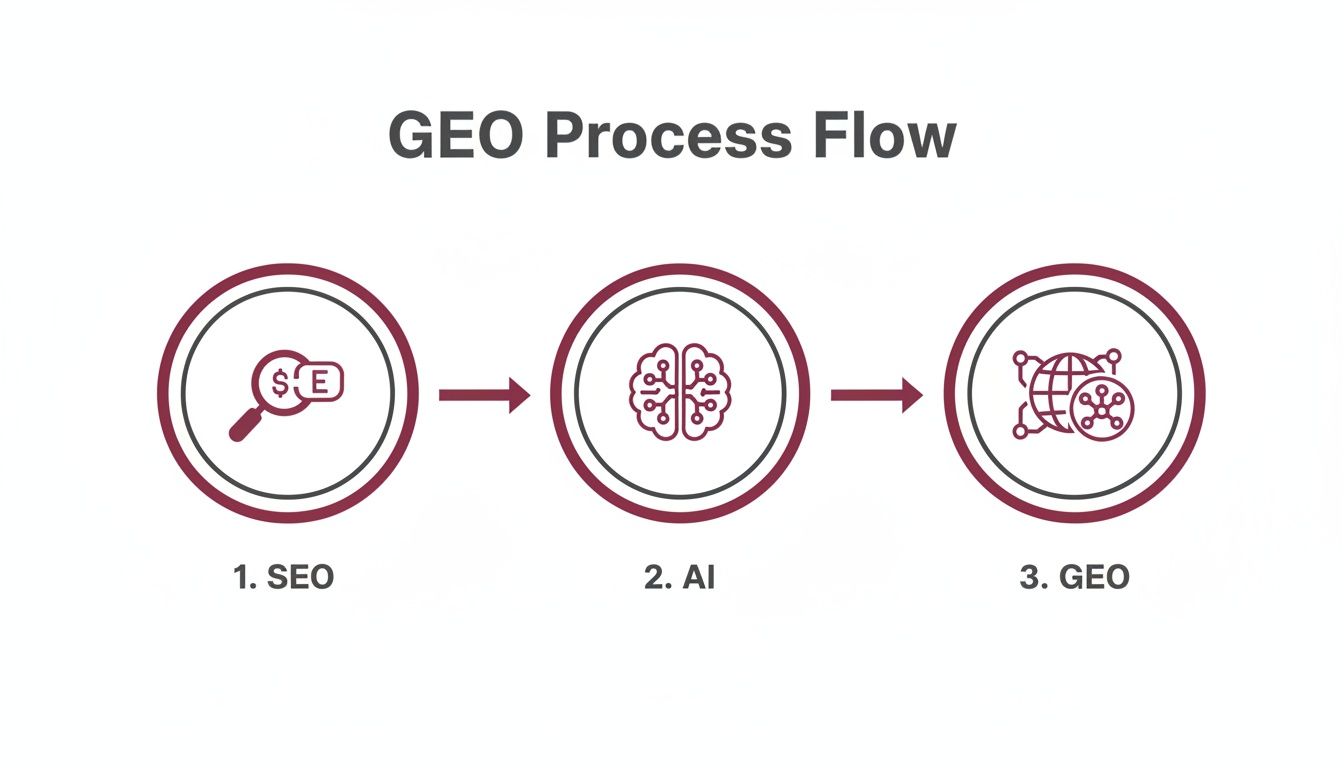
As you can see, solid SEO principles are the launchpad. AI then comes in to enhance and accelerate those efforts, leading to a much more robust GEO outcome.
Evolving Keyword Research With AI
Let's be honest, traditional keyword research can be a tedious slog through endless spreadsheets. Generative AI completely changes the game. It shifts the task from simple data collection to genuine strategic discovery. You're no longer just hunting for keywords; you're uncovering entire semantic maps and the real, conversational questions your customers are asking.
You can get AI to do some seriously heavy lifting here:
- Dig up question-based queries: Give an AI model your main keyword and ask it to list the most common questions people ask about it. This is gold for building out FAQ sections that have a high chance of being featured in AI Overviews.
- Find semantic clusters: Got a messy list of keywords? Ask an AI to group them into thematic clusters. This instantly helps you map out your content pillars and topic clusters, signalling to search engines that you have comprehensive authority on a subject.
- Uncover conversational long-tails: Feed the AI a description of your core service or product. Ask it to generate long-tail, conversational search terms that a real person would use. This is brilliant for capturing voice search traffic and connecting with users who are much further down the buying journey.
For Australian businesses, this shift is no longer optional. Projections show a massive $1.5 billion will be spent on SEO services locally in 2025, a 12% leap from 2024. This isn't just business as usual; it reflects a major push towards integrating traditional SEO with generative AI to get a competitive edge.
If you’re an Australian SME spending between $14,400 and $90,000 a year on SEO, GEO is now a necessity. With a staggering 65% of searches in Australia now ending without a click thanks to AI summaries, getting your content optimised for these models is critical.
The Hybrid Model for Content Creation
One of the biggest myths is that AI will write all your content. The reality is far more nuanced and effective. The best approach is a hybrid model where AI acts as a highly capable research assistant, not the final author.
This frees up your human experts to focus on what they do best: injecting unique insights, personal experience, and genuine authority into the content.
The real power of AI in content creation isn't just about speed. It’s about building a solid, well-researched foundation that your team can then transform into exceptional, E-E-A-T-rich content that genuinely stands out.
Let AI handle the initial grind. Get it to draft detailed outlines, write first-pass sections, or summarise complex reports into easy-to-digest bullet points. Then, your human content team takes over. They refine the tone, fact-check everything, infuse the brand's voice, and add personal stories or case studies—all the crucial elements that AI simply can't replicate. Understanding how this fits into the bigger picture of AI automation for business can unlock even greater efficiencies across your entire operation.
A Smarter Way to Handle On-Page Optimisation
On-page SEO is filled with repetitive but vital tasks—the kind of work that's perfectly suited for AI. This is where you can achieve immediate efficiency gains, freeing your team from the daily grind to focus on big-picture strategy.
Here’s where AI can make a real difference:
- Meta Descriptions: Feed AI your page content and your target keyword. Ask it to spit out five compelling, click-worthy meta descriptions under the character limit. You can then A/B test these to see which one pulls the best click-through rate.
- Schema Markup Generation: This is a huge time-saver. Instead of wrestling with code, just describe your content (e.g., "This is a product page for a men's running shoe") to an AI tool. It can generate the correct JSON-LD schema for you to simply copy and paste. This dramatically boosts your chances of snagging rich snippets and getting visibility in AI Overviews.
- Internal Linking Suggestions: Some of the more advanced AI tools can crawl your entire site's content and suggest relevant internal linking opportunities. This is fantastic for distributing link equity more effectively and strengthening your overall site architecture.
Advancing Technical SEO and Link Building With AI
It's not just keyword research and content where AI is changing the game. The really exciting stuff, for me at least, is how it's shaking up the more technical side of SEO. Tasks that used to be a massive time sink—think deep-dive technical audits and the relentless grind of link building—can now be done faster and with more precision. This is a huge leap for Generative Engine Optimisation, letting us build healthier, more authoritative sites in a fraction of the time.

This isn't just about simple automation. We're now able to diagnose and fix the foundational problems holding a website back, which pays dividends in both classic search rankings and visibility in AI-generated results like Google's AI Overviews.
Supercharging Technical Audits with AI
A solid technical audit is the foundation of any decent SEO campaign, but let's be honest, it can be a painstaking job. AI tools can now act like an expert analyst, sifting through mountains of site crawl data to find critical issues with a speed and accuracy no human could ever match.
Instead of spending hours manually poring over spreadsheets, you can dump your crawl data into a large language model and ask it to run specific diagnostics. This lets you quickly find and prioritise the fixes that really matter for user experience and search engine crawlability.
A few technical SEO tasks that AI has completely streamlined for us include:
- Finding Crawl Errors: AI is brilliant at scanning server logs to find patterns in 404 errors, server issues, or messy redirect chains that are chewing up your crawl budget.
- Flagging Broken Links: Give an AI a list of internal and external links, and it will almost instantly spit back a clean list of broken URLs that need fixing.
- Analysing Site Speed Bottlenecks: AI can take complex performance reports from tools like PageSpeed Insights and suggest specific, actionable fixes, like which oversized images to compress or what JavaScript to defer.
Generating Accurate Structured Data
Structured data (or Schema.org markup) is more important than ever. It’s the language that helps search engines and AI models understand exactly what's on your page—what it is, what it's about, and how it connects to other things.
But writing JSON-LD schema by hand is fiddly and very easy to mess up. This is a perfect job for an AI. You can feed it your page content—product details, an event description, an FAQ section—and ask it to generate the correct schema markup. This saves a huge amount of time and drastically cuts down on syntax errors that would make the markup useless.
By using AI to create flawless schema, you're essentially handing AI search engines a perfectly organised datasheet about your content. This dramatically increases the chances it will be used to construct a detailed AI Overview.
Reinventing Your Link Building Approach
Link building has always been about relationships and a lot of manual grunt work. While an AI can't build a genuine human connection for you, it can absolutely revolutionise the research and outreach stages, making your whole process far more strategic and efficient.
The trick is to use AI for what it's good at: analysing data at scale and automating the repetitive tasks. This frees you up to focus your energy on the real, personalised engagement that actually gets results.
Here’s how AI is changing our link-building workflow:
- Analysing Competitor Backlink Profiles: Feed a competitor's backlink report from a tool like Ahrefs into an AI. Ask it to categorise their links (e.g., guest posts, directory listings, resource pages) and pinpoint their most authoritative referring domains. You've just created a strategic roadmap for your own campaign.
- Pinpointing High-Authority Opportunities: Describe your niche and ideal customer to an AI model. Then, ask it to generate a list of high-authority blogs, industry publications, or resource pages that might accept guest posts or link to your content.
- Drafting Personalised Outreach Emails: AI is fantastic at creating solid first drafts for outreach. Give it some context about the target website and the value you're offering, and it will generate a compelling email. All you have to do is add your own authentic, human touch before you hit send.
By weaving AI into these core technical and off-page SEO tasks, you're not just working faster. You're working smarter, making data-driven decisions that build a much stronger foundation for both classic search and the new world of generative engines.
Choosing Your Tools and Mastering AI Prompts
Alright, let's get practical. To actually bring generative AI into your SEO workflow, you need the right tools. For most Australian SMEs, the sweet spot is finding something powerful but cost-effective. The great news? You don't need a huge budget to get started with Generative Engine Optimisation. Many of the best tools are either free or surprisingly affordable.

The market for these tools is absolutely humming right now. The Australian SEO software market hit a massive $2.1 billion in 2024 and is expected to climb to $5.2 billion by 2030. That growth isn't just happening on its own; it's being pushed by smart SMEs who are pairing AI with traditional SEO to find new ways to grow.
This is exactly where a company like Anitech combines its core strengths—keyword research, on-page optimisation, and building authority links—with AI to meet the needs of Australia's tech-savvy audience. With 92% of marketers saying AI has impacted their roles and 35% already using it for content, it’s clear this is more than just a passing trend. For a deeper dive into these numbers, check out this comprehensive report on Australian SEO software trends.
Selecting the Right AI Tools for the Job
Your AI toolkit should directly mirror your core SEO jobs. I always tell clients to start by pinpointing the biggest time-wasters in their current process. Is it brainstorming content ideas? Is it writing meta descriptions? Find that bottleneck and pick a tool designed to fix it.
Here’s a look at some of my go-to tools for key SEO tasks:
- Keyword Research & Strategy:
- ChatGPT & Gemini: Think of these as your brainstorming partners. They're brilliant for digging up semantic keywords, generating long-tail questions your customers are actually asking, and helping you sort messy keyword lists into neat topic clusters. They're incredibly flexible for that initial discovery work.
- Content Creation & Optimisation:
- Jasper & Copy.ai: These platforms are built from the ground up for content creation. They have templates for just about everything—blog posts, product descriptions, ad copy. They're fantastic for getting a solid first draft on paper that your team can then polish and perfect.
- SurferSEO & NeuronWriter: These tools are the bridge between writing and on-page SEO. They analyse the top-ranking pages for your target keyword and give you a data-driven blueprint for what terms to include, how long your content should be, and how to structure it for success.
Mastering Prompt Engineering for SEO Success
Here’s the real secret: the quality of what you get out of an AI has everything to do with the quality of what you put in. This is where prompt engineering comes in.
A lazy, vague prompt will get you a generic, useless response. A specific, context-rich prompt, on the other hand, can deliver a genuine strategic asset. Think of it like you're a director giving instructions to an actor—you need to provide clear direction, relevant background, and a well-defined goal.
A well-crafted prompt is the difference between getting a random list of keywords and a fully-formed content cluster strategy. It’s about giving the AI a clear role, a specific task, and defined constraints to work within.
To get you started, I've put together some practical, copy-paste-ready prompts that are tailored for common SEO tasks faced by Australian businesses. These aren't just theoretical; they show you how to structure your requests to get actionable results, time and time again.
Sample AI Prompts for Core SEO Tasks
This table gives you some actionable prompts you can copy and paste to start making your SEO workflows more efficient with generative AI.
| SEO Task | Example Prompt |
|---|---|
| E-commerce Content Brief | "Act as an SEO content strategist for an Australian e-commerce store. Create a comprehensive content brief for a product page selling 'Merino wool hiking socks'. The target audience is serious hikers in Australia. Include a primary keyword, 5 secondary keywords, 3 long-tail question-based keywords, a suggested H1, and 4 H2s. Specify a conversational but authoritative tone." |
| Local Service FAQ Schema | "Generate FAQPage schema markup in JSON-LD format for a local plumbing business in Sydney. The questions are: 'What are your emergency call-out fees?', 'Do you service the Northern Beaches?', and 'Are your plumbers licensed and insured?'. Provide the complete, copy-paste-ready code." |
| B2B Semantic Keyword Research | "I am writing a blog post for a B2B software company targeting Australian marketing managers. The primary keyword is 'customer data platform'. Identify 10 semantically related keywords and LSI terms that should be included in the article to demonstrate topical authority. Group them by user intent (informational, commercial)." |
By getting a handle on both your choice of tools and the art of the prompt, you'll find that AI quickly moves from being a fun novelty to a powerful, essential part of your generative engine optimisation strategy.
Gauging Success and Staying Safe in Your GEO Strategy
Putting a generative engine optimisation strategy into play is really just the starting line. If you want it to actually succeed, you have to ground everything in solid measurement and smart governance. When you shift to GEO, your old analytics dashboard just won't cut it anymore; you need to look beyond the usual metrics to see the full picture of your new AI-driven visibility. At the same time, you've got to have a clear framework for managing the risks that come with AI, so you can maintain quality and protect the brand reputation you've worked so hard to build.
Time to Evolve Your KPIs for the AI Era
Your classic SEO metrics are still important, of course. Things like organic traffic, keyword rankings, and backlink growth will always matter. But they no longer tell the whole story.
GEO opens up new doors for people to find and engage with your brand, and a lot of that happens without them ever clicking through to your site. This means we absolutely need some new key performance indicators (KPIs) to properly measure what success looks like now.
Think about adding these GEO-specific metrics into your reporting mix:
- Visibility in AI Overviews: How often is your domain being cited as a source in Google's AI Overviews for your target search queries? There are some new tools popping up to help track this, but for now, doing some manual checks is still essential.
- Conversational Keyword Performance: Keep a close eye on your rankings and traffic from long-tail, question-based keywords. A big jump here is often a great sign that your content is hitting the mark for what AI engines are looking for.
- Branded Search Volume: You might notice more people searching directly for your brand name. This is a fantastic side effect of a good GEO strategy. When an AI cites you as an authority, it builds brand recall, and people start seeking you out on their own.
- Zero-Click Search Impact: Dig into your click-through rates (CTR) in Google Search Console. If you see your CTR drop for a high-ranking keyword, it could mean that people are getting their answer straight from an AI Overview — where, hopefully, your brand was featured.
A winning GEO strategy isn't just about chasing clicks anymore; it's about owning the conversation in your industry. The real goal is to become the trusted, go-to source of information, whether someone finds that on your website or within an AI-generated summary.
Building a Framework for Quality Control and Risk Mitigation
The speed and sheer volume of content you can create with AI is amazing, but it also brings real risks. If you start publishing content that's inaccurate, low-quality, or just doesn't sound like your brand, you can seriously damage user trust and tank your SEO efforts. A rock-solid quality control process isn't just a nice-to-have; it's completely non-negotiable.
Your governance plan should be built around clear editorial guidelines that spell out exactly how AI fits into your content workflow. This isn't about killing creativity — it's about setting clear standards for accuracy, tone of voice, and originality.
Every single piece of AI-assisted content must be checked by a human before it ever sees the light of day. This "human-in-the-loop" approach is critical for a few key reasons:
- Fact-Checking: AI models can sometimes "hallucinate" or present old information as if it's a current fact. You need a human expert to verify every claim, statistic, and technical detail.
- Brand Voice Alignment: An AI can do a decent job of mimicking your brand's tone, but it takes a human editor to get the nuance, personality, and voice just right.
- Adding E-E-A-T: A human must be the one to weave in unique experiences, genuine expertise, and authoritative insights that an AI simply can't create on its own.
Sample SOP for AI Content Assurance
To put this into practice, here’s a simple Standard Operating Procedure (SOP) you can adapt for your team. This helps keep everyone on the same page and ensures accountability.
- AI-Assisted Draft Creation: It all starts with a content creator using an approved AI tool. They'll use a detailed, human-written brief to generate the first draft.
- Initial Human Review: The creator then goes through that draft, editing for flow, clarity, and basic accuracy. They’ll add their own initial insights and give the content a logical structure.
- Subject Matter Expert (SME) Verification: Next, the draft goes to a subject matter expert, either in-house or external. Their only job is to rigorously fact-check every single claim and add authentic, experience-based insights.
- Final Editorial Polish: From there, the content moves to a final editor. They polish the copy for grammar, style, and brand voice, and do one last check for SEO elements like keyword use and internal linking.
- Publishing and Monitoring: Only after passing all four stages does the content get published. Then, its performance is tracked against your new GEO and traditional KPIs.
By marrying advanced measurement with a strict governance framework, you can confidently bring generative AI into your SEO strategy, drive real results, and protect your brand's integrity along the way.
Your Top Questions About GEO Answered
As we start talking more about Generative Engine Optimisation (GEO), it’s understandable to have a few questions. It’s a new frontier, after all. Here, I’ll tackle some of the most common queries I hear from Australian business owners, giving you straight-up answers to help you weave generative AI into your SEO work with confidence.
Will Generative AI Make SEO Professionals Redundant?
Absolutely not. Think of generative AI as a seriously powerful co-pilot, not a replacement for the expert in the driver's seat. It's brilliant at handling the grunt work – think drafting initial content outlines, churning out schema markup, or generating meta descriptions at scale. This frees up the human expert to focus on what really moves the needle.
Real SEO success comes from strategic thinking, genuine creativity, and a deep, nuanced understanding of a business and its market. AI just isn't there yet. There are key areas where a human touch is completely non-negotiable:
- Strategic Direction: Crafting a long-term SEO strategy that actually ties back to your business goals.
- Relationship Building: The human element is crucial for authentic link building and digital PR. You can't automate trust.
- E-E-A-T Compliance: Ensuring content hits the mark on Experience, Expertise, Authoritativeness, and Trustworthiness is an art form that requires real-world insight.
The future isn’t about AI versus humans; it’s a hybrid model where smart SEOs use AI to get more done, faster and better.
How Does GEO Affect Local SEO for Aussie Businesses?
For local SEO, GEO isn't just important—it's a game-changer. In a market like Australia, so many searches have local intent. People are looking for instant, direct answers to things like "best coffee near me in Melbourne" or "emergency plumber in the Sutherland Shire," and AI-driven search is built to serve those up on a silver platter, often with a map.
To even be in the running for these hyper-local, AI-generated results, you have to nail the local SEO basics first. That means a perfectly optimised Google Business Profile, a constant flow of great local reviews, and content that’s laser-focused on your service areas.
GEO then comes in as the next layer. It's about creating content that speaks the language of AI by directly answering common local questions conversationally. For example, a detailed FAQ page on your site that covers your specific service areas, call-out fees, and opening hours provides the kind of structured, reliable data AI models love. This makes it a no-brainer for them to recommend your business to someone just around the corner.
What's the Biggest Mistake to Avoid When Using AI for SEO Content?
The single biggest blunder you can make is hitting "publish" on raw, unedited AI-generated content. If you treat an AI's output as the finished article, you're on a fast track to a website full of generic, bland, and sometimes flat-out wrong information that won’t engage anyone, let alone rank.
This approach can do serious damage to your brand’s credibility. It also puts you at risk of falling foul of search engine guidelines that penalise low-quality, unhelpful content created just to chase rankings.
Always treat AI drafts as a starting point, never the final destination. A human expert must fact-check, refine, and enrich the content with unique insights, authentic brand voice, and real-world experience to provide genuine value to the user.
How Can I Measure the ROI of My GEO Strategy?
Measuring the return on investment (ROI) from your GEO efforts involves a mix of old and new. You absolutely need to keep tracking your core SEO metrics because they're still the foundation of your digital performance.
Your fundamental KPIs remain the same:
- Organic traffic
- Keyword rankings (especially for your money-making terms)
- Backlink profile growth
- Conversion rates from organic search
But now, you need to add a few new indicators to the dashboard that show your performance in these new AI-powered search spaces. Keep an eye on your brand’s mentions in Google's AI Overviews. Dig into your analytics to see how you're performing for long-tail, conversational questions. And watch for shifts in engagement that might point to zero-click searches. Often, a bump in direct and branded traffic is a great sign, as people who see your brand mentioned in an AI answer might come looking for you directly.
The end goal is to connect these new visibility signals back to real business results—leads, sales, and revenue—to calculate the true return on your investment in integrating traditional SEO with generative AI.
Ready to adapt your strategy for the new era of search? The expert team at Anitech specialises in data-driven Generative Engine Optimisation tailored for Australian businesses. We integrate proven SEO fundamentals with advanced AI tactics to ensure you dominate rankings and drive sustainable growth. Book your free, no-obligation consultation today.