Quick Summary: To improve Google rankings, focus on three core pillars: Technical SEO for site health, On-Page SEO for relevant content, and Off-Page SEO for authority. This involves fixing technical errors, optimizing for user experience with Core Web Vitals, creating valuable content that matches search intent, and earning high-quality backlinks from reputable sources.
Trying to boost your Google rankings by just writing more blog posts or chasing backlinks is a bit like driving in the dark with no headlights. You're moving, but you have no idea what's in front of you. That's why the absolute first step in any successful SEO campaign is a proper, in-depth SEO audit. Understanding your website's current performance is fundamental to developing a strategy for higher search engine visibility.
This isn't just about running a quick tool and getting a score. A real audit is a diagnostic process. It’s about building a data-backed blueprint that clearly shows your website's strengths, weaknesses, and, most importantly, its biggest opportunities for growth. Think of it as your strategic roadmap to improve your Google rankings.
Why You Can't Skip the Audit
Jumping straight into tactics without an audit is pure guesswork. You could waste months creating content for keywords you have no chance of ranking for, all while a critical technical error stops Google from even seeing your most important pages.
An audit provides clarity. It benchmarks where you are right now, pinpoints the low-hanging fruit, and uncovers the hidden problems that might be holding you back.
An SEO audit turns a vague goal like "rank higher" into an actionable plan: "Fix these three crawl errors, re-optimise these five pages for commercial intent, and build authority around this specific topic cluster."
The Three Pillars of a Solid SEO Audit
A comprehensive audit always looks at your website through three distinct lenses. Each one is crucial, and they all work together. If one is weak, the others can't perform at their best.
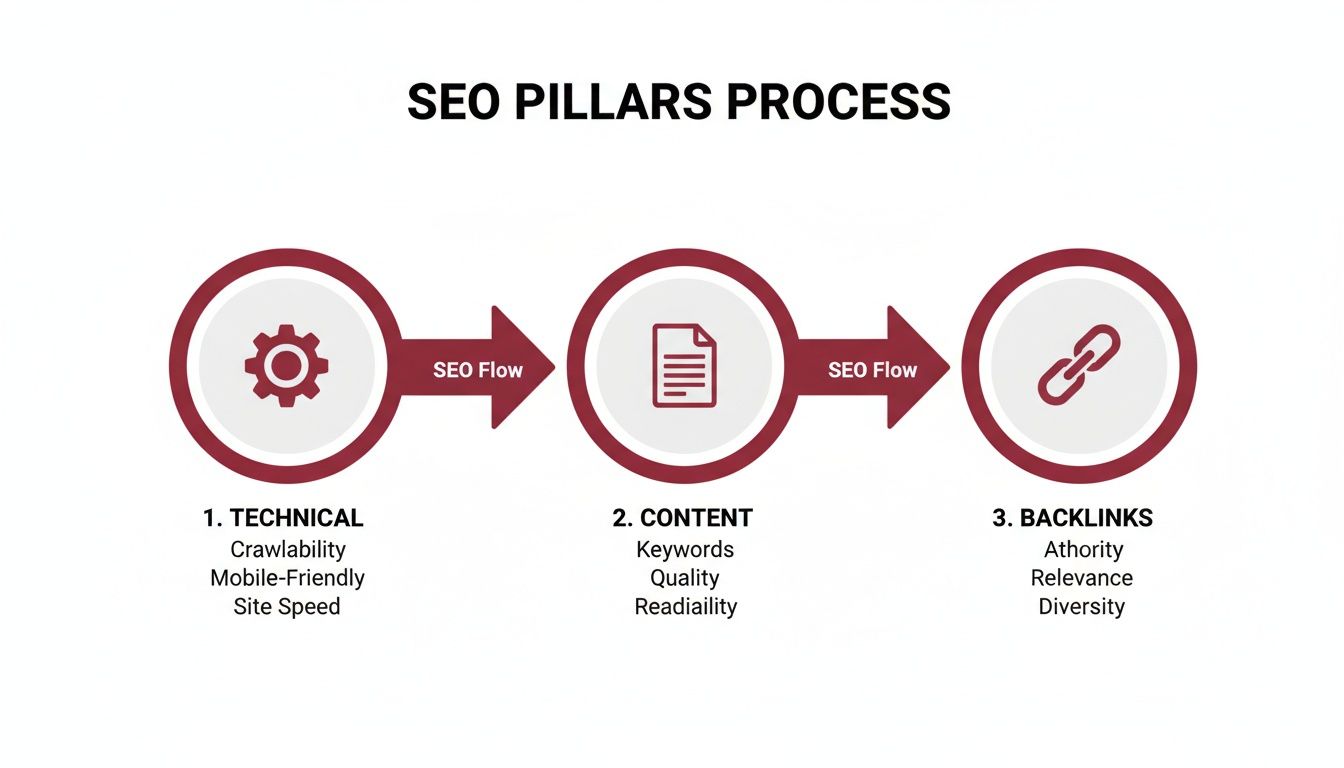
As you can see, technical health is the bedrock. Your content is what engages users and answers their questions, and your backlinks act as votes of confidence from other sites, building your authority.
To help you visualise how these elements come together, here’s a quick summary of the path we’re about to take.
Your Google Rankings Roadmap At a Glance
This table breaks down the core pillars of our strategy, outlining the main goal for each and the key actions we’ll be taking to achieve it.
| SEO Pillar | Primary Goal | Key Actions |
|---|---|---|
| Technical SEO | Ensure Google can efficiently find, crawl, and index your website without any issues. | Fix crawl errors, optimise site speed (Core Web Vitals), improve site architecture, and ensure mobile-friendliness. |
| On-Page & Content | Create high-quality, relevant content that matches user intent and is optimised for target keywords. | Conduct keyword research, map content to the user journey, write valuable content, and implement schema markup. |
| Off-Page SEO | Build your website's authority and credibility by earning high-quality backlinks from reputable sources. | Acquire links from relevant sites, run guest posting campaigns, and use broken link building tactics. |
This roadmap provides the structure for everything that follows, ensuring every action is purposeful and contributes to the end goal: better rankings.
Your Initial Audit Checklist
To kick things off, you don't need to fix everything at once. The initial goal is discovery. You're gathering the intel needed to build your action plan.
Here's where to start:
- Technical Health Check: Jump into Google Search Console. Check the Coverage report for crawl errors and the Core Web Vitals report for performance issues. Are there mobile usability problems? Note them all down.
- Content and Keyword Gaps: Where are you ranking right now? Look for those valuable keywords sitting on page two or three. These are often your quickest wins. More importantly, does your content actually satisfy the searcher's intent for those terms?
- Backlink Profile Review: Take a look at who is linking to you. Are the sites relevant and authoritative? Finding and disavowing genuinely spammy or toxic links is a cleanup task that can sometimes yield surprisingly positive results.
Working through these areas gives you the raw data to make smart, informed decisions. This is where you shift from a reactive to a proactive SEO mindset, setting the stage for real, sustainable growth.
How to Improve Google Rankings with Technical SEO Essentials
Think of your website's technical SEO as its very foundation. You could have the most stunning design and persuasive copy, but if the site is built on shaky ground, you're not going to get very far. Without sorting out the technicals first, all your hard work on content and link-building will never truly pay off. A strong technical base is essential for any strategy aiming to improve Google rankings.
This is all about making it dead simple for Google’s crawlers to find, understand, and index your website. But it's not just about keeping the search engines happy. A technically sound site is fast, secure, and easy for people to use, which keeps them around longer—a powerful signal to Google that you’re giving users what they want.
Optimise Your Core Web Vitals for User Experience
User experience isn't just a fluffy marketing term anymore; Google has made it a direct ranking factor. Their Core Web Vitals are specific, measurable metrics that tell you how real people are actually experiencing your site.
- Largest Contentful Paint (LCP): How quickly does the main piece of content (like a big image or text block) load? You should be aiming for an LCP of 2.5 seconds or less. More often than not, large, unoptimised images are the culprit here.
- Interaction to Next Paint (INP): How responsive is your page? This measures the lag between someone clicking a button and something actually happening. A good INP score is under 200 milliseconds.
- Cumulative Layout Shift (CLS): Ever tried to click something on a page, only for an ad to load and push everything down? That’s layout shift. A low CLS score (under 0.1) means your page is visually stable and doesn't create a frustrating experience for users.
The best place to start is Google Search Console, which will flag these issues for you. Fixing them—by compressing images or cleaning up clunky code—can give you a noticeable rankings boost.
Build a Logical Site Structure
A well-organised site structure, or site architecture, is like a clear roadmap for both your visitors and Google. It shows search engines which pages are most important and how they all relate to one another. A messy, confusing structure waters down your authority and can leave your most important pages buried.
Keep it simple and hierarchical. Your homepage should link to your main categories (e.g., "Services," "About," "Blog"), and those pages should then link to more specific subpages. This creates a logical flow of "link equity" from your most powerful page—the homepage—down through the rest of your site.
A clean site structure ensures that no page is more than three or four clicks away from the homepage. This not only makes life easier for search engine crawlers but, more importantly, makes navigation a breeze for your human visitors.
Prioritise Mobile-First Indexing
Let's be clear: Google now primarily uses the mobile version of your website for indexing and ranking. It’s called mobile-first indexing. If your site is a disaster on a phone—with tiny text, buttons that are impossible to tap, and slow load times—your rankings will take a hit across the board, even for people searching on a desktop.
Your website absolutely must be responsive, meaning it adapts perfectly to any screen size. You can quickly check your pages with Google's own Mobile-Friendly Test tool to find and fix any problems. In today's world, this is non-negotiable.
Secure Your Site with HTTPS
Security is a big deal for Google, and having an HTTPS protocol is a confirmed (though minor) ranking signal. The 'S' stands for secure, and it means the data between a visitor's browser and your website is encrypted. This protects sensitive info and immediately builds trust.
In 2024, not having HTTPS is a massive red flag. Browsers like Chrome will literally label your site as "Not Secure," which is enough to send many potential customers running. Make sure your entire site uses HTTPS by getting an SSL certificate installed. It's a fundamental trust signal you simply can't afford to ignore.
Creating a Winning Content and On-Page SEO Strategy
If technical fixes get your website into the race, a world-class content and on-page SEO strategy is what helps you win it. This is where you move beyond simply ticking boxes and start connecting directly with what your audience actually needs. It's less about stuffing keywords onto a page and more about creating genuinely valuable resources. At the end of the day, brilliant content is the clearest signal you can send Google that your site deserves to be at the top.
The goal is to build a content ecosystem that cements your authority. Forget about writing random blog posts. Instead, think in terms of topic clusters.
This approach involves creating a central "pillar" page covering a broad topic (like "Small Business SEO"). You then surround it with more specific "cluster" articles (for instance, "Keyword Research for Cafes" or "Local SEO for Plumbers") that all link back to that main pillar page. This structure demonstrates deep expertise on a subject, making it far easier to improve your Google rankings for a whole group of related terms, not just one.

Uncovering What Your Audience Really Wants
Great on-page SEO always starts with keyword research that’s laser-focused on search intent. You have to get inside your customer's head and figure out the why behind their search. Are they looking to buy something right now? Are they trying to learn how to do something? Or are they just looking for a specific website?
Aligning your content with that intent is non-negotiable. A user searching for "best running shoes for flat feet" is after comparisons and reviews, not a deep dive into the history of footwear. Creating content that directly solves their problem is the fastest way to earn that click and the ranking that comes with it.
While tools are a huge help for finding keywords, your real-world knowledge of your customers is your biggest advantage. Just think about the questions they ask you every single day—those are your golden keyword opportunities, sitting right there in front of you.
Weaving Keywords into Your Content Naturally
Once you know your target keywords and what the user is trying to achieve, it's time to optimise the page itself. This isn't about robotic repetition; it’s about making your page as relevant and clear as possible.
Here’s where to focus:
- Title Tag: This is arguably your most important on-page element. Get your primary keyword as close to the beginning as you can, but keep it compelling and under 60 characters. For example, "How to Improve Google Rankings | A 2024 Guide."
- Headings (H1, H2s): Your main H1 heading should feature your primary keyword. Use your secondary keywords and related phrases naturally throughout your H2 and H3 subheadings to give your content a logical flow.
- First 100 Words: Mentioning your main topic early on is a simple way to confirm relevance for both your readers and search engines.
- Image Alt Text: Write accurate descriptions for your images to improve accessibility, and include relevant keywords where it makes sense to do so.
Think of on-page optimisation as creating signposts. You're making it incredibly obvious to both Google and your reader what your page is about and why it's the best answer to their query.
Avoiding Thin and Duplicate Content Penalties
Google rewards depth and originality. Thin content—pages with barely any text, auto-generated copy, or content scraped from other sites—offers no real value to a user and can harm your rankings. Likewise, duplicate content, where significant blocks of text are repeated across different pages on your site (or others), can dilute your authority and confuse search engines.
The fix is to concentrate on creating substantial, unique content for every important page on your site. Every service page, blog post, and product description needs to have a clear purpose and offer something of genuine value.
Got some old, low-traffic blog posts from years ago? It might be time to update them with fresh information or even delete and redirect them. Pruning low-quality pages is a healthy part of site maintenance. As you refine your approach, building out a powerful SEO content strategy will give you the framework needed to drive real growth. A well-maintained website signals quality, which is fundamental to improving your search engine rankings.
Building Authority with Strategic Link Building
Once you've got your content and technical SEO sorted, it's time to focus on authority. In the SEO world, authority is a currency, and it's earned primarily through backlinks – links from other websites pointing to yours. Think of a quality backlink as a personal recommendation or a vote of confidence. It's another site telling Google, "Hey, this content is legit, trustworthy, and valuable."
But here's the catch: not all links are created equal. A single link from a highly respected industry publication can do more for your rankings than a hundred links from low-quality, spammy sites. The goal isn't just to get links; it's to earn them from relevant, authoritative sources. This is the heart of link building, and it's a non-negotiable part of climbing the search results.
Launching a Successful Guest Posting Campaign
One of the most reliable ways to earn powerful backlinks is through guest posting. The idea is simple: you write a top-notch article for another website in your industry. In exchange for your expert content, you usually get an author bio with that all-important link back to your website.
A scattergun approach won't work here. You need a strategy.
- Find the right opportunities: Start by looking for blogs your target audience genuinely reads and trusts. A few smart Google searches like
"your industry" + "write for us"or"your topic" + "guest post"will uncover plenty of prospects. - Pitch ideas that actually add value: Don't just send a generic, templated email. Take the time to read the blog, get a feel for its audience, and then pitch a couple of unique article ideas that fill a genuine gap in their content.
- Write something you're proud of: When your pitch gets the green light, don't phone it in. Deliver a fantastic piece of content. Your aim is to provide so much value that the editor is thrilled to publish it and their readers are keen to find out more about you.
Done right, guest posting builds more than just links. It builds your brand, establishes your expertise, and forges valuable relationships within your industry.
Master the Broken Link Building Technique
Broken link building is one of my favourite tactics because it’s so clever and effective. The process involves finding a broken link (a "404 not found" error) on someone else's website and offering them your own, relevant content as a perfect replacement. It's a true win-win: you help the site owner fix an error, and you walk away with a quality backlink.
First, identify some key authoritative websites in your niche. You can then use a tool like Ahrefs' Broken Link Checker to scan their pages for dead links. When you find one that's related to a topic you've already written about, it's time to reach out.
Keep your email short, friendly, and genuinely helpful. Something like this works wonders:
"Hi [Name], I was just reading your fantastic article on [Article Topic] and noticed the link to [Dead Page] seems to be broken. I actually have a resource on [Your Topic] that might make a great replacement, if you're interested. You can find it here: [Your URL]."
This approach immediately positions you as a helpful peer, not just another person asking for a favour.
Building a strong backlink profile is a marathon, not a sprint. The real secret is to create 'link-worthy assets' from the get-go—things like original research, comprehensive guides, and free tools. When you create genuinely valuable resources, the links will start coming to you. Earning links is always more sustainable than just building them.
Performing Regular Backlink Audits
Just as crucial as building good links is pruning the bad ones. A toxic backlink from a spammy, irrelevant, or low-quality site can actively damage your rankings. This is why regular backlink audits are a vital part of your ongoing SEO maintenance.
You can use tools like Google Search Console, Semrush, or Moz to get a clear picture of your backlink profile. Keep an eye out for these red flags:
- Links from sketchy, low-quality directories or private blog networks (PBNs).
- Links from websites in a completely unrelated niche or a different language.
- Any sudden, unnatural spike in the number of new links pointing to your site.
If you uncover toxic links, your first port of call should be to contact the website owner and ask for them to be removed. If that doesn't work, you can use Google's Disavow Tool as a last resort to tell Google to simply ignore those links when assessing your site. A clean, high-quality backlink profile is fundamental to long-term SEO success.
Winning the Local Search Game
If you have a physical shopfront or serve a specific local area, showing up in local search results isn't just a nice-to-have—it's everything. When a potential customer in your suburb searches for "cafe near me" or "plumber in Richmond," you simply have to be there. This is where local SEO becomes a game-changer, putting you directly in front of high-intent customers who are ready to buy.
The goal isn't just general visibility. It's about dominating the most valuable real estate on the search results page: the Google Maps "local pack." Landing one of those top three spots can send a flood of foot traffic and phone calls straight to your business.

Nail Your Google Business Profile
Think of your Google Business Profile (GBP) as the cornerstone of your entire local SEO strategy. It’s a free profile that feeds information directly into Google Search and Maps, and it's your most powerful tool for local visibility. Don't just set it and forget it; treat it like a dynamic, information-rich hub for your business.
You need to fill out every single section, and I mean every section.
- Business Info: Double-check that your business name, address, phone number (NAP), and opening hours are perfect. No typos!
- Categories: Be specific. Instead of "Restaurant," choose "Italian Restaurant." Add relevant secondary categories too.
- Photos: Keep them fresh. Regularly upload clear, high-quality photos of your shopfront, products, team, and happy customers.
- Services/Products: Detail everything you offer. Add descriptions and pricing where possible to answer questions upfront.
- Google Posts: This is your free advertising space. Use it to share updates, special offers, and events directly in your profile.
The Power of Reviews and NAP Consistency
Positive customer reviews are a massive trust signal, both for potential customers and for Google's algorithm. You need to actively encourage your happy clients to leave feedback. The more consistent, positive reviews you get, the more likely you are to stand out. And just as importantly, always respond to reviews—both good and bad. It shows you're engaged and that you value what your customers have to say.
Another absolute fundamental is NAP consistency. This stands for Name, Address, and Phone number. Your NAP details must be identical across your website, your GBP, and every other online directory you're listed in (like TrueLocal or Yelp). Even a tiny variation, like "St." versus "Street," can confuse search engines and dilute your local authority.
A consistent NAP and a steady stream of positive reviews are two of the strongest signals you can send to Google that your business is a legitimate, trusted, and prominent player in your local area.
Build Citations and Location-Specific Pages
Local citations are simply online mentions of your business's NAP. You'll find them on local business directories, industry-specific sites, or even social media profiles. The more high-quality, consistent citations you have, the more confident Google becomes that your business is exactly where you say it is.
Things get a bit more complex if you have multiple locations. For this, you absolutely need to create unique, optimised pages for each physical spot. Each page should feature:
- The specific location's NAP details.
- Unique content about that particular store or service area.
- An embedded Google Map for that address.
- Testimonials from local customers.
This strategy stops your locations from competing against each other and allows each one to rank for its own geographically specific searches. If you have multiple shopfronts, you'll need a tailored plan; you can learn how to do local SEO for multiple locations to make sure every area gets the visibility it deserves.
Australian-specific research shows this multi-location strategy pays off in a big way. Aussie businesses targeting multiple locations drive a whopping 557% more organic traffic on average compared to single-location ones. This isn't just about having more physical spots; it's about the power of scaled content and stronger authority signals across multiple service areas that really supercharges your rankings.
Measuring What Matters: How to Track Your SEO Success and Sharpen Your Strategy
Right, so you’ve put in the hard yards. You’ve sorted out the technical gremlins, crafted some brilliant content, and started earning quality links. But how do you know if any of it is actually working?
This is where we move from "doing SEO" to managing it. Without tracking your performance, you're essentially flying blind. You’re just guessing what’s moving the needle. Proper measurement is the only way to turn your efforts into a repeatable, predictable process for climbing the Google rankings. It’s what separates the websites that get stuck on page three from the ones that consistently grow.
Your Go-To SEO Measurement Toolkit
You don’t need a complicated and expensive software suite to get started. Honestly, the two most critical tools are completely free, straight from Google. Getting comfortable with these is non-negotiable if you're serious about this.
- Google Search Console (GSC): Think of this as your direct line to Google. It shows you how Google sees your site, which search queries are bringing people in, your click-through rates, and any crawling or indexing errors that are holding you back.
- Google Analytics 4 (GA4): GSC tells you what happens before the click; GA4 tells you everything that happens after. It reveals how people behave on your site—which pages they visit, how long they stick around, and, crucially, which traffic sources are actually driving leads and sales.
Used together, these two give you the full story, from the moment someone searches on Google to the moment they become a customer.
The Metrics That Truly Count
It’s easy to get bogged down in a swamp of data. The trick is to focus on the metrics that actually signal SEO success and contribute to your business goals. Forget the vanity numbers; let’s track what informs your next decision.
Here’s what you should be keeping a close eye on:
- Keyword Rankings: Watch how your position changes for your most important keywords. Are you climbing the ladder? Pay special attention to anything lingering on page two (positions 11-20). These are often your low-hanging fruit—a small push can make a big difference.
- Organic Traffic Growth: Is the number of visitors from organic search going up month-on-month? You're looking for a steady, sustainable trend, not just random spikes.
- Click-Through Rate (CTR): You’ll find this in GSC. If your ranking is solid but your CTR is low, it’s a massive red flag that your page title and meta description aren't grabbing anyone's attention.
- Conversions from Organic Traffic: This is the bottom line. Are people who find you on Google actually filling out your contact form, buying your products, or signing up for your newsletter? This is where GA4 shines.
Turning Data into Action
Having the data is one thing; knowing what to do with it is another. This is the feedback loop that drives real, continuous improvement.
For Australian businesses, this is especially true when it comes to local search. The competition is fierce, but the payoff is huge. Nailing that #1 spot in local Australian search results can scoop up 24.4% of all clicks. When you realise that almost half of all Google searches are for local information, it becomes clear that a data-driven approach is essential. If you want to dive deeper, you can explore more local SEO statistics and their impact on Aussie businesses to see the full potential.
Your data is trying to tell you a story. A page with high rankings but a poor click-through rate is screaming for a better title. A page with heaps of traffic but zero conversions has an intent mismatch. You just have to listen.
Based on what you find, you can decide what to tackle next. Is a critical service page underperforming? Time for a content refresh. Did a new technical error pop up in GSC? Get it fixed, fast. Did a guest post send a flood of referral traffic? That’s your sign to double down on that tactic.
This cycle of measure, analyse, and act is the core of any successful SEO campaign. It’s how you achieve and, more importantly, maintain those top spots on Google.
Got Questions About Improving Your Google Rankings? We've Got Answers
When you're trying to climb the search rankings, a lot of questions pop up. It’s completely normal. Let's tackle some of the most common ones I hear from business owners so you can move forward with confidence.
How Long Does It Really Take to Improve Google Rankings?
This is the million-dollar question, isn't it? The honest answer is, it depends. SEO isn't an overnight fix; it's a marathon, not a sprint.
For less competitive keywords, you might start seeing some positive movement in as little as 3 to 6 months. But if you're targeting highly competitive search terms, a more realistic timeline is around 6 to 12 months to achieve significant, lasting results. Think of it as building a strong foundation – it takes time, but consistent effort creates momentum that pays off.
Can I Actually Boost My Rankings Without Spending Money?
Yes, you absolutely can. Some of the most effective SEO activities don't require a hefty budget, just your time and a bit of know-how.
Here are a few high-impact tasks you can do for free:
- Dive into Google Search Console to find and squash technical bugs.
- Sharpen up your on-page content—think titles, headings, and the actual words on the page.
- Focus on improving your site speed and making sure it's a dream to use on mobile.
- Take full control of your Google Business Profile to own your local search presence.
What’s the Single Most Important Ranking Factor?
If only it were that simple! The truth is, there's no magic bullet. Google’s algorithm is incredibly sophisticated, looking at hundreds of different signals to decide who ranks where.
Instead of searching for one secret factor, it’s much more useful to focus on the three core pillars of modern SEO: creating high-quality, genuinely helpful content that answers a searcher's query; building a strong backlink profile from reputable websites; and ensuring a fantastic user experience through a technically sound website. If you drop the ball on any one of these, you'll struggle to get ahead.
Ready to stop guessing and start seeing real growth? The expert team at Anitech builds data-driven SEO strategies that deliver measurable results for Australian businesses. Learn how we can help you dominate the search rankings and drive sustainable growth. Book your free consultation today!