Quick Summary: To increase website traffic, focus on a multi-faceted approach combining technical SEO, high-quality content creation, and strategic promotion. Start by auditing your current traffic sources to establish a baseline. This guide provides a detailed playbook for businesses, covering SEO optimization, creating content that matches user intent, and amplifying your reach to achieve real, sustainable growth in website visitors.
Where Do You Really Stand? Auditing Your Traffic Foundation
Before you can create a roadmap for growth, you need to understand your starting point. Trying to increase website traffic without a solid baseline is like driving from Sydney to Perth without a map—you might be moving, but you have no idea if you're heading in the right direction.
The objective here is to move past superficial "vanity metrics" like total page views. We need to analyze the data that tells the real story about user behavior on your site and how your website is actually performing. This initial audit is the most critical step in any traffic growth strategy, providing the context to make informed decisions instead of just guessing.
Setting Your Performance Baseline
First things first: you need an honest, clear performance baseline. This involves collecting data to understand not just how many people are visiting, but who they are, how they’re finding you, and what they do when they arrive.
Your two most important tools for this are Google Analytics 4 (GA4) and Google Search Console. These are the absolute cornerstones for understanding your digital footprint.
- Google Analytics 4 (GA4): This is your window into what happens on your website. It shows you which pages are most popular, how long people stay, and the journey they take from one page to another.
- Google Search Console (GSC): This tool focuses on your performance in Google’s search results. It tells you which search terms people are using to find you, which of your pages are ranking, and flags any technical issues holding you back.
When you combine the insights from both, you get a comprehensive, 360-degree view of your website's health.
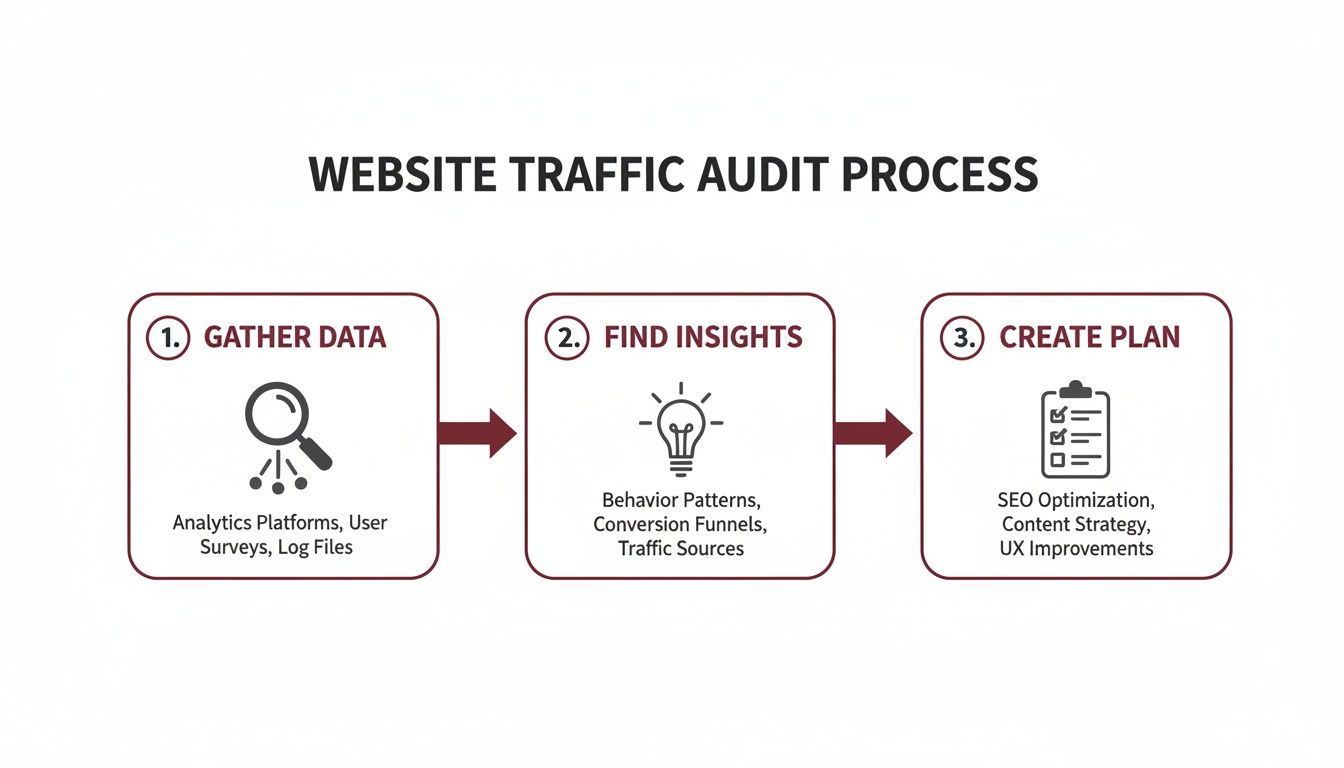
This simple flow—gather data, find the story within it, and build a plan—is the foundation of every successful traffic campaign.
Analysing Key Traffic Channels
It's a simple truth: not all traffic is created equal. Understanding which channels bring you the most engaged visitors is essential for knowing where to invest your time, effort, and budget. Your audit should break down traffic into its primary sources:
- Organic Search: People finding you through a search engine like Google. This is often your highest-quality traffic because it’s driven by real user intent.
- Direct: Visitors who type your website address directly into their browser. This usually indicates strong brand recognition and loyal repeat visitors.
- Referral: Traffic coming from links on other websites. A great sign of your site's authority and credibility.
- Social: Clicks from social media platforms like Facebook, LinkedIn, or Instagram.
- Paid Search: Visitors from your paid advertising campaigns, such as Google Ads.
Look for patterns. Is your organic search traffic converting well but the volume is low? That signals a significant opportunity for SEO. Is one specific blog post bringing in a large amount of referral traffic? That’s a valuable asset you should promote even more.
Your goal isn't just to get more visitors; it's to attract the right visitors. A thousand engaged users from organic search are far more valuable than 10,000 disinterested clicks from a poorly targeted ad.
The numbers support this focus. With the average Australian spending 41 hours online weekly and digital ad spend reaching $20.7 billion, businesses must analyze and optimize their traffic sources. Using analytics to understand and capture your target audience isn't a "nice-to-have" anymore; it's essential for survival.
This checklist below will give you a solid starting point for your audit, ensuring you cover the most important metrics from the beginning.
Your Core Website Traffic Audit Checklist
Here’s a practical checklist to guide your initial data-gathering. It will help you establish that crucial baseline by focusing on the metrics that truly matter for increasing website traffic.
| Metric To Check | Recommended Tool | What This Tells You |
|---|---|---|
| Total Users & Sessions | Google Analytics 4 | Your overall traffic volume and how frequently people visit. |
| Traffic by Channel | Google Analytics 4 | Which sources (Organic, Direct, Social) are driving the most visitors. |
| Top Performing Pages | Google Analytics 4 | Which content resonates most with your audience and attracts visitors. |
| Top Search Queries | Google Search Console | The actual keywords people use to find you on Google. |
| Top Ranking Pages (Organic) | Google Search Console | Your best-performing pages in search results. |
| Device Breakdown (Mobile vs. Desktop) | Google Analytics 4 | How users access your site, which impacts user experience priorities. |
| Bounce Rate / Engagement Rate | Google Analytics 4 | How many visitors leave after viewing only one page (a key engagement signal). |
| Conversion Rate (by Goal) | Google Analytics 4 | How effectively your site turns visitors into leads or customers. |
Once you’ve collected this data, you'll have a clear, evidence-based picture of where you stand and, more importantly, where the biggest opportunities for growth are hiding.
Of course, attracting more people is only half the battle. To make a real impact on your business, you need to get better at turning that traffic into tangible results. Take some time to learn how to improve website conversion rates—this is how you ensure all your hard work actually pays off.
Winning the Technical SEO Game for Organic Visibility
Once you have a handle on your website's performance metrics, it’s time to look under the hood. This is where we delve into technical SEO—ensuring search engines can find, crawl, and understand your content. Without a solid technical foundation, even the most brilliant content will struggle to get seen.
Think of your website as a library and Google as the librarian. Technical SEO is about making sure all your books (your pages) are on the right shelves with clear titles, so the librarian can easily find and recommend them. If the library is a mess, with broken stairs (broken links) and unmarked aisles, the librarian simply won't bother.
For any business, this is non-negotiable. We live in a mobile-first world, so a fast site and a seamless user experience aren't just nice-to-haves; they are the price of entry for ranking well and driving valuable organic traffic.

Optimising Your Site for Speed and Mobile Users
It's no secret that most searches happen on a phone. If your site is slow to load on a mobile device, you’re not just frustrating potential customers; you're signaling to Google that you don't prioritize user experience. And Google pays attention to those signals.
Your target should be a page load time of under three seconds. Any longer, and you risk losing visitors before they've even had a chance to see what you offer.
Here are a few quick wins to focus on for an immediate speed boost:
- Shrink Your Images: Large image files are a common culprit for slow sites. Use a tool like TinyPNG or an image compression plugin to reduce file sizes without sacrificing image quality.
- Switch on Browser Caching: Caching instructs a visitor's browser to save parts of your site, so it doesn't have to re-download everything on their next visit. It’s a simple change that makes a significant difference for returning users.
- Minify Your Code (CSS, JavaScript): This sounds technical, but it’s simply the process of removing unnecessary characters from your site's code, like extra spaces and comments. Smaller code files mean faster loading.
Mastering Crawlability and Site Structure
A logical, clean site structure is your roadmap for Google. It helps search engines understand what your site is about and which pages are most important. A messy structure can lead to "crawl budget" issues, where Google gives up before indexing all your valuable content.
A great starting point is to run a crawlability audit. Tools like Screaming Frog or the site audit feature in Semrush are excellent for spotting technical issues that need fixing.
Keep an eye out for these common offenders:
- Broken Links (404 Errors): These are dead ends for both users and search engine crawlers. Find them and redirect them to a relevant, live page.
- Redirect Chains: When one page redirects to another, which redirects to another, it slows everything down and dilutes ranking power. Ensure your redirects are direct.
- Clean URL Structure: Your URLs should be short, descriptive, and include relevant keywords. A URL like
yourdomain.com/services/seo-auditsis far better thanyourdomain.com/p=123?cat=4. It tells both users and Google exactly what the page is about.
A healthy technical foundation isn't a one-time fix; it's ongoing maintenance. Regularly auditing your site for technical issues ensures your SEO efforts are always built on solid ground, preventing small problems from becoming major traffic barriers.
The Power of Internal Linking
Internal linking—the simple act of linking from one page on your site to another—is one of the most overlooked yet potent SEO tactics. When done correctly, it achieves two crucial things:
- It Guides Users: It creates a natural path for visitors to discover more of your content, keeping them on your site longer and guiding them towards your key pages.
- It Spreads Authority: It passes ranking power (or "link equity") from strong pages, like your homepage, to other important pages, giving them a boost in search results.
For example, if you have a popular blog post on "how to choose the right running shoes," you should absolutely link from it to your specific product pages for trail runners or marathon shoes. It’s a logical connection for both your readers and for Google.
Using Schema Markup to Stand Out
Schema markup is a form of microdata you add to your site's HTML to help search engines understand your content on a deeper level. In return, Google might reward you with "rich snippets" in the search results—those eye-catching extras like star ratings, event details, or FAQ dropdowns.
While schema won't directly make you rank higher, these enhanced listings can significantly improve your click-through rate (CTR). A better CTR sends a strong signal to Google that your result is a great match for the query, which can indirectly lead to better rankings over time. For an e-commerce store, using product schema to show price and availability directly in the search results can be a game-changer.
Creating Content That Actually Attracts an Audience
Let's discuss what truly moves the needle. Establishing a sound technical foundation is a crucial start, but it’s only half the job. The real engine for long-term traffic growth is, and always will be, your content. Without genuinely valuable, problem-solving content, there’s nothing for Google to rank or for people to discover. This is where you transition from simply having a website to becoming a genuine authority in your field.
Think of great content as a magnet, constantly pulling in your ideal customers. It’s what answers their questions, solves their problems, and builds trust long before they consider making a purchase. The key is to stop guessing what people want and start building a smart framework that delivers exactly what they’re searching for.
Adopting the Topic Cluster Model
First, abandon the practice of creating random blog posts. If you're still writing about disconnected topics, you're making it much harder for Google (and your audience) to see you as an expert. The most effective content strategy today is the topic cluster model.
This model organizes your content to prove you're the go-to resource on a particular subject.
Here’s the breakdown:
- The Pillar Page: This is your major, cornerstone piece of content. It’s a comprehensive guide that covers a broad topic in depth. For an accountant, a pillar page might be "The Ultimate Guide to Small Business Tax in Australia."
- The Cluster Content: These are smaller, more focused articles that dive deep into specific subtopics from your pillar page. Examples include "Claiming Home Office Expenses," "Understanding GST for Sole Traders," or "How to Choose the Right Business Structure."
- Internal Linking: This is the glue that holds everything together. Every cluster article links back to the main pillar page, and the pillar page links out to each of its supporting articles. This creates a tightly-knit web of related content that signals expertise to search engines.
Why does this model work so well? Because it mirrors how people actually search. They often start with a broad question and then drill down into specifics. This ensures you’re there to help them at every stage of their journey.
Conducting Keyword Research with User Intent in Mind
Great content always starts with understanding what your audience is really looking for. This goes beyond just finding keywords with high search volume. It means digging into user intent—the ‘why’ behind the search query.
Someone searching for "SEO agency Sydney" has a completely different goal than someone searching for "how to do keyword research." The first person is ready to hire (transactional intent), while the second is in learning mode (informational intent). Your content must match that intent perfectly.
Tools like Ahrefs or Semrush are brilliant for finding keyword ideas, but don't stop there. Always ask yourself, "What problem is someone trying to solve with this search?" Adopting this mindset will help you create content that doesn't just rank, but genuinely helps the user.
The goal of keyword research is not just to find what people are typing, but to understand what they are thinking. When your content perfectly aligns with their underlying need, you win both the click and their trust.
For any business, this focus on organic search is a strategic imperative. The data is clear: organic search drives a significant portion of all website traffic. With people spending hours online every day, being visible where they’re actively looking for answers is the most direct path to increasing website traffic. You can explore more insights on Australian web traffic trends to get a better feel for the local digital environment.
Planning Your Content with an Editorial Calendar
Consistency is the undisputed secret weapon of content marketing. Publishing sporadically sends confusing signals to both your audience and the search engines. This is where an editorial calendar becomes invaluable—it’s a simple tool that turns your great ideas into a reliable, ongoing schedule.
This doesn't need to be complex software; a basic spreadsheet is often all you need.
Here’s a simple structure you can adapt:
| Column | Description | Example |
|---|---|---|
| Publish Date | When the piece is scheduled to go live. | 15 August 2024 |
| Topic/Title | The working title for the article. | 5 Common Mistakes in BAS Statements |
| Primary Keyword | The main keyword phrase you're targeting. | BAS statement mistakes |
| User Intent | The goal of the person searching. | Informational (avoiding errors) |
| Content Type | The format you're creating. | Blog Post / How-To Guide |
| Status | Where it is in your workflow. | Writing in Progress |
A calendar like this keeps your team aligned, guarantees a steady stream of fresh content, and helps you plan topics around key dates or promotions. It’s what separates reactive content creators from those who are proactively building a traffic-generating machine. By establishing a rhythm, you build anticipation with your readers and prove your reliability to Google—both are absolutely crucial for growing your website traffic over time.
Building Authority Through Strategic Link Building
With a solid stream of high-quality content established, it's time to focus on what is arguably one of Google's most powerful ranking signals: backlinks. Think of a backlink as a vote of confidence. When another website links to yours, they are essentially telling search engines that your content is credible, trustworthy, and worth paying attention to.
However, this isn't a numbers game. The old strategy of acquiring as many links as possible is obsolete. Today, it’s all about quality over quantity. The right links build genuine authority, improve your rankings, and, just as importantly, send highly relevant referral traffic from audiences you might not have reached otherwise.
First, Create Something Worth Linking To
The most effective way to earn high-quality backlinks is to create "linkable assets." These are pieces of content so valuable that other website owners, bloggers, and journalists want to reference them in their own work. Instead of constantly asking for links, you create a magnet that attracts them naturally.
Examples of linkable assets include:
- Original Research & Data: Conducting industry surveys and publishing the findings can be highly effective. Imagine a report on "The State of Renovations in Queensland" or "SaaS Adoption Trends in Australian Startups." Data like this gets cited frequently.
- Free Tools & Calculators: If you're a finance broker, a mortgage repayment calculator is an incredibly useful tool. For an eCommerce store, a postage cost calculator provides real value. These practical resources become go-to references that people link to repeatedly.
- The Definitive Guide: Remember those pillar pages? A truly comprehensive, "ultimate guide" on a topic—one that is better than anything else available—naturally becomes the authority that others point to.
Creating these assets requires more effort, but the reward is a sustainable flow of high-authority, organic backlinks for years to come.
Get Proactive with Your Outreach
While linkable assets are fantastic for attracting links passively, you can accelerate the process with proactive outreach. This isn't about sending spammy, generic emails. It's about building relationships and offering genuine value.
One of the most effective and scalable tactics is broken link building. The concept is simple and effective. You find relevant websites in your niche that are linking to pages that no longer exist (resulting in a 404 error).
Here’s how it works:
- Use a tool like the Ahrefs Broken Link Checker to scan authoritative sites for dead links.
- Find a piece of your own content that would be a perfect replacement for what the broken link was pointing to.
- Send a brief, friendly email to the site owner. Let them know you found a broken link on their page and gently suggest your resource as a great alternative for their readers.
It's a genuine win-win. You're helping them improve their website, and in return, you have a strong chance of earning a highly relevant backlink.
Keep Your Backlink Profile Squeaky Clean
As you build great new links, you can't forget to monitor your existing backlink profile. Over time, websites can accumulate low-quality or "toxic" links, often from spammy directories or irrelevant sites. These can actively harm your rankings.
Think of your backlink profile like a garden. You need to be planting new seeds (building good links) while also pulling out the weeds (getting rid of toxic links) to keep it healthy.
You should get into the habit of regularly auditing your backlinks with a tool like Semrush or Moz. If you spot a pattern of suspicious links, you can tell Google to ignore them by using their Disavow Tool. This is crucial housekeeping that protects the authority you've worked so hard to build.
Time to Amplify: Get Your Content in Front of More People
Relying solely on SEO for your traffic is risky. It's like building a house with a single support beam—it might stand for a while, but it’s fragile. A truly resilient traffic strategy involves a system where multiple channels work in harmony, each one boosting the others. Once you’ve invested in creating brilliant content, the next logical step is to ensure it reaches the widest possible audience. That means looking beyond organic search.
This is where you shift from a single-channel focus to building a fully integrated digital presence. By strategically using social media, nurturing a loyal email list, and knowing when to invest in paid ads, you can create a powerful and sustainable growth engine.

Use Social Media to Build a Community, Not Just a Billboard
For businesses, platforms like Instagram, Facebook, and LinkedIn are much more than places to post links. They're powerful community-building tools. The goal isn't to just broadcast your latest blog post; it’s about sparking genuine conversations and cultivating a following that wants to visit your site.
- Post Natively. Don't just drop a link. Reformat your content for the platform. Turn a key statistic from your blog into a slick Instagram graphic, a thought-provoking point into a LinkedIn post, or a listicle into a snappy video Reel.
- Make it a two-way street. Ask questions, run polls, and—this is crucial—reply to every single comment. The more you engage with your audience, the more the platform's algorithm will reward you, and the more your followers will come to trust your brand.
- Be smart with your traffic. Use the "link in bio" on Instagram effectively and craft clear calls-to-action on other platforms. The idea is to warm up your audience on social media before you invite them to your website for the full story.
Your Email List is Your Most Valuable Asset—Treat it That Way
Think about it: your email list is the only traffic channel you truly own. It's a direct line to your most engaged followers, completely safe from the whims of Google's or Facebook's next algorithm update. Building an email list is non-negotiable for long-term traffic growth, giving you the power to bring high-intent, repeat visitors back to your site whenever you want.
Your email subscribers are your core community. They have explicitly asked to hear from you. That makes them far more likely to read your content, share it, and eventually become paying customers. Don't neglect this valuable asset.
Get started by offering something valuable in exchange for an email address. This could be a simple checklist, an exclusive guide, or a discount code. Once they're on your list, nurture that relationship with regular, genuinely useful content that points them back to your best articles and pages.
Knowing When to Turn on the Paid Taps
Paid advertising, whether it's Google Ads or social media campaigns, probably shouldn't be your first move, but it can be an incredible accelerator. Once you have a solid understanding of which content resonates with your organic audience, paid channels allow you to put that proven content in front of a much larger, highly targeted audience—fast.
To get the most value, a strategic approach is essential, focusing on smart ad spend optimization to ensure every dollar works as hard as it can.
Here are a few scenarios where paid ads make perfect sense:
- To supercharge your best content. If a blog post is already performing well organically, a small ad budget can give it a massive push.
- To zero in on niche audiences. Paid platforms offer incredibly detailed targeting, letting you get your content in front of the exact people you want to attract.
- For time-sensitive promotions. When you're running a sale or promoting an event, paid ads deliver the immediate traffic you need for success.
The power of a multi-channel strategy is evident in competitive markets. By combining great content with smart amplification across multiple channels, businesses can achieve explosive growth. You can dive deeper into how digital strategies are shaping the Australian online marketplace to see the bigger picture.
Got Questions About Driving More Traffic? We've Got Answers
If you're trying to figure out how to get more people to your website, you're not alone. It's a question we hear all the time from business owners. Let's cut through the jargon and get straight to the answers for some of the most common questions.
"How Long Will It Take for My SEO to Actually Work?"
This is a common question. The honest answer is: it depends. SEO isn’t an instant solution; it's more like growing a garden. You'll likely start seeing some initial positive signs—keyword movements and traffic increases—within three to six months.
However, for significant, game-changing results, especially for competitive terms, you're typically looking at a six to twelve-month journey of consistent, dedicated effort.
Several factors can influence this timeline:
- Your website's history: An established site with some history and authority will see results faster than a brand-new domain starting from scratch.
- Your industry's competitiveness: Ranking for "plumber in Dubbo" is very different from competing for "online clothing store Australia." The tougher the competition, the longer it takes.
- Your investment: A well-resourced strategy that covers all bases—technical SEO, great content, and quality link building—will always get you there quicker.
Think of SEO as a long-term investment. The work you do today—fixing your site, writing a helpful article, earning a great link—is building an asset that will pay you back with sustainable traffic for years. It's all about consistency.
"Should I Spend My Money on Paid Ads or SEO?"
This isn't an "either/or" situation. The smartest approach is to use both, as they serve different purposes and support each other effectively.
- Paid Ads (like Google Ads): This is your source for instant traffic. It's excellent for getting results right now, testing new offers, reaching very specific demographics, or promoting a sale. The downside? The moment you stop paying, the traffic stops.
- SEO (Organic Traffic): This is about building a valuable, long-term asset. It takes time and effort to gain momentum, but the traffic you earn is effectively "free." More importantly, it builds a level of trust and authority that ads cannot buy.
A great strategy is to use paid ads to bring in leads and sales immediately, which takes the pressure off while your long-term SEO strategy builds momentum. You can even use the data from your ad campaigns to identify winning keywords for your SEO efforts.
"How Much Content Do I Really Need to Create?"
Here's the golden rule: quality always triumphs over quantity. It is far better to publish one genuinely helpful, in-depth article a month than to churn out four weak, generic posts that don't help anyone.
With that said, consistency is crucial. It signals to Google that your site is active and relevant. For most small to medium businesses, aiming for one to two high-quality blog posts per week is a fantastic goal. It's enough to build your authority on a topic, target a good range of keywords, and keep your audience engaged without causing burnout.
Remember, every single piece of content is another entry point to your website and another opportunity to rank for a new keyword.
"Is Link Building Still a Thing in SEO?"
Absolutely. One could argue it's more important than ever. Backlinks remain one of Google's primary methods for determining trust and authority. Think of them as votes of confidence from other websites.
However—and this is a significant distinction—the way we build links has completely changed. The old practice of acquiring hundreds of low-quality links from random directories is obsolete and can be harmful. Today, it’s all about earning high-quality, relevant links from respected websites in your field.
One single, powerful link from a major industry blog is worth more than a thousand spammy ones. If you're serious about increasing your website traffic, strategic link building must be part of your plan.
Ready to stop guessing and start seeing real growth? At Anitech, we build data-driven SEO strategies that get measurable results for Australian businesses like yours. Our team can put together a plan to grow your organic traffic, help you climb the search rankings, and hit your business goals. Book your free, no-obligation strategy session today and let's get you on the path to the top of Google.