Quick Summary: Engineering a content moat is a strategic blueprint for building a defensible library of proprietary data and unique insights. This strategy elevates your brand by focusing on "information gain" (new data) and "originality" (unique perspectives), creating assets your competitors cannot easily replicate. This secures long-term SEO dominance and builds audience loyalty.
In a competitive digital landscape, engineering a content moat is about creating a defensible content library that your competitors simply can't copy. It’s a strategic framework built on two key ingredients: proprietary data (what we call information gain) and unique insights (your originality). By getting this mix right, you elevate your brand's authority, lock in long-term SEO rankings, and build a loyal audience that keeps coming back because you offer value they can’t find anywhere else. It’s how you move from generic content to genuine thought leadership.
This strategy goes far beyond standard content marketing. You’re not just writing articles; you're creating assets that are incredibly difficult, if not impossible, for others to replicate. This is how you secure a lasting competitive advantage, both in search rankings and in the minds of your customers.
Why Your Content Needs a Defensible Moat
Let's be honest. The internet is drowning in a sea of lookalike blog posts and generic, AI-generated articles. Just publishing more content isn't going to cut it anymore. The old playbook of targeting a keyword and writing a slightly longer, slightly "better" version of what's already on page one is a game of diminishing returns. Both your audience and the search engines are getting smarter, prioritising content that delivers real, tangible value—something new, insightful, or uniquely helpful.

This is where the idea of a "content moat" comes into play. Think of it like the moat around a medieval castle that protected it from invaders. Your content moat protects your brand’s authority and search rankings from competitors. Instead of water and stone, your moat is built from:
- Information Gain: This is about providing new data, a fresh perspective, or unique insights a user won’t find in the other top-ranking results for their search.
- Originality: This is how you present that information—through your brand’s distinct voice, proprietary research, and custom creative assets that can't be easily ripped off.
Moving Beyond Conventional Content Strategies
To truly master information gain and originality, you need to embrace strategic thought leadership for B2B. This is the key to building a defensible content advantage. It marks a fundamental shift from being a "content renter"—someone who just borrows and rephrases existing ideas—to becoming a "content owner" who creates net-new value for your entire industry.
In Australia's competitive digital space, businesses that champion original content are seeing huge gains. The content marketing sector has ballooned to a market size of $453.2 million, and Aussie businesses are on track to invest a staggering $1.5 billion in SEO services this year alone. It’s no surprise that 74% of businesses now have a documented content strategy that puts a heavy emphasis on originality to cut through the noise.
A content moat transforms your blog from a simple marketing channel into a strategic business asset. It’s an investment in building long-term authority that pays dividends in organic traffic, customer loyalty, and market leadership.
A solid content moat is built on four interconnected pillars. Each one contributes to creating a powerful, defensible advantage that competitors will struggle to overcome.
The Four Pillars of a Content Moat
| Pillar | Description | Key Metric |
|---|---|---|
| Proprietary Data | Unique information generated from your own research, surveys, or internal data. | Exclusivity Score |
| Expert Insights | Deep, experience-based analysis from subject matter experts that can't be replicated. | Authority Lift |
| Unique Brand Voice | A distinct personality and tone that builds a memorable connection with your audience. | Audience Resonance |
| Custom Assets | Original visuals, tools, and templates that add unique value and are hard to copy. | Replicability Index |
Each pillar reinforces the others, creating a cumulative effect that strengthens your moat over time.
Ultimately, engineering a content moat means you're playing a different game. You stop competing on volume and start competing on value. This guide will walk you through the strategic blueprint for building that defensible library of proprietary data and unique insights, creating a competitive edge that lasts.
Identifying Your Strategic Content Opportunities
Before you can even think about building your content moat, you need a solid blueprint. This all starts with finding strategic opportunities—and I don't mean just running another keyword report. We’re talking about hunting for genuine information gaps in your market.
The whole game shifts when you stop asking, "What are people searching for?" and start asking, "What are people searching for that they aren't finding?". It's a move away from the obvious. It means doing a forensic audit of your competitors' content, digging into search results to spot missed user intent, and tapping into your most valuable resource: your customers. The goal is to build a repeatable system for finding topics where your unique expertise can deliver a serious information gain.
Auditing Competitors for Originality Deficits
A standard competitor analysis usually stops at checking keywords and backlinks. That’s not enough if you want to build a real moat. You have to go deeper and specifically look for what I call originality deficits.
Get your hands dirty. Scrutinise the top-ranking articles for your most important topics and start asking some tough questions.
- Are they all just citing the same outdated study from five years ago?
- Is every single article structured as a generic listicle with the same recycled tips?
- Do they use generic stock photos instead of showing real-world examples or screenshots?
These weaknesses are your openings. If every competitor is just rephrasing the same basic information, a huge opportunity exists for the brand that can bring proprietary data, first-hand experience, or a completely new perspective to the table. Start documenting these "sameness" patterns—they are the cracks in your competitors' defences.
Uncovering Missed User Intent in Search Results
The search engine results pages (SERPs) are a goldmine of clues about what users really want. You need to look beyond the top few blue links and analyse the entire page.
- "People Also Ask" (PAA) Boxes: These aren't just for SEO. They reveal the secondary and tertiary questions that are on your audience's mind. If the top articles barely touch on these, that’s a content gap you can drive a truck through.
- Forum and Reddit Threads: Head over to platforms like Reddit. The discussions there highlight the nuanced problems, frustrations, and real-world scenarios that generic blog posts always seem to miss. These conversations are raw, unfiltered intel on your audience's true pain points.
- Video and Image Carousels: If you see these popping up in the search results, it’s a massive signal that users are looking for visual or demonstrative content. If your competitors are only offering walls of text, creating a detailed video tutorial or an original infographic gives you an instant information gain.
Analysing these signals helps you understand the unspoken needs of your audience. It lets you create content that feels far more complete and satisfying than anything else out there.
By focusing on the questions that competitors ignore and the formats they neglect, you can craft content that not only ranks but also genuinely serves the user, building trust and authority.
Developing an Originality Scorecard
To get away from gut feelings and move towards a more objective analysis, you need a simple framework. I call it an Originality Scorecard, and it helps you rate and prioritise your content ideas based on their moat-building potential.
This simple tool forces you to think critically about how defensible a piece of content will actually be.
Try scoring your ideas on a scale of 1-5 across a few key dimensions:
| Scoring Dimension | Description |
|---|---|
| Data Exclusivity | Can we get our hands on proprietary data from surveys, internal analytics, or customer interviews that no one else has? |
| Expertise Uniqueness | Do we have in-house experts with a unique perspective or hands-on experience that competitors simply can't match? |
| Format Innovation | Could we present this information in a novel format (like an interactive tool or an original video series) that’s hard to copy? |
| Angle Freshness | Can we attack this topic from a completely fresh angle or for a specific, underserved niche within our broader audience? |
The scorecard isn't about finding perfect "5/5" topics every single time. It's a strategic tool to make sure you are consciously engineering a content moat with every major piece you create, pushing you to prioritise the work that builds a lasting, defensible advantage.
Right, you've done the strategic groundwork. Now comes the fun part: actually building the assets that form your content moat. This is where we move from theory to production, crafting content that isn't just another article but a valuable, defensible piece of property for your brand.
It’s all about a deliberate process. We’re talking about generating your own data and then weaving it into compelling stories that competitors will find too difficult, too expensive, or just plain impossible to copy.
The goal here isn't just to answer a user's query; it's to own the definitive answer. And you don't achieve that by writing a longer post. You do it by creating a resource that delivers undeniable information gain and originality.

Unearthing Proprietary Data
The absolute foundation of a strong content moat is data that only you have. Don't worry, this doesn't mean you need a multi-million dollar research budget. It just requires a bit of creativity and the willingness to look where your competitors aren't.
- Customer Surveys: Your own customer base is a goldmine of unique insights. Use simple tools like Google Forms or SurveyMonkey to ask targeted questions about their pain points, what success looks like for them, or their take on industry trends. The data you gather is yours and yours alone.
- Internal Business Data: Dig into your own sales figures, customer support tickets, or project results. You might discover trends like "the average ROI for our Victorian clients is 320%" or "the most common SEO mistake we see in the retail sector is X." No one else has access to this.
- Expert Interviews: Your network is a powerful asset. Set up structured interviews with your in-house experts or other respected figures in your industry. Transcribing their unique, experience-based perspectives creates content that is inherently original and authoritative from the get-go.
When you generate your own data, you become the primary source. This puts your competitors in a tough spot: either they have to cite you (which builds your authority) or they have to publish weaker, less credible content. It's a win-win.
Translating Data into Compelling Narratives
Raw data is interesting, but a good story is what people remember. The next crucial step is to wrap your findings in a narrative that truly connects with your audience. Don't just dump a spreadsheet on them. Build a story around the "why." Explain what the numbers actually mean, why they matter, and what your audience should do now that they have these fresh insights.
This kind of originality is what builds an unbreachable moat, a strategy that’s becoming absolutely vital in the Australian market. We're seeing a massive surge in content demand—it's up 5x or more for 86% of marketing teams, and 63% expect that to keep climbing. This is largely driven by a need for greater personalisation and a big shift towards video.
For local businesses, bringing in unique perspectives from micro-influencers who offer genuine engagement is a game-changer, especially as total influencer spend has jumped 13% to $520 million. This all points to an enormous appetite for unique, valuable content. You can learn more about the future of Australian content demand and see how to get ahead of these expectations.
The most powerful content assets don't just present facts; they provide a framework for understanding. They connect the dots for the reader, turning novel information into actionable wisdom.
Choosing Formats with High Moat Strength
When it comes to defensibility, not all content formats are created equal. A standard blog post might be quick to write, but it's just as quick for a competitor to rip off. If you're serious about engineering a content moat, you need to prioritise formats with a high barrier to replication.
The format you choose has a direct impact on how defensible your content becomes. Some are simply built stronger than others.
Content Format vs Moat Strength
Here's a quick breakdown of how different content formats stack up when it comes to building a real, sustainable moat.
| Content Format | Moat Strength (1-5) | Reasoning | Example for an Australian Business |
| :— | :— | :— |
| Standard Blog Post | 1 | Easy to replicate, low barrier to entry. | A general post about '5 SEO tips'. |
| Expert Roundup | 3 | Requires network access and coordination. | Interviewing 10 Australian e-commerce founders on their biggest growth challenge. |
| Proprietary Data Study | 5 | Requires original research, data analysis, and is highly defensible. | Anitech publishing a study on the average SEO ROI for Victorian service businesses. |
| Interactive Tool | 5 | Requires development resources, unique IP. | A free calculator that estimates local SEO impact for multi-location businesses in Australia. |
Putting your resources into these higher-strength formats—think proprietary data studies, detailed case studies with exclusive metrics, and interactive tools—is a long-term investment. These pieces become reference points in your industry, constantly attracting links, traffic, and authority that solidify your moat with every single view and share.
This is the very essence of moving from just "creating content" to strategically engineering valuable assets.
Getting Your Original Content the Attention It Deserves
You’ve done the hard work. You’ve created a genuinely original, data-rich piece of content. But hitting ‘publish’ and hoping for the best is like building a brilliant product and never telling anyone about it. If you want to engineer a real content moat, you need a deliberate amplification strategy to make sure your hard-earned information gain and originality actually reaches people and earns the authority it deserves.
This is where you switch gears from creator to promoter. The aim here is to build a distribution engine as robust as the content itself, creating a flywheel where every share, mention, and backlink reinforces your position.

A simple social media post won’t cut it. When you have proprietary data, you’re holding a valuable card that journalists, influencers, and other creators genuinely want to see. You just need to get it in front of them.
Reaching Out to Journalists and Publications
Journalists are always on the hunt for fresh data and unique angles to beef up their stories. Your original research is a goldmine for them. The trick is to stop thinking in terms of generic outreach and start thinking about targeted, value-first pitches.
Find reporters and bloggers in your niche who have a track record of citing studies or data-driven content. Then, craft a personalised pitch that gets straight to the most surprising finding from your research. Make their life easy: give them a tight summary, a few key stats, and maybe even some embeddable charts or graphics.
The key is to position your content not as an article you want them to link to, but as a primary source that enriches their own work. This changes the dynamic from a request to a collaboration.
This approach takes a bit more time and precision, but the payoff is huge: high-authority backlinks that your competitors will find almost impossible to replicate.
Tapping Into Influencer and Partner Networks
Getting your content shared by respected voices in your industry can be a game-changer for its reach. This isn't about paying for a quick shoutout; it’s about building strategic partnerships where everyone wins.
Try sharing your exclusive findings with a hand-picked group of influencers before you even publish. Give them early access and a few unique talking points. This lets them put their own spin on your data, so when they share it, it feels authentic and insightful to their audience. This tactic works particularly well in the Australian market.
Building a content moat in Australia is all about delivering genuine information gain, and amplifying it through the right channels is non-negotiable. With social media advertising costs hitting AU$7.5 billion and influencer marketing set to reach AU$1.3 billion by 2029, you can't afford to ignore organic amplification. At Anitech, our 95% success rate across 500+ clients is built on integrating smart tactics like guest posting and broken link building to maximise the reach of original content—especially since 62.5% of internet users use search engines to research brands. There are many resources online that can teach you more about Australian social media trends and how these channels can supercharge your content promotion.
Slicing and Dicing Your Core Research for Wider Reach
A single proprietary data study isn't just one piece of content. It’s the raw material for dozens of smaller assets. By repurposing your core research into different formats, you can connect with different audience segments on the platforms they actually use.
Think about all the ways you can spin off your main piece:
- Infographics: Turn your most compelling stats into a visually striking, shareable infographic for places like Pinterest and LinkedIn.
- Webinar Presentations: Host a live webinar to do a deep dive into your methodology and the implications of your findings, finishing with a Q&A session.
- Short-Form Video: Create a series of punchy videos for TikTok or Instagram Reels, with each one highlighting a single, surprising stat from your report.
- Podcast Episodes: Dedicate an entire episode to discussing the research. You could even invite another expert on to get their take on your data.
Each repurposed asset acts as a new doorway to your core research, widening your reach and attracting links and shares from all corners of the internet. It’s how you squeeze every last drop of value out of your initial investment.
Measuring The ROI of Your Content Moat
So, you’ve put in the hard yards—the time, resources, and brainpower—to engineer a genuine content moat. The big question now is, how do you prove it’s actually working? How can you draw a clear line from your proprietary data studies and original insights right through to the bottom line?
Measuring the return on this kind of strategic investment means looking past the usual suspects like page views or time on page. You need a different set of metrics, ones that truly reflect the strength and impact of your defensible content assets. These are the numbers that show you’re not just pulling in traffic, but actually building real authority and driving revenue.
Moving Beyond Standard Traffic Metrics
Vanity metrics can feel good, but they don't paint the full picture. A true content moat doesn't just deliver a short-term traffic spike; it generates compounding returns that surface in more advanced, strategic KPIs. This is where you really see the value of all that effort you put into achieving high information gain and originality.
Here are the core metrics you should have your eyes on:
- Branded Search Volume Growth: This one’s a beauty. As your brand becomes the definitive source on a topic, people stop searching for the topic and start searching for you. A steady climb in searches like "[Your Brand] + [Topic]" is a massive signal that your moat is establishing you as a trusted authority. Keep an eye on this in your Google Search Console reports.
- Share of Voice (SoV): Think of this as your market share in the search results. It measures how visible you are for a key set of target keywords compared to your competitors. Tools like SEMrush are great for setting up projects to monitor this. As your original content starts to dominate, your SoV should climb, proving you own the conversation.
- Inbound Links to Proprietary Assets: This is probably the most direct measure of your moat’s strength. Are high-quality, relevant domains linking to your original research, tools, or deep-dive case studies? Every one of those links is a vote of confidence that bolsters your domain authority.
- Lead Quality from Original Content: Don't just count the leads; assess their quality. Are the leads coming from your moat-building assets a better fit for your ideal customer? Are they from larger, more strategic companies? This connects your content directly to tangible sales outcomes, not just marketing metrics.
The ultimate goal here is to stop being just another result on a search page and start becoming a destination people seek out directly. These advanced KPIs are how you track that critical shift.
Tying Moat-Building to Business Outcomes
Let's walk through a realistic scenario to see how this all connects.
Imagine a Melbourne-based financial tech company that wants to be the absolute authority on business lending for startups in Australia. They decide to skip the generic "5 tips for business loans" articles and instead go all-in on creating a proprietary asset: "The 2024 Australian Startup Lending Report."
They build it by surveying 500 Australian startup founders and mixing that with their own anonymised platform data. The result is a report brimming with exclusive stats and insights that simply don't exist anywhere else.
Here’s a breakdown of how they'd measure the ROI:
- Setting the Baseline: First up, they create a dedicated landing page for the report and use Google Analytics to track downloads. In parallel, they set up a keyword tracking project in SEMrush to monitor rankings for a whole cluster of terms around "startup loans Australia."
- Amplification and Link Building: They launch the report with a targeted outreach campaign to financial journalists and industry bloggers. This pays off, earning them powerful backlinks from several high-authority news sites and directly boosting their Domain Authority (DA).
- Tracking Performance Over Time: Six months down the track, they check the results. Their DA has jumped by 10 points. Their "Startup Lending Report" now holds the #1 spot for its main keyword, and it has pulled several related blog posts up onto the first page with it.
- Connecting to Revenue: Here's the kicker. When they analyse the sales data, they discover that leads who downloaded the report have a 30% higher conversion rate into paying customers compared to leads from any other piece of content.
That's the playbook. Drawing that clear line from a unique content asset, to increased domain authority, to a flood of high-quality leads is precisely how you prove the immense business value of engineering a content moat.
Your Blueprint for Sustained Content Dominance
Building a genuine content moat through information gain and originality isn't a task you tick off a list. It’s a fundamental shift in how you operate—a commitment to becoming the go-to, indispensable resource in your field. This entire framework is designed to be your blueprint for that journey, helping you secure sustained market leadership and positioning your brand as the primary source of truth.
It all starts with smart research, digging for those originality gaps your competitors have left wide open. From there, it’s a continuous cycle of creating unique value, amplifying it, and measuring its real-world business impact. This is how you build something competitors can't just copy and paste.
Your Final Checklist for Building a Content Moat
To make this practical, here’s a strategic checklist to guide you. It ensures every part of your process, from the initial idea to measuring the results, is focused on building that defensible advantage.
- Research & Ideation: Systematically audit the competitive landscape for weaknesses and tired, recycled ideas. Your Originality Scorecard is your best friend here—use it to pinpoint and prioritise topics where you can deliver the most significant information gain.
- Creation & Production: Don't just write another blog post. Focus on high-moat formats like proprietary data studies, expert-led frameworks, or interactive tools. The goal is to translate your unique data and insights into compelling narratives that offer actionable advice, not just a dump of raw numbers.
- Amplification & Distribution: You've built something amazing, now get it seen. Develop a targeted outreach plan to connect with journalists, podcasters, and influencers who will appreciate and share your unique data. Remember to repurpose that core asset into different formats (videos, infographics, social threads) to maximise its reach.
- Measurement & Refinement: Forget vanity metrics. Track the KPIs that actually matter, like the growth in your branded search volume and the number of high-quality inbound links pointing to your original assets. Crucially, connect these content metrics directly to lead quality and revenue to prove its undeniable ROI.
This process flow brings it all together, showing how you can measure the return on your investment by focusing on outcomes that truly move the needle.
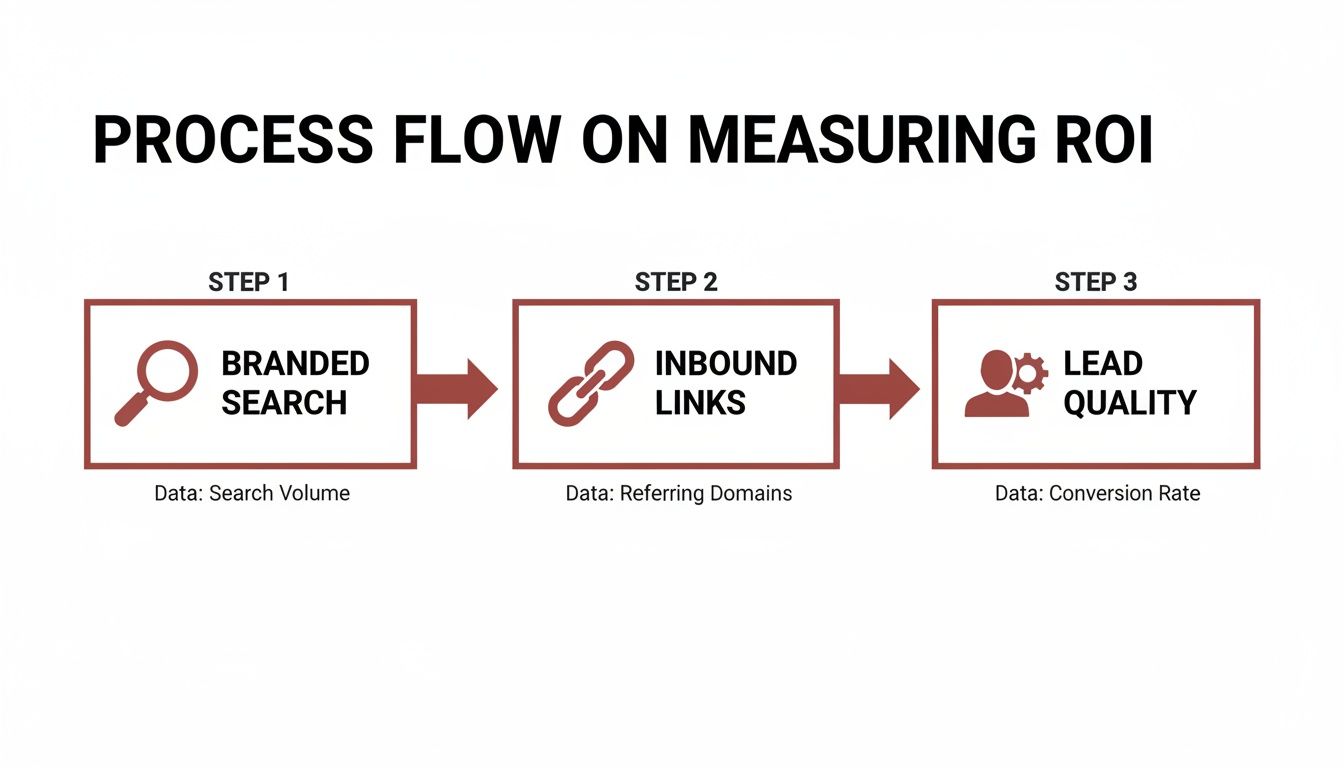
As you can see, a successful content moat drives tangible business results, from stronger brand recognition all the way to higher-quality customer acquisition. If you're looking for a foundational guide to pull all these concepts together for long-term growth, you should learn how to create a content marketing strategy that drives B2B growth.
Got Questions? We've Got Answers
You're not alone if you've got a few questions buzzing around. Building a proper content moat is a big shift from the old "publish and pray" model. Let's tackle some of the common hurdles that pop up when putting this all into practice.
"We're a Small Business. How Can We Possibly Do Original Research?"
This is a big one, but the answer is surprisingly simple: you don't need a massive budget. What you need is to get creative with what you already have and narrow your focus.
Start by looking inwards. You're sitting on a goldmine of data nobody else can touch—your customers. Pop a survey together using a free tool like Google Forms to ask about their real-world challenges and goals. Or, dig into your own sales data. Are there patterns or trends that tell a unique story?
Here's a pro-tip: find a few friendly industry experts in your local area and interview them. By weaving their distinct viewpoints into a single, high-value report, you've instantly created something 100% original. It’s all about finding that small niche where your unique position gives you an edge.
"How Often Should We Be Publishing This Moat-Building Content?"
When you're building a content moat, you have to flip the script from quantity to quality. Forget feeding the content beast with daily updates. The real goal is to create assets that are truly defensible.
Instead of churning out several standard blog posts a week, channel all that energy into creating one knockout, data-rich "pillar" piece each quarter. It's a much more sustainable pace, and the impact on your long-term authority is far greater.
From that one cornerstone piece, you can then carve out dozens of smaller bits of content—social media snippets, infographics, newsletter highlights, and short videos. They all act as signposts, directing traffic back to your main research for months to come. This way, every major effort is geared towards maximising information gain and originality.
"With All This AI Content, Is Originality Even Worth It Anymore?"
It’s not just worth it; it’s more critical than ever. The flood of AI-generated articles has created a massive ocean of sameness. Genuinely original insights and data-driven perspectives don't just stand out—they shine.
Think about it from a search engine's perspective. They are doubling down on rewarding content that proves real-world experience, expertise, authoritativeness, and trustworthiness (E-E-A-T). AI is fantastic at rehashing what’s already out there, but it can't interview your customers, analyse your internal data, or share a strategic viewpoint forged from years of hands-on experience.
That’s where your moat gets its strength. It’s built on those deeply human, non-replicable elements. This is your ticket to cutting through the noise, building genuine trust, and creating a competitive advantage that actually lasts.
Ready to stop competing and start dominating the search rankings in Australia? At Anitech, we live and breathe data-driven SEO and content strategies that create real, measurable growth. Our team is here to help you find those strategic gaps and build original content that secures your authority for the long haul.
Book your free, no-obligation strategy session with Anitech today!