Quick Summary: To succeed in an AI-first search world, your content must be a foundational source for generative engines. This requires focusing on information gain (adding new value) and originality (providing unique data and insights). By leveraging first-party data, expert experiences, and proprietary research, your website can become a citable authority, ensuring visibility within AI-generated answers from engines like Google's AI Overviews, Perplexity, and Copilot, which are increasingly shaping user search behavior.
Search as we know it is changing. AI-driven engines are no longer just serving up a list of blue links; they're synthesising direct, conversational answers on the spot. This shift, driven by information gain & originality: generative engine retrieval, means that to stay visible, your content needs to be seen as a foundational source—one that provides real value and unique insights for Large Language Models (LLMs) like ChatGPT and Perplexity to select as their data "foundation".
This new reality is built on two core concepts: information gain and originality. For your content to be picked up and cited by systems like Google's AI Overviews, it can't just repeat what everyone else is saying. It has to offer something genuinely new.
From Blue Links to AI-Powered Answers
For years, SEO was about climbing the ladder of the search results page. You fought for a top spot, hoping a user would click your link and piece together the information themselves.
Today, generative engines are like an expert research assistant. Instead of giving you a pile of books to sift through, they read the most relevant ones and hand you a concise summary. This is the new world of information gain & originality: generative engine retrieval.

This evolution completely changes how we need to think about creating and optimising content. Your website isn't just competing for a click anymore. It’s competing to become a trusted source cited directly within the AI's answer. If you're not part of that conversation, you might as well be invisible. This is a critical strategy to ensure LLMs like ChatGPT and Perplexity select your data as their "foundation".
The Two Pillars of Generative Retrieval
Getting your content selected as a foundational source really boils down to two key ideas:
- Information Gain: How much new, non-repeated value does your content add to what’s already out there? Think fresh data, overlooked details, or a perspective that can't be found on a dozen other sites.
- Originality: This is more than just avoiding plagiarism. It's about bringing something uniquely yours to the table—proprietary research, firsthand experiences, unique case studies, or a genuinely novel analysis that proves your expertise.
For Australian small businesses and marketing managers, getting a handle on these concepts isn't just a good idea; it's essential for staying relevant and driving growth in an AI-first search world.
The Australian Search Market Shift
We’re already seeing this change play out locally. In Australia, Google holds a massive 93.95% market share, where information gain has long been a factor in traditional SEO. But new generative engines are starting to chip away at that dominance by delivering more original, comprehensive results.
Bing’s market share, for example, has climbed to 4.48%, largely thanks to its AI integrations like Copilot. It provides rich, synthesised answers, not just links, which is a big step up in information gain. For businesses, this means optimising for generative retrieval can open up new avenues for visibility, particularly as Australian users continue to show a strong preference for high-quality search results. You can find more detail in the full research on Australian search engine usage statistics.
The core challenge for businesses is no longer just being discoverable, but becoming indispensable. Your content needs to be the unique ingredient that an AI engine cannot ignore when formulating its answer.
Traditional SEO vs Generative Engine Optimization
To get a clearer picture of this new environment, it helps to compare the old rules with the new. The focus is shifting from technical signals and keyword density to providing genuine, citable value.
| Factor | Traditional SEO (Google Search) | Generative Engine Optimization (AI Overviews) |
|---|---|---|
| Primary Goal | Rank in the top 10 blue links to earn a click. | Become a cited source within the AI-generated answer. |
| Key Metric | Keyword rankings, organic traffic, click-through rate (CTR). | Inclusion in generated answers, brand mentions, attributed traffic. |
| Content Focus | Comprehensive coverage of a topic, keyword optimisation. | Unique data, novel perspectives, and high information gain. |
| User Interaction | User clicks a link, then synthesises information themselves. | User gets a direct, synthesised answer, potentially without clicking. |
| Authority Signal | Backlinks, domain authority, E-E-A-T signals. | Verifiable originality, proprietary data, expert analysis. |
This table shows a clear departure from simply "playing the algorithm." In the generative era, the quality and uniqueness of the information itself have become the most powerful ranking factors.
Decoding Information Gain and Content Originality
In the new world of AI-driven search, two ideas have become the secret sauce for creating content that gets noticed: information gain and originality. Grasping these concepts isn't just a good idea anymore; it's essential for any business that wants to be cited as a go-to source by generative engines. This is what separates the content that AI uses to build its answers from the content it completely ignores.
Think about it like being in a conversation. You stay tuned in when you’re learning something new, not when someone just rehashes what you already know. Generative engines work in much the same way. They're built to hunt down and prioritise content that adds something fresh and valuable to the massive ocean of information already online. This is the essence of information gain & originality: generative engine retrieval.
What Is Information Gain?
At its core, information gain is a measure of how much new knowledge your content brings to the table on a given topic. When an AI model scours the web to answer a question, it’s not just looking for keyword matches. It's actively searching for pages that fill in knowledge gaps, offer a different perspective, or provide details that are missing from other top-ranking sources.
Here’s a simple way to picture it: if ten articles all explain the basics of a subject, the eleventh article that just repeats those same points has an information gain score of virtually zero. But an article that introduces a novel statistic, a different technique, or a unique case study? That one provides a huge amount of information gain. It’s the special ingredient that makes the AI's final answer richer and more complete.
The question you need to ask yourself is, "What does my content offer that a user cannot find anywhere else?" If you don't have a clear answer, a generative engine won't have a clear reason to cite you.
This means that being thorough isn't enough anymore. Your content has to be uniquely valuable, contributing something that genuinely raises the collective understanding of the topic.
The True Meaning of Originality
Taking a step beyond information gain, we get to originality. This is a much bigger concept than just not plagiarising. In the eyes of a generative engine, originality means being the primary source of information, not just another voice commenting on what others have already said. It's about bringing unique intellectual property to the conversation that can only come from you.
Nailing this kind of originality demands a real shift in how you think about creating content. As the search landscape continues to change, it's smart to look at tools and strategies that can give you an edge in both traditional search and with AI. The goal has to shift from simply gathering information to generating it.
Here are a few practical ways you can inject real originality into your work:
- Proprietary Data: Turn your internal business data into public assets. Think customer survey results, anonymised usage stats, or performance numbers that can serve as industry benchmarks.
- First-Hand Experience: Share genuine case studies, detailed project breakdowns, or honest accounts of your own processes. This showcases expertise that simply can't be faked.
- Unique Synthesis: Pull together existing information from different places and connect the dots to form a brand-new conclusion or framework that no one else has articulated.
- Expert Insights: Conduct interviews with your in-house experts or other industry leaders. Their exclusive quotes and perspectives instantly make your content one-of-a-kind.
For instance, a local plumbing business in Melbourne could analyse its job data from the last five years to publish a report on the most common plumbing problems in different suburbs. This hyper-local, data-driven insight is something a generic content mill could never replicate. This is exactly the kind of original, high-value asset that AI engines are desperate to find and feature, making your website an authoritative source they can't afford to ignore.
How Generative Engines Find and Rank Your Content
If you want to create content that wins with generative engines, you first need to get inside their heads. It’s no longer about just stuffing in the right keywords. We're now dealing with a far more sophisticated process designed to find the most trustworthy and valuable information out there. This whole process is called generative engine retrieval.
Think of it like an AI taking an "open-book exam". Before it spits out an answer, it does a lightning-fast research blitz across the web. Your web pages are the textbooks, and the AI's job is to find the most reliable and insightful ones to study from before it starts writing.
The RAG Framework: The AI’s Research Process
This "open-book exam" isn't just a metaphor; it's a real technical framework known as Retrieval-Augmented Generation (RAG). RAG is a game-changer because it connects the creative power of Large Language Models (LLMs) with real-time information pulled from external sources, like your website.
Instead of just relying on its internal, and often outdated, training data, a RAG model works in two steps:
- Retrieval: First, it scans a huge database (like the web) to find documents and snippets that are semantically related to the user's question.
- Generation: Then, it takes the best information it just found and uses it to build a coherent, context-rich, and fact-based answer.
This approach is incredibly important. It's the key to slashing AI "hallucinations" (when an AI just makes stuff up), with some models seeing error rates drop from over 60% down to just 3-5%. It forces the AI to base its answers on current, verifiable information—and that's where your content comes in.
Dense Retrieval: Understanding Meaning, Not Just Words
So, how does that first 'retrieval' step actually happen? Old-school search engines were all about keyword matching. Generative engines use a much smarter technique called dense retrieval, which focuses on the underlying meaning and context of your content, not just the specific words you use.
Dense retrieval works by translating both the user's query and the content on your pages into complex numerical representations, known as vectors. These vectors are essentially a mathematical fingerprint of the text's meaning.
The system then hunts for the content whose vector is closest to the query's vector—think of it like finding the closest point on a map. This means a page can be flagged as highly relevant even if it doesn't contain the exact keywords from the original prompt.
This is a massive shift in how we need to think about content. It’s precisely why the experts at Anitech talk about creating a "semantic cocoon" of expertise around a topic. When you cover a subject thoroughly and from multiple angles, you build a rich semantic profile that dense retrieval systems can easily spot as a top-tier resource.
This diagram shows how your content travels from being a collection of known facts to becoming a source of genuine insight for a generative engine.
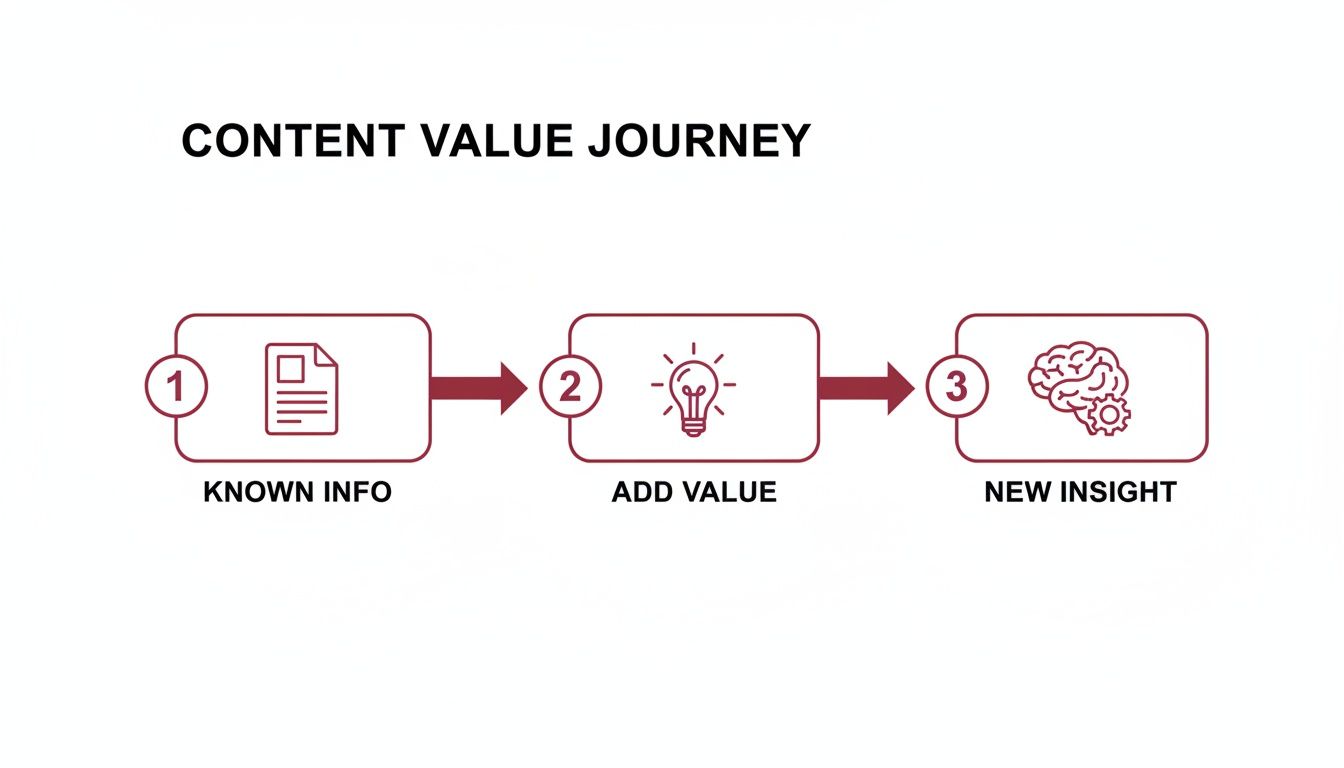
The real takeaway here is that you create value when you add your own unique analysis, data, or perspective. That’s how you turn common knowledge into something original that these new engines are designed to reward.
Reranking for Authority and Trust
But the process doesn't stop after the initial information grab. Once the system has a pool of relevant documents, it performs a crucial reranking step. This is where it sorts through the candidates to prioritise the most authoritative and trustworthy sources. And yes, this is where all your foundational SEO work pays off big time.
The reranking algorithm looks at a whole host of signals to figure out which "textbooks" are the most credible. These include:
- E-E-A-T: Your demonstrated Experience, Expertise, Authoritativeness, and Trustworthiness are non-negotiable.
- Backlink Profile: A healthy profile from reputable sites is a powerful vote of confidence that the AI can understand.
- Site Structure: A clean, logical site architecture helps AI crawlers digest and make sense of your content more easily.
- Freshness: AI agents are built to prefer the most current information, making regular content updates essential.
At the end of the day, a page with high originality and strong authority signals is far more likely to be chosen as a primary source. The generative engine retrieval process is purpose-built to find content that is not only relevant but also reliable, making traditional SEO best practices more critical than ever in this AI-driven world.
Practical Strategies to Maximise Content Originality
Knowing the theory behind information gain and originality is one thing, but actually putting it into practice is where you get the real edge. If you want to position your site as a go-to source for generative engines, you need a solid strategy for creating content that’s genuinely unique and impossible for an AI to overlook. This means stepping away from just rehashing what's already out there and becoming a primary source of new insights yourself.
The whole point is to build a competitive moat around your content. You’re aiming to produce assets so valuable and specific that they become the definitive answer on a topic, essentially forcing generative models to cite you as the source. These strategies are key to ensuring LLMs like ChatGPT and Perplexity select your data as their "foundation".

This isn't just a future trend; it's already influencing Australian search habits. Generative engine retrieval is quietly reshaping how people find information, and originality is becoming a key metric as AI-powered tools like Bing's Copilot gain traction. For businesses, this means focusing on content with high originality is non-negotiable, since these engines are specifically programmed to seek out and reward novel insights. You can see more on Australia's evolving search engine market share to get a sense of the changing landscape.
Tap into Your First-Party Data
Your business is sitting on a goldmine of unique data that no one else can touch. The trick is to turn that internal information into public-facing content—it’s one of the surest ways to score high on originality.
- Case Studies: A local service provider could publish a detailed case study showcasing a 30% efficiency gain for a client, complete with anonymised data and real-world outcomes. This is the kind of tangible proof generative engines love.
- Customer Insights: An e-commerce brand could analyse thousands of customer reviews to build the ultimate buying guide, uncovering patterns and preferences that competitors simply can't see.
- Internal Analytics: Share what’s happening in your own operations. A logistics company might publish a report on delivery time fluctuations across different Australian states, offering up valuable, location-specific data.
Lean on Your In-House Experts
The expertise within your team is a unique asset just waiting to be tapped. Capturing and sharing this knowledge is a direct line to creating content that screams E-E-A-T (Experience, Expertise, Authoritativeness, Trustworthiness).
Originality without credibility is powerless in the generative engine ecosystem. E-E-A-T is the bedrock of your strategy, proving that your unique insights come from a trustworthy source.
Set aside some time for quick interviews with your experts. Seriously, a 20-minute chat can give you dozens of unique quotes, tips, and perspectives to weave into your articles. This not only injects originality but also cements your brand's authority.
Run Your Own Research
You don’t need a massive research and development budget to produce original research. Simple surveys or a bit of data analysis can lead to powerful, citable content that makes you stand out.
- Industry Surveys: Use a tool like SurveyMonkey or even a straightforward LinkedIn poll to gauge opinions from your audience on a hot-button industry topic.
- Data Synthesis: Pull together publicly available data from different places (like the Australian Bureau of Statistics) and combine it to draw a fresh conclusion. The originality here comes from your unique analysis, not just the raw data.
Create Unique Visual Assets
Generative engines aren't just reading your text; they're also processing and valuing unique visuals. Investing in custom graphics can give your content’s originality score a significant boost.
- Custom Infographics: Turn your first-party data or research findings into a compelling infographic that breaks down complex information visually.
- Original Diagrams and Flowcharts: If you're explaining a process, don't just write about it—draw it. A custom diagram is a highly valuable asset that others will want to reference, linking back to you as the original source.
- Real Photography: Ditch the generic stock photos. Use authentic images of your team, your products in action, or your physical location. This adds a layer of trust and experience that's incredibly hard to fake.
By putting these practical tactics to work, you stop being a content curator and become a true content creator. Every piece you publish becomes a unique data point that enriches the web, making your site an essential stop for both human users and the generative engines that serve them.
Measuring Success in the World of Generative Search
As we drift away from the familiar list of blue links, the way we measure success has to change too. Old-school metrics like keyword rankings still have their place, but they’re losing their punch in a world that wants answers, not just links. So, how do you know if your hard work on information gain & originality: generative engine retrieval is actually moving the needle? It all comes down to a new breed of Key Performance Indicators (KPIs) built for this new era.
Success isn't just about winning a click anymore. The real goal is to become a trusted, cited source within the AI's answer. If your brand doesn’t get a mention, you’re basically invisible to a huge and growing chunk of search users.
New KPIs for the Generative Era
To get a real sense of your performance, you need to start tracking metrics that show your visibility inside AI-generated responses. These new KPIs paint a much more honest picture of your content's actual impact.
Here are the key metrics to start watching:
- Citation Rate: This is your most direct measure of success. It’s simply the percentage of times your website is cited as a source when an AI answers one of your target queries. A high citation rate is a clear sign that the AI sees your content as authoritative and original.
- Feature Rate in AI Overviews: Think of this as the new "position zero." This metric tracks how often your content gets featured in Google's AI Overviews. It's prime real estate.
- Unattributed Brand Mentions: Sometimes, an AI will pull from your data without a direct link back. That’s why tracking mentions of your brand name within these answers is so important for understanding your "Share of Model" – basically, how much of the AI's knowledge you own.
How to Manually Check Your Visibility
While the big analytics platforms are still playing catch-up, you can—and absolutely should—do manual spot checks. This hands-on approach gives you immediate, real-world feedback on whether your high-originality content is breaking through.
Imagine a marketing manager who wants to check their work. Instead of a generic search like "best accounting software," they could ask Perplexity or Google’s AI Overviews a more specific question: "What are the most common accounting challenges for Australian retail businesses with under 20 employees?"
If their company’s in-depth research on that exact topic pops up with a citation, that’s a massive win. This kind of manual check provides a direct line to measuring the ROI of creating unique, data-rich content.
The goal is to move from asking "Did we rank?" to "Were we cited?" This subtle but powerful shift in perspective is the key to measuring what truly matters in generative search.
This shift is particularly important for the Australian market. By mid-2025, search engine alternatives in Australia are expected to lean even more heavily on information gain & originality in generative retrieval. While DuckDuckGo has a small market share, Bing's growth to 5.4% is fuelled by its AI features, which reward originality. For local service providers and multi-location businesses, this means creating content with a much higher degree of semantic uniqueness is the only way to get featured—a strategy that's already proving to drive serious traffic. You can find more on this in our guide to Australia's evolving search engine landscape.
Got Questions About Generative Engines? We've Got Answers.
As we all get our heads around this shift to generative search, a lot of practical questions are bound to pop up. It's a new landscape, and figuring out how to adapt your content strategy is key to making sure you don't get left behind.
Let's tackle some of the most common questions we've been hearing. My goal here is to give you straightforward answers and solid advice to help you navigate these changes with confidence.
Does This Mean Keywords Are Dead?
Absolutely not. Keywords and topics are still the bedrock of search. They’re the first signal you send to any search engine—generative or traditional—that your content is relevant.
Think of it this way: keywords get you in the door. They ensure your content is part of the initial pool the engine considers. But getting in the door isn't enough anymore. To actually get cited and win that top spot, you need to bring something new to the table. That’s where information gain and originality come into play.
How Can a Small Business Compete with Big Brands on Originality?
This is where things get exciting for small and medium-sized businesses. You have a massive, often underestimated, advantage: genuine, on-the-ground expertise. A huge multinational corporation simply can't fake the authentic, firsthand experience of a local plumber or the unique customer insights of a boutique online store.
Your superpower is what you know that no one else does. Lean into it. Create content that the big players can't just spin up with a massive budget.
- Local Case Studies: Go deep on projects you've completed right here in your community.
- Your Own Business Data: Share trends you're seeing in customer requests or sales patterns.
- Real Team Expertise: Get your team in front of the camera. Film interviews, tutorials, or just let them share what they've learned from years of doing the job.
Generative engines are hungry for specific, authentic information. This is the perfect opportunity for Australian SMBs to become the go-to primary source that AI systems rely on.
Your unique, localised experience isn't a limitation; it's your most potent weapon. Large corporations can buy scale, but they cannot buy your authenticity.
What’s the Single Most Important Thing I Can Do to Prepare?
Start with your most important piece of content. Pick one page—your flagship blog post, your main service page—and ask yourself this one, honest question: "What unique information does this page provide that a user cannot find anywhere else on the web?"
If the answer is "not much," then you've found your starting point. Your mission is to enrich that page. Don't just rephrase what's already out there. Add something that's genuinely missing from the online conversation. This could be a simple data table from your own findings, a direct quote from one of your experts, a custom diagram you've sketched out, or a detailed case study.
Switching your mindset from rewriting information to creating what’s missing is the most critical change you can make. It's the core principle that will set you up for success in the age of generative AI.
At Anitech, we specialise in crafting SEO strategies that thrive in this new environment. Our team helps Australian businesses transform their expertise into high-originality content that generative engines are built to reward. If you're ready to position your brand as a foundational source, explore our data-driven SEO services.