Quick Summary: The Master Framework for Information Gain in 2026 is a definitive guide to delivering unique value that search engines and AI models must cite. It’s about creating content so original—using proprietary data, demonstrable expertise, and novel analysis—that it becomes the authoritative source, ensuring visibility and authority in a crowded digital landscape.
The rules of the digital content game have well and truly changed. For years, winning meant mastering keywords. But as we head towards 2026, there's a new priority in town. The information gain & originality: master framework for information gain in 2026 is becoming the only way to cut through the noise.
Why Information Gain Is The New SEO Gold Standard
In a world increasingly filtered through AI, just matching what people type into a search bar won't get you very far. The real measure of success is now the unique, tangible value your content adds to the online conversation.

Think of the old search engines like a basic library card catalogue. You'd use keywords to pull up a list of books that might be relevant. Today, search engines and AI are becoming more like a specialist librarian who doesn't just hand you a list; they recommend the one definitive resource that perfectly answers your question.
The Shift From Keywords To Value
This change is a direct result of content saturation. For many Australian SMEs, the digital marketplace feels impossibly crowded. Pumping out more of the same keyword-stuffed content just adds to the echo chamber, making it even harder to get ahead.
The only real solution is to stop playing the old game. It's time to focus on what algorithms are now built to reward: genuine originality and measurable information gain. This framework gives you the strategy to do just that.
A few key things are driving this shift:
- AI-Powered Search: Generative AI models need sources to cite. They are literally programmed to hunt down and reference content that provides new facts, original data, and unique perspectives.
- User Expectations: People are sick of generic, rehashed articles. They want definitive answers and expert insights that solve their problems without the fluff.
- Competitive Differentiation: When everyone else is saying the same thing, the only way to stand out is to offer something that can't be found anywhere else.
To put it into perspective, here’s how the focus is shifting from old-school SEO tactics to what matters now.
The Evolution Of SEO Priorities
This table contrasts traditional SEO metrics with the emerging priorities of the Information Gain Framework, highlighting the strategic shift required for success.
| Focus Area | Traditional SEO Approach | Information Gain Framework |
|---|---|---|
| Content Goal | Rank for specific keywords | Become the citable source of truth |
| Primary Metric | Keyword rankings, click-through rate | Authority, citation by AI, brand recall |
| Research Method | Keyword research tools | First-party data, expert interviews, surveys |
| Core Tactic | On-page optimisation, link building | Creating novel data, unique analysis |
| Measure of Success | Organic traffic volume | Influence on the topic, SERP ownership |
This new approach isn’t just a minor tweak; it's a fundamental change in how we need to think about creating content for the web.
Adapting To The Zero-Click Reality
The rise of AI-powered search has also supercharged a critical trend. In Australia, zero-click searches have jumped to around 58% of all search queries in 2026, a big leap from 51% back in 2023. This is happening because features like Google's AI Overviews and featured snippets answer questions directly on the results page. You can dig deeper into Australian digital behaviour statistics on ROI.com.au.
This trend makes old metrics like click-through rates a less reliable sign of success.
This shift makes it essential for Australian businesses to adopt a framework that captures value beyond the click. When your content is the source for an AI-generated answer, your brand gains authority and visibility even without a direct visit. Your goal is to become the citable source.
What Is Information Gain, Really?
To get our heads around the master framework for information gain in 2026, we need to ditch the abstract jargon. Let’s talk about what "information gain" and "originality" actually mean for the content you create every day. It's less about algorithms and more about the genuine value you give to your audience.
Picture the entire internet as one giant, ever-growing encyclopedia on any given topic. Information gain is when you write a new chapter—the one crucial, missing piece that people have been looking for but couldn't find anywhere. It's that fresh data, that unique perspective, or that real-world story that adds something meaningful to what's already known.
This isn’t about finding a new way to say the same old thing. It's about making a net-positive contribution. Your content needs to leave someone more informed and better equipped than they were before they clicked, armed with an insight they didn't get from the first five results they just glanced at.
Defining True Originality in Content
In this context, originality is so much more than just passing a plagiarism check. It’s about being the source of a new idea, a new connection, or a new piece of data. For a sophisticated search engine or an AI model, this is the very definition of citable authority.
Here’s the bottom line: if your content could have been written by just summarising the top 10 search results, it has no real originality and offers next to no information gain. You have to bring something new to the table.
So, how do you do that? This "newness" can take a few different forms:
- Proprietary Data: This is your secret weapon. Think statistics from your own operations, results from a customer survey, or analysis from your internal research. It’s information that, by definition, exists nowhere else.
- First-hand Experience: Share what you’ve actually done. We're talking unique case studies, detailed project breakdowns, or hands-on tutorials that showcase your organisation's hard-won expertise.
- Novel Analysis: You can take publicly available information and connect the dots in a way nobody else has. By creating a unique synthesis or a different analytical model, you can uncover trends and insights that others have completely missed.
Practical Examples of Information Gain
Let's make this real with a few examples relevant to Australian businesses. The aim here is to move from theory to a clear plan for creating content that genuinely stands out.
Imagine a local plumbing company in Sydney. Instead of pumping out another generic post like "Top 5 Plumbing Problems," they could dig into their own job logs from the past year. This would let them publish something incredibly specific and original, like "The Three Most Common Household Water Leaks in Sydney's Eastern Suburbs and Their Real Repair Costs."
This article provides huge information gain for a few key reasons:
- It's hyperlocal and specific, offering value a generic, nationwide article simply can't match.
- It uses proprietary data (their own job history), which is impossible for competitors to copy.
- It answers a deeper question about cost, which is often what a potential customer really wants to know.
Or think about an Australian ecommerce store that sells hiking gear. They could go beyond standard product reviews and survey 500 of their customers to create an original report on "The Most Underrated Hiking Trails in Victoria According to Experienced Hikers." This piece of content is not only unique and easy for others to cite, but it also builds a strong community connection by showing they truly understand their customers' world.
These examples highlight a fundamental shift in thinking. It’s about looking inward at your own data, expertise, and experience to create value that can't be scraped from the web. That’s the core of building content that search engines and AI models will have no choice but to recognise as an authoritative source.
The Three Pillars of the Information Gain Framework
To really get a handle on information gain and originality, we need to get practical. The framework for making this work in 2026 is built on three core pillars. Think of them as working together, each one adding another layer of unique value—the kind of value that search engines and AI models are specifically designed to find, prioritise, and cite.
It's a bit like a three-legged stool. If you only have one or two legs, the whole thing is wobbly and easy for a competitor to knock over. But get all three working in harmony, and you create a rock-solid foundation for your content's authority.
This diagram shows how these ideas stack on top of each other, turning basic information into something genuinely valuable.
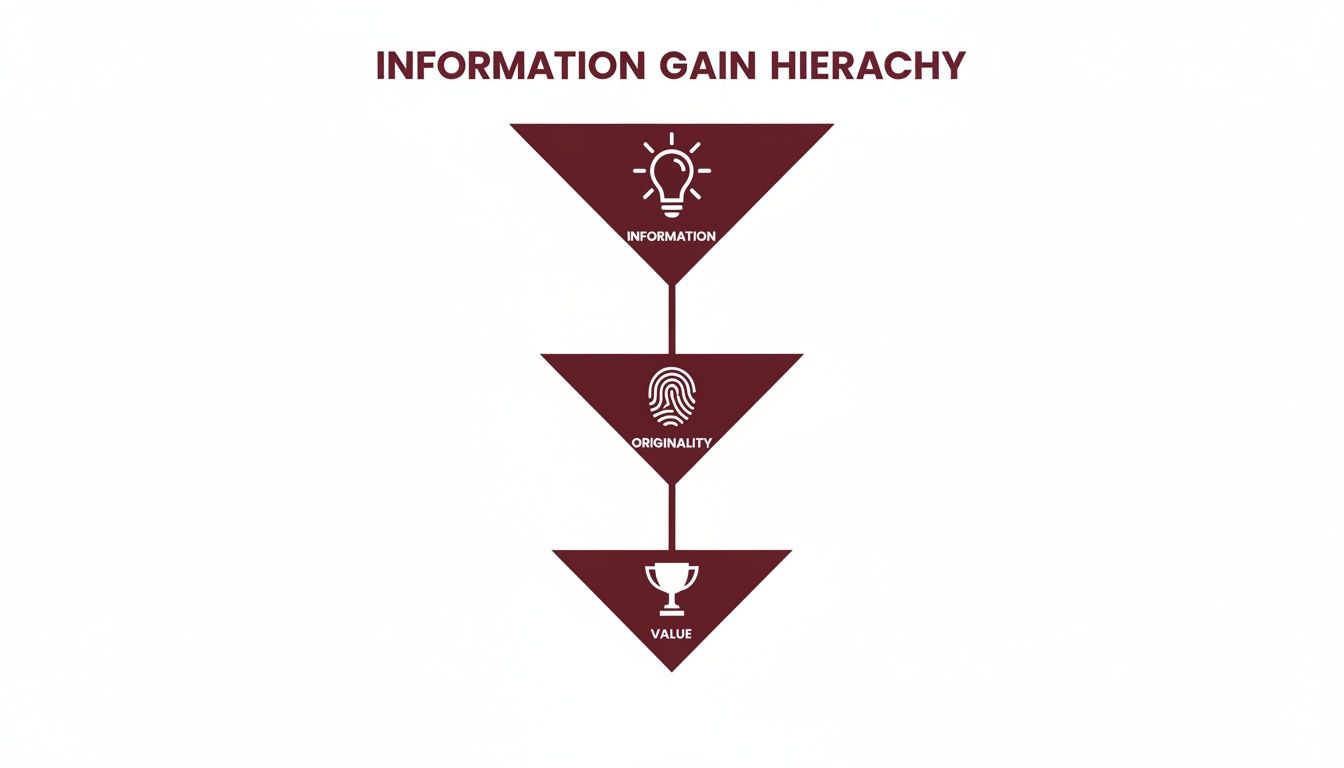
You can see the clear path here: it starts with raw information, which is then refined into something original, and finally becomes the kind of asset that earns authority and citations.
Pillar 1: Proprietary Data and Research
The most direct way to be undeniably original is to create information that doesn't exist anywhere else. That's the whole point of proprietary data. It's your own first-party information, something competitors can't just copy and AI models can't invent out of thin air.
An ecommerce store, for example, could survey 500 customers about their shopping habits to pull out some fresh industry stats. The resulting report—something like "New Data Reveals 65% of Australian Online Shoppers Prioritise Sustainable Packaging"—instantly becomes a citable source.
Here’s how to put this into practice:
- Analyse your internal data: Dig into your sales figures, customer service logs, or operational data to find unique trends. A SaaS company might analyse user behaviour to report on how quickly new features are adopted.
- Conduct customer surveys: Use simple tools like Google Forms or SurveyMonkey to poll your audience on topics specific to your industry.
- Create original case studies: Document a client's success in detail, sharing the specific numbers and methods you used to show off your unique process and prove your results.
Pillar 2: Demonstrable Expertise and Experience
Your organisation's collective experience is a goldmine of original content. This pillar is all about turning years of hands-on, real-world knowledge into insights that prove you know your stuff. AI is great at summarising what's already out there, but it can't replicate the nuanced wisdom that comes from a decade of actually solving problems for real people.
Imagine a seasoned financial advisor writing an article titled, "The Single Biggest Mistake I've Seen Young Australians Make with Superannuation." The value here doesn't come from keyword research; it's pulled directly from lived experience, making it inherently original and incredibly useful.
Demonstrable expertise is about showing, not just telling. It's the difference between a generic "how-to" guide and a detailed walkthrough from a veteran who has seen it all and can guide you around the common pitfalls. This is what builds real trust with both people and algorithms.
To turn your team's expertise into content:
- Interview your internal experts: Grab a coffee with your most experienced team members, hit record, and ask them about the biggest challenges in your field.
- Document your processes: Create content that breaks down your unique methodology for getting results for clients.
- Share the hard-won lessons: Write about your failures and what you learned. That kind of transparency is rare, and it builds enormous trust.
Pillar 3: Novel Synthesis and Analysis
Originality isn't always about inventing something completely new. Sometimes, the most valuable thing you can do is connect existing dots in a way nobody else has. This pillar is about taking publicly available information and applying your unique analytical lens to uncover new patterns, draw fresh conclusions, or create a new framework.
It’s about looking at the same landscape as everyone else but seeing a completely different map. For example, a marketing agency could analyse public reports from several different sources to publish a definitive piece like "The Converging Trends Shaping Australia's Digital Advertising Spend in 2026." The raw data might be public, but the synthesis and the conclusions are all new.
The goal is to provide the "so what?" that so much other content is missing. By adding your unique layer of interpretation, you create a new perspective that pushes the conversation forward, which is the very essence of information gain. This analytical depth is a huge signal of high-value content for today's sophisticated search systems.
How Search Engines and AI Figure Out What's Genuinely Valuable
To get a real grip on the information gain and originality framework for 2026, you have to understand what’s happening behind the curtain. How do search engines and AI models actually sift through the mountain of digital noise to find the good stuff? It’s no longer a simple keyword-matching game; we’re talking about a deep, semantic analysis of a piece of content's actual worth.
Think of today's search algorithms and Large Language Models (LLMs) as incredibly smart, discerning researchers. They aren't just tallying up words or backlinks. Instead, they're digging into the patterns, complexity, and context of your content to figure out how much new value it adds to the conversation. It's a sophisticated process designed to reward real insight, not just cleverly rehashed filler.
This process hinges on identifying unique signals—the digital fingerprints proving your content is more than just an echo of what’s already out there.
The Tell-Tale Signs of Authenticity and Originality
Algorithms have become scarily good at telling the difference between genuinely new information and content that's just been rephrased. A massive factor here is the uniqueness of your data points. When you publish your own survey results or metrics from an internal case study, those numbers don't show up anywhere else. This instantly flags your content as a primary source.
Another powerful signal is the citation pattern. When other authoritative sites start linking to your content as a source, it’s a huge vote of confidence that validates its originality. Algorithms are tracking these inbound links and mentions, treating each one as a sign of trust. This sophisticated approach isn't just for web pages; it's also vital for platforms to determine the visibility of specific products, as seen with Amazon product ranking services.
This move towards rewarding unique contributions is only picking up speed. Projections show Australian IT spending is on track to hit A$172.3 billion in 2026, and by 2028, generative AI features are expected in 75% of software spending. As AI content tools become the norm, the ability to produce truly original, human-driven insights is the key differentiator that algorithms are being fine-tuned to spot. You can discover more insights about this trend on Techpartner.news.
Using Structured Data to Prove Your Value
It’s not just about what you write; you can also use technical signals to explicitly tell search engines that your content is original. This is where Schema markup becomes a total game-changer. Think of it as a special vocabulary that adds context to your information, making it perfectly clear for machines to understand.
By using specific schema types, you can send powerful trust signals:
Authorschema: This connects your content to a real person with a verifiable online presence, reinforcing their expertise.Citationschema: Use this to clearly mark the sources you've referenced, showing your work is well-researched and credible.Datasetschema: This explicitly identifies original data sets within your content, making it easy for AI to parse, understand, and credit them.
Here's a look at the vast library of schema types from Schema.org, the collaborative community behind this vocabulary.
This just scratches the surface, showing how you can define everything from a person to a creative work, directly signalling its context and value to search engines.
Think of Schema markup as a detailed ingredient list for your content. Instead of making an algorithm guess what's inside, you're handing it a precise recipe that highlights all the unique, high-value components. This makes your content far easier for search engines to understand and much more likely to be featured. It's the technical step that connects the 'why' (creating original value) with the 'how' (communicating that value effectively).
Putting The Information Gain Framework Into Action
Let’s get practical. Moving your content strategy away from the old keyword-chasing game and into a system that genuinely creates value isn't just about tweaking your current workflow. It’s a fundamental shift in how you think about content, from the initial idea all the way to a published, citable asset.
By embedding the information gain & originality framework for 2026 into your operations, you build a repeatable process for creating content that actually earns its authority.

This guide breaks down the entire content lifecycle, giving you the hands-on steps needed to make information gain the foundation of everything you publish.
Step 1: Conduct An Originality Gap Analysis
First things first: you need to change how you research. Instead of just looking at what’s popular, start hunting for what’s missing. Traditional keyword research is great for telling you what people are searching for, but an Originality Gap Analysis reveals where the existing answers are weak, rehashed, or simply not there.
Your team's mission is no longer just to identify high-volume keywords. Now, they need to dig into the top-ranking results for those terms and ask some tough questions:
- What critical angle or piece of information is everyone ignoring?
- Is the content I'm seeing based on fresh, original data, or is it just recycled talking points?
- Where's the opening for us to bring in a completely new perspective or our own proprietary insights?
This process isn't about finding gaps in keywords; it's about finding gaps in knowledge. It points you directly to the topics where you can make a real contribution and achieve genuine information gain.
With Australia's internet penetration sitting at a massive 97.1%, the game has changed. You can't rely on a growing user base anymore. Competitive advantage now comes from the originality and quality of your information. Businesses have to win over existing users with superior content that offers something nobody else does. You can discover more insights about Australia's digital landscape on datareportal.com.
Step 2: Build Workflows For Generating Proprietary Data
Nothing beats original data. It's the most powerful, defensible asset you can have in your content toolkit. But to get it consistently, you can’t treat it like a one-off project. You need to build scalable workflows that make data collection a regular part of your operations.
Think about putting these kinds of repeatable processes in place:
- Quarterly Customer Surveys: Create a standard survey template you can use to poll your audience on emerging trends, challenges, or pain points in your industry.
- Internal Data Mining: Set up regular meetings with your sales or operations teams. Their internal data is a goldmine of unique patterns and insights just waiting to be turned into public-facing content.
- Annual "State of the Industry" Reports: Commit to producing one major, data-driven report each year. This quickly establishes your brand as the go-to source for industry benchmarks and trends.
Building these habits turns data generation from a daunting, occasional task into a predictable and powerful part of your content calendar.
Step 3: Craft Content Briefs That Demand Originality
Your content briefs are the architectural plans for your articles. If you want original work, you have to demand it from the very beginning. A standard brief might list keywords, a word count, and a few competitors. An information gain-focused brief goes so much deeper.
It's time to upgrade your briefs. They should now include mandatory sections for:
- The Original Angle: A clear, concise statement defining the unique perspective or argument this article will make.
- Proprietary Data Requirement: This section specifies exactly what internal data, survey results, or expert interviews must be included.
- Expert Contributor: Name the internal or external expert who will either provide first-hand insights or review the final piece for accuracy and depth.
This simple change makes originality a non-negotiable checkpoint right at the start of the creative process.
Step 4: Execute A Citation-Focused Promotion Strategy
You’ve published an incredible, data-rich piece of content. Now what? The promotion strategy needs to evolve from just driving traffic to actively earning citations. The real goal is to get your original data and unique insights referenced by other authoritative sources. That's the ultimate proof of information gain.
Concentrate your outreach efforts on people who value and need fresh information:
- Journalists and Publications: Pitch your original research directly to reporters in your industry. They are always on the hunt for new statistics to support their stories.
- Academic Institutions: Share your findings with university researchers or departments that might find your data relevant to their work.
- Industry Analysts: Get your reports in front of the key analysts who shape industry narratives and are trusted by decision-makers.
By targeting sources that cite original work, you build a powerful web of high-quality backlinks and brand mentions. This is what solidifies your content's authority, not just with users, but with the search engines and AI models that are increasingly shaping our world.
Your Information Gain Content Workflow Checklist
To make sure these principles stick, a checklist can be a huge help. It ensures every piece of content is held to the same high standard before it ever sees the light of day. Here’s a practical workflow you can adapt for your team.
| Phase | Action Item | Verification Check |
|---|---|---|
| 1. Ideation & Research | Conduct Originality Gap Analysis for the target topic. | Have we identified at least one significant knowledge gap in the top 10 results? |
| Identify potential sources for proprietary data. | Is there an internal dataset, a planned survey, or an expert we can tap into? | |
| 2. Briefing | Define the "Original Angle" in the content brief. | Is the unique perspective stated clearly in a single sentence? |
| Specify the required proprietary data/expert input. | Does the brief list the exact data points or expert quotes needed? | |
| 3. Creation | Integrate original data and expert insights into the draft. | Is the proprietary data presented clearly with charts or callouts? |
| Write a compelling narrative around the new information. | Does the content tell a story, or is it just a list of facts? | |
| 4. Pre-Publication Review | Fact-check all original data and expert quotes. | Has the source expert or data owner signed off on the final version? |
| Confirm the content directly answers the knowledge gap. | Does this piece deliver on the promise made in the "Original Angle"? | |
| 5. Promotion | Create a target list of journalists, academics, and analysts. | Is the list focused on entities that publish and cite original research? |
| Pitch the content's unique findings, not just the URL. | Does our outreach email highlight the specific, citable statistics? |
Using this checklist helps turn abstract goals like "originality" and "information gain" into concrete, repeatable actions your team can follow every single day.
Got Questions About Information Gain? You're Not Alone.
Whenever you shift gears from a tried-and-true strategy—like classic keyword targeting—to something new, questions are going to pop up. It’s natural. Moving towards a model that’s all about unique value, like the information gain & originality framework for 2026, means rethinking how you approach content.
So, let's tackle some of the most common questions and hurdles we see businesses, especially Aussie SMEs, run into when they start putting this into practice. The aim here is to give you clear, straightforward answers so you can make this change confidently.
"How Can a Small Business Create Original Data Without a Big Budget?"
This is probably the biggest myth out there. The truth is, small businesses are often in the perfect position to create powerful, original data. Why? Because you operate in a specific niche or local area. You don’t need a huge research team; you just need to look at what you're already doing.
Start with your own operations. Every single day, your business generates a mountain of proprietary information that no one else has access to.
Take a local plumber in Melbourne, for instance. They could analyse a year's worth of job data and publish a knockout report like: "The Top 3 Melbourne Suburbs for Emergency Hot Water System Repairs in 2026." That kind of hyperlocal data is gold for potential customers and completely impossible for a big national competitor to copy.
Here are a few low-cost ways to dig up unique data:
- Customer Surveys: Use free tools like Google Forms to ask your customers what they think. Quiz them on their biggest challenges, their buying habits, or what they think about industry trends. The answers you get are yours and yours alone.
- Your Own Sales Data: An e-commerce store can look at its own sales figures to spot emerging trends. A report titled "Aussies Are Choosing Eco-Friendly Pet Toys: Our 2026 Data Shows a 40% Jump" instantly becomes a citable, valuable asset.
- Tap into Your Team's Know-How: The experience your team has on the frontline is a data goldmine. Chat with them, collect their observations, and turn that collective wisdom into unique content.
The trick is realising that the information you already have is incredibly valuable. Your unique spot in the market is your biggest advantage for creating content that genuinely offers something new.
"Does This Mean I Don't Need to Do Keyword Research Anymore?"
Not at all. If anything, it makes keyword research even more important. It’s still the foundation for understanding what people are searching for and the exact words they use. This framework doesn’t throw that away; it just changes what you do with that knowledge.
Instead of seeing a keyword as a target to hit, you need to see it as a question that deserves a truly original, definitive answer. The keyword is where you start, not where you finish.
Think of it like this: Keywords tell you what conversation people are having. Information gain is how you win that conversation by adding something new and valuable that no one else has brought to the table.
Your process just gets an extra step. Once you’ve found a relevant keyword, you then need to ask, "What original data, unique angle, or first-hand experience can we bring to this topic that’s missing from the current search results?" You still have to know the question (the keyword) to deliver the best answer (the information gain).
"How Long Will It Take to See SEO Results From This?"
Patience is a virtue here. An information gain strategy is a long-term play. You're building lasting authority, not chasing short-term ranking hacks. The results are stickier and more resilient, but they take a bit longer to show up compared to older tactics.
Because you’re creating deep, original, and often data-backed content, the whole process takes longer. You're not just banging out an article; you're doing real research, analysing information, and packaging up expert insights.
Here’s a realistic timeline:
- 3-6 Months: You might start seeing the first signs of life. Search engines begin to notice the depth and authority of your content, which can lead to better rankings for more specific, long-tail searches.
- 6-12 Months: This is when things really start to snowball. Your content will begin attracting high-quality, natural backlinks from other sites that want to cite your original data. It also becomes a prime candidate for being pulled into AI Overviews.
- 12+ Months: At this point, your brand is becoming the go-to source on the topic. You’re not just ranking for keywords anymore; you are the definitive answer people look for. This creates a powerful competitive advantage that’s incredibly hard for others to beat.
Ultimately, this approach builds a defensive moat around your online presence that is far more resistant to the whims of future algorithm updates.
"Can I Use AI-Generated Content With This Framework?"
You can use AI tools as a helpful assistant, but they can’t be the main author. That difference is crucial. Using AI to just rephrase or summarise what’s already out there is the exact opposite of what information gain is all about.
The whole point of the master framework for information gain in 2026 is to provide what AI models can't create by themselves: new, real-world information grounded in human experience and your own unique data.
That said, AI can definitely speed things up. Here’s how to use it effectively as a support tool:
- Data Analysis: Feed your own data into an AI tool to help you spot trends, patterns, and interesting stats much faster than you could manually.
- Content Outlines: AI is great for helping you structure your thoughts and create a logical flow with compelling subheadings.
- Brainstorming Angles: You can prompt an AI to help you come up with fresh perspectives or unexplored questions on a given topic.
- Polishing Your Draft: Once your human-written draft is done, AI is an excellent editor for checking grammar, clarity, and flow.
The heart and soul of the content—the original data, the expert insights, the first-hand stories—has to come from a human. Use AI to be more efficient, but always lean on human expertise to deliver the originality that creates real information gain.
Ready to build a content strategy that search engines and AI can't ignore? Anitech is Australia's leading SEO agency, specialising in creating data-driven content that delivers measurable growth. Let our expert team help you dominate the rankings. Learn more about our SEO services at anitech.au