Quick Summary: Search engine optimisation (SEO) services are professional strategies designed to increase a website's visibility on search engines like Google. This comprehensive guide explains what SEO services involve, typical costs in Australia, realistic timelines for results, and how to select the right agency to drive measurable business growth and connect with customers actively seeking your products.
Think of SEO services as the bridge connecting your business to the customers actively searching for what you sell. By using a mix of technical know-how, creative content, and sharp strategy, these services aim to push your website higher up in Google's search results. It’s like moving your shop from a quiet side street to the main drag of a bustling city centre.
Unlocking Growth with Search Engine Optimisation Services
If your website were a physical store, launching it without any SEO is like opening a fantastic shop in a hidden alleyway with no signs pointing the way. Customers would have to be incredibly lucky to stumble upon it. Search engine optimisation services are the architects and sign-writers for your online presence, making sure you show up right when potential customers in Australia are looking for you.
This isn't about finding a magic bullet or some secret loophole. Real SEO is a core business strategy that builds sustainable, long-term growth. It's about connecting with customers who have a genuine need for your product or service at the exact moment they're looking for a solution, creating a powerful, consistent stream of quality leads.
Why Should You Invest in SEO?
For most Aussie businesses, a smart investment in SEO can shift marketing from being just another expense to a genuine revenue-generator. Unlike old-school ads that interrupt people, SEO pulls in customers who are already searching for what you offer. This makes it a far more efficient and powerful way to spend your marketing dollars.
The real-world benefits of a solid SEO campaign are pretty clear:
- More Organic Traffic: You'll attract more visitors to your website without having to pay for every single click. This naturally leads to a better return on investment over the long run.
- Greater Brand Credibility: Let's be honest, we all trust the sites at the top of Google a little more. High rankings build consumer confidence and position you as a leader in your industry.
- Properly Measured Results: Good SEO isn't guesswork. It's backed by clear data on your rankings, website traffic, and sales conversions, so you can see exactly how it's impacting your bottom line.
Getting to Grips with User Intent
One of the most crucial ideas in SEO is 'user intent'. It's all about figuring out the why behind someone's search. Grasping What Is Search Intent in SEO is absolutely fundamental, as it dictates which keywords you should target and what kind of content you need to create.
When you line up your website's content with what people are actually trying to achieve, you're providing real value. This keeps your visitors happy and sends strong signals to Google that your page is a quality result, which in turn helps boost your rankings.
At the end of the day, search engine optimisation isn't just about keywords and techy stuff. It's about truly understanding your audience and building an online presence that meets their needs, head-on. In this guide, we'll pull back the curtain on the whole process, from the technical basics to building your authority online.
So, What Do You Actually Get with SEO Services?
When you pay for search engine optimisation services, you’re not buying a single, off-the-shelf product. You’re bringing in a team to run a complex, multi-layered strategy. Think of it like building a high-performance race car to compete on the brutal track that is Google’s search results.
Every part of that car has a critical job to do. A monster engine is useless without a solid chassis, and even with both, you're not winning any races without a skilled driver and sleek aerodynamics. SEO works the same way. It's built on three core pillars, and if you neglect one, the whole effort stalls.
Pillar 1: Technical SEO – The Engine and Chassis
First up is Technical SEO. This is the engine, the chassis, the core mechanics of your digital race car. It’s all about the foundational health of your website, making sure search engines can easily crawl, index, and understand your site without hitting any roadblocks. Get this part wrong, and even the most amazing content or powerful links won't save you.
It helps to imagine Google sending out little robots (or "crawlers") to map the internet. If your site is slow, broken, or structured like a maze, those robots get confused and give up. A weak technical foundation is like a race car with a sputtering engine—it’s just not going to compete.
Key jobs in the technical SEO pit-stop include:
- Website Speed Optimisation: Making your pages load lightning-fast. Site speed is a massive ranking factor, and a recent study found a 1-second delay in page load can slash conversions by 7%.
- Mobile-Friendliness: Ensuring your site works perfectly on a smartphone, since that's where most people are searching these days.
- Site Architecture: Building a logical site structure so users and search engines can find what they need without getting lost.
- XML Sitemap Creation: Handing Google a clear map of your website so its crawlers can find and index every important page.
- Crawl Error Resolution: Finding and fixing all the broken links and technical glitches that stop search engines from accessing your content.
Pillar 2: On-Page SEO – The Aerodynamics and Controls
Next, we have On-Page SEO. This is your car’s aerodynamics, the driver's controls, and the eye-catching design. This pillar is all about optimising the actual content and code on your web pages. The goal is to make it blatantly obvious to both people and search engines what each page is about, ensuring it’s perfectly relevant for the keywords you want to rank for.
On-page SEO is how you directly tell Google what your page is about and why it’s valuable. It’s about fine-tuning every element so your content reads brilliantly for a human while being perfectly structured for an algorithm.
This is where your content becomes a strategic weapon. Many search engine optimisation services involve building brand authority through smart content marketing strategies and storytelling that actually drives sales.
Common on-page tasks include:
- Keyword Research and Integration: Finding the exact phrases your customers are searching for and weaving them naturally into your page titles, headings, and text.
- Content Creation and Optimisation: Writing genuinely useful blog posts, articles, and service pages that answer people's questions and are optimised for your target keywords.
- Title Tag and Meta Description Optimisation: Crafting compelling headlines and descriptions for the search results page to make people want to click.
- Header Tag Structuring (H1, H2, H3): Using headings to break up your content logically, which is great for both readability and SEO.
- Internal Linking: Linking between relevant pages on your own website to guide users and spread ranking power around.
Pillar 3: Off-Page SEO – Your Reputation and Sponsorships
Finally, there’s Off-Page SEO. This is your race team's reputation, its big-name sponsorships, and the glowing endorsements from respected figures in the racing world. This pillar covers all the work done away from your website to build its authority and trustworthiness in the eyes of search engines.
The main game here is earning high-quality backlinks. A backlink is simply a link from another website to yours. Google sees these as votes of confidence. The more "votes" you get from reputable, relevant websites, the more Google trusts you, and the higher you're likely to rank.
Key off-page activities involve:
- High-Quality Link Building: Earning links from authoritative websites in your industry—not just any old site.
- Brand Mentions: Getting your business name talked about on other sites, even if they don't include a link.
- Guest Blogging: Writing articles for other respected blogs in your field to build your reputation and earn a valuable backlink.
- Local SEO and Citations: For local businesses, this means getting your name, address, and phone number listed consistently across relevant online directories.
When you bring all three pillars together, you get a complete, powerful strategy that makes sure your website is technically flawless, full of great content, and widely trusted across the web.
How to Budget for SEO Services in Australia
Let's talk money. Figuring out a realistic budget for search engine optimisation services is often the biggest sticking point for Australian businesses. You've probably seen quotes that are all over the place, making it tough to know what's fair and what you should actually get for your investment.
This section will cut through the noise. We'll break down the costs and give you some solid benchmarks for the Aussie market. The goal is to shift your thinking from "How much does it cost?" to "What value am I getting?" A proper budget means you can find a partner who delivers real results, not just a slick sales pitch.
Think of it this way: your SEO budget funds the core activities that drive growth. The image below shows the three fundamental pillars of a strong SEO strategy. Your investment is spread across all of them.
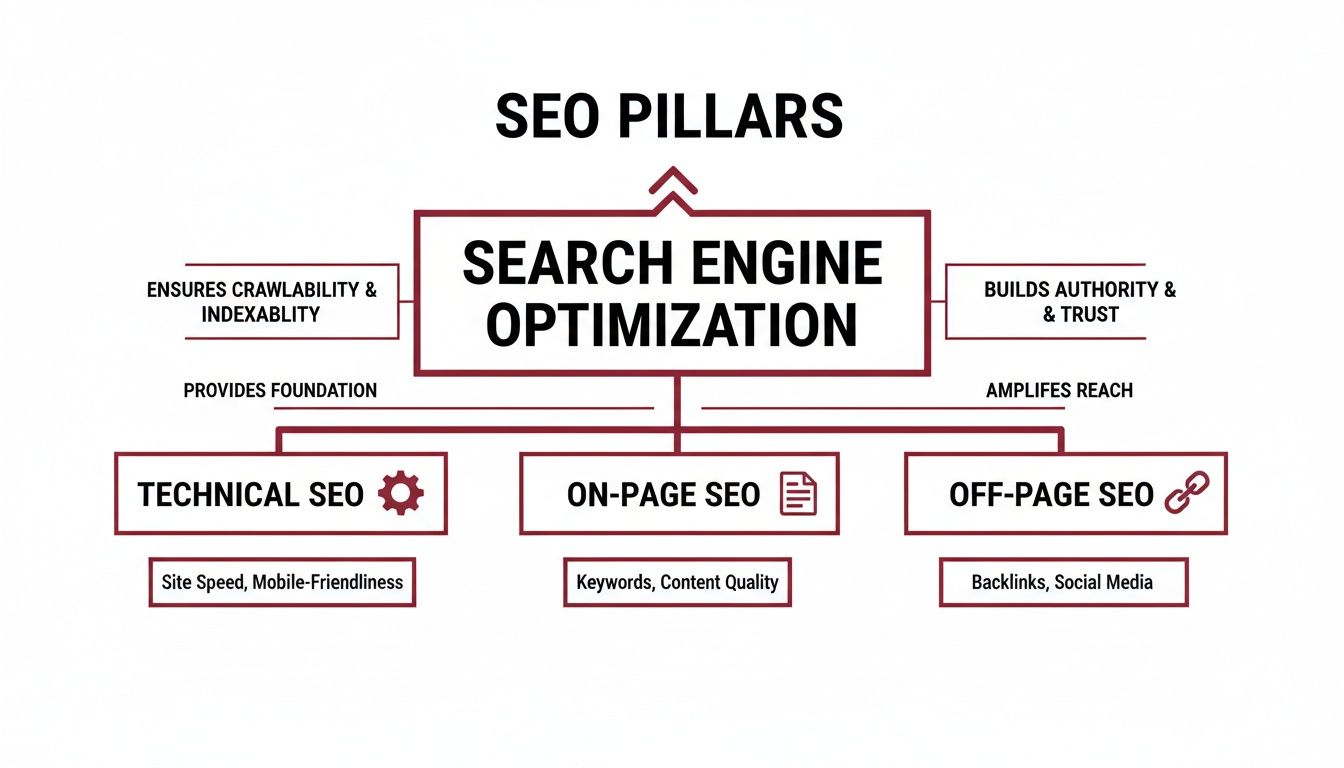
As you can see, a successful campaign needs consistent effort in technical SEO, on-page content, and off-page authority building. Each requires specialist skills, time, and resources from your agency.
Common Ways Agencies Price Their Services
When you start getting quotes, you'll find they usually fall into one of three buckets. Knowing the difference helps you pick the right fit for your business.
- Monthly Retainer: This is the industry standard for a reason. You pay a set fee each month for an ongoing program of work—think content creation, link building, and performance tracking. It’s perfect for building long-term, sustainable growth.
- Project-Based Pricing: Got a specific, one-off job? This is your model. It’s a fixed price for a defined outcome, like a full technical SEO audit before a website launch, cleaning up a Google penalty, or a site migration.
- Hourly Consulting: Sometimes you just need an expert on call. Hourly rates are great for businesses that need targeted advice or training for their in-house team but don't need a fully managed campaign.
For most businesses looking for real growth, a monthly retainer is the way to go. SEO is a marathon, not a sprint. A consistent, long-term partnership allows an agency to build momentum, react to Google's algorithm updates, and deliver results that compound over time.
What Should You Expect to Pay in Australia?
So, what's the actual number on the invoice going to look like? Australian businesses are taking SEO seriously. Projections show local companies are on track to spend USD 1.5 billion on SEO services in the next year, a jump of 12% from the year before. This isn't just a line item anymore; it's a core business investment. If you want to dive deeper into these numbers, you can check out the full breakdown of local SEO statistics in Australia.
This growing investment is scaled based on the size of the business and how ambitious its goals are.
To give you a clearer picture, here’s a breakdown of what businesses typically invest in SEO across Australia.
Typical Monthly SEO Investment in Australia by Business Size
| Business Size | Average Monthly Investment (AUD) | Typical Annual Budget (AUD) |
|---|---|---|
| Small & Local Business | $1,500 – $3,000 | $18,000 – $36,000 |
| Medium-Sized Business | $3,000 – $7,500 | $36,000 – $90,000 |
| Large & Enterprise | $7,500 – $15,000+ | $90,000 – $180,000+ |
These figures provide a general guide, but let's look at what you can expect to get for that investment at each level.
Small Business and Local SEO Budgets
If you're a local business—a plumber, cafe, or boutique shop—your main goal is to show up when nearby customers are searching. The strategy is hyper-focused on your service area, nailing your Google Business Profile, building local citations, and targeting geo-specific keywords.
- Average Monthly Investment: $1,500 – $3,000 AUD
- What you get: The essentials done right. This includes fixing foundational technical issues, optimising your main service pages, managing your Google Business Profile, and starting some basic local link building.
Medium-Sized Business Budgets
For a medium-sized business operating across a state or nationally, the competition gets tougher. Your SEO needs become more complex, demanding a steady stream of new content, a more assertive link-building plan, and much closer performance tracking.
- Average Monthly Investment: $3,000 – $7,500 AUD
- What you get: Everything in the small business plan, but scaled up. This means a consistent content marketing engine, more advanced backlink acquisition, and detailed monthly reports that show what's working and why.
Large and Enterprise-Level Budgets
This is the big league. For large national brands or e-commerce sites with thousands of products, SEO is a fierce, high-stakes game. These campaigns need serious technical expertise, massive content strategies, and a powerful authority-building program to go after the most competitive keywords in the country.
- Average Monthly Investment: $7,500 – $15,000+ AUD
- What you get: A comprehensive, multi-channel strategy. We're talking advanced technical SEO, large-scale content production, digital PR to earn top-tier links, and even conversion rate optimisation (CRO) to make sure all that new traffic actually turns into revenue.
Setting Realistic Timelines for SEO Results
One of the first questions I always get asked is, "So, how long until we see results?" It's a perfectly reasonable question, but the answer isn't a simple number. SEO isn't like flicking a switch and watching the traffic flood in. It’s more like building a valuable asset for your business, piece by piece.
Think of it like planting a garden. You can’t just throw some seeds on the ground today and expect to be picking fruit tomorrow. First, you have to prepare the soil (that’s your technical SEO), choose the right plants for your climate (keyword research), and then consistently water and feed them (content and link building). Just like a garden, your online presence needs time to grow and flourish.
This gradual process is essential because you’re not just trying to trick a computer; you're building genuine trust with search engines like Google. Earning a top spot is a big deal, and Google wants to see consistent, high-quality signals over a sustained period before it hands over that prime digital real estate.
The First Three Months: Laying the Groundwork
The first 1-3 months are all about getting the foundations right. This is the "prepare the soil" phase. You probably won't see a massive jump in leads or traffic just yet, but the work done here is absolutely crucial for any future growth. An agency that rushes this part is building your house on sand.
Here’s what’s happening behind the scenes:
- Technical SEO Audit & Fixes: We’ll be like mechanics, getting under the bonnet of your website to fix things like slow page speeds, broken links, or a clunky site structure. This just makes sure search engines can actually crawl and understand what your site is about.
- Deep-Dive Keyword Research: We'll figure out the exact words and phrases your potential customers in Australia are typing into Google to find a business just like yours.
- On-Page Optimisation: This involves fine-tuning your existing pages – tweaking titles, meta descriptions, and the content itself to align perfectly with our new keyword strategy.
- Getting the Gauges Working: We'll set up or fix your Google Analytics and Google Search Console to make sure we can measure everything accurately from day one.
By the end of this phase, we should start to see some early green shoots – maybe some small improvements in rankings for less competitive keywords or better indexing of your pages.
Months Four to Six: Building Momentum
This is where things start to get exciting. From month four to six, the foundational work really begins to pay off and you’ll see more tangible results. The seeds we planted are starting to sprout.
At this stage, the focus shifts from fixing what was broken to actively building something new. We're rolling out a proactive content plan and earning backlinks that act as votes of confidence, telling Google your site is a credible source.
Key activities and what you should expect to see:
- Consistent Content Creation: We'll be publishing regular, high-value articles and guides that are genuinely helpful to your audience and target our chosen keywords.
- Strategic Link Building: This is the process of getting other reputable websites to link back to yours. It’s one of the most powerful signals you can send to Google.
- Noticeable Ranking Improvements: You should see more of your target keywords climbing up the search results, many hitting the first few pages.
- A Real Bump in Organic Traffic: As your rankings improve, you'll naturally see a measurable increase in visitors coming to your site from search engines.
This is the point where you can look at your analytics charts and see a clear upward trend. It's the proof that the strategy is working.
Months Seven to Twelve: Gaining Authority and Seeing ROI
From the seven-month mark and beyond, a well-run SEO campaign really starts to hit its stride. Your website is no longer just a participant; it's becoming an authority in your field. The consistent effort creates a powerful flywheel effect where growth actually begins to accelerate.
In this mature phase, it’s realistic to expect:
- First-Page Rankings: Many of your most important keywords should now be sitting comfortably on the first page of Google, where the vast majority of clicks happen.
- Substantial Traffic Growth: Organic search should now be a significant and, more importantly, a reliable source of traffic for your business.
- Real Business Impact: This is the bottom line. The increased traffic will be turning into phone calls, quote requests, and sales. We’ll see a measurable impact on your business goals.
By the 12-month mark, the value of search engine optimisation services becomes undeniable. You've built a sustainable pipeline of new customers that keeps delivering long after the initial work is done, providing a fantastic return on your investment.
How to Choose the Right SEO Agency for Your Business
With so many providers offering search engine optimisation services, finding a genuine partner can feel like searching for a needle in a haystack. The right agency works like an extension of your own team, driving real, measurable growth. The wrong one can burn through your budget and leave you worse off than when you started.
The choice is getting harder, too. The industry is booming, and Australia's SEO software market alone is tipped to nearly double in value, hitting USD 5.2 billion by 2030. This incredible growth, detailed in recent research on the Australian SEO market, shows just how vital online visibility has become for Aussie businesses. But it also means a flood of new providers, making your decision more critical than ever.
This guide will help you cut through the noise, so you can stop being a passive buyer and start acting like an informed partner who knows exactly what to look for—and what to run from.
Key Qualities of a Top-Tier SEO Agency
When you start vetting potential agencies, your focus should be on two things: tangible proof of their expertise and a commitment to total transparency. These are the non-negotiables that separate the real pros from the pretenders.
Here’s what to look for:
- Proven Case Studies and Testimonials: Any agency worth its salt will be eager to show off its wins. Ask them for case studies that are relevant to your industry and business size, complete with real data on traffic growth, ranking improvements, and lead generation.
- A Customised Strategy: Steer clear of any agency pushing a generic, one-size-fits-all package. A great partner invests the time upfront to really understand your business goals, your customers, and your competition before they even think about proposing a strategy.
- Transparent Reporting: You have a right to know exactly what you're paying for and the results it's generating. Insist on clear, easy-to-digest monthly reports that connect their SEO activities directly to your business objectives, not just vanity metrics.
Critical Red Flags to Avoid
Knowing what to look for is only half the battle; knowing the warning signs is just as important. Some agencies still rely on outdated or shady tactics that can get your website penalised by Google. Others are just good at making big promises they can't keep.
Be extremely wary of any agency that guarantees a "#1 ranking on Google." Nobody can ethically promise this. Google's algorithm is a complex, ever-changing beast. A promise like that is the biggest red flag in the industry and a sure sign you're not talking to a real expert.
Here are the warning signs you can't afford to ignore:
- Guaranteed Rankings: As we just covered, this is an impossible promise. Real SEO is about sustained improvement across a whole portfolio of valuable keywords, not just gunning for a single, mythical top spot.
- Vague or "Secret" Strategies: If an agency can’t—or won’t—clearly explain their monthly plan of attack, walk away. There's no "secret sauce" in good SEO, just deep expertise, consistent hard work, and a solid, well-researched strategy.
- Lack of Communication: Your SEO agency should be a proactive partner. If they're hard to get a hold of during the sales process, just imagine how it will be once you've signed on the dotted line.
- Focus on Low-Quality Links: Always ask about their approach to link building. If they start talking about buying links in bulk or using automated programs, it's a massive red flag. These are risky "black-hat" techniques that can do serious, long-term damage to your site's reputation.
Choosing the right provider for search engine optimisation services is a major business decision. By focusing on proven results, demanding a tailored strategy, and keeping a sharp eye out for these red flags, you can find a partner who operates with integrity and is genuinely invested in seeing your business grow.
Your Pre-Launch Checklist for Starting an SEO Campaign
Alright, you've made it this far. You understand what SEO is, how it works, and what to look for in a provider. Now it's time to move from theory to action.
Before you even think about picking up the phone or sending an email to an SEO agency, it’s crucial to get your own house in order. Running through a simple checklist first will make sure you’re prepared, focused, and ready to make a smart investment. Think of this as less about hiring a supplier and more about finding the right partner.
This checklist pulls together the key lessons from this guide into a few practical steps. It’ll put you on the right track and help you have a much more productive first chat with any potential SEO company.
Step 1: Define What You Actually Want to Achieve
Before you get lost in the world of keywords and rankings, take a step back. Why are you doing this? SEO is just a vehicle; you need to know your destination.
- What's the main goal? Are you trying to get more quote requests through your website's contact form? Is it all about driving sales on your e-commerce site? Or maybe you want to become the go-to expert in your field.
- What does success look like in 12 months? Get specific. A vague goal is a useless goal. Aim for something like, "a 20% increase in qualified leads from organic search" or "ranking on page one for our five most important product categories."
- What's a new customer worth to you? Knowing the lifetime value of a customer is essential. It helps you figure out a realistic budget and, more importantly, calculate whether your SEO investment is actually paying off.
Step 2: Get to Know Your Audience and Your Rivals
Great SEO isn't about tricking Google; it's about deeply understanding the people you want to reach and the other businesses vying for their attention. Don't rush this part.
You need to get inside your customer's head. What problems are they typing into Google? What are they hoping to find? Your website's job is to provide the absolute best answer to those questions.
Take some time to do this initial homework:
- Map Out Your Ideal Customer: Who are they really? What are their biggest headaches? What words and phrases do they use when they're looking for a solution online?
- Pinpoint Your Top Competitors: Make a list of three to five competitors who always seem to pop up in the search results. What are they doing right? Where are the chinks in their armour?
- Analyse Their Game Plan: Have a good look at their blogs, service pages, and how their site is put together. The goal isn't to copy them. It's to find gaps and opportunities where you can do a much better job.
Step 3: Get Ready for Your First Agency Chat
Once you’ve done your internal prep work, you’re ready to have a proper, meaningful conversation with a potential SEO provider. Walking into that first meeting prepared will help you get the most out of it and accurately judge if they’re the right fit for your business.
Here's what you should have ready to go:
- A Solid List of Questions: Go back to the "red flags" we talked about earlier and turn them into questions. Ask them about how they report on progress, their approach to building links, and their experience working with businesses like yours.
- Your Website Analytics: Be prepared to give them view-only access to your Google Analytics and Google Search Console. This is a non-negotiable. Any decent agency will need this to do a quick health check and give you a data-backed proposal, not just a generic quote plucked from thin air.
- Your Goals and Budget: Be upfront about what you want to achieve and what you're prepared to invest. This kind of honesty right from the start lays the foundation for a genuine partnership built on trust and realistic expectations.
Got Questions? We've Got Answers
Even with a solid game plan, it’s natural to have a few questions before you dive into an SEO partnership. We get it. Let’s clear up some of the most common queries we hear from Australian business owners.
Local vs. National SEO: What's the Difference?
Imagine you’re fishing. Local SEO is like dropping a line in your favourite local creek to catch a specific type of fish you know is there. National SEO is like casting a massive net into the open ocean.
Local SEO is perfect for businesses with a physical shopfront or a defined service area—think a Melbourne plumber, a Sydney cafe, or a Brisbane dentist. The goal is to show up for searches like "emergency plumber near me" or "best coffee in Surry Hills." It’s all about dominating your immediate geographical area and making your Google Business Profile your best friend.
National SEO, on the other hand, is for businesses that aren't tied to one spot. If you run an e-commerce store shipping Australia-wide or a software company with clients from Perth to Hobart, this is your playground. The focus shifts to broader keywords that don’t have a location attached, aiming to capture a nationwide audience.
Are Long-Term SEO Contracts a Red Flag?
Not necessarily. In fact, they can be a sign you’re dealing with a professional who knows what it takes to get real results. SEO isn't a magic trick; it’s more like planting a tree. It needs time, care, and a consistent strategy to grow strong and bear fruit.
A 6 or 12-month agreement is pretty standard because it gives your SEO partner enough runway to research, implement, analyse, and refine their strategy to actually deliver that return on investment.
The real red flag isn't the contract's length. It's the agency that promises the world overnight, won't be clear about their process, or tries to lock you into an iron-clad agreement with no performance clauses. A good partner is transparent and confident enough to build a fair agreement.
Can We Just Do SEO Ourselves?
You absolutely can tackle some of the basics in-house, especially if you have a marketing person with some time on their hands. But being competitive today means going far beyond just tweaking a few page titles.
Hiring a professional agency brings a few heavy-hitting advantages to the table:
- Serious Expertise: A good agency lives and breathes this stuff. They’re constantly tracking Google's mood swings (a.k.a. algorithm updates) so you don’t have to.
- The Right Tools for the Job: Professional SEO relies on powerful software for keyword research, competitor analysis, and technical audits. These tools are often prohibitively expensive for a single business but are part of an agency's standard toolkit.
- Time and Focus: A proper SEO campaign is a massive time sink. An agency has a team dedicated to the nitty-gritty of content creation, technical fixes, and earning high-quality backlinks, freeing you up to run your business.
When you weigh it all up, partnering with an agency is often far more cost-effective than trying to build a specialist SEO team from scratch.
Ready to see how a data-driven SEO strategy can transform your business? The expert team at Anitech is here to help you dominate the search rankings and achieve measurable growth. Contact us today for a free consultation and see what's possible.