Quick Summary: Search engine optimisation (SEO) services for small business involve refining your website to rank higher on search engines like Google. This guide explains how strategic on-page, technical, and local SEO drives high-quality organic traffic, builds brand credibility, and delivers a strong return on investment, making it an essential growth strategy for small businesses.
For a small business, getting found online isn't just a goal; it's the key to survival and growth. You could offer the best products or services in your area, but if your customers can't find you when they search online, you might as well be invisible. This is where professional search engine optimisation services for small business come in, acting as the digital signpost that guides customers directly to your door.
Think of it this way: you could have the most amazing shop in the world, but if it’s tucked away on a hidden backstreet, no one will ever find it. SEO is the art of moving your online business from that quiet laneway right onto the busiest main road in town. For a small business in Australia, where Google is king, getting found isn't just a bonus—it's absolutely vital for survival.

Why SEO Is a Game-Changer for Small Businesses
Bringing in professional search engine optimisation services for your small business is one of the smartest moves you can make for growth. It goes far beyond simply appearing on Google; it’s about making a direct connection with customers at the very moment they’re searching for what you sell.
This steady flow of organic traffic gives your business a solid, sustainable foundation to build on. Unlike paid ads that vanish the second you stop paying, a strong SEO presence keeps delivering results and builds momentum over time. A well-executed SEO strategy doesn't just increase visibility; it enhances your digital presence, improves user experience, and ultimately boosts your bottom line. It's a comprehensive approach to digital marketing that yields long-term benefits, making your business more resilient and competitive in a crowded online marketplace. This strategic investment ensures you're not just seen, but that you're seen by the right people at the right time.
Capitalise on Overwhelming Search Dominance
The simple truth for any Australian business is that one search engine holds almost all the cards. An incredible 94.5% of the search engine market share in Australia belongs to Google, with competitors like Bing barely making a dent. This sheer dominance means that if you’re serious about your digital strategy, optimising for Google isn't optional. You can dig deeper into these Australian search statistics at Safari Digital.
When almost every single potential customer is using the same tool to find local businesses and services, not showing up is like locking your doors during opening hours. A smart SEO campaign makes sure you’re open for business exactly where it counts. Failing to appear in these search results means you're missing out on a massive audience of potential customers who are actively looking for your products or services. This isn't just about visibility; it's about being a relevant and accessible option in the modern consumer's journey. By investing in SEO, you ensure that your business is not just participating in the digital economy but is positioned to thrive within it.
Build Trust and Credibility Organically
Ranking high on Google does more than just get you clicks—it builds powerful brand credibility. People instinctively trust the organic search results more than the paid ads at the top of the page. This trust is a valuable currency in the digital world.
Think of a high ranking as a stamp of approval from Google. It tells searchers that you're a legitimate, authoritative voice in your field. That kind of trust is priceless and something that's very hard to buy through other marketing.
This credibility boost has a direct impact on your bottom line. Visitors who find you organically are often more confident and ready to take the next step, whether that's making a purchase or picking up the phone. This enhanced user trust translates into higher engagement rates, as visitors are more likely to explore your site, read your content, and interact with your brand. Over time, this builds a loyal customer base that not only returns to your business but also recommends it to others, creating a virtuous cycle of growth and brand advocacy.
Drive High-Quality, Relevant Traffic
The goal of SEO isn't to get just any traffic; it's to attract the right kind of traffic. By targeting the specific keywords and phrases your ideal customers are actually typing into Google, you ensure that the people landing on your website are genuinely interested in what you have to offer. This process involves deep keyword research and an understanding of search intent, ensuring your content aligns perfectly with user needs.
This targeted approach pays off in several ways:
- Higher Engagement: When someone finds your site after searching for exactly what you do, they’re far more likely to stick around, read your content, and see what you’re all about. This leads to lower bounce rates and longer session durations, both of which are positive signals to search engines.
- Improved Lead Quality: These visitors are often much further along in their decision-making process. That means the leads and enquiries you get are more qualified and have a higher chance of converting into actual sales or long-term clients.
- Better ROI: By focusing your efforts on people who are actively looking for you, you get more bang for your marketing buck and avoid wasting money on an audience that isn't a good fit. This efficient use of resources makes SEO one of the most cost-effective marketing strategies available to small businesses, delivering a higher return on investment compared to many traditional advertising methods.
The Core Components of an Effective SEO Service
So, what are you actually paying for when you hire someone to do your SEO? It can often feel like you’re buying something invisible, but a proper SEO strategy is built on several concrete, interconnected parts. When they all work together, they boost your visibility and bring in more business.
Think of it like building a house. You need a solid blueprint and strong foundations (Technical SEO), well-designed and useful rooms (On-Page SEO), a great address in the right neighbourhood (Local SEO), and a good reputation that makes people want to visit (Content & Link Building). If you skimp on any one of these, the whole structure can start to feel a bit wobbly. Each component is critical, and a holistic SEO strategy integrates them seamlessly to create a powerful engine for organic growth.
Understanding what goes into each part helps you see exactly where your investment is going and, more importantly, how it’s going to pay off. It demystifies the process and empowers you to have more meaningful conversations with your SEO provider about strategy and performance.
On-Page SEO: Perfecting What’s on Your Site
On-page SEO is all about optimising the individual pages of your website so they can rank higher for the right searches. It's the art of making your website perfectly clear to both search engines and your potential customers. This is where we align what's actually on your site with what people are typing into Google. It involves meticulous attention to detail, from title tags and meta descriptions to header structure and content relevance.
A good SEO provider will get their hands dirty with tasks like:
- Keyword Optimisation: Finding the exact phrases your customers are using and weaving them naturally into your page titles, headlines, and main text. It's not about stuffing keywords; it's about speaking your customer's language and demonstrating topical relevance. This includes using primary keywords, secondary keywords, and long-tail variations.
- Content Quality: Making sure your content is genuinely helpful, informative, and actually answers the questions people are asking. Google’s main job is to provide the best answers, so it rewards pages that do just that. This means creating in-depth, well-researched, and engaging content that provides real value to the user.
- Internal Linking: Smartly linking between pages on your own website. This helps search engines understand how your content is related, establishes a clear information hierarchy, and spreads ranking power (or "link equity") throughout your site, strengthening the authority of your most important pages.
This is the groundwork. Without solid on-page SEO, any other efforts are built on shaky ground. It’s the most direct way to communicate your website's purpose and value to search engines.
Technical SEO: Building a Rock-Solid Foundation
If on-page work is decorating the rooms, technical SEO is making sure the house has a solid foundation, good plumbing, and reliable wiring. It’s all the work done on your website’s backend to make it easy for search engines like Google to find, crawl, and understand your site. It addresses the non-content elements of your website that impact search visibility.
A website with poor technical health is like trying to have a conversation in a noisy room. No matter how great your message is, search engines will struggle to hear it.
Common technical tasks involve improving your site’s loading speed, making sure it works perfectly on mobile phones (mobile-friendliness), fixing broken links (404 errors), implementing structured data (schema markup), and submitting a logical XML sitemap. With around 53% of all website traffic coming from organic search, you can't afford to turn visitors away with a slow or broken website. A technically sound site provides a better user experience, which Google rewards with higher rankings.
Local SEO: Winning Over Your Neighbourhood
For any small business serving a specific geographic area—think plumbers, cafes, dentists, or retail shops—local SEO is absolutely essential. Almost half of all Google searches are for local information, and showing up in that map section at the top of the results (the "map pack") can send a flood of foot traffic and phone calls your way. This is your digital storefront for local customers.
Local SEO zeroes in on:
- Google Business Profile (GBP) Optimisation: Building out and actively managing a detailed, accurate GBP listing is the cornerstone of local search. This includes adding photos, services, posts, and encouraging customer reviews.
- Local Keyword Targeting: Focusing on search terms that include a location, like "plumber in Fitzroy" or "cafe near me." This helps you capture users with high purchase intent in your service area.
- Online Reviews and Citations: Encouraging happy customers to leave reviews and making sure your business name, address, and phone number (NAP) are consistent across all online directories and citation sources. This consistency builds trust with both users and search engines.
Content Creation and Link Building: Earning Trust and Authority
Content and links are the fuel that powers the entire SEO engine. Great content proves you’re an expert in your field and gives people a reason to visit your website. Link building, on the other hand, is about earning links (backlinks) from other reputable websites back to yours. Think of these links as votes of confidence that tell Google your site is trustworthy and authoritative.
The two go hand-in-hand. You create fantastic, helpful content—like blog posts, guides, or case studies—and other sites naturally want to link to it as a resource. This synergy is fundamental to modern SEO. This process, often called content marketing, not only attracts links but also positions your brand as a leader in its industry. You can get a deeper insight into this process by exploring this guide to SEO on the Digital Marketing Institute's blog. A strategic approach to creating valuable content is the most sustainable way to build a strong backlink profile.
The Real-World ROI of Investing in SEO
Let's cut to the chase. As a business owner, you’re not interested in theory; you care about the return on your investment. So, when it comes to professional search engine optimisation services for a small business, is it just another cost on the books, or is it a genuine investment that pays for itself?
Think of it this way. A smart SEO strategy doesn't just bring you traffic for a day or a week. It builds a permanent asset for your business—a stream of potential customers that doesn't vanish the moment you stop paying for ads. The authority and rankings you build today will continue to bring people to your door for months, and even years, to come. It's about building a sustainable channel for customer acquisition that grows more efficient over time.
The Lasting Value of Organic Traffic
Imagine a local plumber needs more calls. They could try paid ads, or they could invest in a solid SEO campaign. The two paths look very different over time.
- The Paid Ad Route: They fire up a Google Ads campaign and the phone starts ringing almost immediately. But every single click has a price tag. The moment their daily budget runs out, the ads switch off, and the leads dry up completely. It's like having a tap you can only turn on by feeding it money.
- The SEO Route: The first few months feel slower. It takes work to get the site ranking. But then, it starts to happen. The business begins showing up on the first page of Google, and a steady flow of organic—or "free"—clicks starts rolling in. After a year, that initial SEO investment, spread across a constantly growing number of leads, almost always results in a much lower cost per customer than the paid ads ever could.
The key difference is ownership. Paid ads are like renting a billboard on a busy highway. The moment you stop paying rent, your sign comes down. SEO is like buying the land and building your own permanent sign—it’s yours to keep.
This isn't a secret, either. The Australian SEO software market alone hit USD 2.1 billion in revenue in 2024 and is on track to reach USD 5.2 billion by 2030. That's a clear signal that local businesses are serious about owning their growth, not just renting it. You can dig into these figures in more detail with this Australian market outlook from Grand View Research.
Credibility and Trust Are Real Assets, Too
There's another benefit to SEO that you can't buy with ads: brand credibility. When a potential customer searches for a solution and sees your business ranking high in the natural results, it sends a powerful message. People instinctively trust these organic listings more than the sponsored ads at the top. It feels earned.
This built-in trust has a direct impact on your bottom line:
- Better Conversion Rates: A visitor who finds you organically is coming in with a higher level of trust. They’re more confident in your business and therefore more likely to make a purchase, fill out your contact form, or give you a call.
- Stronger Brand Reputation: Showing up again and again for important searches in your industry positions you as a leader. You become the go-to name in your local area or niche. This repeated visibility builds brand recall and reinforces your market position.
- A Competitive Defence: A strong organic ranking is tough for a competitor to knock down overnight. It takes them time and effort to catch up, giving you a solid defensive advantage that protects your market share. This digital moat is a significant long-term business asset.
At the end of the day, investing in SEO is about far more than just fiddling with keywords. It's about building a dependable, cost-effective growth engine for your business—one that keeps paying you back long after the initial work is done. It's a strategic move towards sustainable profitability.
Choosing Your SEO Partner: Agency vs Freelancer vs In‑House
Deciding who will handle your SEO is a massive step for your business's future online. It’s a question I see business owners wrestle with all the time. Do you hire a full-service agency, partner with a solo freelancer, or take on the challenge of building your own in-house team?
This isn't just about the price tag. It’s about finding a partner that truly gets your vision, fits with your resources, and matches your company's pace. Each path has its own unique flavour, with different benefits and trade-offs.
An agency brings a whole crew of specialists—from the super technical folks to creative content writers—but that comprehensive support naturally costs more. A freelancer, on the other hand, can offer incredibly focused, one-on-one service, though their skillset might be more specialised. Building your own team gives you total control, but make no mistake, it's a huge commitment of both time and money. Your choice will depend on your budget, growth goals, and how hands-on you want to be.
Choosing Your SEO Partner: A Comparison
To get a feel for the different models, it's worth understanding what an agency offers and using that as a benchmark. Once you know what a full-scope partnership looks like, you can better weigh the pros and cons of each approach against what your business actually needs right now.
Here's a straightforward breakdown to help you compare your options at a glance.
| Factor | SEO Agency | Freelancer | In-House Team |
|---|---|---|---|
| Cost | Highest (monthly retainer) | Moderate (project or hourly) | High upfront (salaries, tools) |
| Expertise | Broad (team of specialists) | Niche (often specialises in one area) | Dependent on who you hire |
| Scalability | High (can scale services up/down) | Low (limited by one person's capacity) | Moderate (slow and costly to expand) |
| Accountability | High (contracts and clear deliverables) | Varies (dependent on individual) | Direct (part of your company) |
Ultimately, this table helps you navigate the fundamental choice illustrated below: do you invest in SEO to build a long-term asset and lower your customer acquisition costs, or do you stick with more expensive, short-term tactics?
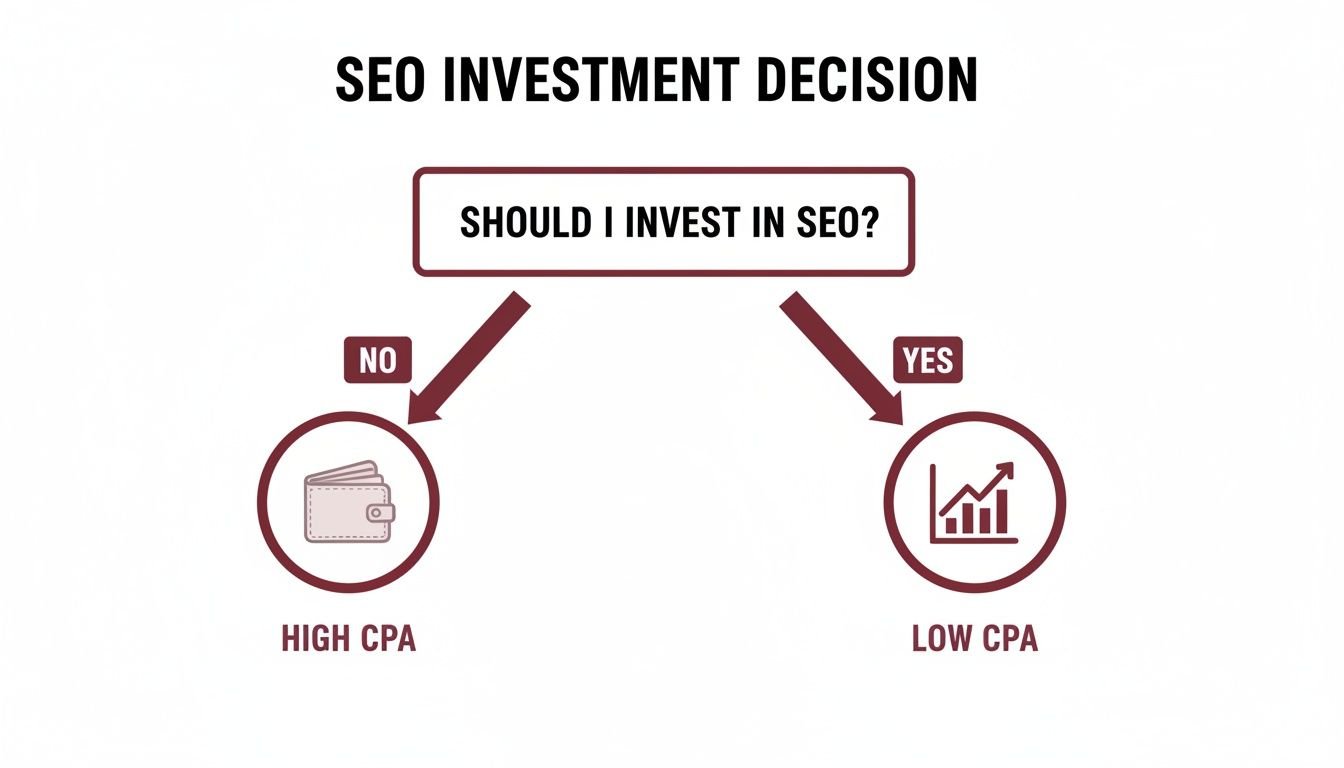
As you can see, the 'Yes' path is all about creating a more sustainable, profitable way to attract customers over the long haul.
What Australian Small Businesses Are Doing
This isn't just a theoretical decision; it's a major trend unfolding right now. Here in Australia, small and medium businesses (SMEs) are the main force behind the SEO services market, which is set to grow at a huge CAGR of 16.8% through 2030.
This boom tells a clear story. For a significant number of Australia's 2.5 million SMEs, investing in search engine optimisation services for small business is no longer a 'nice-to-have'—it's seen as a must-do to stay competitive. You can dig deeper into these Australian SME trends with Prosperity Media. This data highlights a clear shift in marketing priorities towards digital, with SEO at the forefront.
For many small business owners I talk to, the choice boils down to budget and risk tolerance. Starting with a freelancer for a specific project can feel like a safe, low-risk way to test the waters. In contrast, an agency is the better fit for businesses that are primed for serious, sustained growth and ready to invest in a long-term strategy.
At the end of the day, there’s no single right answer. The best choice for you really depends on where your business is today, where you want it to be tomorrow, and what resources you have to get there. A clear-eyed look at these factors will point you toward the partnership that sets you up for real success. It's about finding the right fit for your specific business journey.
Understanding SEO Pricing and What to Expect
When you bring on a partner for search engine optimisation services for your small business, it's important to see it as an investment, not just another monthly expense. You need to know what you’re paying for and what the road ahead actually looks like. The first few weeks are all about laying the groundwork, moving from an initial discovery phase to a clear, actionable strategy.
Any good SEO engagement kicks off with a deep dive. Seriously, they should want to get under the bonnet of your website. Expect your new partner to run a thorough technical audit to uncover any backend issues holding you back, while also doing a detailed competitor analysis to see what you’re up against. This initial work shapes everything that follows, leading to keyword research reports and a content strategy that maps out exactly how you'll start getting found in search results. This foundational phase is crucial for setting the stage for long-term success.
Common SEO Pricing Models
Here in Australia, SEO services are usually packaged in a few standard ways. Getting your head around these models makes it much easier to compare quotes and find something that aligns with your budget and business goals.
You’ll most often come across two main structures:
- Monthly Retainer: This is by far the most common model. You pay a set fee each month for ongoing SEO work, which covers things like content creation, building links, technical monitoring, and regular reporting. A retainer is perfect if you’re in it for the long haul and want to see sustained growth over time.
- Project-Based Fees: If you have a single, specific goal in mind—like getting a comprehensive website audit or sorting out your local SEO setup—you might pay a one-off, fixed price. This is great for hitting targeted goals, but it won’t cover the continuous optimisation needed to stay competitive.
To get a better feel for what you might be up for, it’s worth looking into common marketing agency pricing models and how they relate to SEO. For a small business in Australia, a quality monthly retainer can run anywhere from $1,500 to $5,000+ per month, but this really depends on the scope of work and just how competitive your industry is.
A quick word of warning: please be extremely wary of "cheap" SEO packages promising guaranteed number-one rankings for a few hundred dollars. These outfits often use dodgy, outdated tactics that can get your site slapped with a Google penalty, doing far more harm than good. True SEO is a skilled process, not a magic trick.
What a Good SEO Proposal Includes
A transparent, professional proposal is a huge green flag that you’re dealing with a credible provider. It should never feel vague or fluffy. What you want is a document that spells out the deliverables and sets clear expectations from day one. It's a roadmap for your SEO journey.
A solid proposal should clearly specify:
- Scope of Work: A detailed list of the exact services you're getting. Think number of blog posts per month, specific technical fixes, link-building activities, and reporting frequency.
- Key Deliverables: What you’ll actually receive in your hands (or inbox). This includes things like monthly performance reports, keyword ranking updates, and content calendars.
- Timeline: A realistic schedule for the initial audits, strategy rollout, and an honest indication of when you can expect to see the first signs of progress (this is typically 3-6 months).
- Reporting Schedule: An outline of how and when they’ll communicate progress, which is usually a mix of monthly reports and regular check-in calls. This ensures accountability and keeps you informed.
At the end of the day, SEO is a long-term commitment. A fair price reflects the expertise, time, and resources needed to build a strong online presence that delivers real, sustainable growth for your business.
How to Measure Your SEO Success
So, you've invested in search engine optimisation services for a small business. How do you know it’s actually working? Hitting that number one spot on Google feels great, but that’s not the whole picture. Real success is about turning those higher rankings into genuine business growth.
A good SEO partner won't just send you reports full of jargon. They’ll be transparent, clearly communicating how their work is affecting your bottom line. The conversation should quickly move past vanity metrics like rankings and onto the real prize: your return on investment (ROI). It's about connecting SEO activities to tangible business outcomes.

The Metrics That Truly Drive Your Business
Seeing your keyword rankings climb is a good sign, but it’s just one piece of the puzzle. To understand the real impact of your SEO, you need to look at the numbers that connect directly to your business goals. These are the key performance indicators (KPIs) you should actually care about.
Here’s what to focus on:
- Organic Traffic Growth: This is the most basic health check. Are more people finding you through search engines than last month? A steady climb in organic visitors is the first sign that you’re becoming more visible to potential customers.
- Conversion Rate from Organic Traffic: Getting people to your site is one thing; getting them to act is another. This metric tells you what percentage of those organic visitors are actually doing what you want them to do, like making a purchase, filling out your contact form, or signing up for a newsletter.
- Lead Quality: It's not just about the quantity of new leads, but their quality. A well-executed SEO strategy doesn't just attract anyone; it brings in genuinely interested prospects who are actively looking for the exact services or products you offer. Tracking this helps validate your keyword strategy.
Let’s be clear: the point of SEO isn't just to rank high on a page. It's to make money. Tracking how many sales and qualified leads come directly from organic search is the only way to prove your investment is paying off. This is the ultimate measure of SEO success.
What to Do Next: A Simple Action Plan
Knowing all this is one thing, but putting it into practice is what counts. Here’s a clear path to get started and take control of your SEO journey.
Follow these simple steps:
- Ask for Relevant Case Studies: Before you commit, ask any potential SEO provider to show you examples of their work with businesses like yours. You want to see proof they’ve solved similar problems and delivered results in your industry. This demonstrates their experience and capability.
- Book a No-Obligation Strategy Call: A good agency, like Anitech, will happily chat with you for free. Use this time to discuss your goals, ask tough questions, and get a feel for whether they’re the right partner for you. This is your chance to vet their expertise and communication style.
- Define What Success Looks Like: Before signing on the dotted line, make sure you're both on the same page about reporting. Agree on which KPIs matter to your business and how often you’ll get updates. This alignment is crucial for a successful partnership.
By following this approach, you'll be in a much stronger position to partner with an SEO provider, hold them accountable, and make sure your investment becomes a powerful driver for your business.
Your Top SEO Questions, Answered
If you're looking into search engine optimisation services for your small business, you probably have a few questions. That's a good thing. A healthy dose of curiosity and skepticism will help you find the right partner. We hear a lot of the same queries from business owners, so we've put together some straightforward answers to the most common ones.
How Long Until I Actually See Results from SEO?
This is easily the number one question we get asked, and the honest answer is: it takes time. While paid ads can get you on page one tomorrow, organic SEO is more of a long game. Think of it as building a reputation rather than just buying an advertisement.
You should start to see some positive signs—like small jumps in your rankings or a bit more traffic—within the first 3 to 6 months. But for the kind of significant, lead-generating results that really impact your bottom line, you're usually looking at a 6 to 12-month timeframe. It all depends on where your website is starting from, the competitiveness of your industry, and the intensity of the SEO campaign. Patience is key.
Is SEO a One-Off Job or Does It Need Constant Work?
SEO is definitely an ongoing commitment. It’s never a "set and forget" task. The moment you stop, your competitors are still pushing forward, and Google is always tweaking its algorithm. What worked last year might not work this year.
It's a bit like keeping a garden. You can't just throw some seeds in the ground and hope for the best. To get a real harvest, you need to keep watering, pull out the weeds, and nurture the plants. SEO is the same; it needs consistent care to flourish.
This is why most SEO services operate on a monthly retainer. That consistent effort is what's needed to create new content, build your site's authority, and adapt to the ever-changing search landscape to maintain and improve your rankings.
What’s the Difference Between SEO and SEM?
It’s easy to get these two mixed up. They are related but distinct parts of digital marketing. Here’s a simple way to think about it:
- SEO (Search Engine Optimisation): This is all about earning your spot in Google's organic (unpaid) search results. It’s the art and science of making your website the best possible answer to a customer's search, focusing on long-term, sustainable visibility.
- SEM (Search Engine Marketing): This is the bigger picture. It includes SEO, but it also covers all the paid advertising you can do on search engines, like running Google Ads (often called PPC, or pay-per-click).
So, SEO is one crucial piece of the SEM puzzle. Many businesses find that combining a strong organic SEO strategy with targeted paid ads gives them the best of both worlds—immediate visibility from PPC and long-term authority from SEO. A good provider of search engine optimisation services for small business can help you figure out the right mix for your goals.
Can I Just Do SEO Myself?
Absolutely. You can definitely tackle some of the basics on your own, and it's a great way to start. Things like setting up your Google Business Profile, making sure your contact details are correct on your site, and asking happy clients for reviews are fantastic first steps that can make a real difference.
The challenge comes when you want to move beyond the basics. Advanced SEO involves a lot of technical know-how, deep keyword research, strategic link building, and constant performance analysis. It's not just complex; it’s incredibly time-consuming. Most business owners find that their time is better spent focusing on running their business, leaving the specialised SEO work to an expert who lives and breathes it every day.
Ready to see how a professional strategy could kickstart your online growth? The team at Anitech focuses on data-backed SEO that delivers real, measurable results for Australian businesses like yours. Book a free, no-obligation strategy session with us today, and let's have a chat about what it would take to get you ranking.