Quick Summary: Engineering a Digital Brand Knowledge Graph is a master blueprint for organizing content around unique, identifiable entities. This semantic SEO strategy moves beyond keywords, using entity mapping and Schema.org structured data to define your brand, products, and expertise for search engines, building lasting topical authority and improving visibility in AI-powered search results.
In today's AI-powered search landscape, sticking to a keywords-only strategy is like trying to find your way through a new city using a map from the last century. The real win is in teaching search engines precisely who you are, what you offer, and how you fit into the bigger picture. This is the heart of semantic SEO & entity mapping, a powerful method for constructing a digital brand knowledge graph that creates lasting authority.
Moving Beyond Keywords to Build Digital Authority
The game has changed. For years, SEO was all about matching the keywords on your page to what someone typed into a search bar. Now, search engines like Google are far more sophisticated. They're focused on understanding the meaning behind a query and the relationships between different concepts, people, and things—what we call entities.
This is where your digital brand knowledge graph comes in. Think of it as creating a detailed, interconnected family tree for your brand that Google can read and instantly understand. So, instead of just seeing a string of text like "Anitech," the search engine recognises "Anitech" as an entity. It understands it's an SEO agency, located in Victoria, Australia, founded by a specific person, and that it provides services like link building and technical audits.
The Problem with a Keyword-Only Focus
When you only focus on keywords, you're forcing search engines to guess the context. Sure, your content might rank for a specific term, but the engine doesn't have a deep, foundational understanding of your expertise. This leads to some all-too-common headaches:
- Volatile Rankings: Your positions can swing dramatically with every algorithm update because your authority isn't cemented in facts.
- Missed Opportunities: You become invisible for closely related, high-intent searches that just happen to not include your exact keywords.
- Poor User Experience: Content ends up being written for a phrase, not to comprehensively solve the problem or answer the question a real person has.
Why Entities Are the Future of SEO
When you shift your strategy to focus on entities, you're building a foundation of understanding. It’s a process of clearly defining your brand, your offerings, and how you connect to everything else online. You're essentially building a web of interconnected, verifiable facts that search engines can trust.
This strategic shift is becoming critical in the Australian market. Businesses are set to pour a staggering $1.5 billion into SEO services, a 12% jump from previous years. This surge shows a clear understanding among Aussie businesses that the old days of keyword stuffing are well and truly over. Instead, they recognise that Google rewards brands that help it understand user intent through well-defined entities, leading to better, more durable rankings. You can dig deeper into this trend in recent Australian digital marketing reports.
To understand this better, it helps to see the evolution from the old way to the new.
The Shift from Keywords to Entities
| Aspect | Traditional SEO Approach | Semantic SEO & Entity Mapping Approach |
|---|---|---|
| Core Focus | Matching exact keyword strings. | Understanding the meaning and relationships between concepts. |
| Strategy | Target high-volume keywords on a page. | Build a network of interconnected facts about the brand. |
| Content Goal | Rank for a specific phrase. | Become the authoritative source for a whole topic. |
| Outcome | Potentially volatile rankings, dependent on algorithm whims. | Stable, authoritative rankings and visibility in rich results. |
| Search Engine's View | "This page contains the words 'Anitech SEO'." | "Anitech is an SEO Agency entity, located in Victoria, offering these specific services." |
This table really crystallises the change. We're moving from a two-dimensional world of text strings to a three-dimensional world of connected knowledge.
This is a direct reflection of how search engines now work. As Google themselves explain, they construct their own massive Knowledge Graph filled with interconnected facts about people, places, and things to deliver more relevant results.
Google isn't just matching words anymore; it's connecting entities to understand the real world. This organised knowledge is what allows them to answer complex questions and serve up those rich results we all want. The brands that clearly define their own entity map are the ones that get rewarded.
Identifying and Mapping Your Core Brand Entities
Before you can build a knowledge graph, you need to know what it's made of. This isn't about code or complex tools just yet. It all starts with a clear, honest audit of what your brand is and what it represents. You have to shift your thinking away from a flat list of keywords and start seeing the specific, identifiable concepts that make up your brand's world.
Think of it like this: if your brand were a character in a story, who would it be? What tools would it use? Where does it operate? Answering these fundamental questions is how you start to pin down the people, products, services, locations, and even the abstract ideas that define your expertise.
Uncovering Your Brand's Building Blocks
To kick things off, you don’t need to fire up any fancy data science software. The most valuable information is usually hiding in plain sight, just waiting to be organised. It's best to start with what you already have – dig into your own business data, have a chat with the sales team about what customers are struggling with, and take a look at your best-performing content.
Once you’ve looked inwards, it’s time to look out. Competitor analysis is an absolute goldmine for spotting entities they’re known for that you might be overlooking. Tools like Google Trends can also show you how real people search for concepts in your industry, which helps you get the language right.
Your goal here is to get everything down on paper (or a spreadsheet) – a master list of every 'thing' that matters to your business. We can usually break these down into a few key categories:
- Organisation: This is your company's trading name, its legal name, and any parent companies.
- People: Who are the key players? Think CEO, founders, and your go-to subject matter experts.
- Products/Services: Every single thing you offer, listed out with its proper name and what it does.
- Locations: Where are you? List your head office, any other physical addresses, and the specific areas you service.
- Events: Any webinars, conferences, or workshops you're involved in.
- Concepts: These are the core problems you solve or the topics you're an authority on (e.g., "technical SEO audit," "link building strategies").
This is the foundational shift from simply chasing keywords to defining your brand through a network of interconnected entities.
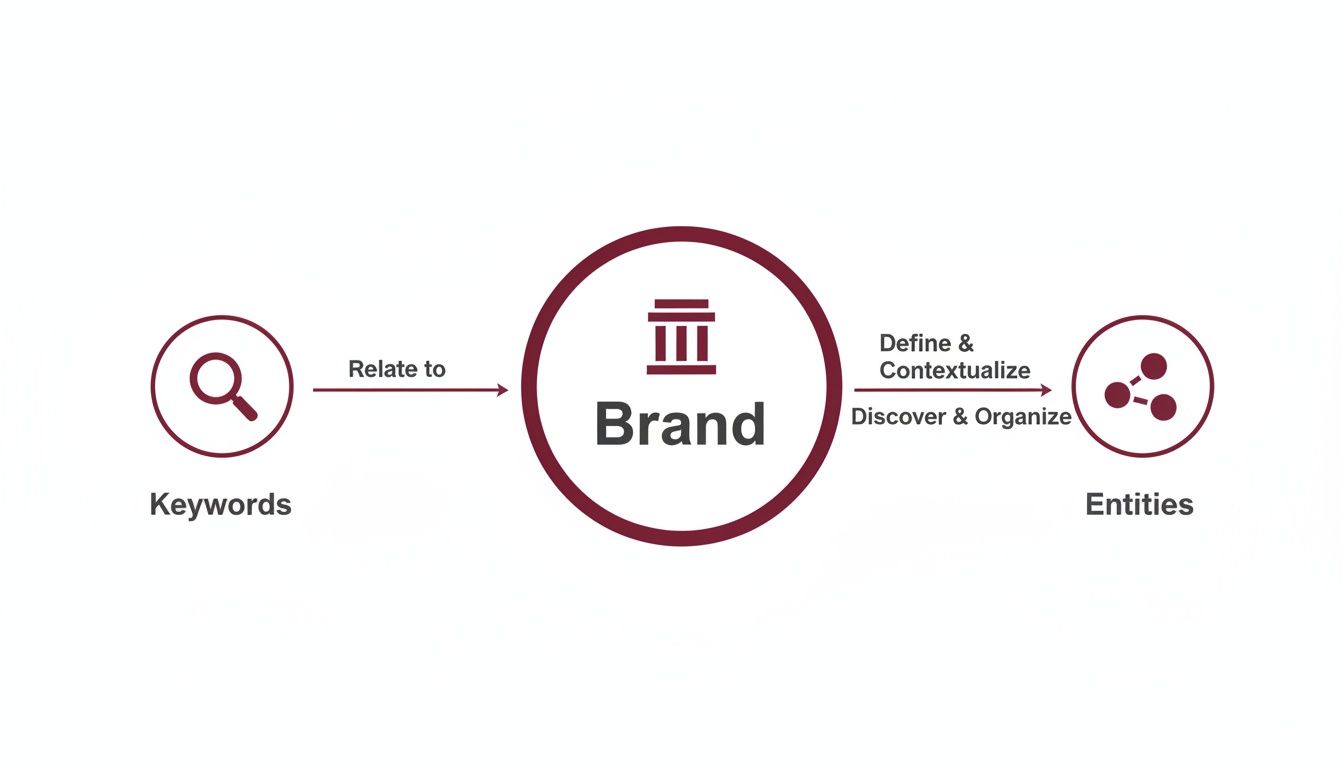
As you can see, user queries (your keywords) point to your brand. From there, it's your job to present a clean, structured map of your core components (your entities) to search engines.
Mapping the Critical Relationships
Just listing your entities isn't enough. The real magic in engineering a digital brand knowledge graph happens when you start mapping the relationships between them. This is where you explicitly connect the dots for search engines, leaving absolutely no room for them to guess.
This mapping process is all about creating a web of verifiable facts. You're not just telling Google that your CEO and your company both exist; you're telling it that one is the founder of the other. That level of precision is what builds real digital authority.
For instance, instead of having two separate concepts like "Anitech" and "SEO Audits," you draw the line between them: "Anitech offers SEO Audits." It's a simple statement, but it creates a powerful semantic link that a machine can instantly grasp.
Here's a straightforward framework I use to think about this:
- Subject: The main entity (e.g., Your CEO).
- Predicate: The relationship itself (e.g., "is the founder of").
- Object: The entity it's connected to (e.g., Your Company).
Let’s put this into practice with a real example from our own agency, Anitech:
- [Anitech]
is a[SEO Agency] - [Anitech]
is located in[Victoria, Australia] - [Anitech]
offers[Link Building Service] - [Link Building Service]
is a solution for[Low Domain Authority]
By carefully documenting all these connections, you start building a logical, machine-readable blueprint of your brand. This map essentially becomes the instruction manual you hand over to search engines, guiding them to understand your expertise with total clarity. Getting this right is the first crucial step in any successful semantic SEO & entity mapping project.
Turning Your Entity Map into Search Engine-Friendly Code
Alright, you've done the hard work of mapping out your brand's core entities and how they all relate. Now it’s time for the really crucial part: translating that blueprint into a language search engines like Google can actually read and process.
This is where structured data comes in, specifically using the vocabulary from Schema.org. Think of it as moving from an architect's drawing to laying the physical foundation. Your abstract map is about to become a concrete technical asset that actively teaches search engines who you are.
Without this step, search crawlers are left guessing. They might infer that "Anitech" is a company and "Victoria" is its location, but structured data lets you state these facts directly. You’re removing all the guesswork and feeding clear, verifiable information straight into their knowledge bases. This is the technical backbone of your brand's knowledge graph.
Why Schema Markup is Your Best Friend
Schema.org is essentially a massive library of "types" (like Organization or Product) and "properties" (like name or founder) that let you describe your entities with incredible detail. It’s the difference between a webpage simply stating, "Our CEO is John Smith," and embedding code that explicitly tells Google, "This Person entity, whose name is John Smith, holds the jobTitle of CEO at this Organization entity." See the difference? One is a suggestion, the other is a direct instruction.
For any Australian business, getting this right is a huge competitive edge. Semantic SEO isn't just a buzzword; it's a driving force behind the growth of our local online advertising market, which has now hit $17.2 billion. With search holding a massive 44% of that market, engineering a knowledge graph with schema is how you build and prove your brand's Expertise, Authoritativeness, and Trustworthiness (E-A-T). You can dive deeper into these numbers in the latest IABA report on Australian advertising spend.
To get started, don't try to boil the ocean. Just focus on the core schema types that apply to almost every business:
- Organization: This is your business entity. Nail down the legal name, logo, address, and link to your official social profiles.
- LocalBusiness: If you have a physical location, this is a must. It’s an extension of
Organizationthat lets you add crucial details like opening hours, service areas, and contact info. - Person: Essential for key people like founders, the CEO, or even the authors of your content. This connects them officially to your
Organization. - Product/Service: This is for what you sell. You can get granular with properties for price, availability, ratings, and reviews.
Getting these basics implemented correctly is the first real step in turning your semantic SEO & entity mapping strategy into something tangible.
Going Pro with Unique Identifiers
Basic schema is good, but if you're serious about building a proper knowledge graph, you need another layer of precision. You need to give each of your core entities a unique, permanent identifier using the @id property.
Think of the @id as a digital fingerprint. Instead of just describing a product on ten different pages and hoping Google connects the dots, you use a consistent @id to tell search engines that every mention refers to the exact same product entity. A common and effective way to do this is with a URL that includes a fragment identifier, like https://anitech.au/#product-seo-audit.
Using a stable
@idfor each core entity is absolutely non-negotiable. This is the glue that holds your entire knowledge graph together, allowing you to build clear relationships across your website and solidify your brand’s structure in Google's mind.
Just look at the sheer volume of options available to describe your business and its offerings. It's a goldmine for specificity.

This shows you can, and should, go way beyond the basics to model what makes your business unique.
Connecting Your Graph to the Wider Web
Your knowledge graph shouldn't be an island. The final piece of this puzzle is connecting your brand's entities to well-known, authoritative sources out there on the web. This is the core idea behind Linked Data.
By using the sameAs property in your schema, you can link your company's entity to its official LinkedIn page, its entry in Wikidata, or other relevant public knowledge bases.
This simple line of code is a powerful act of validation. It tells search engines, "Hey, the 'Anitech' I'm describing on my website is the exact same one you already know about from these other trusted sources." This builds immense trust and cements your place within the broader web of knowledge.
Once you’ve drafted your code, you absolutely must test it. Use a tool like Google's Rich Results Test before anything goes live. It will parse your markup, show you exactly how Google interprets it, and flag any errors or warnings. This is your quality check, ensuring you can either implement the changes with confidence or go back to your development team with a clear, actionable report.
Activating Your Knowledge Graph with Content and Linking
So, you’ve meticulously crafted your knowledge graph, sorted out the schema, and assigned all your unique identifiers. That’s a solid start, but it's only half the job. Think of it like a perfectly wired house with no electricity. To actually flick the switch and bring it to life, you need to power it up with an entity-first content strategy and a really deliberate internal linking structure.
This is where you stop just defining what you're about and start actively demonstrating it. It’s not a one-and-done task, either. This is the living, breathing part of your marketing that bridges the gap between technical SEO and content marketing, forcing them to finally work together to build real digital authority.

Thinking 'Entity-First' with Your Content
An entity-first approach is a mindset shift. You have to stop creating content based on isolated keywords. Instead, you need to build comprehensive content hubs—or topic clusters—around your core brand entities. Every single piece of content should be designed to explore one specific facet of an entity, reinforcing your authority on the whole subject.
Let's take a real-world example. Say one of your core service entities is "Technical SEO Audits." The old keyword-based approach might have you writing a single blog post titled "What is a Technical SEO Audit?" and calling it a day.
An entity-first strategy goes much, much deeper.
You’d create a central pillar page for "Technical SEO Audits." Then, you'd support it with a cluster of articles that dive into all the related sub-topics. Things like:
- How to Fix Crawl Budget Issues
- A Checklist for Core Web Vitals Optimisation
- The Role of Structured Data in Technical SEO
- Common Site Architecture Mistakes to Avoid
See the difference? Each of these articles strengthens the main entity. You’re building a web of content that proves to search engines you don't just know the definition of a technical audit—you're an absolute expert in its execution and all its nuances.
This shift is fundamental. You're no longer just answering a single query. You're building a complete library of knowledge around a core concept, making your website the definitive resource.
This very practice of engineering digital brand knowledge graphs through semantic SEO and entity mapping is a huge driver behind Australia's $1.95 billion digital marketing software market. It's set to grow at a 10.48% CAGR, fueled by strategies where knowledge graphs—linking entities like an 'Australian ecommerce retailer' to live sales data—use real-time analytics to deliver proven traffic gains. You can find more insights on the Australian digital marketing software market and its rapid expansion.
Weaving the Connections with Strategic Internal Linking
If your content clusters are the rooms in your house, then internal links are the hallways connecting them. Strategic internal linking is the physical mechanism that signals the relationships you've mapped out to search engines. It's how you show them that your article on "Crawl Budget Issues" is directly and meaningfully related to your main "Technical SEO Audit" service.
But effective internal linking for a knowledge graph isn't about just dropping links wherever you can. It requires precision and clear intent.
Use Descriptive, Entity-Rich Anchor Text
Vague anchor text like "click here" or "learn more" is a massive missed opportunity. Your anchor text should explicitly name the entity or concept you’re linking to.
- Weak: To learn more about our services, click here.
- Strong: Our comprehensive technical SEO audits identify and resolve these critical issues.
This simple change makes it crystal clear to both users and search crawlers what the destination page is about, reinforcing that crucial semantic connection. It’s a simple but incredibly powerful tactic in engineering a digital brand knowledge graph that, frankly, too many people overlook.
By combining an entity-focused content strategy with a precise internal linking plan, you truly activate your knowledge graph. You're providing both the evidence and the pathways that search engines need to validate your expertise, turning a technical asset into a powerful engine for organic visibility and authority.
Your Toolkit for Building a Brand Knowledge Graph
Building a proper brand knowledge graph requires more than just good intentions; you need the right set of tools in your belt. The strategy is what guides you, but the right tech stack is what gets the job done efficiently and accurately.
Think of it like building a house. You wouldn't just eyeball the foundations. You need precise instruments for every stage, from surveying the land to checking the final structure is sound. This is about creating a seamless workflow where each tool plays its part, taking you from a high-level entity map to machine-readable code that Google can understand.
Let’s walk through the gear you'll need for each part of the process.
Tools for Finding Your Entities and Topics
First things first, you need to figure out what entities actually matter in your space. This discovery phase is all about intelligence gathering—understanding the universe of topics and concepts that both users and search engines associate with your brand.
- Ahrefs: Most people think of Ahrefs for backlinks, but it's a goldmine for entity discovery. Dive into the 'Organic Keywords' report for a competitor to see every entity and topic they're ranking for. Even better, use the 'Content Gap' tool to find the entities they own that you haven't even touched. It's a direct roadmap to opportunity.
- AnswerThePublic: This is my go-to for getting inside the user's head. It visualises the actual questions, prepositions, and comparisons people are searching for around a topic. This is how you find all those crucial sub-entities and intent signals that are essential for a comprehensive graph.
These tools give you the raw materials. They help you build that initial, exhaustive list of the "things, not strings" that make up your brand’s world, a critical first step in any semantic SEO & entity mapping effort.
Platforms for Creating and Checking Your Schema
Once you know what your entities are, you have to translate that knowledge into schema markup. You could write it all by hand, but that's asking for trouble. Using dedicated tools makes the process quicker and, most importantly, far less error-prone.
For the basics, Merkle’s Schema Markup Generator is a brilliant, free starting point. It’s perfect for whipping up simple JSON-LD snippets for common types like Organization or Product.
When things get more complex, you'll want to step up to a platform like SchemaApp. This is where you can start managing interconnected schema across your entire site, making sure your @id identifiers are consistent and the relationships between entities are perfectly mapped. It takes the guesswork out of building a sophisticated graph.
No matter how you generate your schema, validation is absolutely non-negotiable. Always, always run your code through Google's Rich Results Test before you even think about pushing it live. It tells you exactly how Google is interpreting your markup and will flag any show-stopping errors.
Software for Visualising and Linking Your Graph
A list of entities in a spreadsheet is one thing, but seeing your knowledge graph visually can be a real eye-opener. It helps you spot the connections and strategic gaps you'd otherwise miss. The right tools here also help you build the internal linking structure that physically connects the dots for search engines.
A standout tool in this space is InLinks. It’s built from the ground up around entities. It analyses your content, identifies the key entities within it, and then recommends semantically relevant internal links. This is how you automate the painstaking work of building the connective tissue that proves your entity relationships to Google—a core part of engineering a digital brand knowledge graph.
APIs for Checking Your Work and Measuring Impact
So, you've done all the work. How do you know if Google is actually getting the message? Simple: you ask Google directly.
The Google Knowledge Graph Search API is your direct line to Google's brain. You can send a query for your brand or a key entity and see exactly what information Google has stored and verified in its own massive graph.
If the data coming back from the API matches what you’ve defined in your schema, you've got confirmation that your strategy is working. It’s the most direct and tangible way to measure your progress and be sure you’re successfully teaching Google who you are and what you're about.
Here’s a quick-reference table to pull all these tool recommendations together.
Your Toolkit for Building a Brand Knowledge Graph
This table breaks down our recommended tools for each stage of the knowledge graph engineering process, from initial discovery right through to final measurement.
| Tool Category | Recommended Tools | Primary Function |
|---|---|---|
| Entity & Topic Discovery | Ahrefs, AnswerThePublic | Identify relevant entities, competitor topics, and user search intent. |
| Schema Generation | Merkle’s Schema Markup Generator, SchemaApp | Create basic to advanced JSON-LD schema markup and manage interconnected entities. |
| Schema Validation | Google Rich Results Test | Test and validate schema markup to ensure it's error-free and understood by Google. |
| Visualisation & Internal Linking | InLinks | Analyse content for entities and automate the creation of semantically relevant internal links. |
| Measurement & Validation | Google Knowledge Graph Search API | Query Google’s Knowledge Graph to verify that your entity information has been correctly understood and stored. |
Having this toolkit at your disposal transforms the abstract concept of a knowledge graph into a concrete, manageable project with clear steps and measurable outcomes.
Measuring the Impact of Your Knowledge Graph
You've done the hard work of planning, mapping, and building your brand's knowledge graph. So, how do you know if it's actually paying off? To really prove its value, we need to look beyond simple traffic boosts and focus on the KPIs that show a genuine return on all that effort in semantic SEO and entity mapping.
The most obvious win, and often the first thing you'll see, is the appearance and accuracy of your brand's Google Knowledge Panel. When you see a rich, detailed panel pop up for your brand searches—complete with your logo, key people, and correct business info—that’s Google giving you a nod. It's a clear signal that it understands and trusts your entity data.
Tracking Tangible SEO Gains
Beyond the knowledge panel, a few other key metrics will tell the story of your success. You'll want to keep a close eye on the increase in rich results your content is pulling in. Are you suddenly seeing more FAQ snippets, product review stars, or event listings popping up in the search results? Each one is a small victory, proving your structured data is hitting the mark.
Another powerful indicator is a shift in your rankings for broader, intent-based queries. Think bigger than just your main keywords. Instead of just ranking for "Anitech SEO services," you might start showing up for more conceptual searches like "best SEO agency for ecommerce in Australia." This is a huge sign that Google now sees you as an authority on the entire topic, not just a string match for a specific keyword.
The ultimate goal here is to see a measurable increase in search volume for your 'brand as a keyword.' When more people start searching for your brand name directly, it’s the strongest possible signal that your authority and recognition in the market are genuinely growing.
Future-Proofing Your Digital Presence
Building a brand knowledge graph isn't a short-term tactic; it's a long-term investment in your digital foundation. Its importance is only going to skyrocket as search technology continues to evolve. A well-defined graph is absolutely critical for the emerging platforms where clarity and context are everything.
Think about what's just around the corner:
- Voice Search: Assistants like Siri and Google Assistant depend on knowledge graphs to pull direct, factual answers. You're essentially feeding them the right information.
- AI Overviews: To be cited as a trusted source in those AI-generated summaries, your data needs to be structured, unambiguous, and authoritative.
- Emerging Technologies: Any future search or AI interface will be built on machine-readable data, making your knowledge graph an indispensable asset.
Ultimately, this whole process is about building a digital presence that’s resilient, authoritative, and ready for whatever comes next. You're not just optimising for today's algorithm; you're laying down a foundation of truth that will keep your brand visible and trusted for years to come.
Your Entity SEO Questions Answered
As we get to the end of this guide, a few questions always pop up. Let's tackle some of the most common ones I hear from clients and in workshops to clear up any lingering doubts you might have.
What Exactly Is An 'Entity' in SEO?
Think of an entity as a real-world thing, not just a string of text. It’s a person, a place, a company, a product—anything that can be uniquely defined and pointed to. The keyword "Anitech" is just a word, but the entity "Anitech" is understood by Google as a specific SEO agency, with a location in Victoria, with team members, and with relationships to other concepts like "semantic search".
It’s the difference between a simple keyword and a rich, interconnected concept that search engines can truly understand and trust.
Realistically, How Long Until We See Results from Entity SEO?
This is the big question, and the honest answer is: it's a marathon, not a sprint. You're building a foundation of authority, and that takes time.
Some of the first positive signs, like your Google Knowledge Panel getting richer or more accurate, can pop up within a few months of a solid schema implementation. But for the big wins—think significant ranking boosts for competitive terms—you're likely looking at six months to a year. That's the time it takes for Google to repeatedly crawl your site, validate your structured data against other sources, and build genuine confidence in what your brand represents.
Is This a Viable Strategy for Small Businesses?
100% yes. In fact, it’s even more crucial for small and local businesses.
While the term "knowledge graph" can sound intimidating and resource-heavy, the fundamental idea is about being crystal clear about who you are, what you do, and where you do it. For a small business, this is your superpower.
Start simple. Getting your LocalBusiness schema perfect and building out content that clearly defines your core services can give you a massive edge in local search. It allows you to compete on clarity and authority in your niche, rather than just on budget, effectively levelling the playing field against bigger, less-focused competitors.