Quick Summary: In 2026, SEO success moves beyond keywords to understanding meaning, context, and user intent. This guide presents the definitive framework for semantic SEO & entity mapping, focusing on building topical authority through interconnected concepts. Learn how to define entities, create topical maps, and use structured data to align with AI-powered search engines, driving sustainable, long-term organic growth.
The era of chasing keywords is officially over. If your 2026 digital strategy still revolves around matching exact phrases, you're playing a game that has already been won by a smarter, more sophisticated approach. Old-school SEO—the tedious process of keyword stuffing and exact-match optimization—is no longer effective.
The significant wins in today's search landscape, and for the foreseeable future, are driven by semantic SEO & entity mapping. This advanced methodology requires thinking like a modern search engine, focusing on the underlying concepts, the intricate relationships between them, and the true intent behind a user's query.
This guide provides the definitive framework for implementing this future-proof strategy. We will move beyond the outdated practice of simply inserting keywords into content and instead focus on building genuine, demonstrable topical authority. By optimizing for concepts instead of characters, you will create content that comprehensively answers your audience’s questions and aligns perfectly with the AI-powered search algorithms that now dominate the digital world.
The Great Shift From Strings To Things
Let’s use an analogy. Old-school SEO was like a librarian who could only find books by matching the exact title you gave them. If you asked for "books about big cats," they'd only bring back titles with that exact phrase. Pretty limited, right?
Semantic SEO gives that librarian a brain. Now, they understand that "big cats" is a concept. They know it’s connected to distinct entities like lions, tigers, and leopards. Suddenly, they can offer you a much richer, more relevant selection of books, even if the words "big cats" aren't in the title. This is exactly how search engines like Google now work, connecting what you search for to a massive web of real-world things and how they relate to each other.
This table breaks down just how different the two approaches are:
Traditional SEO vs Semantic SEO
| Aspect | Traditional SEO (Past) | Semantic SEO & Entity Mapping (2026) |
|---|---|---|
| Primary Focus | Matching specific keywords and phrases. | Understanding user intent and the meaning behind queries. |
| Unit of Optimisation | The keyword string. | The entity (person, place, thing, concept). |
| Content Strategy | Create one page for each target keyword. | Build interconnected content hubs around topics. |
| Success Metric | Ranking for a single, high-volume keyword. | Achieving topical authority and ranking for many related queries. |
| Technical Element | On-page factors like keyword density. | Structured data (Schema.org) and internal linking. |
The takeaway is clear: while keywords still have a place, the strategy has evolved from a flat, one-dimensional checklist to building a rich, three-dimensional map of your expertise.
Why This Matters For Australian Businesses
For small and medium-sized businesses in Australia, this shift is a golden opportunity. Instead of trying to outspend bigger competitors on fiercely contested keywords, you can carve out your own space by becoming the undisputed expert in your niche.
When you cover a topic inside and out, your content naturally starts showing up for a huge variety of searches, from long, conversational voice queries to the complex questions people are now asking AI assistants. It’s about building a web of knowledge, and a great place to start is by mastering long-tail keyword strategies as a bridge to this conceptual approach.
By focusing on the relationships between topics, you're not just optimising for a single search term; you're building a foundation of topical authority that search engines are built to reward for years to come.
The Foundations: Understanding Semantic Search and Entities
To successfully implement semantic SEO & entity mapping, we must first grasp two core ideas: semantic search and entities. Think of them as the foundational language that modern search engines speak. To communicate effectively and build a future-proof SEO strategy, you must become fluent in this new language.
Semantic SEO is the practice of optimizing your content for meaning, not just keywords. It involves moving beyond simply matching specific phrases and instead teaching Google the intricate language of your industry. When executed correctly, search engines don't just see words on a page; they understand the context, nuance, and relationships between the concepts you discuss. This deeper understanding is key to truly satisfying user intent.
So, What Exactly is an Entity in SEO?
An entity is any well-defined thing, concept, person, place, or organisation that a search engine can uniquely identify and understand. It's a real-world "thing" with its own set of properties and connections to other things.
For an Australian business, an entity could be:
- A person: like Scott Pape, 'The Barefoot Investor'.
- A place: a specific suburb like 'Surry Hills' or a state like 'Victoria'.
- An organisation: a well-known company like 'Anitech' or a government body.
- A product: a classic like 'Blundstone boots'.
- A concept: a broad idea like 'digital marketing' or a niche like 'sustainable farming'.
This is the "things, not strings" philosophy in action. Google no longer just reads text; it identifies these entities as the fundamental building blocks of meaning across the internet.
How Google's Knowledge Graph Fits In
Google’s Knowledge Graph is the massive database and system that organises this colossal universe of entities. It's not just a list; it's a dynamic, interconnected web that maps out the relationships between everything it knows. It’s the reason Google understands that 'Melbourne' (an entity) is a city in 'Victoria' (another entity), which is known for 'AFL' (yet another entity).
You see the Knowledge Graph in action every day in the search results. That informational box that appears with a summary of a person, place, or topic? That’s the Knowledge Graph at work.
This Knowledge Panel is definitive proof that Google isn't just indexing a word; it’s understanding a concept, pulling together its key attributes from trusted sources to give users a comprehensive and immediate answer.
Ultimately, our primary goal with semantic SEO is to have our own business, products, and expertise clearly defined as entities and integrated into this graph.
This field is becoming more technical by the day. By 2026, the success of semantic SEO will depend on adherence to advanced standards and rock-solid semantic HTML. For businesses here in Australia, correctly implementing schema markup is what secures a place in AI-powered search results and coveted Featured Snippets. As you can discover more insights about scaling digital growth on itcompany.com.au, the technical foundation of your website is now just as crucial as your content strategy.
By clearly defining your key business concepts as entities and demonstrating their relationships through high-quality content and structured data, you provide search engines with a clear, unambiguous map of your expertise.
Mastering these fundamentals is the first and most critical step. Now that we have covered the 'what' and 'why', we can move on to the practical application and begin building the entity maps that will establish your topical authority.
How to Build Your Semantic Content Architecture
Theory is essential, but practical application is where you will see tangible results. Building a semantic content architecture is not about randomly churning out articles; it is about methodically designing a comprehensive library of information on your website. Think of yourself as a master librarian, meticulously ensuring every book (or piece of content) is perfectly placed, making it incredibly easy for search engines to recognize you as the go-to expert in your field.
The first step requires a mental shift. You need to move away from obsessing over isolated keywords and start thinking in terms of core business themes and topics. You are essentially creating a detailed blueprint of your expertise that Google can read and understand instantly.
Creating Your Topical Map
A topical map is your high-level blueprint—the architecture of your expertise. Instead of a disjointed collection of blog posts, you are creating a deliberate hierarchy of topics and subtopics that cover a subject comprehensively. It’s like creating the table of contents for your entire domain of knowledge.
The primary goal here is to prove to search engines that you are not just scratching the surface of a topic. You are a genuine authority with deep, structured knowledge.
Let's imagine you're an Australian online store selling hiking gear. You wouldn't just write a single blog post about "hiking boots." Your topical map would be far more rich and detailed, branching out to cover everything related:
- Core Topic: Hiking in Australia
- Sub-Topics: Best hiking trails by state (e.g., Tasmania, NSW), essential gear lists, hiking safety tips.
- Niche Sub-Topics: How to waterproof leather boots, choosing the right hiking socks for Aussie climates, reviews of lightweight tents for overnight treks.
This structured approach demonstrates comprehensive coverage, which is a massive signal of authority to Google and other search engines.
This diagram helps visualise how all these pieces fit together, connecting entities and context to build that deep, machine-readable understanding.
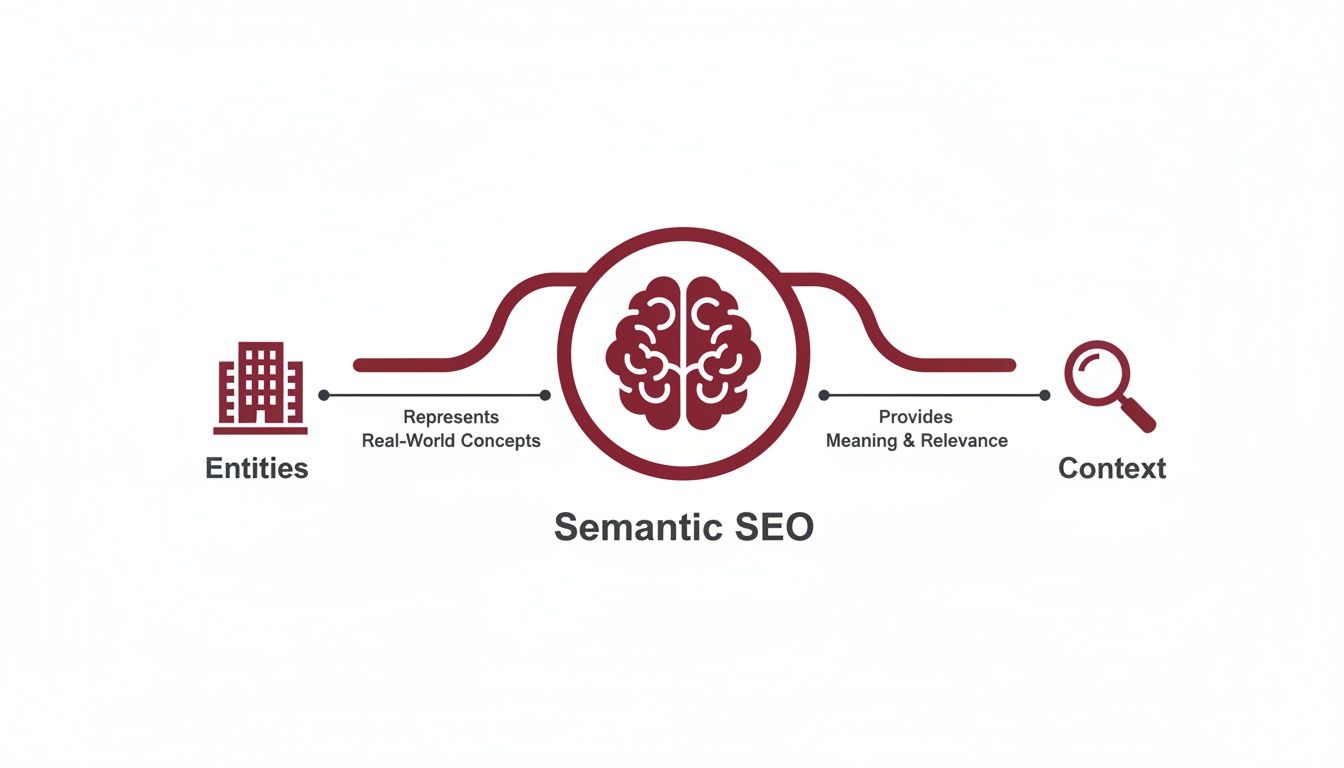
As you can see, real semantic authority doesn't come from a single page. It emerges from the intersection of clearly defined entities and the rich, interconnected context you build around them.
Building Your Entity Graph
Once your topical map is sketched out, it's time to populate it with an entity graph. This is where you get granular. You identify the specific, unique "things" – people, products, places, brands, concepts – that are central to your business and then define precisely how they relate to one another.
You are literally connecting the dots for Google within your own website. This internal knowledge graph makes your content unambiguous and machine-readable, which is precisely what modern search algorithms are designed to reward.
An entity graph is your website's internal 'who's who' and 'what's what'. It clarifies every key concept and its relationship to others, leaving no room for search engine confusion.
Let's bring this to life with an iconic Australian e-commerce example: a business selling Blundstone boots.
Workflow: An E-commerce Example
Imagine you run an online store that specialises in Blundstone boots. A classic keyword-based approach would probably just lead you to create a few basic product pages. A semantic approach, on the other hand, builds a rich, interconnected world of content.
Here’s how you’d do it:
1. Identify Core Entities: First, you list out all the key concepts. What are the 'things' we're talking about?
- Product: Blundstone Boots (and specific models like the #500 or #585)
- Brand: Blundstone (the company itself)
- Place of Origin: Tasmania, Australia
- Material: Leather
- Associated Concept: Leather Care, Waterproofing
- Use Case: Outdoor Work, Fashion, Hiking
2. Define Relationships: Next, you map out how these entities connect to each other. This is the crucial part.
- 'Blundstone Boots' are made by the 'Blundstone' brand.
- 'Blundstone' is based in 'Tasmania'.
- The boots are made from 'Leather'.
- 'Leather' requires 'Leather Care'.
3. Create Content to Reinforce Connections: Finally, you create content that explicitly demonstrates these relationships. You could build a pillar page all about Blundstone boots. From that page, you’d link out to more detailed articles on the company's Tasmanian manufacturing history, a guide to caring for the leather, and blog posts showing the boots being used for hiking in the Blue Mountains.
This creates a powerful web of meaning that search engines can easily follow, understand, and ultimately reward with higher rankings and greater visibility.
Implementing Your Semantic SEO Strategy
You have completed the strategic thinking and mapped out your semantic architecture. Now comes the exciting part: bringing it to life on your website. This is where the blueprint becomes a reality, transforming your site from a mere collection of pages into a cohesive, machine-readable library of expertise. We will begin with the most direct and powerful tool in our kit: structured data.
Structured data, specifically using the Schema.org vocabulary, is your direct line of communication with search engines. It allows you to explicitly label the "things" on your site, leaving nothing to interpretation. You're essentially telling Google in its own native language, "Hey, this chunk of text is our business name," "this number is our ABN," or "this page is about a specific service we offer." You’re not just hoping Google connects the dots; you’re handing it the completed puzzle.
The cleanest and most recommended method for implementation is JSON-LD (JavaScript Object Notation for Linked Data). It is placed within a script tag in your site's code, so it doesn't interfere with the visual design that your customers experience.
Labelling Entities with Structured Data
Let's get practical. Imagine you're an electrician in Melbourne. The first, non-negotiable step is implementing LocalBusiness schema. This markup lets you clearly define your business name, address, phone number, and opening hours as distinct properties of a single, unified entity.
Here's a peek at just some of the properties available for the LocalBusiness schema type, straight from the source.
This screenshot gives you a sense of just how detailed you can get. You can specify everything from the types of payment you accept to the exact services you provide, giving search engines a rich, structured profile of your business.
Here’s what a simplified JSON-LD snippet might look like for our Melbourne sparky:
{
  "@context": "https://schema.org",
  "@type": "Electrician",
  "name": "Sparky & Co. Melbourne",
  "image": "https://yourwebsite.com.au/logo.jpg",
  "@id": "https://yourwebsite.com.au/",
  "url": "https://yourwebsite.com.au/",
  "telephone": "+61 3 9999 8888",
  "address": {
    "@type": "PostalAddress",
    "streetAddress": "123 Collins Street",
    "addressLocality": "Melbourne",
    "addressRegion": "VIC",
    "postalCode": "3000",
    "addressCountry": "AU"
  },
  "geo": {
    "@type": "GeoCoordinates",
    "latitude": -37.8136,
    "longitude": 144.9631
  },
  "openingHoursSpecification": {
    "@type": "OpeningHoursSpecification",
    "dayOfWeek": [
      "Monday",
      "Tuesday",
      "Wednesday",
      "Thursday",
      "Friday"
    ],
    "opens": "08:00",
    "closes": "17:00"
  }
}
This code does more than just list information. It unambiguously defines the entity of "Sparky & Co. Melbourne" and its core attributes, making it crystal clear for Google’s algorithms what your business is and what it does.
Designing Supportive Content Models
Structured data labels the players, but it's your content that has to prove they belong on the field. This is where a smart content model comes in. Think of it as a framework for every new piece of content you create, ensuring it always supports and strengthens your entity map. It’s about being deliberate, not just creative.
This approach shifts the question from "What blog post should we write this week?" to "Which relationship in our entity graph needs more contextual support?"
A content model acts as a quality control system for your semantic strategy. It ensures every new page, post, or product description serves the greater purpose of building a dense, interconnected web of expertise.
Manifesting Relationships with Links and Hubs
Finally, you need to forge the connections from your topical map directly onto your website. The two workhorses for this job are strategic internal linking and the creation of content hubs.
Strategic Internal Linking: Every internal link is a signpost. When you link from a page about "LED downlights" back to your main pillar page on "Home Electrical Upgrades," you're explicitly showing Google how these two concepts are related. Use descriptive anchor text that includes entities (e.g., linking with "our residential electrical services") to make these connections even stronger.
Content Hubs: A content hub, or pillar page, is the home base for a core topic. It's a comprehensive resource that gives a broad overview and then links out to more detailed "cluster" pages that dive deep into specific sub-topics. This structure physically mirrors your topical map on-site, creating a logical journey for users and a clear, crawlable hierarchy for search engines.
This is where all the planning behind semantic SEO & entity mapping pays off. It’s no coincidence that 68% of Australian businesses have seen a higher ROI from their content marketing by adopting this kind of structured, AI-driven thinking. As you can read the full research about these findings, this methodical approach delivers real, measurable results. And as you put these strategies to work, it's wise to keep an eye on what’s next by understanding the latest SEO Trends for 2025.
Applying Entity Mapping for Local and E-commerce SEO
This is where the theory behind semantic SEO & entity mapping hits the ground running and becomes a powerful advantage. For local businesses and e-commerce stores right here in Australia, shifting from chasing generic keywords to building a precise, entity-based strategy is the key to reaching highly targeted, high-intent customers. It’s how the framework stops being a concept and starts driving real growth.
When you map out your entire business ecosystem, you're essentially handing search engines a crystal-clear blueprint of who you are, what you do, and why you’re the perfect match for a specific search. That kind of clarity gets rewarded with better visibility, especially for those super-specific local or niche product searches.

Dominating Local Search with Hyper-Specific Entities
For a local business, your battlefield is your own neighbourhood. Entity mapping lets you weave your business into the very fabric of your community in a language that search engines can finally understand. Instead of just aiming for a broad term like "cafe Sydney," you can build a rich, interconnected web of local entities.
Let's take a small cafe in Surry Hills as an example. A traditional SEO approach might just focus on optimising for its location and stop there. But a semantic strategy digs so much deeper, identifying and connecting all the relevant local entities.
- Location Entities: The cafe itself, Surry Hills (the suburb), Crown Street (the street), and Sydney (the city).
- Landmark Entities: Nearby spots like Central Station, Prince Alfred Park, or the Belvoir St Theatre.
- Event Entities: Annual events like the Surry Hills Festival or even proximity to the Sydney Mardi Gras Parade route.
- Service Entities: What you offer, like specialty coffee, brunch, vegan options, or a dog-friendly patio.
By creating content and structured data that connect your cafe to all these other entities, you're sending a strong signal to Google: "We are a core part of the Surry Hills community." This approach is more potent than ever. Local SEO precision in Australia has skyrocketed in 2026, with Google now able to differentiate between users in Surry Hills versus other Sydney suburbs. This allows for hyper-localised semantic mapping. As you can discover more 2026 SEO predictions on duda.co, this level of geographic detail makes entity mapping absolutely essential for winning the local game.
Capturing High-Conversion E-commerce Queries
E-commerce stores have a different mountain to climb: overwhelming product competition. Entity mapping is your ticket to moving beyond broad category terms and capturing those very specific, "ready-to-buy" searches by mapping product features directly to what a user wants.
Think about an Australian online shop that sells natural skincare. A simple keyword strategy would target phrases like "buy natural moisturiser." An entity-based approach, however, constructs a much smarter map of meaning.
By connecting product attributes, ingredients, use cases, and brand values as interconnected entities, e-commerce stores can attract customers who know exactly what they want, leading to higher conversion rates and greater customer loyalty.
Let's see how this works for a single product that uses a popular native ingredient.
Product Entity Mapping Example
- Core Product Entity: "Kakadu Plum Vitamin C Serum"
- Ingredient Entity: Kakadu Plum (which is then connected to its properties: high in Vitamin C, antioxidant)
- Use Case Entity: Perfect for sensitive skin, brightening dull skin, or reducing hyperpigmentation.
- Attribute Entity: Things like vegan-friendly, cruelty-free, and Australian-made.
- Brand Entity: Your store's brand (which you've associated with natural ingredients and ethical sourcing).
With this map in place, you can create content that nails ultra-specific questions like, "best vegan vitamin c serum for sensitive skin in Australia." Every blog post, product description, and FAQ reinforces the relationships between these entities, building a powerful semantic network. This structured approach ensures you show up for those long-tail searches that scream purchase intent, giving you a serious edge in a crowded market.
Measuring the Success of Your Semantic SEO Efforts
So, you’ve put in the hard yards building out your semantic SEO framework. How do you actually prove it’s working and delivering a real return? The old-school method of obsessively tracking a single, big-money keyword just doesn’t cut it anymore.
To really get a feel for the business impact, you need a new way of looking at performance—one that measures your authority over a whole concept, not just how you rank for a specific search query. Success in 2026 is all about tracking those broader patterns of growth. Are you becoming the go-to expert for your entire topic? That’s the real question.
Key Performance Indicators for Semantic SEO
It's time to stop fixating on one or two keywords and shift your attention to metrics that tell a much bigger, more meaningful story. These are the indicators that truly show how your topical authority is paying off and how much more relevant you're becoming in the eyes of Google.
- Growth in Non-Branded Organic Traffic: This is your north-star metric. When this number goes up, it means brand new customers are finding you because of your expertise, not because they already know your name. It’s the clearest sign that your topical map is hitting the mark.
- Increase in Ranking Keywords Per Page: A single, semantically rich page should be pulling its weight by ranking for dozens, if not hundreds, of related questions and long-tail variations. Watching this number climb for your core pages is a powerful sign you’re doing it right.
- Improved Visibility in AI Overviews and Rich Snippets: Getting featured in AI-generated answers or nabbing rich results like Featured Snippets is a massive vote of confidence from search engines. It shows they trust your content enough to present it as the definitive answer.
The real goal here is to change the conversation in your reporting. Move away from, "Where do we rank for X keyword?" and start asking, "How much of the conversation around our core topic do we own?" This mindset reflects a much deeper, more sustainable way to grow.
Preparing Your Organisation for the Future of Search
Putting a solid semantic SEO framework in place for 2026 isn't just about boosting your rankings today; it's about future-proofing your entire digital strategy. The architecture you're building—with its entity graphs and topical authority—is precisely what the next wave of search technology is being built on.
Think about it. Your semantic work directly sets you up for:
- Voice Search: People don't speak to their devices in keywords; they ask conversational questions. A deep web of content built around entities is perfectly designed to answer these complex, spoken queries.
- AI-Driven Search: AI assistants like Google’s AI Overviews piece together information from trusted, authoritative sources. Your neatly organised, semantic content makes you the perfect source for them to pull from.
- Visual and Multimodal Search: As search becomes more visual, clear entity relationships will be the glue that connects all your digital assets—images, videos, products—to the right user queries.
Your Semantic SEO Questions, Answered
Making the leap to a more intelligent, entity-based approach always brings up a few questions. It’s a different way of thinking about SEO, after all. Let's tackle some of the most common ones we hear from businesses getting started.
What’s the Real Difference Between a Keyword and an Entity?
This is the single most important concept to get your head around. Think of it this way: a keyword is just the text someone types into the search bar, like "best coffee Surry Hills." It’s a literal string of characters.
An entity, however, is the actual thing or concept in the real world that the keyword refers to.
For "best coffee Surry Hills," Google doesn't just see words. It understands the underlying entities:
- 'Surry Hills' (a specific, real-world suburb in Sydney)
- 'Coffee' (a popular beverage with its own universe of related concepts)
- 'Best' (a qualifier indicating a search for quality and recommendations)
Keywords are what your audience types. Entities are what Google understands. Your job is to stop just matching the words and start showing Google you're an expert on the underlying concepts and how they all connect.
How Long Until We See Results from This?
Let's be clear: semantic SEO is a long game, not a quick trick for a rankings boost. You're fundamentally reshaping how search engines view your website's authority on a topic. It's about building a solid foundation, not just chasing fleeting keyword wins.
You'll likely see early positive signals within 3 to 6 months. This might look like individual pages ranking for a much wider variety of related search terms. But the real, meaningful impact—the kind that drives significant non-branded organic traffic and secures those high-value positions—typically becomes clear after 6 to 12 months of consistent, focused work. The reward for that patience is growth that’s far more stable and resilient.
So, Is Keyword Research Dead?
Not at all. In fact, it's more important than ever, but its job has changed. We're not just hunting for high-volume keywords to stuff into a page anymore. The purpose of keyword research in a semantic SEO & entity mapping framework is much more strategic.
Your research should now be focused on:
- Mapping Out Your Topic: Use keyword research to discover all the subtopics, questions, and related ideas your audience has about a core entity.
- Decoding User Intent: The language people use tells you exactly what they need to know or what problem they're trying to solve.
- Finding Contextual Clues: Those long, conversational search queries are gold. They reveal the specific angles and details you need to cover to build a truly comprehensive resource.
Keyword research has evolved from a tool for repetition into a tool for understanding. It's how you listen to your audience and discover the blueprint for your topical map.
Ready to build an SEO strategy that won't just survive future algorithm updates, but thrive on them? The expert team at Anitech specialises in creating data-driven semantic SEO frameworks for Australian businesses. We help you build genuine topical authority that cements your position in the search results for years to come.