Quick Summary: An entity-first content strategy redefines SEO by focusing on interconnected concepts (entities) like people, places, and ideas, rather than isolated keywords. This semantic SEO approach helps build a deep ‘topical moat’ of authority, making your content more resilient to algorithm updates and better positioned for AI-powered search. By mapping entity relationships, you create a richer, more contextually relevant user experience that aligns with how search engines understand the world.
An entity-first content strategy is a complete rethink of modern SEO. Instead of focusing on isolated keywords, it’s about building a web of interconnected concepts, or entities. This approach mirrors how Google actually understands the world, helping you build a deep 'topical moat' that not only boosts your rankings but also establishes true authority and insulates your site from volatile algorithm updates.
Moving Beyond Keywords to Build a Topical Moat

For years, search engine optimisation was a fairly straightforward game: find the right keywords and pepper them throughout your page. This keyword-chasing mindset treated content creation like assembling a wall brick by brick, hoping that if you used enough of the right ones, you’d eventually build something solid.
But search engines like Google have grown up. They no longer just match strings of text; they understand the meaning and context behind the words. That's the heart of semantic search. An entity-first strategy adapts to this new reality by focusing on the architectural blueprint of your entire digital presence, not just the individual bricks.
From Phrases to Concepts
Rather than chasing disconnected phrases, this strategy is all about defining and connecting core concepts, known as entities. An entity is simply a well-defined thing: a person, a place, a business, a product, or even an abstract idea. The goal is to build a topical moat by defining these people, places, and concepts instead of just phrases.
The core idea is a shift from "things, not strings." Search engines now build a web of understanding around real-world entities and their relationships, a world away from simple keyword matching.
Think of it like this: Google doesn't just see the words "Sydney Opera House." It understands this is an entity—a specific performing arts centre (type), located in Sydney, Australia (place), and designed by Jørn Utzon (person). This rich, interconnected web of facts is exactly what powers its Knowledge Graph.
The entity-first approach is about building our own knowledge graphs that Google can easily understand. This helps search engines see how everything we talk about is connected, establishing us as a clear authority on a subject.
Let's look at a clear comparison to see how these two approaches stack up.
Comparing Keyword-First vs Entity-First SEO
| Aspect | Traditional Keyword-First SEO | Modern Entity-First SEO |
|---|---|---|
| Primary Goal | Rank for specific, high-volume keywords. | Build comprehensive authority on a topic. |
| Content Focus | A single page optimised for one or two keywords. | A network of content covering related entities. |
| Strategy | Reactive and fragmented, often chasing trends. | Proactive and holistic, building a long-term asset. |
| User Intent | Answers a specific query (the "what"). | Covers the entire user journey (the "what," "why," and "how"). |
| Resilience | Vulnerable to algorithm updates targeting keywords. | More resilient; based on real-world concepts. |
| Measurement | Keyword rankings, organic traffic to one page. | Topical authority, visibility across a cluster of terms. |
Ultimately, the entity-first method is about building a sustainable, defensible position in search results, not just winning a short-term ranking battle.
The Advantage for Australian Businesses
For Australian businesses, embracing semantic SEO & entity mapping offers a powerful competitive advantage. In a crowded marketplace, this approach has proven to be a game-changer. For example, a Melbourne-based fintech client achieved a 55% increase in topical authority and a 3x ROI within just six months. They did this by shifting their focus to core entities like 'ACCC regulations' instead of just chasing generic keywords. You can find more practical advice on creating entity-rich content from Digital One Agency.
By building your content around entities that are crucial to your industry and location, you send clear signals to Google that you're an expert. You aren't just answering a single question; you're covering an entire topic from every angle. This creates that protective "topical moat" around your brand, making your rankings far more stable and much harder for competitors to challenge.
Getting to Grips with Semantic SEO and Entity Mapping
To build a content strategy that not only weathers Google's updates but actually thrives on them, we first need to understand two key ideas: semantic SEO and entity mapping. These aren't just the latest industry jargon; they represent a smarter way to create content that genuinely connects with people and search engines alike.
Think of semantic SEO as the art of covering a topic so thoroughly that you answer questions your audience didn't even know they had. It's about moving past just stuffing keywords into a page and instead focusing on the intent behind a search query.
It’s a bit like talking to a seasoned expert versus a novice. The novice can answer a direct question, but the expert provides context, anticipates your next question, and connects the dots for you. That’s what semantic SEO does—it builds a rich, contextual web of information around your core topics.
What Is Entity Mapping?
If semantic SEO is the philosophy, then entity mapping is how you put it into practice. This is where you actively identify the key concepts—the ‘entities’—within your niche and clearly define how they relate to one another.
So, what’s an entity? It’s basically any distinct person, place, thing, or idea. For an Australian travel company, some obvious entities would be:
- Sydney Opera House (a landmark)
- Uluru (a natural wonder)
- Qantas (an organisation)
- Great Barrier Reef Marine Park Authority (a government body)
But mapping them isn't just about making a list. It’s about creating a network of connections. You’d link the ‘Sydney Opera House’ entity to its location (‘Sydney’), its architect (‘Jørn Utzon’), and related concepts like ‘live performances’ or ‘Australian architecture’.
By defining these relationships, you're essentially building a mini-knowledge graph for your own business. This signals to search engines that you're an authoritative, expert source on the subject, which is a massive boost for your topical authority.
This process turns your website from a random collection of articles into a deeply interconnected library of expert knowledge.
The Power of Local Connections
For Aussie businesses, this gets really interesting when you start weaving in local signals. When you power up your SEO with precise local entity mapping, you can seriously move the needle on your local search rankings.
Tying your business to well-known local entities creates powerful relevance for anyone searching in your area. Imagine a Sydney-based marketing agency. By connecting its services to entities like ‘Bondi Beach’ or the ‘Sydney Harbour Bridge’ in its content and Google Business Profile, it gains a huge advantage for searches like ‘best marketing agency in Sydney’. You can find plenty of great insights online about boosting local search rankings using this exact approach.
Ultimately, it all comes down to shifting your mindset from chasing keywords to building concepts. When you define the people, places, and ideas that define your business and clearly show how they all link together, you create content that’s far more valuable for your audience and much easier for search engines like Google to understand. This is the bedrock of an entity-first content strategy.
Implementing Your Entity-First Content Strategy
Right, let's get down to brass tacks. Moving from theory to action is where an entity-first strategy really starts to shine. This isn't about fluff; it's a practical framework for building a content moat around your business, starting with the very things that define you: your core entities.
Think of it as transforming your website from a random collection of pages into a cohesive, authoritative resource that Google can’t help but trust. Let's walk through exactly how to get it done.
Step 1: Identify Your Core Business Entities
Before you even think about writing a single word, you need to be crystal clear on what your business is about. What are the fundamental concepts—the people, places, products, and ideas—that make up your brand's DNA?
These are your core entities. They aren't just keywords; they're the real-world "things" that Google understands and connects.
Let’s take a hypothetical local business—an electrician in Geelong, Victoria. Their core entities might look something like this:
- Organisation: "Geelong Electrical Services"
- Service: "Emergency electrical repair," "Switchboard upgrades," "LED lighting installation"
- Location: "Geelong," "Bellarine Peninsula," "Surf Coast Shire"
- Concept: "Victorian electrical safety standards," "Energy Safe Victoria regulations"
This list is your blueprint. From now on, every single piece of content you create must tie back to one or more of these core entities. It’s how you ensure everything is connected and ridiculously relevant.
Step 2: Map the Relationships Between Entities
Once you've got your list, the next job is to play connect-the-dots. You need to map out how these concepts are linked in the real world. This process is essentially building your own mini knowledge graph, explicitly telling search engines how everything fits together.
For our Geelong sparky, the relationships are pretty straightforward:
- "Geelong Electrical Services" (Organisation) provides "Emergency electrical repair" (Service).
- "Emergency electrical repair" (Service) is performed in "Geelong" (Location).
- All services, like "Switchboard upgrades" (Service), must comply with "Energy Safe Victoria regulations" (Concept).
Mapping these connections creates a logical web that search engines can easily crawl and understand, proving you're an expert on the entire topic, not just a few keywords.
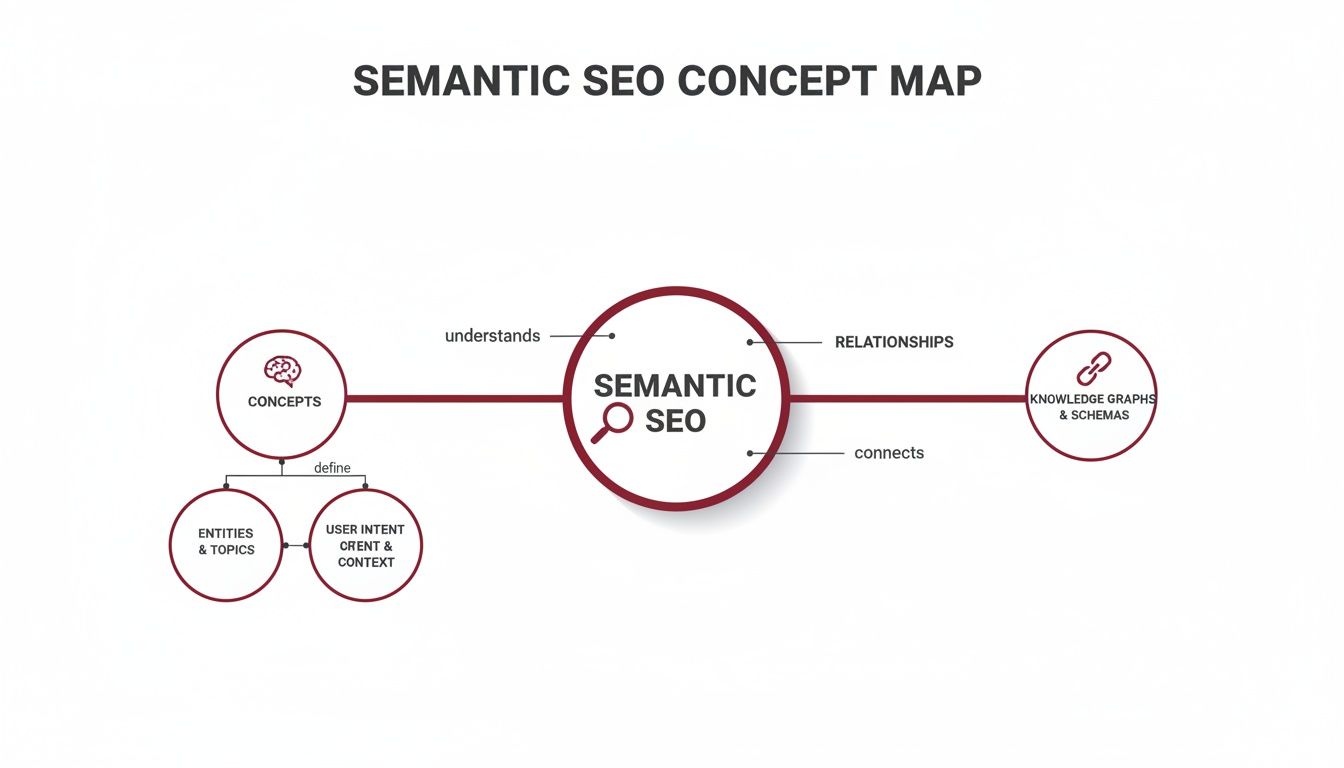
This foundational work makes the next step—actually creating the content—infinitely more powerful.
An entity-first strategy isn't about creating more content; it's about creating smarter, more connected content. Each piece should serve as a node in your knowledge graph, strengthening the entire network.
Step 3: Structure Content Using Topic Clusters
With your entities and their relationships mapped out, it’s time to build. The best way to do this is with the topic cluster model. This structure involves a central "pillar" page covering a broad topic, which is then supported by multiple "cluster" pages that dive deep into specific sub-topics.
This model is the perfect real-world application of semantic SEO & entity mapping: the entity-first content strategy.
- Pillar Page: Think of this as your magnum opus on a primary entity. For our example, it could be a massive guide titled "The Complete Guide to Electrical Services in Geelong." This page would touch on all the core services they offer.
- Cluster Content: These are the deep-dive articles, each focused on a specific, related entity. For instance, "5 Signs Your Home Needs a Switchboard Upgrade" or "A Homeowner's Guide to Victorian Electrical Safety Certificates."
Each cluster page links back to the main pillar page. The pillar page, in turn, links out to the relevant cluster pages. This tight internal linking structure signals to Google that your pillar page is the undisputed authority, with the cluster content providing all the supporting proof.
It’s an organised, strategic way to demonstrate comprehensive expertise and build a content fortress that your competitors will find almost impossible to penetrate. This three-step process—identify, map, and structure—is a repeatable framework for building lasting authority.
To help you put this into practice, here's a simple checklist to follow.
Your Entity-First Implementation Checklist
This table breaks down the process into actionable phases, making it easier to manage and track your progress as you build out your entity-based content strategy.
| Phase | Action Item | Key Objective |
|---|---|---|
| 1. Foundation | Identify 5-10 core business entities | Define the absolute essentials of your brand and services. |
| 1. Foundation | Map the direct relationships between core entities | Create a basic conceptual map showing how your entities connect. |
| 2. Strategy | Choose one core entity for your first pillar page | Select a high-value, broad topic to build your first cluster around. |
| 2. Strategy | Brainstorm 5-8 cluster content ideas | Identify specific sub-topics that support the pillar and answer user questions. |
| 3. Execution | Write and publish the pillar page | Create a comprehensive, long-form guide that acts as the central hub. |
| 3. Execution | Write and publish the cluster content | Develop detailed articles, each focusing on one specific sub-topic. |
| 4. Amplification | Implement internal linking | Link all cluster pages to the pillar page, and the pillar to the clusters. |
| 4. Amplification | Add schema markup to key pages | Use structured data to explicitly define your entities for search engines. |
Following these steps methodically ensures you're not just creating content, but building a powerful, interconnected asset for your business.
Driving Business Growth for Australian Companies
Shifting to an entity-first content strategy is much more than a technical box-ticking exercise for your SEO team. It's a direct investment in real, measurable business growth. For Australian small and medium-sized enterprises (SMEs) and e-commerce brands, this approach is about moving past vanity metrics to get tangible results: a stronger market position, long-term digital resilience, and, most importantly, higher conversion rates. It’s about turning your website from a simple online brochure into a powerful asset that consistently generates qualified traffic and sales.

Ultimately, this strategy connects directly to your bottom line. It helps you build a deep 'topical moat' that protects your rankings, makes your content immune to most algorithm updates, and creates a far more persuasive journey for potential customers.
Building a Defensible Topical Moat
In a crowded market, just ranking for a handful of keywords is a fragile advantage. A competitor can always come along and target the exact same phrases. An entity-first approach is different. It helps you build a deep and wide 'topical moat' around your business, making it incredibly difficult for others to challenge your authority.
When you cover a topic and all its interconnected concepts comprehensively, you're sending a powerful signal to Google that you are the definitive resource. This isn't just about one of your pages ranking better than a competitor's page; it's about your entire content ecosystem proving your expertise beyond a doubt.
Example: A Queensland Tourism Operator
Think about a tourism business based in Cairns. Instead of just hammering the keyword "Great Barrier Reef tours," they could build a rich content ecosystem around all the related entities:
- Concepts: 'Great Barrier Reef conservation', 'marine biology for tourists', 'sustainable tourism practices'.
- Locations: 'Cairns Esplanade', 'Port Douglas', 'Fitzroy Island'.
- Organisations: 'Great Barrier Reef Marine Park Authority', 'local Indigenous tour guides'.
By creating content that logically connects all these entities, they establish themselves as an expert not just in tours, but in the entire experience and ethos of the region. This builds a competitive moat that a simple tour aggregator website could never hope to cross, attracting higher-quality traffic that is far more likely to book.
Future-Proofing Your SEO Investment
Google's algorithms are constantly getting smarter and more sophisticated, moving towards an AI-driven understanding of content. Old-school strategies that relied on keyword density or trying to find loopholes are flimsy and bound to fail. An entity-first strategy, on the other hand, is built for the future because it aligns perfectly with where search is heading.
By focusing on well-defined concepts and their real-world relationships, you are creating content that is already optimised for next-generation search technologies like AI Overviews and conversational voice search. These systems rely on understanding context, not just keywords.
This makes your content far more resilient to algorithm updates. Because your entire strategy is based on demonstrating genuine expertise, any future updates designed to reward high-quality, authoritative content will almost certainly work in your favour. It's about shifting from a reactive SEO mindset to a proactive one.
Increasing Conversions with Contextual Relevance
At the end of the day, traffic is only valuable if it converts. A major benefit of semantic SEO & entity mapping is its power to guide potential customers through their buying journey more effectively. When you create contextually rich content that genuinely answers people's questions, you build trust and confidence.
This approach lets you meet users at every stage of their journey, from their first curious search to their final purchase decision. By understanding the relationships between different concepts, you can anticipate their next question and provide the answer before they even have to type it into Google.
Example: An Australian-Made Goods Retailer
Imagine a national retailer that specialises in 'Australian-made goods'. They can use entity mapping to turn browsers into buyers:
- A customer searches for "ethical clothing brands Australia" (an entity).
- They land on a pillar page about sustainable fashion in Australia.
- This page then links out to cluster content about specific related entities, like 'Australian merino wool' or 'Melbourne-based designers'.
- Each of these pages features relevant products, answering the user's initial query while seamlessly introducing them to things they can actually buy.
This creates a smooth, informative path from discovery right through to conversion, dramatically increasing the likelihood of a sale. The content doesn't just attract visitors; it actively nurtures them into becoming customers.
The Right Tools for Your Entity & Semantic SEO Toolkit
An entity-first content strategy isn't just theory; it's a practical approach that needs the right set of tools to bring it to life. Think of these tools as the bridge between your ideas and what search engines actually understand. They help you pinpoint the right entities, analyse how they connect, and then communicate all that rich context directly to Google.
Trying to do this manually is a recipe for a headache. Entity research and building schema markup would take forever. Thankfully, there are some brilliant tools out there to make the whole process smoother, whether you're a local Aussie business or a national ecommerce brand.
Tools for Finding and Researching Entities
Before you can write about entities, you have to find them. The first step is to identify the core people, places, concepts, and things that matter in your industry. These tools are perfect for that initial discovery phase.
- Wikipedia and Wikidata: Don't underestimate these free resources. They are goldmines for understanding how knowledge is structured online. Use them to find the official names for entities, grab clear descriptions, and see the relationships that search engines already know and trust.
- Google's Knowledge Graph Search API: Want to see how Google views the world? This API lets you peek directly into its massive entity database. You can search for a concept and see exactly how Google defines it, what attributes it has, and how it’s linked to other entities.
These are your foundational tools. They'll help you build out a solid list of the main entities you need to focus your content on.
Platforms for Optimising Your Content
Once you know which entities you're targeting, you need to weave them into your content in a way that makes sense. Content optimisation platforms use natural language processing (NLP) to act as your guide.
Getting an entity-first strategy right really comes down to having the proper tech in your corner. For a great rundown of what's out there, check out these best AI SEO tools.
These platforms are smart. They scan the top-ranking pages for your topic and pull out all the crucial related concepts and entities you should probably include. This gives you a data-backed roadmap to creating content that covers a topic from every important angle, which is the very heart of semantic SEO & entity mapping. Big names in this space include platforms like SurferSEO and MarketMuse.
Generators for Schema Markup
The final, crucial step is translating your beautifully structured content into a language search engines can instantly understand. That language is called schema markup (or structured data). It’s how you explicitly tell Google, "Hey, this piece of text is about this specific entity."
The vocabulary for this comes from Schema.org, a collaborative project that standardises the whole system. It provides all the labels you need to turn your text into clear, machine-readable facts.
Thankfully, you don't need to be a coding whiz to do this. Schema generators make it easy to create the necessary JSON-LD code. Tools like Merkle’s Schema Markup Generator have simple interfaces that let you build the right markup for articles, products, or your local business, ensuring search engines get the message loud and clear.
Winning in the Future of AI-Powered Search
The days of a simple list of ten blue links are numbered. We're seeing a fundamental change in how search works, shifting towards AI-powered, conversational answers. Think of Google's AI Overviews – they aren't just a shiny new feature; they're a preview of where search is heading. In this new game, an entity-first content strategy isn't just a nice-to-have. It's essential for survival.
AI models are designed to understand context, relationships, and concepts, which is exactly what semantic SEO & entity mapping is all about. When an AI like Google's Gemini or ChatGPT generates an answer, it isn't just looking for keywords. It pulls information from multiple sources it considers authoritative, blending facts and ideas into a single, cohesive summary. Your job is to make sure your content is one of those trusted sources.
Becoming a Source for AI Engines
An entity-first approach sets your content up to be easily understood and used by these complex AI systems. When you clearly define the entities on your page, give your content a logical structure with clean headings and lists, and use schema markup to spell out relationships, you're essentially handing the AI a cheat sheet.
This makes your content highly "machine-readable," positioning it as a reliable piece of the puzzle in the AI's knowledge graph. Instead of just trying to rank on a results page, you're aiming to be cited directly within the AI's generated response—a much more powerful place to be.
By structuring your content around entities, you move from simply answering a query to becoming the foundational knowledge that powers the answer. This is the key to not just ranking today but becoming an authoritative voice tomorrow.
The Australian Advantage in AI Visibility
This forward-thinking strategy is already delivering results for businesses that are quick to adapt. For Australian companies, the entity-first content strategy is a game-changer for visibility in AI results and what's now being called Answer Engine Optimisation (AEO). It’s all driven by technologies like natural language processing and knowledge graphs, which help us optimise for the way people actually talk and ask questions.
Focusing on topical clusters and schema—not just isolated keywords—directly improves AEO performance. It helps brands show up in the AI-generated answers people get from tools like ChatGPT or Gemini. You can dig deeper into how Australian agencies are pioneering this with AI-driven semantic entity mapping on AppLabx.com.
By putting your money on an entity-first model now, you're future-proofing your entire content investment. You're building an asset that will stand up to algorithm updates because it’s built for the way AI thinks. This is bigger than just SEO; it's about making sure your brand stays relevant in the next chapter of how we find information online.
Frequently Asked Questions
It's natural to have questions when you're moving towards an entity-first approach. Let's tackle some of the most common ones that business owners and marketing managers ask, clearing up how semantic SEO and entity mapping really work in practice.
These are the straight-up answers you need to understand the entity-first content strategy and put it to work.
How Is Entity SEO Different From Topic Clusters?
They're not rivals; they're partners. Think of it like building a house: topic clusters are the architectural structure, but entity mapping is the detailed blueprint that shows you exactly what to build and how every room connects.
A topic cluster is a well-known way to organise content, with a central pillar page supported by related cluster pages. Entity mapping is the deep strategy behind it all. It identifies the core concepts (the entities) and all their relationships, giving you the data you need to build topic clusters that are logically connected and semantically rich.
Simply put, you use entity analysis to figure out what your clusters should even be about to build genuine topical authority.
Can a Small Local Business Use an Entity-First Strategy?
Absolutely. In fact, it's a massive advantage for local businesses. For a local Aussie SME, your most powerful entities are often tied directly to your physical location. When you start mapping your services to local entities—things like your suburb, well-known landmarks, or even council regulations—you build incredible relevance for all those "near me" searches.
Let's look at a real-world example for a local business:
- Business: A plumbing service in Geelong.
- Core Service Entity: "Emergency plumbing repairs".
- Local Entities: "Geelong West", "Kardinia Park", "Victorian Building Authority".
Creating content that naturally connects these entities is lightyears ahead of just spamming "plumber Geelong" everywhere. It proves to Google that you're a legitimate, active expert operating within that specific geographic area.
What KPIs Measure the Success of an Entity-First Strategy?
Success with this strategy isn't just about watching a few keywords climb the rankings. You're building a genuine content asset, so you need to measure its overall strength and authority in the market.
Here are the Key Performance Indicators (KPIs) you should be tracking:
- Growth in Topical Authority: This can be measured using SEO tools that analyse your website's overall expertise on a given subject.
- Increased Ranking Keywords Per Page: You'll notice a single page starts ranking for hundreds of related long-tail queries, not just the one or two primary keywords you were targeting.
- Improved Visibility in Rich Results: Watch for an increase in your content appearing in Featured Snippets, People Also Ask boxes, and even AI Overviews.
- Higher Organic Traffic to the Entire Topic Cluster: Don't just look at one page. Measure the collective traffic growth across the pillar and all of its supporting pages.
- Impression Share for Core Topics: Are you showing up more often for the broad concepts that truly define what your business does?
Tracking these metrics gives you a much more accurate picture of your growing authority and how much of the market you truly own.
Ready to build a content strategy that establishes true authority and drives measurable growth? At Anitech, we specialise in creating entity-first SEO frameworks tailored for Australian businesses. Our data-driven approach ensures your content not only ranks but dominates your market. Find out more on our website.