Quick Summary: Semantic SEO and entity mapping are critical for modern search visibility. This guide covers their evolution from keyword matching to concept-based retrieval, driven by updates like Hummingbird, BERT, and now AI Overviews. Learn how to define your brand as a trusted entity and structure content to thrive in the new generative search landscape.
Semantic SEO and entity mapping aren't just the latest industry buzzwords; they represent a fundamental change in how search works. We've moved away from simple keyword matching towards a far more sophisticated understanding of real-world concepts. This journey, kicked off by updates like Hummingbird and fine-tuned by BERT, is now hitting overdrive with things like AI Overviews and generative engines. Getting your head around this conceptual approach is no longer a "nice-to-have"—it's the key to building any kind of lasting online visibility.
The Journey From Keywords to Concepts

The story of SEO is one of constant evolution. In the early days, the game was pretty simple. You found the right keywords, sprinkled them across your pages, and that was most of the job done. Search engines behaved like old-school librarians, meticulously matching the words in your query to the words on a page. But this keyword-first model had some serious flaws.
More often than not, it completely missed what the user was actually looking for. A search for "apple" was a lottery. You might get results about the fruit, the tech company, or even a record label, because the engine had no real way to tell them apart. This ambiguity made for a clumsy user experience and opened the door to spammy tactics like "keyword stuffing," where pages were crammed with terms just to game the system.
A New Direction For Search Retrieval
It became obvious that a smarter system was needed. Search engines had to grow up, moving from basic text-matching machines to systems that could grasp context, nuance, and the intricate connections between ideas. This was the start of the evolution of search retrieval and the push towards a truly semantic web.
This massive shift was propelled by a few clear goals:
- Decipher User Intent: Understand what people mean, not just what they type.
- Recognise Real-World Entities: Connect strings of text to actual people, places, organisations, and things.
- Deliver Contextual Answers: Provide results that aren't just loosely relevant but genuinely helpful for that specific query.
To understand this journey, it helps to look back at the major updates that got us here. The table below charts the path from rigid keyword matching to the fluid, context-aware search we see today.
Key Milestones in Search Retrieval Evolution: From Hummingbird to Generative Engines
| Algorithm Update | Year of Impact | Primary Focus | Impact on SEO |
|---|---|---|---|
| Panda | 2011 | Content Quality | Penalised thin, low-quality content and keyword stuffing. |
| Hummingbird | 2013 | Conversational Search | Shifted focus from keywords to understanding the meaning behind queries. This was the true beginning of the semantic era. |
| RankBrain | 2015 | Machine Learning | Used AI to interpret ambiguous queries and improve relevance for never-before-seen searches. |
| BERT | 2019 | Natural Language Processing | Understood the nuance and context of words in relation to each other, dramatically improving comprehension of complex queries. |
| MUM | 2021 | Multimodal Search | Aimed to understand information across text, images, and video, connecting concepts across different formats. |
| AI Overviews / SGE | 2023+ | Generative AI Answers | Synthesizes information from multiple sources to provide direct answers, fundamentally changing the SERP and raising the bar for content quality. |
These updates weren't just tweaks; they were complete overhauls of the core logic, forcing SEOs to think less about keywords and more about building genuine authority and providing real answers.
The Australian Shift Towards Semantic Search
Here in Australia, this transition has completely reshaped the digital marketing playbook. While Google's Hummingbird update in 2013 laid the foundation, it was the BERT update in 2019 that really accelerated the change locally, giving Google a much better grasp of natural, conversational language. Now, with the rollout of AI Overviews, the need for a semantic approach has become urgent.
Considering that 93% of online experiences in Australia begin with a search engine—with Google holding the lion's share of the market—failing to adapt is simply not an option. You can dive deeper into these Australian SEO statistics to get a clearer picture of the local market.
The core idea behind semantic search is to move beyond the literal interpretation of words and instead focus on the underlying meaning and intent of a user's query. It's about connecting topics, not just matching keywords.
This new reality demands a more thoughtful content strategy. Forget creating dozens of thin pages for every minor keyword variation. The focus now is on building comprehensive topic clusters that cover a subject from all angles. This approach positions your website as a definitive resource, earning trust from both your audience and the search engines.
As we'll explore, getting to grips with semantic SEO & entity mapping is how you win in this smarter, more intuitive search environment.
What Is Semantic SEO and Entity Mapping?
To really succeed in modern search, you have to think beyond old-school keyword stuffing. The game has changed. Today, it's all about two ideas that work together: semantic SEO and entity mapping. These concepts are the key to understanding how search engines have evolved from simple word-matchers into sophisticated systems that grasp real-world meaning.
Semantic SEO is about optimising your content around topics, not just individual keywords. Imagine you’re building a comprehensive library on a subject. Instead of just one article on "roof repairs," you'd create an entire ecosystem of content covering "common roof leak causes," "metal roof maintenance," and "choosing a Sydney roofing contractor." This approach shows search engines you're a genuine authority.
It’s all about meeting user intent, answering their first question and then anticipating the next one before they even ask it. By creating this kind of seamless, helpful experience, you build what’s known as topical authority—a critical signal of credibility for Google's AI-driven algorithms.
Defining Your Brand as an Entity
If semantic SEO is about the meaning of your content, entity mapping is about defining who you are. An entity is simply a distinct thing or concept the search engine can identify—a person, a place, a business, or even an abstract idea.
Entity mapping is how search engines connect a jumble of words to a specific, verified entity in their massive database (often called a Knowledge Graph). It’s how Google figures out that a search for "Apple" could be about the tech giant or the fruit, and it uses the surrounding context to get it right.
For your business, this is everything. You can't just be a name on a page; you need to be a recognised entity.
Becoming a known entity transforms your business from a string of text into a concept Google understands and trusts. This is the bedrock of visibility in an AI-powered search world.
This happens when Google can confidently link your brand to specific details, such as:
- Your official website: The main online home for your business.
- Your physical address: Especially vital for local Aussie businesses.
- Your services or products: What you actually sell or do.
- Customer reviews and ratings: Proof of your reputation and trustworthiness.
The Role of Structured Data
So, how do you give Google a helping hand in mapping your business as a clear, distinct entity? You use structured data, also known as Schema markup. Think of it as a special vocabulary of code you add to your website to label your information in a way machines can instantly understand.
The following screenshot from Google's developer documentation shows how structured data gives context to a recipe page, turning plain text into labelled information like cooking time and nutritional details.

This example perfectly illustrates how you're not just telling Google what your page says, but what it is. For a local business in Victoria, you'd use LocalBusiness schema to explicitly state your business name, address, phone number, and opening hours, leaving absolutely no room for confusion.
When you combine the depth of semantic SEO with the clarity of entity mapping, your strategy becomes incredibly powerful. You're creating authoritative content that thoroughly answers user questions, while making sure Google recognises your brand as the expert providing those answers. This powerful combination is at the heart of the evolution of search retrieval.
How Entity-Aware Search Actually Works
Think of modern search engines less like a simple librarian fetching a book and more like a seasoned detective piecing together clues. They're not just scanning pages for your keywords anymore; they’re trying to understand the real-world context behind what you’re actually looking for. This is the heart of entity-aware search: connecting what you type into the search bar with real, tangible concepts, businesses, and places.
Let's take a classic Aussie search to see how it all clicks into place: "best coffee near the Opera House."
A decade ago, a search engine would have dutifully hunted for web pages that simply contained those exact words. Today, the process is worlds away from that, involving a much more sophisticated breakdown of concepts, intent, and location.
Deconstructing the Search Query
First, the search engine pulls the query apart to get to its core components. It’s not just reading a line of text; it’s identifying distinct entities and the user's underlying goal.
- "Coffee" isn't just a word; it's a concept. The engine immediately links it to related ideas like 'cafe', 'espresso', 'flat white', and 'barista'.
- "Opera House" is instantly recognised as a world-famous entity—the Sydney Opera House. Critically, this entity has a precise geographic location and is connected to other local entities like 'Circular Quay' and 'Sydney Harbour'.
- "Best" is a huge signal of user intent. You’re not just looking for any old coffee; you want a place that’s highly-rated, popular, or well-reviewed.
- "Near" acts as a proximity modifier, telling the engine to filter everything based on its physical closeness to the main entity, the Opera House.
This initial breakdown moves way beyond simple keywords and gets right into the realm of meaning. It’s this first step that sets the stage for a much more accurate and helpful set of results.
The Knowledge Graph Steps In
Once your query is understood, the search engine consults its massive internal encyclopedia: the Knowledge Graph. Picture it as Google’s digital brain, a colossal database containing billions of facts about people, places, and things, and—most importantly—the relationships between them.
The Knowledge Graph knows the Sydney Opera House is a landmark in Sydney, NSW. It also has detailed information on thousands of cafes, each one a unique business entity with its own set of attributes—an address, opening hours, customer ratings, menu items, you name it. The engine uses this incredible network to find entities (cafes) that are both contextually and geographically relevant to the main entity in your search (the Opera House).
An entity-aware search doesn't just find web pages; it queries a map of the real world. It connects your need for "coffee" to a specific cafe entity that is physically close to the "Opera House" entity.
This has completely changed how businesses get discovered online, especially on a local level. For businesses in Australia, getting found has evolved from basic keyword tactics to deep integration with the Knowledge Graph. This shift kicked into high gear alongside a massive 500% growth in 'near me' searches over five years, a trend that’s impossible to ignore when you realise 46% of all Google searches have local intent. Being a recognised entity in Google's eyes is no longer a 'nice-to-have'; it's essential. You can dig deeper into these powerful local search trends with some great insights from Safari Digital.
Using Embeddings to Judge a Good Match
The final piece of this puzzle is a technology called embeddings. You can think of an embedding as a numerical fingerprint—a long string of numbers—that represents a word, phrase, or even an entire entity. This allows the AI to use maths to figure out how closely related different concepts are.
For instance, the embedding for "cafe" would be mathematically much closer to "cappuccino" than it would be to "car park." In the same way, a cafe with hundreds of glowing reviews that specifically mention its "great flat white" will have an embedding that strongly signals it's a great match for a user searching for the "best" coffee.
By comparing the embeddings of your search query with the embeddings of countless local business entities, the search engine can score and rank the results with incredible precision. What you get back isn't just a list of businesses with the right words on their website. You get a list of businesses that are the most contextually relevant and highly-regarded answers to your specific need. This is the core engine driving the evolution of search retrieval right now.
Navigating AI Overviews and the New Search Landscape
The next big shift in search is already here. With Google rolling out AI Overviews and other generative features, the search results page as we know it is changing for good. For years, the goal was simple: get into the top ten blue links. Now, the game is all about becoming a trusted, citable source for Google's own AI.
Think about it. These AI-powered summaries are built by piecing together information from multiple, high-quality sources. When someone asks a complex question, the AI sifts through its index, finds the most reliable content, and presents a neat, consolidated answer right at the top. This means the best spot on the page isn't just position one anymore—it's getting your brand featured inside that AI answer.
Becoming a Citable Source for AI
So, how do you earn a spot in that coveted space? Your content needs to be crystal clear, authoritative, and structured in a way that an AI can easily digest. This is exactly where semantic SEO and entity mapping become your secret weapons. When you’ve clearly defined your brand as an entity and built deep topical authority, you're sending strong signals to Google that you're a go-to source of information.
The aim is to provide definitive, unambiguous answers. Google's AI is trained to prioritise sources that nail Expertise, Experience, Authority, and Trustworthiness (E-E-A-T). By covering a topic from every angle and establishing your brand as a recognised entity, you’re basically pre-qualifying your content as citation-worthy.
This concept map shows how the modern search process works—it's all about matching a user's intent to a specific entity to deliver the right result.
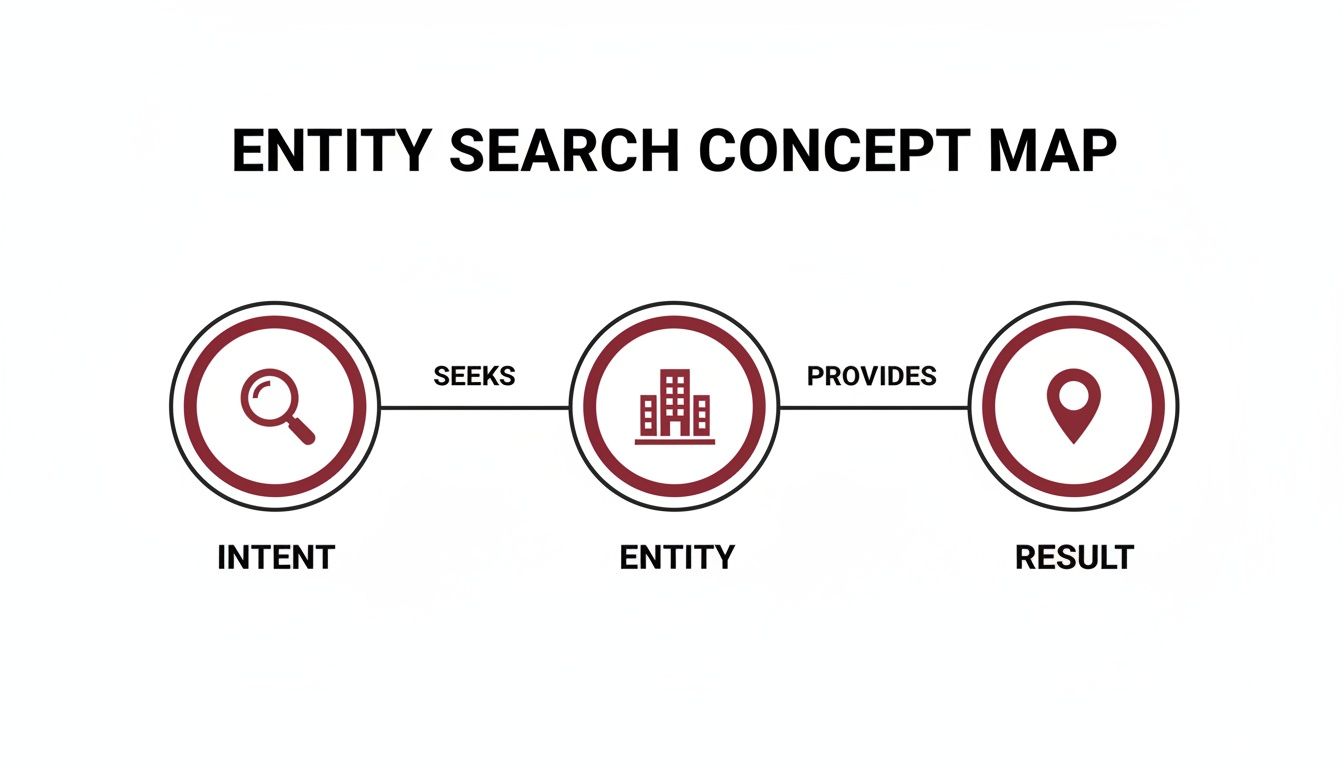
Ultimately, winning in this new era comes down to being seen as the most relevant entity for what a user needs.
The Risks and Rewards in a Generative Era
Let's be blunt: businesses that don't adapt risk becoming invisible. If your content is thin, unstructured, or just a random collection of articles, generative AI will likely skip right over it. That means a serious drop in your organic visibility. If you aren't a citable source, you might not be seen at all.
On the flip side, the opportunity is huge. Getting featured in AI Overviews can give your brand incredible visibility and cement your authority in a way traditional rankings never could. It puts you forward as the expert, often getting your brand name in front of users before they even scroll down to a competitor's website.
This fusion of semantic SEO and AI is already shaking up strategies across Australia. According to a report from WARC, a massive 95% of Australian businesses are now using AI for marketing, and 62% plan to increase their AI spending. A lot of that budget is going straight into advanced SEO. While many are still getting started, some forward-thinking businesses are already seeing revenue boosts of up to 40%.
In the new search landscape, your primary goal is to make your content so clear and authoritative that Google's AI has no choice but to cite you as the source of truth.
To get ahead, start focusing on these practical steps:
- Answer Questions Directly: Shape your content to give clear, concise answers to the questions your audience is asking. This makes it incredibly easy for an AI to extract the information.
- Use Structured Data: Implement Schema markup to explicitly define what your content is about and how it connects to other concepts, leaving no room for guesswork.
- Build Topic Clusters: Create comprehensive content hubs that cover a subject in-depth. This is how you build undeniable topical authority and show Google you're a true expert.
Your Blueprint for Implementing Semantic SEO

Alright, let's move from the 'what' to the 'how'. Knowing about semantic SEO is one thing, but putting it into practice is where you'll see the results. It’s about being methodical and shifting your focus from old-school keyword tactics to building meaning and connections across your site.
This isn’t about a quick fix. It's about structuring your entire digital presence in a way that makes it dead simple for search engines to see what you're about and recognise you as an authority. Think of it as building a library of interconnected knowledge, not just a collection of random blog posts.
Conduct Topic Research Beyond Keywords
First things first: we need to change how we think about research. Stop chasing keywords with high search volume. Instead, start digging into the broad topics and the specific intentions that drive your customers. The goal is to understand the entire conversation happening in your niche, not just the search terms they use.
Kick things off by mapping out your main services or products. For each one, put yourself in your customer's shoes. What questions do they have? What problems are they trying to solve? What related ideas might they be exploring?
Here are a few practical ways to do this:
- Mine "People Also Ask" boxes: Google is literally telling you what other questions searchers have. This is a goldmine for related ideas.
- Hang out where your audience is: Jump into forums like Reddit or industry-specific communities. You'll see the raw, unfiltered language and pain points your customers use every day.
- Use proper topic research tools: Some platforms are designed to show you related concepts and help you build out a full content plan, moving you beyond simple keyword lists.
This whole process is about identifying the core pillars of your content strategy so you can cover a subject from every important angle.
Create Content Models and Topic Clusters
Once you’ve got your topics nailed down, you need to give them structure. The topic cluster model is one of the most powerful ways to organise your content and build genuine topical authority. It’s pretty simple in concept: you have a central "pillar page" that covers a broad topic in detail, which is then surrounded by several "cluster pages" that dive deeper into specific subtopics.
Let’s say you’re an Australian solar panel installer. Your cluster might look something like this:
- Pillar Page: The Ultimate Guide to Residential Solar Power in Australia
- Cluster Pages: "How Much Do Solar Panels Cost in NSW?", "Understanding Solar Rebates in Victoria", "Best Solar Inverters for Australian Homes".
Every cluster page links back to the main pillar page. This creates a really tight internal linking structure that signals to search engines that you have a deep, well-organised body of knowledge. Your website stops being a random assortment of articles and becomes a definitive resource.
A well-executed topic cluster tells Google, "We don't just know about this one keyword; we are an expert on this entire subject." This is a foundational element of semantic SEO.
If you want to get serious about this, exploring advanced AI-powered tools like Alli AI can give you a major advantage. It can help you spot cluster opportunities and understand content relationships without all the manual guesswork.
Use Schema Markup to Define Your Entity
Now for the technical side. One of the most direct ways to speak Google's language is by using Schema.org markup. This is basically a vocabulary of code that you add to your website to explicitly label what your content is about. It removes any guesswork for the search engine.
Think of it as handing Google a perfectly filled-out business card.
Schema markup is the bedrock of entity-based SEO, telling Google exactly who you are, what you do, and how you connect to other things online. For Australian businesses, implementing the right schema is non-negotiable for establishing your digital identity.
Below is a breakdown of the most critical schema types you should be using. This isn't an exhaustive list, but it's the perfect starting point for defining your business as a clear, understandable entity for Google.
Essential Schema Types for Australian Businesses
| Schema Type | Who Should Use It | Key Properties to Include | SEO Benefit |
|---|---|---|---|
LocalBusiness |
Any business with a physical address (e.g., retailers, clinics, cafes). | name, address (with postalCode), telephone, openingHours, geo coordinates. |
Crucial for local pack rankings and establishing your geographic relevance. |
Organization |
All businesses, especially those without a public-facing storefront. | name, logo, url, sameAs (links to social profiles), contactPoint. |
Solidifies your brand as a single entity and connects your web properties. |
Product |
E-commerce sites and businesses selling specific items. | name, image, description, brand, sku, offers (with priceCurrency as AUD). |
Can trigger rich snippets like pricing, availability, and review stars in search results. |
Service |
Service-based businesses (e.g., plumbers, consultants, digital agencies). | serviceType, provider (your LocalBusiness), areaServed (specific suburbs or states). |
Clearly defines your service offerings and service areas to match with local queries. |
FAQPage |
Any page with a list of questions and answers. | A series of Question and Answer pairs. |
Helps you capture more SERP real estate by appearing in FAQ-rich snippets. |
Implementing these schema types isn't just a "nice-to-have" anymore. It's a fundamental step in making sure Google’s Knowledge Graph understands your business correctly, which directly impacts your visibility in everything from map results to voice search.
Your Questions About Semantic SEO and Entity Mapping, Answered
Even with a clear plan, moving to a modern SEO strategy always brings up a few practical questions. Let's tackle some of the most common ones that business owners and marketers ask when they start exploring semantic SEO. My goal here is to give you the clarity and confidence to make the shift.
How Is This Different from Just Targeting Keywords?
The real difference comes down to scope and intent. Traditional keyword targeting is incredibly narrow. You'd pick a specific phrase like "plumber Sydney CBD" and build a single page laser-focused on ranking for that exact term. It’s a very rigid, one-to-one relationship.
Semantic SEO, on the other hand, thinks much bigger. Instead of obsessing over one keyword, you focus on an entire topic, like "emergency plumbing services." You’d then create a central, authoritative page for that topic and surround it with content that answers every possible related question someone might have.
Think about things like:
- What actually counts as a plumbing emergency?
- Step-by-step guide to shutting off your water main.
- Typical costs for after-hours plumber call-outs in Sydney.
This approach is all about building topical authority. It shows search engines that you're a genuine expert on the entire subject, not just a site trying to game the system for a single phrase. You’re moving from just matching words to completely satisfying a user's real-world needs.
How Do I Actually Measure the ROI of This?
Measuring the return on a semantic strategy means you have to look beyond a simple keyword ranking report. While checking individual rankings is still part of the picture, the true signs of success are much broader and far more valuable to your business.
You'll want to focus on these key indicators:
- Growth in Organic Topic Visibility: Stop tracking just one keyword. Instead, monitor your visibility for a whole cluster of related terms. Are you showing up for dozens of long-tail questions connected to your core topic? That's a huge win.
- Increase in Non-Branded Organic Traffic: A solid semantic strategy pulls in people who have never heard of your brand but are searching for expert answers. A steady climb in this type of traffic is a clear sign you’re on the right track.
- Improved User Engagement Metrics: Dive into your analytics and look at metrics like time on page, pages per session, and bounce rate. When you thoroughly answer someone's questions, they stick around. This tells Google your content is high-quality.
- Increase in Conversions from Informational Content: Are your in-depth blog posts and guides leading to real business outcomes like newsletter sign-ups or quote requests? This proves your content isn't just attracting eyeballs; it's building the trust that drives action.
How Long Does It Really Take to Build Topical Authority?
Let's be clear: building genuine topical authority is a marathon, not a sprint. This isn't a quick technical fix; it's a long-term strategy that demands consistency and a bit of patience. How long it takes depends on a few things, like how competitive your industry is, the current health of your website, and the resources you can dedicate to creating great content.
You simply cannot fake expertise overnight. Topical authority is earned, piece by piece, by consistently publishing high-quality, comprehensive content over a meaningful period. It's a gradual process that builds momentum.
Generally, you can expect to see some early positive signs within 3-6 months—things like more impressions and rankings for very specific, long-tail questions. But to properly establish your site as an authority and see a significant impact on traffic and leads, you should really plan for a 12-18 month commitment. The trick is to create a realistic content plan and stick to it.
Can a Small Business Realistically Compete Using This Approach?
Absolutely. In fact, semantic SEO can be the great equaliser for smaller businesses. Big corporations might have huge budgets for ads and links, but they're often slow and clumsy when it comes to creating the kind of deep, niche content that builds real authority.
This is where a small business can shine. You can carve out a serious competitive advantage by going deep on a very specific niche. By becoming the go-to expert on a topic—whether it’s "specialty coffee roasting in Melbourne" or "sustainable building materials for Australian homes"—you can attract a highly targeted and valuable audience. Your agility and genuine expertise are your biggest weapons.
Instead of trying to outspend your competitors, you can out-teach them. That's how you build a loyal following and earn Google's trust in the process.
Ready to move beyond outdated keyword tactics and build lasting authority? The expert team at Anitech specialises in data-driven semantic SEO strategies tailored for Australian businesses. We help you dominate your niche, drive qualified traffic, and achieve measurable growth. Start your journey with a free, no-obligation consultation today. Learn more at anitech.au.