Quick Summary: This guide provides a comprehensive playbook for Australian small businesses to master SEO. It covers building a solid foundation, dominating local search with Google Business Profile, optimizing your website for clicks and conversions, creating customer-centric content, and building authority with practical link-building strategies to drive organic growth.
For any Australian small business, good SEO is the most reliable way to get local customers knocking on your door without blowing a massive budget on ads. It's all about making sure that when people in your area search for the exact products or services you offer, your business is the one they find. This means a steady stream of high-quality, organic traffic coming straight to your website—people who are already looking to buy. Effective SEO for small business Australia isn't a dark art; it's a learnable process.
This guide is your complete playbook for mastering local search, fine-tuning your website, creating content that connects, and building your online authority to drive real, measurable growth. We'll provide in-depth, valuable information using semantic keywords to help you rank higher.
Building Your SEO Foundation
Before we get into the nitty-gritty, we need to lay a solid foundation. This isn’t about chasing the latest shiny trend; it’s about putting the essential building blocks in place that will support everything you do from here on out. A strong start is the only way to make sure your time and money actually deliver results.
For any Aussie small business, this starts with two things: figuring out where you stand right now and setting up the right tools to track your progress. If you don't know your starting point, you're flying blind.
Where Do You Stand Right Now?
First things first, you need a realistic picture of your website's current health and who you're up against. This initial audit doesn't have to be super technical. The goal here is to find the low-hanging fruit—the quick wins that can give you a boost straight away—and to set a baseline so you can measure how far you've come.
Start by asking yourself a few simple questions:
- What are our most important products or services? This will tell you which keywords are the most valuable for your business.
- Who are our main local competitors? A quick Google search for your top services will show you who's currently owning the top spots.
- How do customers find us at the moment? Is it mainly word-of-mouth, a bit of social media, or people typing your website in directly?
Answering these questions gives you clarity. It helps you shift from guesswork to a focused plan, ensuring you put your energy where it will make the biggest difference. The timeline below maps out these foundational stages, from the initial audit right through to ongoing tracking.
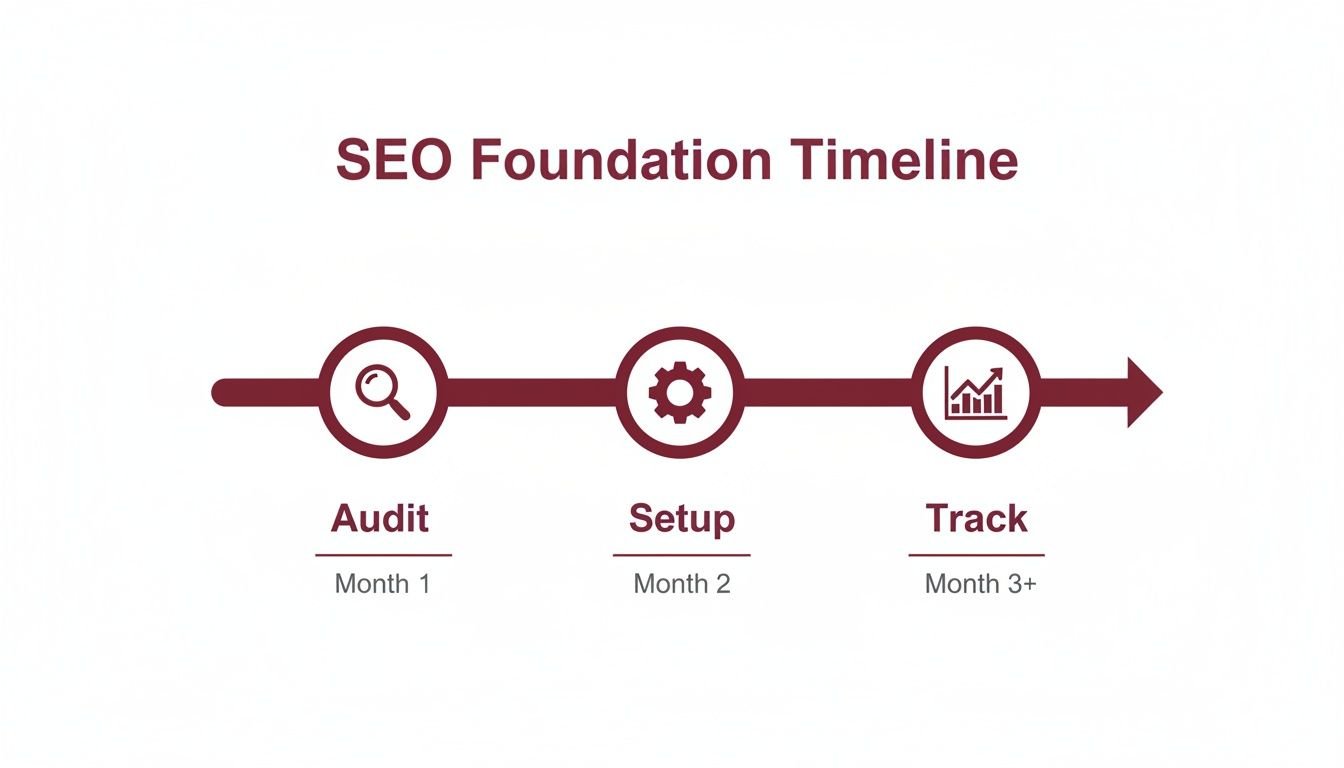
As you can see, SEO isn't a one-and-done task; it's a structured commitment to long-term growth.
Get Your Essential Toolkit Set Up
Once you know where you stand, it's time to set up the free, powerhouse tools that Google gives you. These are completely non-negotiable for any business that's serious about getting found online. They provide a direct look into how Google views your website and how your customers are finding you.
- Google Search Console (GSC): This is your direct line to Google. It’s the platform that tells you what keywords people are using to find you, flags any technical problems with your site, and shows you which pages are (or aren't) in Google's index.
- Google Analytics (GA4): This is your window into what people do once they land on your site. It shows you how many visitors you're getting, where they came from (e.g., Google, Facebook, etc.), which pages they look at, and how long they stick around.
Getting these two tools set up correctly from day one is critical. The data they gather will become the backbone of every decision you make, from what blog posts to write to which technical issues to fix first. If you're running an online store, understanding different approaches is vital; you can explore some winning SEO strategies that work well across various e-commerce models.
The proof is in the numbers. A recent study found that 74% of small businesses in Australia are now investing in SEO, with an average monthly spend of around $497. They recognise it’s no longer a 'nice-to-have' but a crucial engine for organic growth. This isn't just a local trend; the global SEO market is set to explode by 2030, driven almost entirely by small and medium-sized businesses just like yours.
Winning Your Local Area: A Guide to Local SEO
For most Australian small businesses, the path to online success starts right in your own backyard. If you want to attract customers in your service area, getting your head around local SEO for small business Australia is the single most effective thing you can do. This isn't just about having a website; it's about turning that site into a tool that brings real, local customers through your door. It’s how you make sure that when someone searches for ‘plumber in Parramatta’ or ‘cafe near me,’ your business is the one they see first.
The way people search has changed. A massive 46% of all Google searches are now for something local. Think about that for a second. Nearly half of all searches are from people looking for a product or service near them. For small businesses in competitive spots like Victoria or New South Wales, this is a huge opportunity. The businesses that rank in those top few local spots can pull in over 24% of all clicks, leaving competitors in the dust.
Your Google Business Profile is Your New Shopfront
Your Google Business Profile (GBP) is your most valuable piece of digital real estate. Seriously. It’s what people see in Google Maps and the "map pack" in search results, making it the first impression for many potential customers.
Just "claiming" your profile and walking away is a rookie mistake. You need to treat it like a living, breathing part of your business. A well-optimised GBP sends powerful trust signals to Google, but it requires regular attention to stay visible.
Getting the Most Out of Your Google Business Profile
To make your profile work for you, every section needs to be filled out completely and strategically. A complete profile doesn't just inform customers; it proves to Google you're a legitimate, active business worth recommending.
Here’s where to focus your energy:
- Primary Category: This is crucial. Pick the one category that best describes your main offering. If you're a bakery that also sells coffee, your primary category is "Bakery," not "Cafe." Get this wrong, and you're already on the back foot.
- Services and Products: Be specific. Don't just list "Landscaping." Break it down into every single service you provide: "garden design," "lawn mowing," "retaining walls," "paving," etc. Each one is another chance to rank for what people are actually searching for.
- Photos and Videos: Keep them fresh. Regularly upload high-quality photos of your work, your team, and your shop or van. Photos you upload yourself carry more weight than those from customers. I tell my clients to add new photos at least once a month.
- Google Posts: This is your free advertising space. Use it to share special offers, announce news, or highlight a service. These posts expire, so adding a new one each week keeps your profile looking current and engaged.
Key Takeaway: A detailed, active Google Business Profile is the absolute foundation of local SEO. It's the key to ranking in the local map pack, which is where your most motivated customers are looking.
To make this clearer, let's break down how these efforts directly help your business attract local Aussie customers.
How Local SEO Factors Impact Your Australian Business
This table shows the most important local SEO elements and why they matter for winning local customers. It's a quick cheat sheet for where to focus your time for the best results.
| Local SEO Factor | Impact on Your Business | Actionable Tip for Aussie Businesses |
|---|---|---|
| GBP Primary Category | Determines your core relevance. Wrong category = showing up for the wrong searches. | Choose the most specific category that fits. "Pest Control Service" is better than "Home Services." |
| Service Area & Location | Defines your geographical reach for "near me" and location-based searches. | Be realistic. Don't claim all of NSW if you only service Sydney's Northern Beaches. |
| NAP Consistency | Builds trust with Google. Inconsistent details create confusion and hurt rankings. | Do a search for your business name. Find all old addresses or phone numbers and get them updated. |
| Local Citations | Acts as a "vote of confidence" from other reputable sites, reinforcing your location. | Get listed on major Aussie directories like Yellow Pages, TrueLocal, and Hotfrog. Ensure details are identical. |
| Customer Reviews | Provides social proof for customers and is a major ranking signal for Google. | After a job, send a follow-up email with a direct link asking for a review. Make it easy for them. |
| Localised Keywords | Helps you rank for searches like "electrician Bondi" or "best coffee in Fitzroy." | Add your suburb and city name naturally to your website's service pages, titles, and meta descriptions. |
Focusing on these specific factors is the most direct way to improve your visibility in your local service area. It’s about being the most relevant and trustworthy result for Google to show.
The Power of Citations and NAP Consistency
Beyond your GBP, Google cross-references your business information across the web. This is where NAP (Name, Address, Phone number) consistency is vital. Your business name, address, and phone number must be exactly the same everywhere they appear online. Something as small as "St" versus "Street" or "Pty Ltd" versus "Pty. Ltd." can dilute your authority.
These consistent details are published on other websites as citations. Think of a citation as any online mention of your NAP. Building citations on well-regarded Australian directories is like collecting positive references from around the internet.
Make sure you're listed accurately on key Aussie directories:
- Yellow Pages Australia
- TrueLocal
- Hotfrog
- LocalSearch
- StartLocal
Every accurate listing reinforces your business's location and legitimacy in Google's eyes, giving your local rankings a solid boost. While these principles are universal, you can gain more perspective on how regional factors play a role by exploring these local SEO strategies for small businesses, as a great local strategy always considers the local context.
Encouraging and Managing Customer Reviews
Reviews are pure gold. They influence both customer decisions and Google's ranking algorithm. A steady flow of recent, positive reviews is one of the most powerful signals for local search success.
You can't just wait for them to roll in. You have to ask. A simple follow-up email with a direct link to your GBP review page works wonders. Some clients even put a QR code on their invoices. Just as important, make sure you respond to all reviews—good and bad. It shows potential customers (and Google) that you're an engaged business owner who cares about feedback.
On-Page and Technical SEO Wins for Your Website
Now that your local presence is sorted, it's time to get your actual website into shape. This is where we dive into on-page and technical SEO, but don't let the jargon scare you. I’m going to show you how to turn these complex-sounding tasks into simple actions that get real results for your Aussie business.
Think of it this way: this part of the process is about sending clear signals to Google about what your pages are about, all while making sure your human visitors have a great experience. Many business owners get overwhelmed here, but you can see huge returns just by focusing on a few key areas.
We’ll stick to the "quick wins" that make a genuine difference – things like writing titles that people actually want to click, organising your content so it's easy to read, and sorting out the technical glitches that are quietly holding you back.
Let's get your website working for you, 24/7.
Writing Titles and Descriptions That Earn Clicks
Your title tag and meta description are your shopfront in the Google search results. They’re a tiny ad for your page, and getting them right is the key to getting more clicks than your competitors—even if they rank a spot or two above you.
Title Tags: This is the clickable blue headline you see in a search result. It needs to be short, sharp, and feature your main keyword and location.
- Weak Title: Services Page | Smith's Plumbing
- Winning Title: Expert Blocked Drain Plumber in Geelong | Smith's Plumbing
Meta Descriptions: This is the little blurb of text under the title. While it doesn't directly influence your ranking, it massively impacts whether someone chooses your link. Use this space to sell your unique value and tell them what to do next.
- Weak Description: We offer a range of plumbing services in Geelong.
- Winning Description: Fast relief for blocked drains in Geelong. 24/7 emergency service, fixed-price quotes, and a satisfaction guarantee. Call us for a quick solution!
My Two Cents: Stick to under 60 characters for your titles and under 160 characters for your meta descriptions. This stops them from getting awkwardly cut off in the search results. Every word matters, so be direct and compelling.
Structuring Your Content for Humans and Robots
How you lay out your content has a huge impact on both your visitors and Google. Nobody wants to read a wall of text. Clear headings and short paragraphs make your pages scannable and easy to digest, while a logical structure helps search engines figure out what's important.
Here's a simple heading structure to use on every single page:
- H1 (Heading 1): This is your main page title. You only get one H1 per page, so make it count. It should always contain your primary keyword.
- H2 (Heading 2): Use these for the main subheadings. They break your content into big, logical chunks.
- H3 (Heading 3): When you need to break down the topics in your H2 sections even further, use an H3.
This simple hierarchy gives your readers a clear path through the page and tells Google exactly what the main ideas are.
Technical Fixes That Make a Big Difference
Technical SEO can feel like a minefield, but you don't need to be a developer to make meaningful improvements. For a small Aussie business, the two things that matter most are speed and mobile experience, especially since most of your local customers are probably searching on their phones.
Here’s where to focus your effort:
Improve Your Site Speed: A slow website is a deal-breaker. People just don’t wait. Test your site using a free tool like Google's PageSpeed Insights. The most common culprit I see is massive, unoptimised images. Simply compressing your image files before you upload them can make a night-and-day difference to your load time.
Check Your Mobile-Friendliness: Your website must be easy to use on a smartphone. If visitors have to pinch and zoom to read your text, you've already lost them. Most modern website builders create "responsive" sites automatically, but you should always grab your phone and test it out yourself.
Use Smart Internal Linking: Internal links are just links that point from one page on your site to another. They’re brilliant for helping visitors find more of your content and for spreading ranking power around your site. For instance, if you write a blog post on "Signs You Have a Leaking Pipe," you should absolutely link from that post to your "Leaking Pipe Repair" service page. It’s a simple way to guide both users and Google to your most valuable pages.
Crafting a Content Strategy to Win Over Australian Customers
If technical SEO is the engine of your website, then great content is the high-octane fuel that makes it go. It’s what turns your small business from just another name in the phone book into a trusted local expert. Forget just "writing blogs"—we're talking about a proper plan to create content that your ideal Aussie customers are actively searching for.
The real secret? Stop selling and start helping. Think about it: when you consistently answer the real-world questions your customers are asking, you transform your website from a simple brochure into an indispensable resource. This is how you attract the right kind of traffic and become the go-to authority in your suburb or city.

Finding Content Ideas That Actually Resonate
Forget the expensive keyword tools for a second. The best content ideas are hiding in plain sight—in the questions your customers ask you every single day. Every phone call, every email, every conversation is a goldmine.
This simple shift is the foundation of effective SEO for small business in Australia. You’re not guessing what people want; you’re directly addressing their real-world problems. In doing so, you'll naturally start ranking for the specific, long-tail keywords they’re typing into Google.
Here are a few real-world examples of what this looks like:
- Answer a Common Question: "How often should I get my air conditioner serviced in Brisbane?"
- Create a How-To Guide: "How to choose the right paint finish for a Queenslander home."
- Develop a Local Case Study: "Project Spotlight: A Stunning Garden Makeover in Balmain."
- Write a Comparison Post: "Brivis vs. Braemar: Which gas ducted heating is best for Melbourne winters?"
This kind of content works wonders because it’s laser-focused, genuinely helpful, and locally relevant. It's exactly what Google wants to serve up to its users.
Planning Your Attack with a Content Calendar
Consistency is your best friend in the content game, but that doesn't mean you need to burn yourself out. A simple content calendar is all you need to stay organised and avoid that last-minute panic of "What should I write about this month?".
You really don't need any fancy software. A basic spreadsheet gets the job done perfectly.
My Two Cents: I always tell clients to aim for one brilliant piece of content a month instead of four rushed, flimsy posts. When it comes to SEO, quality smashes quantity every single time.
Here’s a dead-simple calendar structure you can copy and paste into a spreadsheet:
| Publication Date | Topic / Title | Target Keyword | Content Type | Status |
|---|---|---|---|---|
| 15 July | How to prepare your deck for summer in Perth | "decking maintenance perth" | How-To Guide | In Progress |
| 12 August | Case Study: New office fit-out in Adelaide CBD | "adelaide office fitouts" | Case Study | Outline Complete |
| 18 September | Choosing the right hot water system for a family | "hot water system adelaide" | Buying Guide | Not Started |
A simple plan like this takes the guesswork out of the equation. It turns content from a nagging chore into a structured, manageable part of your marketing.
Thinking Beyond the Standard Blog Post
Don't box yourself into just writing articles. Different people consume information in different ways, and mixing up your content formats is a fantastic way to showcase your expertise and build rapport with potential customers.
Try weaving some of these into your content plan:
- Local Project Galleries: If you're a builder, landscaper, or interior designer, nothing speaks louder than your work. Create dedicated gallery pages for your best projects, complete with high-quality photos, a description of the job, and the suburb it was in.
- Video 'How-To' Guides: A quick, 2-minute video showing someone how to do something simple (like "How to unblock a sink drain") is incredibly valuable. It builds massive trust and positions you as a true expert.
- Customer Case Studies: A detailed story of how you solved a problem for a local customer is pure marketing gold. It's powerful social proof that works for your business 24/7.
At the end of the day, a winning content strategy is about one thing: being the most helpful answer for your local customers. When you focus on their needs and deliver value with relevant, locally-focused content, you won't just see your rankings climb—you'll see those clicks turn into loyal, paying customers.
Building Your Website's Authority with Practical Link Building
Think of a link from another website to yours as a vote of confidence. When a reputable site points to you, it’s a strong signal to Google that your business is a credible, authoritative voice in your industry. This is called link building, and while it's a huge part of SEO for small business Australia, it often feels like the toughest piece of the puzzle.
The good news? You don't need a massive budget or a dedicated outreach team to make it work. For most Australian small businesses, the best link-building strategies are the most practical ones—the ones that grow out of genuine community engagement and real industry connections.
This isn't about spammy shortcuts or buying links. It’s about earning them by becoming a valuable part of your local community and your field. Let's dig into how you can systematically build your site's authority and create a competitive edge that’s tough for anyone else to replicate.
Start with Your Local Community
Often, your strongest supporters are right in your own backyard. Building links from local organisations is a natural and powerful way to show Google you're a serious player in your service area. It feels authentic because it is authentic.
Look for these kinds of practical, community-focused opportunities:
- Sponsor a local sports team: Whether it’s the kids' local footy club or a community netball team, sponsorships almost always come with a "thank you" link on their website. That’s a high-quality, locally relevant link that cements your connection to the area.
- Support a local charity or event: Putting your name behind a local fete, charity fun run, or community festival is another fantastic way to get your business name—and a link—on an event or organisation's website.
- Host a community workshop: If you're an accounting firm, you could host a free "Tax Tips for Tradies" night. This not only builds goodwill but also creates a reason for local business groups or community centres to link to your event page.
A strategy like this does more than just boost your SEO; it builds real brand recognition within the community you serve every day.
Connect with Local Bloggers and Media
Every town and city has a network of local bloggers, journalists, and niche industry websites. These content creators are always looking for fresh stories and expert sources. Your job is to become one of those go-to sources.
Start by mapping out the key media players in your area. Who writes about new restaurants opening in your suburb? Is there a popular blog for parents in your city? Is there an online trade journal for your industry that’s based in Australia?
Once you have a shortlist, you can start building relationships.
- Offer expert commentary: Reach out and introduce yourself as a local expert. A real estate agent could offer insights on local market trends, while a mechanic could provide tips on "preparing your car for a road trip."
- Share interesting projects: Just finished a noteworthy job, like a unique architectural build or a stunning landscape design? Share some high-quality photos with a local design or lifestyle blogger. They might feature your work and link back to your site.
- Propose a guest post: If you spot a local blog that covers topics related to your field but is missing a specific angle, offer to write a helpful article for their audience.
Pro Tip: When you reach out, make it about them, not you. Frame your pitch around the value you can offer their audience. A generic, self-serving email gets deleted almost every time.
Get Featured on Relevant Australian Websites
Looking beyond your immediate neighbourhood, think about industry-specific directories and websites that serve the wider Australian market. Getting links from these sites positions you as a nationally recognised expert in your field.
While most paid directories aren't worth the money, many high-quality industry associations and resource sites offer fantastic listing opportunities. For example, a home builder could get listed on the Master Builders Australia website, or a registered psychologist could create a profile on the Australian Psychological Society site. These links carry serious weight because they come from highly trusted and relevant sources.
These authority-building activities are non-negotiable for growth. The data shows that strong local SEO, which absolutely includes local link building, drives real results. Australian small businesses that lock in a spot in Google's local pack see 126% more traffic and 93% more actions like phone calls and website clicks. On top of that, a focused local link-building effort can directly lift your referral traffic by an impressive +18%.
You can see for yourself just how much these ranking benefits matter by reading the full local SEO statistics on Rankmax.com.au. It’s clear proof that the effort you put into building local links translates directly into more customers finding and contacting your business.
Your Top SEO Questions Answered
Even with a solid plan, it's normal to have questions. SEO can feel like a moving target sometimes, and we get it. We've heard just about every question in the book from Australian business owners, so let's cut through the noise and give you some straight answers.
How Long Does SEO Take to Show Results in Australia?
This is always the first question, and for a good reason. The honest-to-goodness answer is that it really does depend. Think of SEO as building a foundation for your business—it’s not an overnight job. While you might see small wins within a few weeks from quick fixes, like tuning up your Google Business Profile, the real, meaningful results take a bit of patience.
For most businesses we work with, you’ll start seeing genuine movement in your rankings and website traffic within 4 to 6 months of consistent effort. If you're aiming for the top spots on page one for some really competitive search terms, you're probably looking at a 6 to 12 month journey.
A few things can speed this up or slow it down:
- Your Market: A local plumber in a regional town has a clearer path to the top than a law firm fighting for visibility in the hyper-competitive Sydney CBD.
- Your Website's History: A brand-new site is starting from scratch. An older website that's been around for a few years, on the other hand, often has some existing authority we can build on.
- Your Commitment: Dipping your toes in once a month won't cut it. A consistent strategy that includes creating content, earning links, and keeping the technical side clean will always win out.
The great news? Local SEO often delivers the fastest payoff. Get your Google Business Profile humming and a steady flow of new customer reviews, and you could see more phone calls and clicks coming your way in as little as 1 to 3 months.
Can I Do SEO Myself, or Should I Hire an Agency?
You can absolutely get your hands dirty with DIY SEO. For many small business owners, it’s the perfect way to learn the fundamentals and gain control over your online presence.
You can make a huge impact just by focusing on these key areas:
- Getting your Google Business Profile 100% complete and keeping it fresh.
- Actively asking for customer reviews and making sure you reply to them.
- Writing one genuinely helpful, locally-focused blog post each month.
But there comes a point where your business grows, and the complexity of what it takes to beat your competitors grows with it. That's where an agency can really accelerate things. They bring in specialised tools and expertise for the deeper, more time-consuming work—like technical site audits, competitor deep dives, and building a high-quality link strategy—which frees you up to do what you do best: run your business.
Our advice: Start with what you can realistically manage yourself. Nail your Google Business Profile and start creating some local content. When you feel like you've hit a wall or simply don't have the hours in the day, that’s the ideal time to look for a partner who understands the ins and outs of SEO for small business in Australia.
What’s the Most Important Part of SEO for a Local Service Business?
If you’re a local service business in Australia—whether you’re a tradie, a therapist, or a local cafe—the hands-down winner is local SEO. And the heart of local SEO is your Google Business Profile (GBP).
Think of your GBP as your digital front door. It’s the first thing people see when they search for services like yours, popping up in Google Maps and the all-important "map pack" at the top of the search results.
Once you’ve got your profile optimised, your next priorities are crystal clear:
- Generate a constant stream of positive customer reviews. This is the social proof that tells both Google and potential customers that you’re the real deal.
- Keep your NAP (Name, Address, Phone number) consistent everywhere. From Yellow Pages to your local chamber of commerce site, every mention of your business needs to be identical.
How Much Should a Small Business in Australia Budget for SEO?
There’s no magic number here. While some industry articles might throw around an average monthly spend of $500, that figure doesn't tell the whole story. Your SEO budget should be tied directly to your goals, your industry, and where you're located.
A florist in a small regional town might only need a modest budget that’s laser-focused on their local SEO to see fantastic returns. Compare that to a national e-commerce store or a mortgage broker in the fiercely competitive Melbourne market—they'll need to invest significantly more to make a dent and see a positive return.
Ready to take the guesswork out of your digital marketing and see measurable growth? The expert team at Anitech specialises in data-driven SEO strategies that deliver results for Australian businesses. We offer transparent reporting, dedicated support, and a proven track record of increasing online visibility. Start with a free, no-obligation consultation to discover how we can help you dominate the search rankings. Learn more and get in touch at anitech.au.