TL;DR: To rank in modern search engines, you must demonstrate Experience, Expertise, Authoritativeness, and Trustworthiness (E-E-A-T) through on-page signals. This involves showcasing first-hand experience via case studies, proving expertise with detailed author bios and structured content, building authority with credentials and schema markup, and establishing trust through transparency, reviews, and security measures.
Gone are the days when on-page SEO was just about keyword density. To rank and stay ranked, you have to engineer Experience, Expertise, Authoritativeness, and Trustworthiness (E-E-A-T) into the very fabric of your website. This guide on on-page SEO: engineering E-E-A-T into every page details how to turn every page from a static collection of words into a living testament to your credibility and hands-on knowledge. This isn't just a suggestion anymore; it's a fundamental requirement. Search engines and users alike need to see verifiable signals that you know what you're talking about.
Building Your Foundation With Experience and Expertise
The biggest mental shift you need to make is moving from claiming you're an expert to actively proving it. This is where the first two pillars of E-E-A-T—Experience and Expertise—come in. They form the foundation that separates thin, forgettable content from authoritative resources that actually rank and convert. It’s all about showing, not just telling. This on-page SEO strategy is crucial for establishing credibility.
For any Australian business, this means ditching generic claims and anchoring everything in local context and solid proof. The goal is simple: make it glaringly obvious to a potential customer in Melbourne, and to a Google quality rater, that you have deep, practical knowledge in your niche.
Showcase First-Hand Experience
Google's addition of 'Experience' to the E-A-T acronym wasn't just for show. It was a clear signal that they value real-world, firsthand knowledge. Think about it: who would you trust more for a product review? Someone who has actually unboxed, used, and tested the item, or someone just rehashing the manufacturer's spec sheet?
To build this on your pages, you need to create content that could only come from someone who has been there and done that. This is how you demonstrate experience.
- Go deep with case studies. Don't just slap a few client logos on a page. Develop detailed project breakdowns. Outline the initial challenge, walk through your specific process, and—most importantly—show the measurable results. A Sydney construction company could detail a tricky renovation of a heritage-listed building, complete with photos from every stage of the project.
- Pull back the curtain. Show your processes in action. If you run an Aussie e-commerce store selling hiking gear, publish a blog post with original photos and a video of your team testing a new backpack on a trail in the Blue Mountains. This is undeniable proof of genuine product interaction.
- Give authors real credentials. Every article needs to be tied to a real person. Their bio shouldn't just be a name. It should list their years of industry experience, any relevant qualifications from Australian institutions, and include links to professional profiles like their LinkedIn.
Here’s a pro tip: answer questions with the kind of nuance that only comes from experience. Instead of a generic response, add context, mention common mistakes to avoid, and share a quick personal story. This immediately signals authentic, lived experience that an AI or a novice couldn't replicate.
This simple flow really breaks down how to embed E-E-A-T signals right into your content.
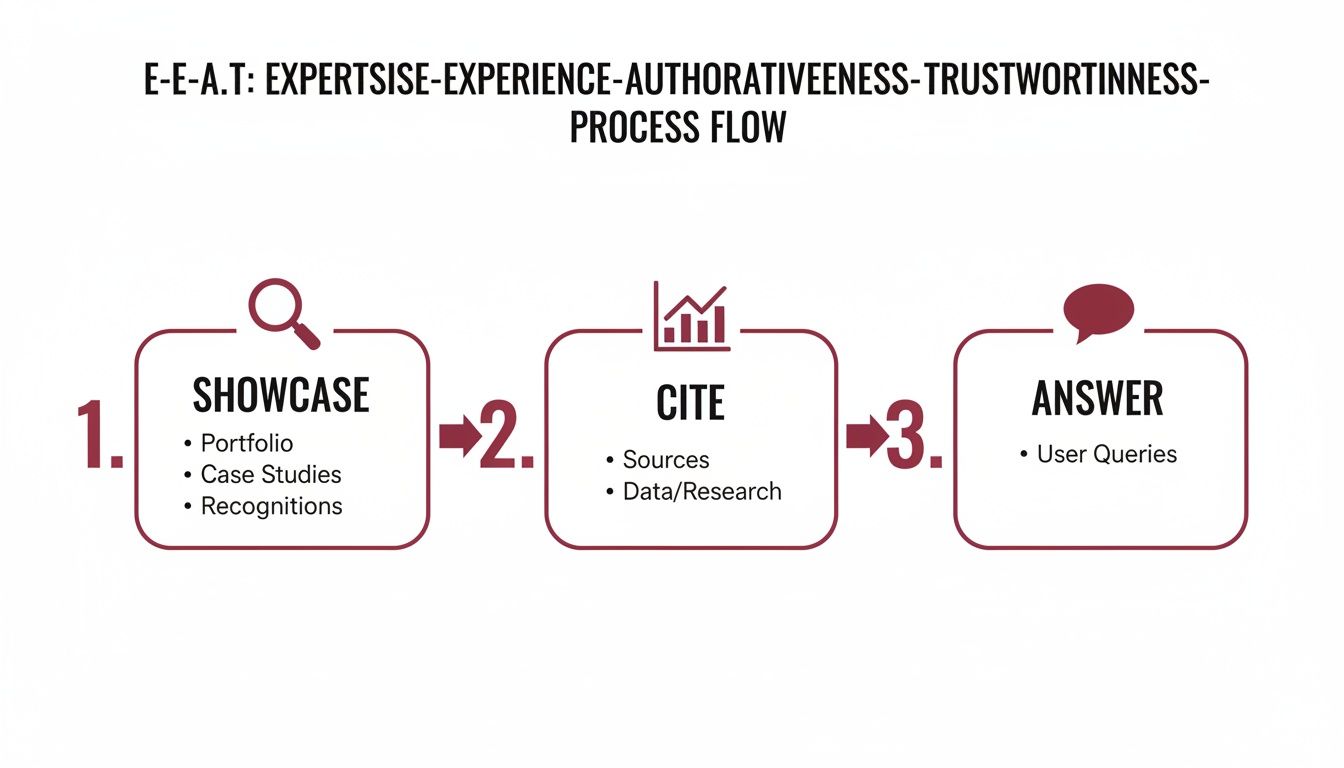
The core idea is to see it as a continuous loop: showcase what you know, cite the proof, and answer user questions with that proven knowledge.
Prove Demonstrable Expertise
While experience is about doing, expertise is about knowing. This is your specialised skill and deep understanding within your field. On the page, you prove this by being a fantastic teacher and an unwavering source of accurate, helpful information for your audience. Your content has to move beyond the surface-level stuff and offer real depth. To demonstrate expertise, your content must be accurate, comprehensive, and clearly written by someone with deep knowledge of the subject matter.
Structure Your Content for Clarity
Nothing screams "expert" like a well-organised page. It shows a mind that has mastered a topic so thoroughly it can explain it simply.
Use clear, logical headings (H2s, H3s) to structure your thoughts and make complex subjects easy for anyone to follow. Break down complicated ideas into simple numbered lists or bullet points. This isn't just great for user experience; it also signals to search engines that you have the clarity of thought to teach intricate topics effectively.
For instance, a financial adviser in Perth writing about superannuation shouldn't just publish a wall of text. They should structure the article with clean sections covering contribution types, investment options, and tax implications.
This structured, thoughtful approach is how you begin to truly engineer E-E-A-T into the DNA of every single page on your site.
Building Authority Directly on Your Website

If expertise is what you know, authoritativeness is what everyone else knows you know. It’s the public proof that transforms your knowledgeable voice into one that’s respected and trusted. To really bake this into your on-page SEO, you need to strategically display the signals that tell both users and search engines you're a credible leader in your field. This is how you demonstrate authoritativeness.
This isn't just about writing great content anymore. It’s about building a digital trophy case. Every award, certification, and media mention serves as a third-party endorsement of your standing, making it clear why someone should choose you over a competitor who might claim similar expertise but lacks the public validation.
Flaunt Your Credentials and Accolades
Your website needs to be the central hub for all your achievements. Don't bury your hard-earned credentials on a single "About Us" page that nobody visits. Instead, weave them into the pages where they matter most—the service and product pages where customers are making decisions.
For businesses here in Australia, that means using local signals of authority. A Victorian builder should have their Master Builders Australia membership logo displayed right there on their project pages. An accounting firm in NSW should feature their CPA Australia affiliation in the site-wide footer and on individual author bios.
These local trust signals create an instant connection with an Australian audience. It shows you’re not just an expert, but an expert recognised by the industry bodies that matter right here at home.
Publish Original Research and Become the Source
One of the most effective ways to build on-page authority is to create content that other experts are compelled to cite. When you publish original research, industry surveys, or data-driven reports, you graduate from being another commentator to being a primary source of information.
Here’s how you can get started:
- Run an industry survey: Poll your customers or peers on a hot-button topic, then publish the anonymised results with your own insightful analysis.
- Analyse your own data: Got unique operational data? Turn it into a public report that highlights key trends nobody else has access to.
- Create a definitive guide: Develop a resource so comprehensive and thorough on a core topic that it becomes the go-to reference for others in your space.
While the backlinks you get from this are a huge off-page win, the on-page effect is just as powerful. It signals a deep commitment to your field that positions you as a genuine thought leader.
Use Schema Markup to Cement Your Authority
Structured data (schema markup) is how you speak directly to search engines in their native language. It removes any guesswork and tells Google precisely who you are, what you’ve accomplished, and why you should be considered an authority.
Implementing Organization schema lets you formally declare your official name, logo, and awards. Even better is Author schema, which connects your content to a real person with a trail of verifiable credentials and social profiles. This machine-readable proof is a non-negotiable part of on-page SEO: engineering E-E-A-T into every page for today's search landscape.
In Australia, embedding E-E-A-T into your on-page strategy is absolutely critical. Local users are often more sensitive to trust signals than the global average. A 2024 Australian Industry Group study found that while 84% of Australian businesses are adopting new tech, 54% of leaders feel held back by a lack of workforce capability.
This skills gap means many of your competitors are likely publishing generic content that fails to demonstrate real expertise. By embedding verifiable credentials and clear authorship, you create a massive competitive advantage. You can find more insights about technology adoption in Australian industry on Ai Group's website.
Weaving Trust into Your Website’s Fabric
Trust is the ultimate currency online. You can have all the expertise and authority in the world, but if users don't trust you, it’s all for nothing. Trustworthiness is the pillar of E-E-A-T that seals the deal, convincing both people and Google that your site is safe, reliable, and credible. This is how you demonstrate trustworthiness.
Think of it this way: building trust isn't a one-off task you can tick off a list. It’s a constant commitment to transparency that needs to be woven into the very DNA of your website.
Without those clear trust signals, even the best content will fall flat. Visitors will think twice before handing over their details, making a purchase, or even believing what you say. For Google, a lack of trust is a massive red flag, especially for anything that could affect someone's health or finances.
The Foundational Trust Signals You Can't Ignore
Every Australian business needs to get the basics right. These are the non-negotiables that users subconsciously look for the second they land on your site. If they're missing, alarm bells start ringing.
- Make it easy to contact you. This sounds obvious, but you'd be surprised how many sites bury their contact details. You need a phone number, a professional email (not a @gmail.com address), and a physical address or clear service area. Pop this information in your footer and create a dedicated contact page.
- Have accessible policy pages. Your Privacy Policy, Terms of Service, and any shipping or refund policies need to be linked clearly from your footer. They aren't just legal boilerplate; they're powerful signals that you're a legitimate operation with clear rules.
- Invest in a professional design. A clunky, slow, or broken website screams unprofessionalism. A clean, modern, mobile-friendly design immediately tells visitors you're a serious business that cares about its digital front door.
Going Beyond the Basics to Build Real Confidence
Once the foundations are in place, you can start adding layers that actively build a sense of security.
The goal is to proactively answer a user's unspoken questions: "Is this business for real?", "Is my data safe here?", and "Can I actually trust what they’re promising?". Every element on your page should be working to get a resounding "yes".
These strategies are where you shift from just being compliant to actively earning trust. It’s how you show customers you value them and stand by your promises—a critical part of on-page SEO: engineering E-E-A-T into every page.
To help you map this out, here’s a quick checklist of on-page signals you can implement.
On-Page E-E-A-T Signal Checklist
This table breaks down each E-E-A-T component into specific, actionable on-page elements. It’s a practical guide for Australian businesses looking to demonstrate their credibility and build trust with their audience.
| E-E-A-T Component | Primary On-Page Signal | Australian Business Example |
|---|---|---|
| Experience | First-hand accounts and case studies | A Melbourne-based roofing company showcases a detailed blog post with photos titled, "How We Repaired a Storm-Damaged Terracotta Roof in Kew." |
| Expertise | Author bylines with detailed bios and credentials | A Sydney financial planner's articles include an author box with their photo, Certified Financial Planner (CFP) designation, and a link to their LinkedIn profile. |
| Authoritativeness | Featuring "As Seen In" logos from reputable Australian media outlets | A Brisbane-based skincare brand displays logos from Vogue Australia and Body+Soul on their homepage where their products have been featured. |
| Trustworthiness | Prominently displayed customer reviews and secure payment logos | An online store selling Aussie-made gifts integrates a live feed of their Google Reviews and displays Afterpay and PayPal logos in the checkout. |
By systematically reviewing your pages against these signals, you can start to identify gaps and opportunities to more clearly communicate your value and reliability to both users and search engines.
Showcasing Social Proof and Security
What other people say about your business is infinitely more powerful than what you say about yourself. Similarly, a few well-placed visual cues can instantly calm a user's security concerns, especially when they're about to make a payment.
- Display real customer reviews. Move beyond generic, anonymous testimonials. Use reviews that feature real names, photos, or even a link to the person's business. Integrating a feed from a trusted third-party platform like Google Reviews is even better, as it adds a layer of undeniable authenticity.
- Feature secure payment logos. If you're running an e-commerce site, make sure the logos for Visa, Mastercard, PayPal, and Afterpay are clearly visible. These symbols are familiar mental shortcuts for security and are proven to help reduce cart abandonment.
- Offer a rock-solid guarantee. A strong money-back guarantee or a detailed warranty demonstrates confidence in what you sell. It lowers the risk for the customer and shows you care more about their satisfaction than just making a quick sale.
The Technical Side of Trust
Finally, don't forget that trust is also a technical issue. Your site’s underlying infrastructure has to be secure to protect your users and signal safety to Google.
The most critical technical signal is HTTPS. Having an SSL certificate that encrypts the connection between your website and your visitor is no longer a "nice-to-have"—it's essential. Modern browsers will literally label your site as "Not Secure" if you don't have one, which is an instant trust-killer. Making sure your entire site runs on HTTPS is a fundamental first step.
Using Structured Data To Amplify E-E-A-T Signals
It’s one thing to show your readers you’re an expert, but how do you prove it to Google? This is where structured data, also known as schema markup, comes into play. Think of it as a translator, taking all the evidence of your Experience, Expertise, Authoritativeness, and Trustworthiness on a page and converting it into a language search engines understand perfectly.
You’re essentially removing all the guesswork. Instead of just hoping Google makes the right connections, you’re handing it a machine-readable blueprint that spells out your credibility. This technical layer is a non-negotiable part of embedding E-E-A-T into your site’s DNA.

Key Schema Types for E-E-A-T
While there are hundreds of schema types out there, a few pack a serious punch for E-E-A-T. Focusing your energy here will give you the most bang for your buck. To get the most out of these, it really helps to understand what is structured data in SEO at a foundational level.
OrganizationSchema: This is your business's digital calling card for Google. You’ll want to place this on your homepage and contact page to clearly state your business name, logo, address (a massive signal for local trust), phone number, and social profiles.AuthorSchema: For every article or guide, you need to connect the content to a real person.Authorschema lets you name the author and, more importantly, link to their dedicated author page or professional profiles (like LinkedIn) with thesameAsproperty. This forges a verifiable chain of expertise.ReviewSchema: Got customer reviews on your site? Mark them up. This schema tells Google that a piece of text is a review, who wrote it, and the rating they gave. It's your ticket to earning those eye-catching star ratings (rich snippets) in search results, which is a huge visual trust signal.FAQPageSchema: Answering common questions is a classic way to show you know your stuff. UsingFAQPageschema helps Google recognise this format, making you eligible for rich results that answer user questions directly on the search page. For a deeper dive, check out our guide on on-page SEO for answer engines.
Attributing AI Content with Transparency
The rise of AI brings both powerful tools and new E-E-A-T challenges. While AI can help draft content, real experience has to come from a human. This is where transparency becomes your best friend. If AI was involved, a human expert absolutely must review, edit, and ultimately sign off on the final piece.
This is where Australian businesses have a real advantage. The Department of Industry’s 2023 report highlighted how local businesses are using AI to get ahead. At the same time, Australian Industry Group’s 2024 research found that while 82% of medium businesses are adopting new tech, 54% of their leaders admit they don't have the skills to use it well.
What does this mean? Your competitors are likely pumping out AI content without the expertise to fact-check or localise it—a massive E-E-A-T red flag. In contrast, a business like Anitech can use AI as a starting point, but then layer on human review and cite local data, proving expertise in a way generic content never can. You can find more insights in Australia’s artificial intelligence ecosystem report.
When using AI-assisted content, your author schema is more important than ever. The person listed as the author must be the human expert who verified every fact, added their own insights, and is accountable for the content's quality. This keeps the human-centric core of E-E-A-T intact.
Implementing Schema for Maximum Impact
You don't need to be a coding wizard to get started with structured data. There are plenty of tools that make it surprisingly straightforward.
- CMS Plugins: If you're on WordPress, plugins like Yoast SEO or Rank Math have schema features built right in. You can add all sorts of structured data without ever looking at a line of code.
- Google's Structured Data Markup Helper: This free tool from Google is a great starting point. You can visually highlight different elements on your page and tell the tool what they are. It then generates the JSON-LD code for you to paste into your page’s
<head>section. - Testing is Essential: Once you've implemented your schema, always run the URL through Google's Rich Results Test tool. It will tell you if your markup is valid and if the page is eligible for rich results. This quick check can save you from a simple error undoing all your hard work.
Weaving E-E-A-T into Your Local SEO Strategy
For Australian businesses that live and breathe by postcodes, blending E-E-A-T with your local SEO isn't just a good idea—it's essential for dominating your service area. Think about it: when someone in Perth searches for a "plumber near me," they're not after a generic guide. They need a local, trusted expert, and they need them now. Your on-page strategy has to be built to meet this exact high-intent need.
This means we need to move beyond standard optimisation. It's about embedding localised trust signals directly into every relevant page on your site. The goal is to prove to both Google and your potential customers that you aren't just an expert, but the definitive expert in their community. We're turning a simple location page from a digital business card into a powerful local authority hub.
Make Your Location Pages a Hyper-Local Resource
A location page for your Parramatta office shouldn't just list an address and a phone number. It needs to breathe local life. This is your prime opportunity to show you have a deep, first-hand understanding of the community you serve.
How? By infusing your pages with content that could only be written by someone who is actually there. Mention local landmarks when giving directions. Talk about projects you’ve completed in nearby suburbs like Westmead or Harris Park. You could even reference specific council regulations that affect your industry. This micro-level detail proves you're an active part of the community, not just a pin on a map.
Integrate Your Google Business Profile Signals
Your Google Business Profile (GBP) is a goldmine of local trust, but it's amazing how often it's left siloed from the main website. The real magic happens when you bridge this gap and pull those hard-earned trust signals directly onto your own domain.
An easy win is to embed your GBP map on your contact and location pages. But to really level up, use a plugin or widget to showcase a live feed of your latest Google reviews. Seeing that stream of positive, recent feedback from other locals provides undeniable social proof and builds instant confidence.
Your website and your GBP should work together in a virtuous cycle. A well-optimised location page helps your GBP rank. In turn, the reviews and signals from your GBP, when embedded on your site, amplify your on-page E-E-A-T.
This synergy reinforces your authority right across Google's entire local ecosystem.
Showcase Hyper-Local Case Studies and Testimonials
General case studies are good. Hyper-local ones are brilliant for building E-E-A-T. Instead of a vague success story, feature a detailed breakdown of a project you completed for a well-known local business or in a recognisable suburb.
Here are a couple of real-world examples:
- A roofer in Adelaide: Detail a complex roof restoration on a heritage home in North Adelaide. Include plenty of before-and-after photos and, crucially, a glowing testimonial from the homeowner.
- A commercial cleaner in Brisbane: Showcase a case study on getting a popular Fortitude Valley restaurant ready for a health inspection, highlighting the specific challenges and results.
These specific examples demonstrate tangible experience right where it matters, making your claims far more believable. For businesses looking to get more of this social proof, it's worth exploring effective strategies to increase your Google reviews, as they are absolutely vital for local E-E-A-T.
Maintain Impeccable NAP Consistency
Your Name, Address, and Phone number (NAP) are the absolute bedrock of local SEO. Any inconsistency here sends confusing signals to search engines and, frankly, looks unprofessional to users. It's critical that the NAP details in your website's footer, on your contact page, and on every single location-specific page are exactly identical to what’s listed on your Google Business Profile.
This consistency acts as a constant verification signal, reinforcing your legitimacy. Go a step further and use schema markup to explicitly define your local business information for search engines. This removes any ambiguity about who you are, what you do, and where you operate. Think of it as the foundational layer of local trust.
The connection between these on-page signals and Australian search behaviour is direct and measurable. According to Red Search’s 2025 Local SEO statistics, "near me" searches in Australia surged by a massive 136% in 2023. Yet, an astonishing 55% of local businesses still weren't even listed on Google Business Profile. This creates a huge opportunity. By meticulously engineering E-E-A-T into your local pages with schema-marked NAP details, GBP reviews, and suburb-specific content, you become highly visible to a motivated audience where over half your competitors are basically invisible.
Your E-E-A-T and SEO Questions Answered
As you start the real work of weaving E-E-A-T into your site, you’re bound to run into some specific questions. It's one thing to know the theory, but another to apply it page by page. This section tackles some of the most common hurdles we see Australian businesses face.
We'll get into the practical stuff—like how to show credibility when you're the new kid on the block, when to use a personal author versus a brand voice, and even how to turn a bad review into a good thing.
How Can I Showcase Experience If My Business Is New?
This is a classic problem, but the solution is simple: shift the focus from the age of your company to the experience of your people. A brand-new business can be run by professionals with decades of industry experience, and that's what you need to highlight.
Your whole strategy should revolve around proving that the knowledge is already there.
- Go deep on founder and team bios. Don't just list job titles. Create detailed author pages that unpack each person's credentials, their years in the industry, specific qualifications from Australian institutions, and key projects they led in previous roles.
- Use your first projects as proof. Even pilot programs or pro-bono work can become powerful case studies. Document every step with photos, data, and testimonials. This shows your methodology and proves you can get results right from the start.
- Tell your origin story. Why did you start this business? Articulating the unique perspective or firsthand experience that sparked the idea is a compelling way to demonstrate your deep-seated expertise.
Even without a long client list, you can prove the human experience behind the brand is rock-solid.
Is It Better To Have A Single Author Or A Brand Voice?
This really comes down to your industry and the kind of content you're creating. There's no one-size-fits-all answer, but for high-stakes topics, the choice is clear.
If you’re touching on any "Your Money or Your Life" (YMYL) subjects—like finance, health, or legal advice—a named, qualified author isn't just a good idea, it's essential. Australian users need to see that a real expert with verifiable credentials stands behind the information. An article giving tax advice, for example, absolutely must be credited to a certified accountant.
For more general business content, a consistent brand voice can work perfectly well. You might attribute articles to your "Editorial Team," but don't just leave it at that. This "team" needs its own page that clearly outlines your editorial standards, fact-checking process, and commitment to accuracy. You’re essentially establishing the brand itself as the expert.
How Do I Handle Negative Reviews On My Site?
Lean into them. Seriously. See them as a golden opportunity to build trust through transparency. A site with nothing but glowing five-star reviews can feel a bit fishy. Hiding negative feedback is even worse—it suggests you have something to hide.
The best approach is to respond to negative reviews publicly and professionally, right where they're posted. Acknowledge the person's issue, show a bit of empathy, and briefly explain what you did to fix it or what steps you're taking.
This move accomplishes two critical things at once. First, it shows potential customers you listen to feedback and genuinely care. Second, it turns a potential negative into a very public demonstration of your integrity and problem-solving skills, which is a massive trust signal.
Ready to transform your website's authority and climb the search rankings? The expert team at Anitech specialises in data-driven SEO strategies that engineer E-E-A-T into every page, delivering measurable growth for Australian businesses. Partner with us to dominate Google and achieve your business goals. https://anitech.au