Quick Summary: This technical guide explores strategic link building, focusing on how to audit backlink profiles and use analytics to forecast revenue impact. We detail how to measure the business value of digital authority, moving SEO from a cost center to a predictable profit engine by directly connecting link acquisition to measurable ROI.
Think of strategic link building as a calculated investment, not just another marketing expense. When you master backlink analytics, you can draw a straight line from your link acquisition efforts to your revenue, proving its tangible business value every step of the way. This guide will provide a technical framework for auditing link profiles and forecasting the revenue impact of new acquisitions.
It's time to stop chasing arbitrary link counts and start focusing on measurable impact. An effective link building strategy is a serious business driver, but securing buy-in requires demonstrating how it generates revenue. Many marketers struggle to connect a new backlink to an actual sale. We're here to provide the methodology to fix that, transforming your link building from an art into a science.
From Cost Centre To Profit Centre: Measuring the Business Value of Authority
I'm going to walk you through a practical, data-first methodology to audit your current link profile, leverage powerful backlink analytics tools, and construct a model that forecasts the revenue impact of your campaigns. You’ll learn how to build a rock-solid business case for SEO by demonstrating precisely how link-driven authority contributes to the bottom line.
Why ROI is a Non-Negotiable Metric in SEO
For far too long, link building success was measured with vanity metrics. How many links did we acquire this month? This question is irrelevant if those links didn't move the needle on key business objectives. The only metric that truly matters is whether the investment is generating a positive, measurable financial return.
Consider this: a 2023 study from Backlinko found that the #1 result in Google has, on average, 3.8 times more backlinks than the pages ranking in positions #2 through #10. The correlation between links and rankings is undeniable, but the ultimate goal is to convert that ranking potential into profit.
This guide provides a framework to translate link building activities into tangible business outcomes. We'll focus on the components that directly influence revenue:
- Auditing Your Link Profile Foundation: First, you need a clear, data-driven picture of your existing link profile—what's driving authority, what's creating risk, and where untapped opportunities lie.
- Tracking Meaningful Analytics: We'll move beyond simple link counts and focus on the backlink analytics that have a demonstrable correlation with revenue growth.
- Calculating Financial Return: You'll receive a clear, replicable formula to calculate the ROI of your link building, eliminating guesswork from your reporting.
- Forecasting Future Revenue Impact: Learn how to use your data to predict the business value of your next link acquisition campaign before you allocate a single dollar.
When you master the connection between backlink analytics and ROI, you stop treating SEO as an operational cost. Instead, it becomes a predictable and scalable profit engine for your business.
This fundamental shift in mindset is crucial. It's how you justify and secure larger budgets, and it's how you prove the incredible value a sophisticated link building program delivers. It's about demonstrating, with hard data, that every link you build is a calculated step towards real, measurable business growth.
Finding Hidden Opportunities: A Technical Audit of Your Current Backlink Profile
Before pursuing new backlinks, the most strategic action is to conduct a thorough technical audit of your existing link profile. Your current backlinks are a goldmine of data, revealing which strategies have been effective, what may be hindering your performance, and where the most immediate opportunities for growth are located. A comprehensive backlink audit isn't a mere checklist item; it is the critical first step in formulating a robust, data-informed strategy.

The initial step is to aggregate all your link data using an enterprise-grade tool like Ahrefs, Semrush, or Moz. These platforms continuously crawl the web, providing a comprehensive index of nearly every site linking to yours. Once you export this raw data, the analytical work begins. It’s time to segment and classify your link portfolio.
Segmenting Your Backlinks For Analytical Clarity
Analyzing a raw spreadsheet containing thousands of linking domains can be overwhelming and unproductive. To make this data actionable, you must categorize each link. This segmentation process transforms a chaotic list into a clear strategic roadmap for your next actions.
I recommend starting with these four primary classifications:
- High-Authority Assets: These are your most valuable links. They originate from reputable, topically relevant websites and provide a significant boost to your Domain Rating and organic rankings.
- Potential Toxic Risks: These are liabilities in your link profile. They are links from spammy, low-quality, or entirely irrelevant sites that can actively harm your SEO performance. These must be identified and neutralized.
- Unlinked Brand Mentions: This represents low-hanging fruit. These are instances where a website has mentioned your brand name but failed to include a hyperlink back to your site.
- Niche-Relevant Opportunities: These are good but not exceptional links. They might come from a relevant industry blog or directory that doesn't possess high domain authority itself but contributes to topical relevance.
This segmentation allows you to focus your resources where they will have the most significant impact. You can protect your existing authority, capitalize on easy wins, and gain a clear understanding of what types of links have historically driven performance.
Auditing Each Link Category
Once your links are systematically organized, you can analyze each group to determine the appropriate course of action. For your high-authority assets, pay close attention to the content that earned these links. Was it a deep-dive research report, a comprehensive guide, or a free tool? This insight is invaluable for planning future content that can attract more high-quality links.
Now, for the potential toxic risks, precision is key. In the fiercely competitive Australian SEO landscape, maintaining a clean backlink profile is non-negotiable. Research from Websites That Sell found that backlinks have an 81.6% correlation with organic traffic, making them a massive growth lever. The same study revealed that top-performing local sites had a staggering 35x more referring domains than those at the bottom. This gap has a direct impact on traffic and rankings. You can delve deeper into these Australian SEO findings to appreciate the competitive advantage a strong profile provides.
Protecting the authority you have already built is just as important as acquiring new authority. A single toxic link can negate the positive impact of ten good ones if it triggers a Google penalty or filter.
If you identify links from spam directories, irrelevant foreign-language sites, or pages with a high spam score, add them to a dedicated list. This list will form the basis of your disavow file, which you can submit directly to Google Search Console. This action instructs Google to "ignore these links when evaluating my site," thereby neutralizing any potential negative impact.
Finally, we address the unlinked brand mentions—my preferred quick wins. Utilize a tool like Google Alerts or Brand24 to systematically track these occurrences. In most cases, a professional and polite email to the site owner is all that is required to convert the mention into a hyperlink. With minimal effort, you've transformed a simple mention into a valuable, authority-building backlink.
Getting to Grips with the Backlink Metrics That Actually Matter
Diving into backlink analytics can feel overwhelming. You are inundated with dozens of metrics, charts, and proprietary scores, making it easy to get lost in the data.
However, only a handful of these numbers genuinely drive the results that feed into your ROI. Focusing on the right Key Performance Indicators (KPIs) is what separates unfocused activity from strategic link building that grows your business. Let's cut through the noise and concentrate on the data that has a real, provable connection to improved search rankings and increased organic traffic.
The “Core Four” Backlink Metrics
While every SEO tool has its proprietary scores, such as Domain Authority or Domain Rating, the underlying principles are largely consistent. To get a true sense of your backlink profile's health and potency, you need to analyze four key areas. It's not just about knowing what they are, but understanding how they work in concert.
These are the metrics I consistently rely on:
- Domain Rating (DR) or Domain Authority (DA): This is a composite score, typically on a 1-100 logarithmic scale, representing your website's overall "authority." It serves as a high-level predictor of ranking potential, calculated based on the quantity and quality of links pointing to your entire domain. A higher number generally indicates greater ranking power.
- URL Rating (UR) or Page Authority (PA): This metric is more granular. Instead of evaluating the entire domain, it measures the backlink strength of a single page. A high UR on a specific blog post indicates it has attracted powerful, direct links, making that individual page more likely to rank for its target keywords.
- Referring Domains: This is the count of unique websites linking to you. Ten links from one website count as only one referring domain. This metric is critical because Google views links from a diverse range of quality sites as a much stronger signal of authority than numerous links from just one or two sources.
- Anchor Text Distribution: The anchor text is the clickable text in a hyperlink. Analyzing the words and phrases people use to link to you reveals how they (and by extension, Google) perceive your content's topic. A healthy, natural distribution includes a mix of your brand name, target keywords, and generic phrases like "click here" or "read more."
Going Deeper: Link Velocity and Relevance
Once you have a handle on the core four, a couple of other factors add crucial context. These aren't just single scores; they're about the patterns hiding in your link profile.
Link Velocity is the rate at which you acquire new backlinks. A steady, gradual increase in referring domains looks natural and organic to search engines. A sudden, massive spike can appear manipulative and may even trigger an algorithmic penalty. Monitoring this helps ensure your link acquisition efforts appear authentic and sustainable.
Topical Relevance is, in my opinion, the most critical qualitative metric. A link from a high-DR website is valuable. But a link from a high-DR site that is also a respected authority in your industry? That is an order of magnitude more valuable. For an Australian accounting firm, a link from the Australian Financial Review is infinitely more powerful than one from a popular food blog, even if their domain scores are identical.
A backlink is a vote of confidence. When that vote comes from a respected voice within your own industry, it speaks volumes to both users and search engines about your expertise and trustworthiness.
Tracking these numbers is the first step, but what you really want to understand is how they impact your bottom line. Below is a quick breakdown of some essential metrics and how they tie directly into ROI.
Essential Backlink Metrics for ROI Analysis
| Metric | What It Measures | Why It Matters for ROI |
|---|---|---|
| Referring Domains | The total number of unique websites linking to your site. | More high-quality referring domains directly correlates with higher organic rankings, leading to increased traffic and potential conversions. |
| Domain Rating/Authority | The overall authority and "link equity" of your entire website. | A rising DR/DA often precedes a site-wide lift in keyword rankings, boosting visibility for all your commercial pages. |
| Organic Traffic | The number of visitors arriving at your site from non-paid search results. | This is the clearest indicator of success. More relevant traffic means more leads, sales, and measurable revenue. |
| Keyword Rankings | Your site's position in search results for specific, valuable keywords. | Tracking commercial "money" keywords shows if your links are improving visibility where it counts—for the terms that drive sales. |
| Conversion Rate | The percentage of organic visitors who complete a desired action (e.g., a sale or enquiry). | Attributing conversions to organic traffic growth validates the financial return on your link building investment. |
Ultimately, the objective isn't just to acquire links; it's to acquire links that positively impact traffic and revenue. This data connects the tactical activities to strategic outcomes.
Choosing Your Backlink Analysis Toolkit
You cannot manage what you do not measure, so you'll need the right tools for the job. While numerous options exist, three platforms dominate the market with their comprehensive data and powerful analytical features.
Here’s a quick rundown of the major players:
- Ahrefs: My preferred tool for deep competitor analysis. It boasts the largest and freshest backlink index, making its 'Site Explorer' tool an absolute powerhouse for reverse-engineering the strategies of your rivals.
- Semrush: A fantastic all-in-one SEO suite. It's an excellent choice if you prefer a single platform for SEO, PPC, and content marketing. Its 'Backlink Audit Tool' is particularly effective for identifying and disavowing potentially harmful links.
- Moz: The original pioneer of the Domain Authority (DA) metric. Moz Pro is incredibly user-friendly, with clear visualizations that make it ideal for beginners or for tracking campaign progress in a straightforward manner.
The "best" tool ultimately depends on your specific needs and budget. Many Australian businesses start with one platform and add another as their strategic link building program matures. The key is to select one, use it consistently, and establish it as your benchmark for progress. This consistent tracking is what will enable you to draw a direct line from a link building campaign to a measurable increase in traffic and revenue.
A Practical Framework For Calculating Link Building ROI
Now, let's address the most critical aspect: connecting your link building efforts to the financial metrics that matter to the business. This is where we transition from abstract metrics to demonstrating tangible value. Calculating the return on investment (ROI) for link building requires a rigorous analysis of your total investment versus the financial returns it generates.
This isn't merely about justifying a budget. It's about fundamentally shifting the perception of SEO from a cost center to a predictable, powerful growth engine.
Tallying The True Cost of Investment
First, we must accurately account for the ‘investment’ component of the ROI equation. This extends beyond the invoice from your agency. For a true ROI calculation, you must factor in every cost associated with your link building program.
Let's break down the key cost components to track:
- External Costs: These are the most straightforward. They include agency or freelancer fees, plus subscriptions for essential backlink analytics tools like Ahrefs, Semrush, or Moz.
- Content Creation: Do not overlook the budget allocated to writers, designers, or videographers who produce the link-worthy assets. This is a direct cost of the campaign.
- Internal Time: This is the most commonly missed variable. You must calculate the hourly cost of your in-house team's time spent on the project. This includes the marketing manager overseeing the strategy, the developer implementing technical changes, or the executive reviewing reports.
Summing these costs gives you the Total Link Building Investment. This figure is the foundation of your entire ROI calculation.
Models for Measuring Financial Return
With your total investment quantified, we can now measure the return. There is no single, one-size-fits-all method; the optimal approach depends on your business model. However, it typically comes down to attributing a dollar value to the growth in organic traffic.
One of the most direct methods is to track the organic traffic uplift to your key commercial pages—those that directly drive leads or sales. Using Google Analytics, compare the organic traffic to these pages before and after a link building campaign. Once you observe a sustained increase, you can apply your average conversion rate and customer lifetime value (LTV) to assign a specific financial value to that growth.
Another effective approach is to monitor keyword ranking improvements, specifically for high-intent, commercial search terms. For an Australian e-commerce store, a high-value keyword might be "buy running shoes Melbourne." As link building improves your ranking for such terms, your qualified traffic increases, leading directly to a measurable rise in sales.
This illustrates how core backlink metrics influence the ranking improvements you will use to measure ROI.
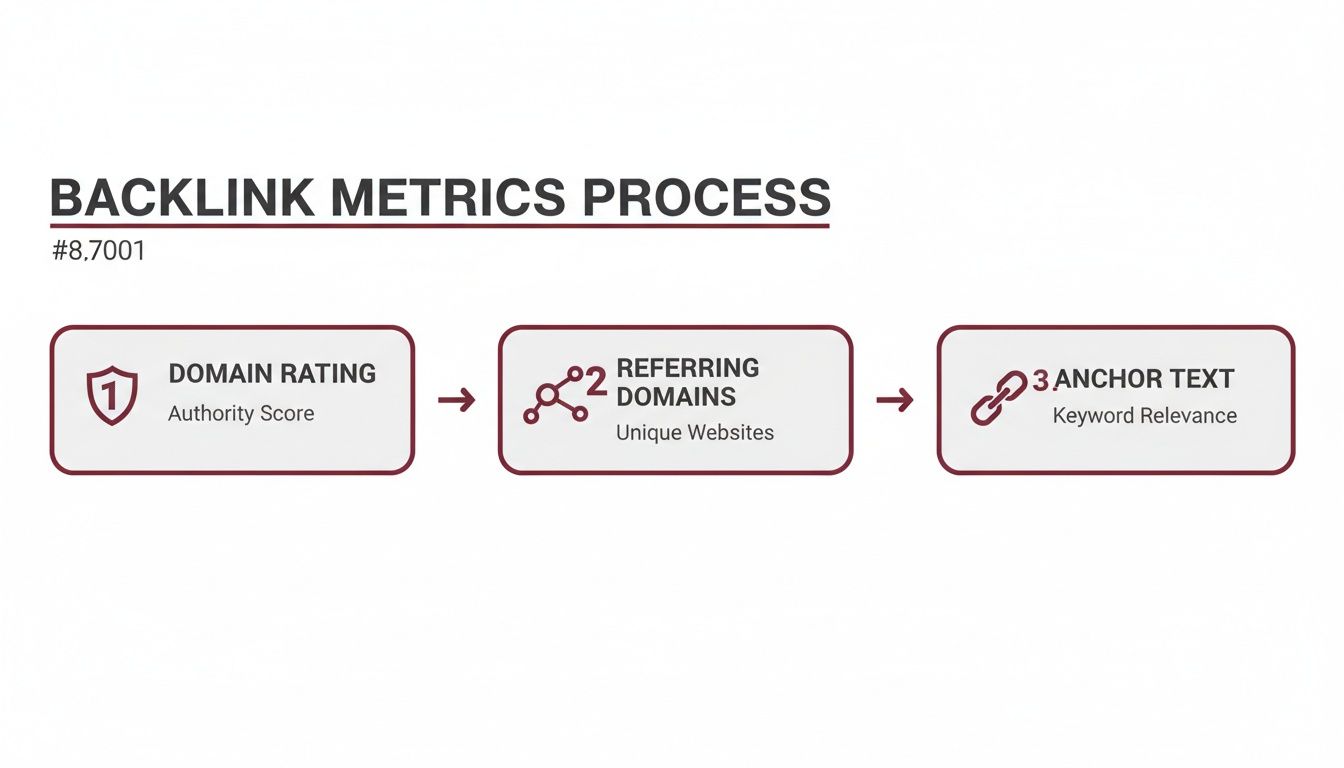
You can see how improving domain-level authority and focusing on quality referring domains directly impacts the keyword rankings essential for measuring your ROI.
Putting It All Together: A Real-World Scenario
Let’s make this tangible with a hypothetical case. Consider an Australian e-commerce business specializing in handmade leather goods that undertakes a focused, six-month link building campaign.
The Investment:
- Agency Fee: $4,000/month ($24,000 total)
- Content Creation: $1,000/month ($6,000 total)
- Tool Subscriptions: $500/month ($3,000 total)
- Total Investment: $33,000
The Return Measurement:
- Their primary target is the "Handmade Leather Bags" category page.
- Before the campaign, the page received 1,500 organic visitors per month.
- Six months later, it now receives 4,500 organic visitors per month—a net increase of 3,000 visitors.
- Their analytics data shows an average conversion rate for this page of 2%.
- The average order value is $250.
Now for the calculation:
- New Monthly Conversions: 3,000 new visitors x 2% conversion rate = 60 new sales per month.
- New Monthly Revenue: 60 sales x $250 average order value = $15,000 per month.
- Total New Revenue (over 6 months): The revenue impact grows over time. For a simple calculation, if we conservatively estimate the total revenue generated during the campaign period, it might be around $45,000.
- Calculate the ROI: ($45,000 Revenue – $33,000 Investment) / $33,000 Investment = 36% ROI.
However, this calculation is highly conservative. The real value lies in the fact that the $15,000 in monthly revenue is now a recurring asset. Those links will continue to drive traffic and sales long after the campaign concludes, pushing the long-term ROI significantly higher.
Presenting this kind of clear, data-driven case is how you transform SEO from a "marketing expense" into a proven investment. This aligns with broader market trends in Australia. Recent data shows that 78.1% of SEO professionals are seeing satisfying returns, even as the cost of quality links increases. This is because 93.8% now prioritize relevance and authority over sheer quantity, which is the only sustainable strategy in Australia’s competitive landscape. You can explore more of these link building statistics and trends to understand the local market dynamics.
When you can build a business case with a solid ROI framework like this, securing ongoing investment for your SEO strategy becomes a much simpler proposition.
Forecasting The Revenue Impact Of Future Link Building
Measuring the ROI of past campaigns is one thing. Confidently predicting the financial outcome of future link building is what elevates your role from tactical to strategic.
This is how you shift link building from a reactive marketing task to a proactive driver of business growth. By building a forecast grounded in competitive data and your own performance benchmarks, you can set realistic expectations, secure necessary budgets, and create a roadmap that aligns directly with the company’s overarching financial goals.
At its core, this process is built on two pillars: sharp competitor analysis and your own historical performance data. Instead of guesswork, you're constructing a model that estimates potential revenue based on what is already proven to work in your niche. This transforms an uncertain investment into a calculated strategy with a predictable financial upside.
Sizing Up The Competitive Link Gap
First, you must quantify the "link gap" between your site and the top-ranking competitors for your most valuable keywords. This analysis goes beyond simply counting backlinks. It’s about understanding the quality and volume of links required to compete at the highest level of search results.
Using a tool like Ahrefs or Semrush, analyze the backlink profiles of the top three to five domains ranking for your target commercial keyword. Your analysis should answer several key questions:
- How many high-quality referring domains point to their ranking page? Focus specifically on domains with a solid Domain Rating (DR) or Domain Authority (DA).
- What is the average DR of these linking domains? This establishes a quality benchmark for your own acquisition efforts.
- What type of content earned these links? Was it an in-depth guide, original research, a data visualization, or a free tool?
This analysis will provide a data-driven estimate of how many links of a certain quality you need to acquire to have a realistic chance of securing a top ranking. The difference between their link profile and yours is your link gap.
Building A Data-Backed Roadmap
Once you have quantified the gap, you can develop a practical plan to close it. This involves calculating the required investment and then projecting the potential financial returns.
Let’s apply this to a real-world scenario. Imagine you're working with a local plumber in Sydney who wants to rank for the high-value keyword "emergency plumber Sydney."
Example Scenario: Sydney Plumber
-
Competitor Analysis: An analysis of the top 3 ranking sites reveals that each has an average of 25 referring domains from DR 40+ websites pointing specifically to their emergency services page. Our plumber’s page currently has only 5. The link gap is 20 high-quality links.
-
Calculating the Investment: Based on industry data, acquiring a good DR 40+ link might cost, on average, $500 when factoring in content creation, outreach, and management time. To close the gap, the estimated investment is 20 links x $500/link = $10,000.
-
Projecting Traffic: Moving from page two to a top-three position for a high-commercial-intent keyword like this could realistically increase their monthly organic traffic from 100 visitors to 1,000 visitors. This represents an increase of 900 visitors per month.
Forecasting isn't about having a crystal ball. It's about using competitor data and your own conversion metrics to turn an ambiguous goal like "rank higher" into a specific business objective with a clear financial target.
Projecting Revenue And Setting Clear Goals
The final step is to connect that projected traffic increase to actual revenue. This requires using your own internal business metrics.
Let’s continue with our Sydney plumber example:
- Current Conversion Rate: Their analytics show that the website converts 10% of organic visitors into a qualified phone lead.
- Lead-to-Customer Rate: The sales team (or the plumber) successfully closes 25% of these phone leads into paying customers.
- Average Job Value: Each emergency call-out generates an average of $600 in revenue.
With these figures, we can construct a robust revenue forecast:
- Projected New Leads: 900 new visitors/month x 10% conversion rate = 90 new leads/month.
- Projected New Customers: 90 new leads x 25% close rate = ~22 new customers/month.
- Projected New Revenue: 22 customers x $600/job = $13,200 in new monthly revenue.
The business case is now crystal clear. By investing $10,000 in a targeted link building campaign, the plumber can realistically project a return of $13,200 every single month following the initial campaign period. This model provides a powerful, data-backed justification for the investment, transforming SEO from a hopeful expense into a predictable engine for business growth.
Got Questions About Link Building and ROI? We’ve Got Answers.
When you're investing in strategic link building, questions are inevitable. It’s logical to want to connect your activities directly to business outcomes. Delving into backlink analytics and ROI can seem complex, but achieving clarity on these points is what separates a guessing game from a data-driven strategy.
Let's address some of the most common questions business owners have when trying to determine the financial return on their SEO investment.
"How Long Until I Actually See a Return on My Investment?"
This is the most critical question. While you can often observe positive leading indicators—such as improvements in keyword rankings—within the first 3 to 4 months, the tangible, measurable ROI typically materializes later. For a clear financial impact, you should be planning within a 6 to 12 month timeframe.
Link building is a long-term strategy, not a short-term tactic. It's about systematically building your website's authority. The significant advantage is that these returns compound over time. Every quality backlink you earn adds to your domain's credibility, creating a snowball effect that builds momentum and drives sustainable organic growth long after the initial investment. Patience is a key component of a successful strategy.
The value of a solid link building campaign doesn't just show up and then disappear. It builds on itself, delivering compounding returns as your authority grows and cements your place in the search results for years to come.
"Should I Focus on Link Quantity or Quality?"
The answer, unequivocally, is quality. A single, highly relevant backlink from a trusted, authoritative website will provide more SEO value than a hundred low-quality links combined. Chasing a high volume of links from irrelevant or spammy sites is an inefficient use of budget and carries the risk of a Google penalty.
The fundamental purpose of link building is to earn genuine signals of trust and authority. Therefore, focus your resources on acquiring links that serve as legitimate votes of confidence from respected entities in your industry. This approach not only improves your search rankings but also drives high-quality referral traffic—visitors who are genuinely interested in your offerings and are more likely to convert into customers. This is how you directly impact ROI.
"Can I Figure Out the ROI of a Single Backlink?"
Attributing an exact dollar value to one specific link is extremely difficult, but you can certainly estimate its value. This analysis is useful for understanding which types of links and acquisition tactics are most effective.
Here’s a practical framework for this assessment:
- Analyze Referral Traffic: Use Google Analytics to measure the direct traffic that a specific link sends to your site. You can then apply your website's average conversion rate and customer lifetime value to this traffic to get a rough revenue estimate.
- Monitor Ranking Changes: Track the organic ranking of the page the backlink points to. If it experiences a significant jump for its target keywords immediately after the link is acquired, you can reasonably attribute a portion of the subsequent traffic increase to that specific link.
- Factor in Brand Exposure: Do not underestimate the "billboard" effect. A link from a major industry publication or news site builds brand awareness and credibility. While not a direct sale, this intangible value contributes to long-term trust and ultimately supports the bottom line.
Ultimately, the true power of link building is cumulative. Every quality backlink strengthens your entire domain. While analyzing individual links helps refine your tactics, the most accurate measure of ROI comes from evaluating the campaign's overall impact on your organic traffic, leads, and sales over a sustained period.
Ready to stop treating link building as just another expense and turn it into a predictable profit engine? At Anitech, we live and breathe data-driven SEO and strategic link building that gets measurable results for Australian businesses. Our team is focused on building powerful backlink profiles that drive authority, traffic, and revenue.
Discover how our tailored SEO strategies can grow your business today.