Quick Summary: The 2026 master framework for strategic link building shifts from collecting links to earning them. This definitive guide focuses on building authority by creating high-value, linkable assets and leveraging relationship-driven outreach. The core strategy involves original research, digital PR, and technical alignment to build a resilient backlink profile that drives tangible business results.
In the evolving landscape of SEO, the game has fundamentally changed. The 2026 master plan for strategic link building isn't about collecting links anymore; it's about earning them through quality, relationships, and genuine authority. This definitive guide focuses on earning authority through high-value assets and relationship-driven outreach. We're talking about creating truly valuable assets and using smart digital PR to build influence that lasts, a must for any Aussie business serious about long-term growth.
The Future of Authority and Strategic Link Building in 2026
Let's be blunt: the old days of chasing link counts are dead and buried. As we gear up for 2026, the entire mindset behind smart SEO has moved on. It’s no longer a transactional numbers game. It's now a strategic, asset-driven model. Think of it less like renting billboard space and more like building a landmark that everyone wants to talk about.
This guide is your playbook for getting ahead—and staying there. We'll walk through exactly how to build a powerful, resilient backlink profile that does more than just boost rankings. It drives real, measurable business results, from higher visibility to a steady stream of the right kind of traffic.
From Quantity to Quality
It wasn't long ago that link building was all about volume. The more backlinks you had, the better you ranked. This approach spawned a whole industry of low-quality, spammy tactics that offered zero long-term value. Today, the reality is starkly different: a single, editorially-given link from a respected industry authority is worth infinitely more than hundreds of junk links from flimsy directories.
This is the fundamental shift we’re seeing, and it’s at the heart of any successful strategic link building effort heading into 2026.
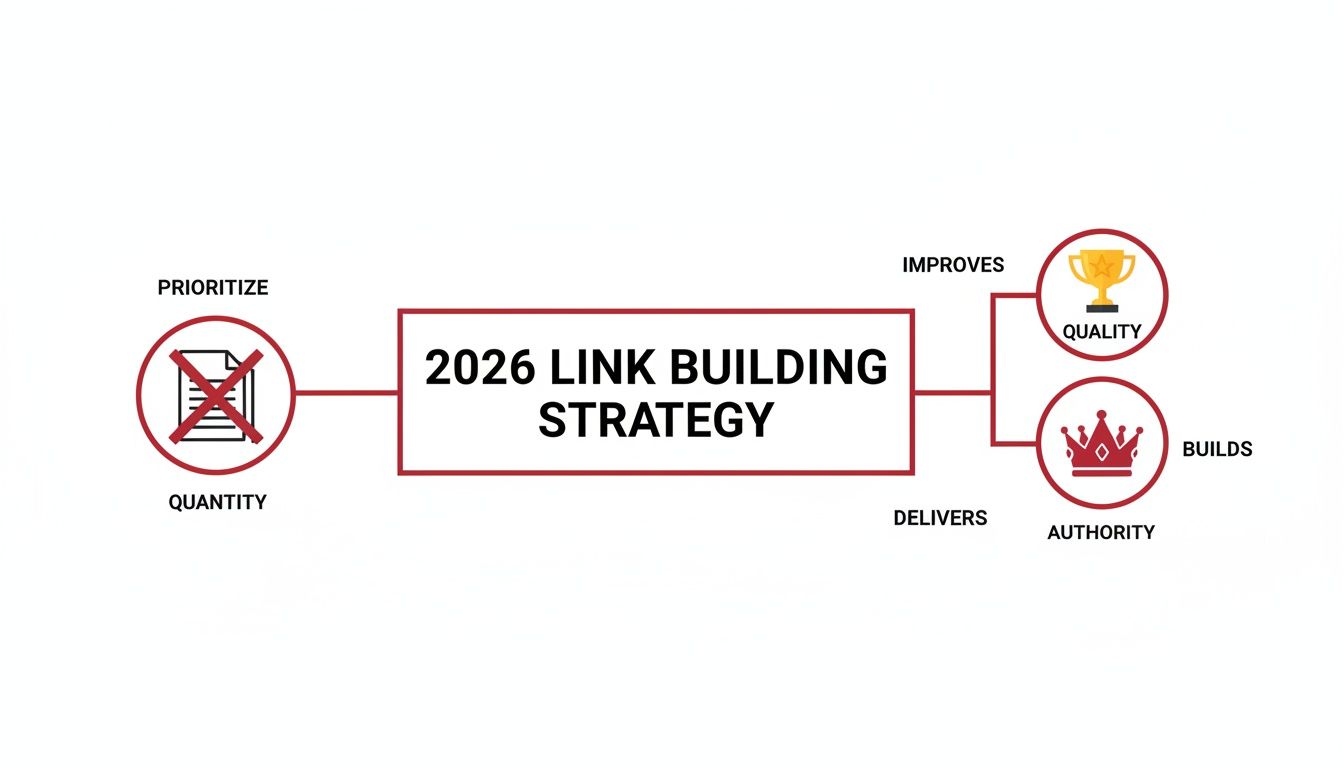
The takeaway here is simple but crucial. Ditching the outdated obsession with quantity is the first and most important step towards the real prize: digital authority.
Earning Authority Through Value
The new framework is built on one powerful idea: create things so genuinely useful that other websites want to link to them. This isn't just a small tweak; it's a complete change in how we approach the work. It all comes down to a few core activities:
- Original Research: Don't just report the news, make the news. Publish unique data, surveys, and industry reports that become the go-to source for journalists, bloggers, and academics.
- High-Value Content: Go beyond basic blog posts. Develop comprehensive guides, compelling case studies, and practical tools that solve tangible problems for your audience. Make your content the definitive answer.
- Relationship Building: Stop sending cold, templated emails. Focus on building real, human connections with journalists, editors, and key figures in your industry. This turns a transactional "ask" into a collaborative partnership.
Before we get into the weeds of specific tactics, it’s essential to have a solid grip on what link building strategy entails. This groundwork ensures that every action you take is pulling in the same direction—towards building sustainable authority, not just chasing a temporary bump in the rankings.
To properly frame this new approach, let's break down its core components.
Core Pillars Of The 2026 Link Building Framework
This table summarises the foundational elements that define a modern, strategic approach to link building. Each pillar works in concert with the others to create a system that delivers sustainable, long-term results.
| Pillar | Description | Primary Goal |
|---|---|---|
| Asset Creation | Developing unique, high-value content (e.g., data studies, tools, expert guides) that naturally attracts attention and links. | To create "linkable assets" that serve as the foundation for all outreach and PR efforts. |
| Digital PR & Outreach | Building genuine relationships with media, journalists, and industry influencers to secure editorial placements and mentions. | To earn high-authority, editorially-vouched-for links that search engines trust. |
| Technical SEO Alignment | Ensuring the website is technically sound, crawlable, and provides a positive user experience to maximise the impact of every link. | To support and amplify the authority passed by backlinks, ensuring they contribute to overall site health. |
| Performance Measurement | Tracking meaningful KPIs beyond just link count, such as referral traffic, brand mentions, and impact on target page rankings. | To demonstrate tangible business value and continuously refine the strategy based on data. |
These pillars aren't just a checklist; they represent a fundamental shift in philosophy. Moving forward, success isn't just about what you do, but why you're doing it.
By focusing on creating indispensable assets and nurturing authentic relationships, you're not just building links; you're building a competitive moat that is incredibly difficult for others to replicate. This is the core of link building in 2026.
Getting Your House in Order: The Link Building Readiness Audit
Before you even think about building new links, you need to check the foundations of your website. Kicking off a link building campaign without a proper audit is like trying to build a house on a shaky slab – it's just a matter of time before things start to crumble. This readiness audit is your chance to make sure every new link you build is on solid ground.
This isn't just about ticking boxes. It's an essential first step that stops you from throwing money down the drain, chasing the wrong websites, or worse, building on a toxic backlink profile that’s just asking for a Google penalty. Think of it as mapping out the terrain before you set off on your expedition.
Step 1: A Deep Dive into Your Own Backlinks
First up, you need to get brutally honest about your current backlink profile – the good, the bad, and the downright ugly. Grab a tool like Ahrefs or Semrush and export a complete list of every single domain linking to your site. Your mission is to find and deal with any nasty links that might be holding you back.
So, what does a "toxic" link look like? It usually has a few tell-tale signs:
- It’s from a low-quality, spammy-looking, or completely irrelevant website.
- The anchor text is stuffed with exact-match keywords (think "best plumber sydney" over and over).
- It comes from a site that’s clearly part of a private blog network (PBN).
- The link is shoved in a website's footer with dozens of other random, unrelated links.
Once you’ve got a list of these sketchy links, it's time to act. The first port of call is to try and contact the site owner and ask them to remove it. If you get radio silence, your next move is to use Google's Disavow Tool. This tells Google to simply ignore those links when assessing your site. It’s like pruning dead branches off a tree to let the healthy parts grow.
Step 2: Sizing Up the Competition
Okay, with your own site cleaned up, it's time to see what your competitors are up to. Honestly, one of the best ways to find great link opportunities is to see who is linking to the top players in your industry. You can effectively reverse-engineer their success and create a solid game plan for your own outreach.
The goal here isn't to just blindly copy every link your competitor has. It's about spotting patterns. You want to identify the types of authoritative sites in your niche that are open to linking out. This gives you a real feel for your industry's "link economy."
As you dig into their backlink profiles, keep asking these questions:
- Who’s linking to them but not to me? This immediately becomes your hot list of prospects.
- What piece of content actually earned that link? Was it a detailed guide, an original research report, or maybe a handy free tool?
- How recently did they get their best links? This shows you which sites are still actively linking to content like yours right now.
This kind of analysis gives you a treasure trove of qualified websites to contact, saving you hours of guesswork and focusing your energy where it counts.
Step 3: Taking Stock of Your "Linkable Assets"
Finally, it’s time for some internal reflection. So many Australian businesses are sitting on a goldmine of content that others would love to link to, but they don't even realise it. These are your "linkable assets" – valuable resources on your own site that give other websites a genuine reason to link to you.
What counts as a linkable asset? It could be almost anything valuable:
- A massive "how-to" guide that solves a common customer problem.
- An original research study or industry survey packed with unique stats.
- A free calculator, template, or simple online tool.
- A brilliant, data-rich infographic.
- An in-depth case study showcasing incredible results.
Do yourself a favour and create a simple spreadsheet. List out each asset, its URL, and a quick sentence on why it's so valuable. This document becomes the heart of your outreach. Now, when you contact another site, you’re not just asking for a link; you're offering them a fantastic resource that will make their own content even better for their readers. This simple shift changes the entire conversation from begging for a favour to providing genuine value.
Creating Assets That Naturally Attract Links
Let's be honest, modern link building isn't about begging for links anymore. It’s about earning them. The core of this entire framework rests on one simple, powerful idea: create digital assets so genuinely useful that journalists, bloggers, and industry leaders want to link to them. This flips the script entirely. You're no longer asking for a favour; you're offering real value.
Forget just churning out blog posts. For 2026, the real wins come from developing high-impact resources that solve a genuine problem, offer unique data, or provide incredible insight. These "linkable assets" become the engine of your whole campaign. They position your brand as an essential resource, making your outreach efforts infinitely more successful.

Beyond The Blog Post: Types Of Linkable Assets
To really get ahead, you need to diversify your content. Sure, in-depth articles are great, but the assets that pull in the absolute best backlinks are the ones that provide serious utility or exclusive data. Think of yourself as a librarian building a collection of indispensable resources, not just a writer publishing a series of articles.
Here are the heavy hitters that should form the bedrock of your link building program:
- Original Research & Industry Reports: Nothing makes you an authority faster than publishing your own data. Whether it's from a survey you ran or a deep dive into your own internal numbers, you instantly become a primary source. Journalists and bloggers are constantly hunting for stats to back up their claims, and citing your report with a link becomes a no-brainer for them.
- Interactive Tools & Calculators: Free, practical tools are absolute link magnets. Imagine a mortgage repayment calculator from a bank, or a simple carbon footprint calculator from an environmental consultancy. These things solve an immediate problem for a user, making it incredibly easy for other websites to link to them as a genuinely helpful resource.
- Data-Rich Infographics: People love visuals. A sharp, well-designed infographic that summarises complex industry trends or breaks down a complicated process is highly shareable and linkable. Why? Because it makes any article it's embedded in better.
See the common thread? Each of these provides tangible value that goes far beyond just reading some text. They are powerful tools in your arsenal.
The Playbook For Asset Creation
Whipping up a compelling asset isn't just about a sudden burst of creativity; it’s a disciplined process. Follow this playbook to make sure every resource you build is engineered from the ground up to attract high-quality, authoritative links.
Step 1: Brainstorm With Purpose
Start by digging into the real pain points and unanswered questions in your industry. Fire up tools like AnswerThePublic, dive into Reddit forums, or even analyse your competitors' most popular content to spot the gaps. The goal is to find a topic where you can become the definitive resource.
Step 2: Conduct Thorough Research & Data Gathering
If you're doing a data study, this means designing and running a proper survey or getting your hands on a unique dataset. If you're building a tool, it means mapping out the exact problem it solves and the features it needs. This is where you gather the raw materials that will make your asset stand out.
Step 3: Design & Produce a Polished Final Product
Presentation matters. A lot. Invest in professional design for your reports and infographics. If it’s a tool, make sure the user interface is clean, intuitive, and works flawlessly. A high-quality finish screams credibility and makes other people far more likely to trust and link to your work.
The most successful linkable assets are born from a deep understanding of your audience's needs. When you create something that genuinely helps them, you're not just building a piece of content; you're building a reason for others to endorse your brand.
Promoting Your Asset For Maximum Link Velocity
Look, creating a brilliant asset is only half the battle. If a tree falls in the forest and no one is around to hear it, did it make a sound? If you build an amazing tool and nobody knows it exists, nobody is going to link to it. Your promotion plan needs to be just as thoughtful as the creation process itself.
That initial promotional push is absolutely crucial for building momentum. It should include:
- Targeted Outreach: First, build a list of websites, journalists, and influencers who have linked to similar content in the past. Then, craft a personalised pitch explaining exactly why your new asset is a fantastic resource for their audience.
- Digital PR: For a big data study, don’t be afraid to write a press release. Highlight the most newsworthy findings and send it out to relevant media outlets to catch a journalist's eye.
- Community Sharing: Share your asset in relevant online communities, Slack channels, and forums where it can actually help people. The key is to be a contributor, not a spammer.
By following this strategic approach, you stop chasing individual links and start creating a system that consistently earns them. This is how you build a strong, resilient backlink profile for 2026 and beyond, and it’s a cornerstone of any effective strategic link building framework.
Mastering Relationship-Driven Outreach
You can create the most incredible, data-packed digital asset in the world, but if no one sees it, it’s just taking up server space. This is where outreach kicks in—the art of connecting with the right people to get your hard work the attention and, more importantly, the links it deserves.
Forget the old spray-and-pray tactics of firing off thousands of generic, spammy emails. In 2026, strategic link building is all about turning outreach from a cold numbers game into a system for building genuine, long-term relationships. It’s about personalised communication and offering real value, not just begging for a backlink. When you nurture real connections with journalists, editors, and industry influencers, you earn the kind of powerful, contextually relevant links that search engines love.
This is the secret to sustainable SEO success.

Identifying And Qualifying Your Link Prospects
Great outreach starts with knowing exactly who to talk to. Blasting your message to everyone is not only inefficient, but it also actively damages your brand’s reputation. What you need is a methodical process for finding and vetting high-authority prospects who are a perfect match for your asset and your audience.
Your target list should be a healthy mix of different sources. Think about including:
- Top-tier media outlets that cover your industry.
- Niche industry blogs with a loyal, engaged readership.
- Journalists and authors who have a track record of writing on your subject.
- Website managers who look after resource pages or "best of" lists.
To dig up these prospects, start by using backlink analysis tools to see who is already linking to your competitors' similar content. You can also get creative with advanced Google searches, like using [your topic] inurl:blog or [your topic] "guest post" to find hidden gems. Once you've built a list, the real work begins: qualifying each prospect by checking their domain authority, content quality, and how well their audience aligns with yours.
Crafting Emails That Actually Get Opened
Let’s be honest: your email is your one shot to make a good first impression. Generic, copy-paste messages are sniffed out and deleted in seconds by busy editors and journalists. The trick to getting a response is personalisation and showing you’ve actually done your homework. At the end of the day, success comes down to knowing how to write professional emails that get replies by making a real connection.
The goal of your first email isn't just to get a link; it's to start a conversation. Show them you understand their work and their audience, and explain exactly how your asset provides value specifically for them.
Here’s a simple, effective structure for a personalised outreach email:
- A Compelling, Personalised Subject Line: Ditch the generic titles. Try something like, "Quick question about your article on [Topic]" or "A resource for your [Website Name] readers".
- A Genuine Compliment: Kick things off by mentioning a specific article they wrote or something you genuinely admire about their work. It instantly shows you’re not a robot.
- The Value Proposition: Get straight to the point. Clearly explain why your asset is a brilliant fit for their audience. Frame it around their needs, not your own.
- A Soft Ask: Instead of demanding a link, make a gentle suggestion. Something like, "It might be a great addition to your page on [Topic]" works wonders.
This approach respects their time and positions you as a helpful peer, not just another marketer with their hand out.
The Art Of The Follow-Up
People are busy. Your first email, no matter how perfect, might get buried. That's why a polite but persistent follow-up strategy is non-negotiable. But there's a fine line between being persistent and becoming a pest.
A good rule of thumb is to send a maximum of two follow-ups, spaced about three to five business days apart. Keep it short and sweet; you're just giving them a gentle nudge. Simply reply to your original email with a brief note like, "Just wanted to make sure you saw this," or "Circling back in case this fell through the cracks." This bumps your original message to the top of their inbox without being pushy.
By 2026, a massive 56% of SEO professionals are expected to outsource at least some of their link-building to specialised agencies, highlighting the resource crunch many businesses face. For many clients, this is why partnering with a proven agency that has a 95% success rate provides such a clear advantage. With 92% of marketing professionals believing their competitors are buying risky links, an ethical and strategic approach is designed for sustainable, long-term growth.
Executing Proven Link Building Tactics
Alright, you’ve got your killer content assets ready and a smart outreach system in place. Now for the fun part: putting it all into action. This is where your strategic link building plan truly comes to life. Let's dive into three of the most reliable and scalable link building tactics you’ll need in 2026, with a clear walkthrough for each.
These are battle-tested methods that consistently generate high-quality, relevant backlinks when you do them right. Mastering these is how you build a diverse and powerful backlink profile that actually moves the needle on your SEO.
Strategic Guest Posting
Guest posting is still a cornerstone of link building, but the game has completely changed. In 2026, it's all about delivering genuine value on high-authority websites, not just snagging a link. Think of it less like handing out a business card and more like being invited to give a guest lecture at a top university—you're there to share real expertise.
The aim is to contribute a piece of content so genuinely useful that the host’s audience gets a ton of value from it. Your link should feel like a natural, helpful reference that adds to the conversation, not a clunky advertisement.
Here's the new rule for guest posting: if the article wouldn't be worth publishing without your backlink, it's not good enough. The link should be a by-product of exceptional content, not the sole reason it exists.
To get this right, you need to:
- Identify Authority Sites: Look for industry blogs and publications that have a real, engaged audience and strong domain authority. Forget the content farms.
- Pitch with Precision: Generic, templated pitches get deleted. Really study the site's content and propose a topic that fills a genuine gap you've spotted in their coverage.
- Write Your Best Stuff: This is not the place to offload second-rate articles. Invest the time to create a well-researched, insightful piece that makes both your brand and the host publication look good.
Broken Link Building
This one is a clever and incredibly effective technique because it positions you as a helper. Broken link building is exactly what it sounds like: you find "dead" links on a relevant website (ones that lead to a 404 error page) and reach out to the site owner, offering your own awesome resource as a replacement.
Why does this work so well? Because it’s a genuine win-win. You’re helping a webmaster fix a problem on their site, which improves their user experience, and in return, you earn a valuable, contextually perfect backlink.
A simple workflow looks like this:
- Prospecting: Use SEO tools to find relevant websites in your niche, specifically looking for ones that have resource pages or long-form content.
- Link Checking: Run a broken link checker (like the one in Ahrefs or a simple browser extension) on your target pages to hunt down those dead links.
- Content Matching: Make sure your linkable asset is a perfect—or even better—replacement for whatever the dead link used to point to. It needs to be a seamless fit.
- Helpful Outreach: Write a friendly, low-pressure email. Point out the broken link you found and politely suggest your resource as a helpful alternative for their readers.
The success of this tactic really comes down to the quality of your replacement content and the helpful, non-pushy tone of your email.
Resource Page Link Building
Resource pages are basically curated lists of the best links, tools, or guides on a particular topic. Getting your content featured on one of these is a fantastic way to earn a high-quality link from a source that your target audience already trusts and uses.
These links are especially powerful because they're editorially vetted. A real person has looked at your content and decided it’s good enough to recommend to their audience.
The process is pretty straightforward:
- Find Resource Pages: Use advanced Google searches. Things like
[your topic] inurl:resourcesor[your topic] + "useful links"work wonders. - Qualify Your Prospects: Don't just blast every page you find. Check that the page is high-quality, looks like it's maintained, and is truly relevant to your niche.
- Craft a Value-Driven Pitch: Your outreach email should be short and to the point. Explain why your resource is a great fit for their list and how it will add value for their readers. The key is to make it incredibly easy for them to say yes and add your link.
Comparison Of Core Link Building Tactics
To help you decide where to focus your energy, it's useful to see how these tactics stack up against each other. Each has its own profile when it comes to the time, money, and potential payoff involved.
| Tactic | Effort Level | Typical Cost | Potential Impact |
|---|---|---|---|
| Strategic Guest Posting | High | Low to Medium (content creation) | High |
| Broken Link Building | Medium to High | Low (tool subscriptions) | High |
| Resource Page Links | Medium | Low | Medium to High |
Ultimately, a healthy link building strategy will likely incorporate a mix of these approaches. The right blend depends entirely on your resources, your industry, and the specific goals of your campaign.
The value of getting this right is immense, especially in competitive markets. Looking ahead to 2026, any business ignoring strategic link building is essentially leaving 96.55% of its content to gather dust in Google’s no-traffic zones. This master framework is designed to flip that script, using these very tactics to secure the links that actually propel rankings. The premium on quality is real; some firms charge up to $25,000 per campaign, which shows just how much value there is in expert execution. You can learn more about the top link building services and their proven impact on rankings to see what’s possible.
Measuring the Real Impact of Your Link Building
A link building campaign isn't just a numbers game. Racking up a high count of backlinks means very little if it doesn’t actually move the needle for your business. If you can’t measure the real-world impact, you can't prove its value or make smart decisions about where to invest next.
We have to look past simple vanity metrics. The goal is to connect your link building activities directly to tangible business outcomes. Think of it this way: collecting links is like gathering ingredients. The real test is whether you can use them to cook a meal that actually brings customers to the table—driving traffic, leads, and ultimately, revenue. That’s how you prove a powerful return on investment.
Key Metrics That Truly Matter
To get a proper read on your campaign's success, you need to zero in on a specific set of metrics. These are the KPIs that paint a clear picture of how the authority you've earned translates into business growth.
Your main focus should be on these three areas:
-
Domain Authority (DA/DR) Growth: While they aren't direct Google ranking factors, metrics like Ahrefs' Domain Rating (DR) or Moz's Domain Authority (DA) are still brilliant barometers for your site's overall backlink strength. A steady climb here is a strong signal that your link profile is getting healthier and more powerful.
-
Referral Traffic & Conversions: It’s one thing to get a link; it’s another for people to actually click on it. You need to track how many visitors are coming to your site directly from your new backlinks. Even more importantly, are they converting? A single link that sends consistent, converting traffic is worth more than a dozen that send none.
-
Improved Keyword Rankings: Keep a close eye on the search rankings for the pages you're actively building links to. A well-executed campaign will produce a clear upward trend for your most valuable commercial and informational keywords. This is where the rubber meets the road.
The ultimate measure of any link building effort is its contribution to organic revenue. By tracking these core metrics, you can draw a direct line from your outreach activities to tangible financial results, proving the immense value of a well-executed strategy.
Building Your Link Building Dashboard
A well-organised dashboard is your best friend for showing results to clients or your leadership team. It takes all that raw data and turns it into a compelling story of growth, making progress easy to see at a glance.
Think about structuring your report with these key sections:
-
Top-Level Summary: Lead with the highlights. Kick things off with the total number of high-quality links you've secured, the overall lift in domain authority, and the percentage growth in organic traffic. Give them the good news upfront.
-
Ranking Improvements: This is best shown visually. Use a simple table or a line graph to track the movement of your target keywords. Show where they started, where they are now, and the net change for each.
-
Referral Traffic Analysis: Pinpoint which of your new links are the top performers. Include data on user engagement, like bounce rate or time on page, to show that the traffic coming through is high quality, not just high volume.
-
Conversion & Revenue Attribution: This is the most crucial part—the "so what?" of your report. This is where you connect your link building work to actual business goals. Showcase the number of leads generated or the revenue you can attribute to organic search improvements since the campaign began. This is how you prove your ROI, plain and simple.
Got Questions About Link Building? We’ve Got Answers.
As you start planning your link building strategy for 2026, a few questions are bound to pop up. It’s a complex part of SEO, after all. Here are straight-up answers to some of the most common queries we hear.
How Long Until I See Real Results From Link Building?
Let’s be honest: link building is a marathon, not a sprint. While you might spot some positive flickers in your rankings within the first 1-3 months, the really meaningful, needle-moving results tend to take 6 to 12 months of consistent, focused effort.
So, what affects that timeline? A few things:
- Your starting point: What does your website's authority and current backlink profile look like?
- The competition: How tough is your industry and the keywords you're chasing?
- Your momentum: How many high-quality links are you earning, and how quickly?
Think of it like building a solid reputation in your community. It doesn't happen overnight. It’s the result of consistent, valuable contributions over time that earn you trust and authority, both with people and with Google.
What’s The Difference Between a "Good" and a "Bad" Link?
This is crucial. A "good" link is essentially a genuine recommendation from another website—an editorial vote of confidence that search engines value. On the flip side, a "bad" link can do more harm than good, actively damaging your rankings.
Here's what to look for in a good link:
- Relevance: The link comes from a site that’s topically aligned with your niche or industry.
- Authority: The website linking to you is well-respected and has a strong backlink profile of its own (think high Domain Authority or Domain Rating).
- Context: It's placed naturally within a quality piece of content, where it actually makes sense for a reader to click.
Bad links, on the other hand, usually come from spammy, low-quality sites, use clunky, keyword-stuffed anchor text, or are part of an obvious link scheme. This entire master framework for link building in 2026 is built around one thing: earning genuinely good links.
How Much Should I Actually Budget for This?
Link building budgets can swing wildly, from a few thousand dollars a month for a smaller campaign to well over $25,000 for businesses in highly competitive spaces. Your investment really depends on your goals, how competitive your market is, and how fast you want to grow.
A better way to think about it is this: link building isn't just another marketing expense. It's an investment in a core business asset—your website's authority. And just like any good investment, quality links compound in value over time.
Ready to build a powerful backlink profile that drives real, measurable growth? At Anitech, we specialise in creating data-driven SEO strategies specifically for Australian businesses. Our team focuses on building high-quality, relevant links that boost your authority and deliver a clear return on investment. Get in touch for a free, no-obligation consultation today and see how we can help you climb the search rankings. Learn more at https://anitech.au.