Expanding your business across borders involves far more than just translating your website copy. For any real, lasting success, you must focus on technical SEO: architecting infrastructure for international markets is the critical first step. This foundational work ensures search engines can correctly crawl, understand, and serve your content to the right users, no matter their country or language. Architecting this digital framework is crucial for sidestepping common pitfalls like duplicate content penalties and poor user experiences that can completely derail your global ambitions.
This technical blueprint is non-negotiable. It helps you avoid the common mistakes that prevent businesses from gaining traction abroad, ensuring your international expansion is built on a solid, scalable, and search-friendly foundation from day one.
Building Your Foundation for Global SEO
When you start venturing into international markets, you have to shift your thinking from single-language optimisation towards a more complex, multi-layered technical SEO framework. Before a single word gets translated or a new product is launched abroad, your digital architecture must be designed to support this growth. This means making critical upfront decisions about how search engines will crawl, understand, and ultimately rank your site across different regions, languages, and user expectations.
One of the most common missteps is treating international expansion as a simple content task. Businesses often create translated pages but completely miss the necessary backend signals, like hreflang tags, multi-regional hosting strategies, or a logical URL structure. This approach almost always leads to confused search engines, which end up serving the wrong language version to users, cannibalizing traffic, and diluting your site's overall authority.
Why a Technical-First Approach is Non-Negotiable
At its core, international technical SEO is all about clarity and precision. You need to give search engines unambiguous signals that answer three key questions for every single page:
- What language is this content written in?
- Which geographical region is it targeting?
- How does this page relate to other language or country versions?
Answering these questions properly involves a mix of domain strategy, server configuration, and on-page tagging. For instance, your choice between country-code top-level domains (ccTLDs), subdomains, or subdirectories has massive implications for geotargeting and how link equity flows through your site. Likewise, a well-planned Content Delivery Network (CDN) is absolutely essential for delivering fast page load times to users worldwide—a critical ranking factor you can't ignore in any competitive market.
Investing in a Framework That Can Scale
The importance of getting this technical foundation right is mirrored in market trends. Australia's SEO market, for instance, is projected to hit a whopping $1.75 billion by December 2025. For any Australian business looking to grow internationally, this just underscores the need to invest in a technical setup that can handle multiple currencies, languages, and regional server demands. It's a complex job that demands real strategic foresight. If you're interested, you can learn more about these market insights and what they mean for SEO investment.
A successful international strategy demands a holistic approach. Your technical architecture has to be purpose-built from day one to support your global content strategy. It's not an afterthought; it's the blueprint.
Ultimately, architecting your infrastructure for international markets is about building a system that can scale without creating a mountain of technical debt. Get this right, and your global expansion will be built on a stable, search-friendly framework, paving the way for sustainable organic growth in every new market you enter.
This guide is your playbook for making those foundational decisions correctly.
Choosing Your International Domain and URL Structure
Picking your domain structure is the bedrock of your global strategy. It’s far more than a technical box-ticking exercise; it's a critical decision that tells search engines and users exactly who you're targeting. This choice directly shapes your geotargeting signals, how your brand is perceived in new markets, and how SEO authority flows through your site.
Getting this right from the beginning saves you from a world of pain and costly migrations later on. You've got three main paths to choose from: country-code top-level domains (ccTLDs), subdomains, and subdirectories. Each has its own set of pros and cons that hinge on your business goals, available resources, and where you see yourself in five years.
Before you even get to that, though, you need a quick reality check. Is your business truly ready to support a global push?
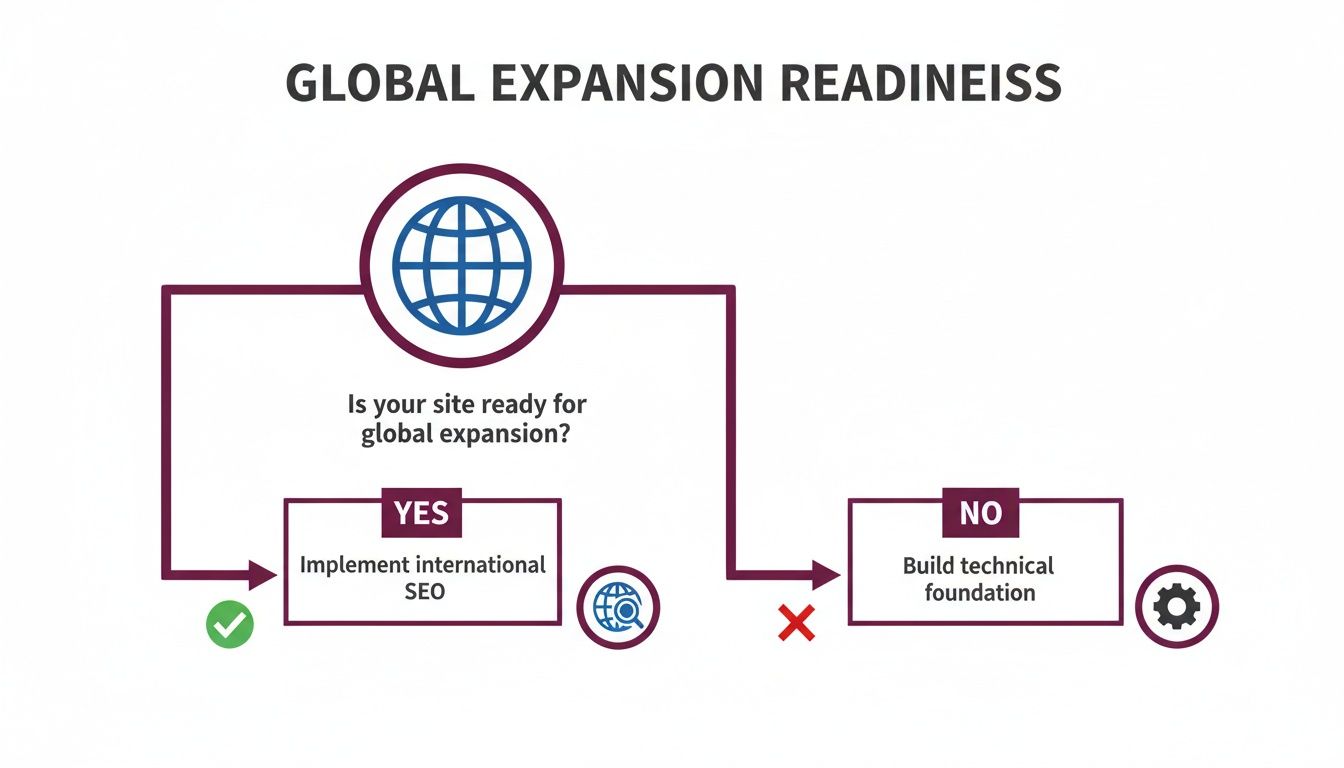
This flowchart really drives the point home: if the foundational pieces aren't in place, jumping into a complex international domain strategy is putting the cart before the horse.
Country Code Top Level Domains (ccTLDs)
Using ccTLDs—think yoursite.com.au for Australia or yoursite.fr for France—sends the clearest, most powerful geotargeting signal possible. There's zero ambiguity for search engines. On top of that, local users instinctively trust these domains, which can give your click-through rates and conversions a nice little boost.
But there’s a catch. This approach comes with serious overhead. Every ccTLD is a brand-new website in the eyes of Google. That means you're starting from scratch with SEO authority for each one, building up backlinks and credibility from zero. For massive, well-funded companies with distinct business units in each country, it’s often the best way to go.
The big win with ccTLDs is that they are automatically tied to their specific country in Google Search Console. This makes them a fantastic tool for any business needing to cement a strong, undeniably local brand presence.
The Subdomain Approach
Subdomains, like au.yoursite.com or fr.yoursite.com, represent a sort of middle ground. They give you the flexibility to use different hosting or server locations, which is great for improving site speed for users around the world. They also provide some geotargeting signals, though they aren't nearly as strong as a ccTLD.
While Google says it’s pretty good at associating subdomains with the main domain, my experience shows they are often treated as separate entities. This means, much like with ccTLDs, you'll find yourself building up authority for each one individually. This path is a solid choice for companies that want to create clear divisions—perhaps for different product lines or regions—without the headache of managing completely separate domains.
The Subdirectory Strategy
For most businesses, especially those just dipping their toes into international waters, subdirectories are the most practical and SEO-friendly choice. With a structure like yoursite.com/au/ or yoursite.com/fr/, all your international content lives under one roof on your powerful root domain.
This strategy has one massive, game-changing advantage: all your link equity and domain authority are consolidated. Every backlink you earn, no matter which country-version it points to, strengthens the entire domain. This makes it so much easier to gain traction and rank in new markets. From a management perspective, it's a dream—you’re only dealing with a single website and CMS. It's the strategy I recommend most often for scalability and sheer efficiency.
Comparison of International Domain Structures
To make an informed decision, you need to weigh the technical SEO and business factors side-by-side. This table breaks down how each structure stacks up against the criteria that matter most.
| Factor | ccTLD (e.g., .com.au) | Subdomain (e.g., au.site.com) | Subdirectory (e.g., site.com/au) |
|---|---|---|---|
| Geotargeting Signal | Strongest possible signal. Unmistakable. | Moderate signal. Can be configured in GSC. | Weakest signal. Heavily relies on hreflang. |
| SEO Authority | Each domain builds authority independently. | Often treated as a separate entity by search engines. | Consolidates all authority to one powerful domain. |
| Management Cost | High. Requires managing multiple sites, hosting, and legal entities. | Moderate. Separate configurations, but often on shared infrastructure. | Low. A single website to manage and update. |
| User Trust | High within the target country. Feels local. | Moderate. The brand is recognisable but less local. | Generally good, but can feel less localised to users. |
When it comes down to it, the subdirectory approach usually offers the most efficient way to leverage your existing website's strength as you expand. It simplifies the entire technical SEO architecture for your international markets and ensures all your hard work compounds over time.
Getting Hreflang Right for Language and Region Targeting
When you’re building a site for international markets, hreflang tags are your single most important tool for communicating with search engines. Think of them as precise signposts in your code. They tell Google exactly which page version to show a user, depending on their language and location, forming a critical part of managing your international SEO infrastructure.
Getting these tags wrong is one of the most common—and damaging—mistakes in international technical SEO. It’s how you end up with your Australian pages ranking in the UK, cannibalising your own traffic and creating a confusing user experience.
Nailing this is absolutely critical, especially in competitive regions. Take Australia, where Google has a mind-boggling 93.95% market share. In that market, the top 10 results get 94% of all clicks, and the number one spot alone grabs nearly 40%. For any business trying to expand, precise hreflang implementation isn't just a 'nice to have'—it's what gets you those high-value rankings. You can read more about Australian search market dynamics to see just how much technical precision matters.
Choosing Your Hreflang Implementation Method
There's no one-size-fits-all answer here; the best way to implement hreflang really depends on your site's tech stack and your team's resources. You've got three main options.
-
HTML Tags in the
<head>: This is the most common approach. You simply drop the link elements directly into the<head>section of each page's HTML. It’s dead simple for smaller sites but can quickly become a real headache to manage and adds unnecessary code bloat on larger, more complex websites. -
HTTP Headers: This is your only choice for non-HTML files, like PDFs. Instead of being in the page code, the hreflang info is sent via the server’s HTTP response header. It's a much cleaner way to do things because it doesn't add to the page's HTML, but it does require server-side configuration, which can be a bigger lift for some development teams.
-
XML Sitemaps: For any large, sprawling website, this is the gold standard. Instead of cluttering up every single page with hreflang tags, you define all the language and regional versions in one organised XML sitemap. This keeps your HTML lean and makes auditing and management infinitely easier.
For most businesses scaling internationally, just go with the XML sitemap method. It centralises everything, slashes the risk of page-level mistakes, and makes life so much simpler when you inevitably add more countries or languages down the track.
Executing a Flawless Hreflang Strategy
Picking your method is only the first step. The real devil is in the details, and it's these details that will make or break your international SEO.
The golden rule of hreflang is reciprocity. If your Australian page (Page A) points to your New Zealand page (Page B) as an alternate version, then Page B must link back to Page A. This two-way handshake confirms the relationship for Google. A missing return tag is probably the most common error I see, and it causes Google to just ignore the directive completely.
Another crucial piece of the puzzle is the self-referencing canonical tag. Every regional version of a page needs a canonical tag that points to itself. This essentially tells search engines, "For this specific audience, this is the definitive version." The hreflang tag then works alongside it, saying, "And by the way, here are the definitive versions for all the other audiences."
Advanced Tactics for Global Targeting
Once you’ve got the fundamentals locked down, you can start to refine your strategy. One of the most useful tools in your kit is the x-default attribute.
-
Implement
x-default: By adding<link rel="alternate" hreflang="x-default" href="https://yoursite.com/en/" />, you can direct any user who doesn't match your specified language/region pairs to a generic global page or a country selector. It’s a great fallback that prevents a confusing user experience. -
Use the Right Codes: This sounds obvious, but it trips people up all the time. Always use the correct ISO 639-1 format for languages (e.g.,
enfor English) and ISO 3166-1 Alpha 2 for regions (e.g.,AUfor Australia). A classic mistake is usingen-ukwhen the correct code isen-gb. -
Be Clear on Language vs. Region: Know exactly who you're targeting. Is it anyone who speaks a language, or people in a specific country?
hreflang="es"targets Spanish speakers anywhere in the world.hreflang="es-ES"targets Spanish speakers who are specifically in Spain.
By meticulously implementing and auditing your hreflang tags, you're building a clean, logical architecture that search engines can actually understand. This level of precision is a cornerstone of technical SEO: architecting infrastructure for international markets, ensuring your hard work reaches the right audience, every single time.
Architecting a High-Performance Global Hosting and CDN Strategy
In a global marketplace, speed is everything. A user in Berlin expects the same snappy experience as a user in Brisbane, and your hosting architecture is the foundation that makes this happen. When you're planning infrastructure for international markets, the choices you make have a direct, measurable impact on user experience and, ultimately, your search rankings. This includes decisions around multi-regional hosting and content delivery networks.

The biggest enemy here is latency—that frustrating delay it takes for data to travel from your server to a user's screen. The numbers don't lie: for every 100 milliseconds of latency, conversion rates can sink by a staggering 7%. Your core mission is to shrink this delay for every single user, no matter where they are on the planet.
Centralised Hosting vs. Multi-Regional Hosting
One of the first big decisions you'll face is where to physically host your website. There are really two main paths, and the right one depends on your business's scale and where your customers are.
With a centralised hosting approach, you've got a single server location doing all the work. This is definitely simpler and cheaper to manage, but it can create noticeable lag for anyone far from that server. This model can work just fine for businesses with a smaller international footprint or an audience concentrated in one primary region.
On the other hand, multi-regional hosting means deploying servers in several key geographic locations—think North America, Europe, and Asia-Pacific. This setup slashes latency by serving content from a server physically closer to the user, delivering a much faster and more reliable experience for a truly global audience. For example, a business targeting Australia, the UK, and the USA would benefit from servers located in each of those regions. This ensures that a user in London isn't waiting for data to travel from a server in Sydney, dramatically improving load times and user satisfaction.
Multi-regional hosting is the gold standard for performance, but it comes with a bigger price tag and more management overhead. You're effectively running multiple, distinct server environments, which demands serious technical resources.
The Critical Role of a Content Delivery Network
No matter which hosting model you choose, a Content Delivery Network (CDN) isn't a "nice-to-have"; it's an essential part of any serious international SEO strategy. A CDN is a global network of proxy servers that caches your static content—things like images, CSS, and JavaScript—in locations much closer to your users.
When someone visits your site, the CDN serves these files from a nearby Point of Presence (PoP), which is just a fancy term for one of their data centres. This simple act drastically cuts down on load times.
Here’s why it’s a game-changer:
- Massively Improved Page Speed: By closing the physical gap data has to travel, a CDN takes a huge bite out of latency, directly improving your Core Web Vitals.
- Reduced Server Load: The CDN takes a huge amount of traffic pressure off your main "origin" server, boosting its stability and preventing it from getting overwhelmed.
- Enhanced Reliability: If your origin server ever goes down, the CDN can often keep serving the cached version of your site, preventing a complete outage for your users.
When you're chasing a faster user experience, every millisecond counts. You can get into the nitty-gritty of this by reading our technical SEO guide on the Core Web Vitals page experience playbook.
Choosing and Configuring Your CDN for International Success
Picking the right CDN provider is crucial. Start by analysing where your key audiences are, then find a provider with a dense network of PoPs in those specific regions. Not all CDNs have the same global footprint, so do your homework.
Once you’ve made your choice, getting the configuration right is just as important. This involves setting up smart caching rules to make sure assets are stored efficiently and for the appropriate amount of time. Some advanced setups even allow you to serve dynamic content from the "edge," cutting out even more trips back to your origin server.
Finally, a quick tip: remember to give Google a heads-up about your geographic targeting, especially if you're using a generic domain like .com. You can set this in the old International Targeting report in Google Search Console. While less critical if you're using ccTLDs and precise hreflang signals, it’s another signal that helps Google understand your focus. This combination of intelligent hosting and a powerful CDN creates the rock-solid backbone of a high-performance global website.
Managing Crawl and Indexation Across Multiple Markets
When you're running a massive international site, it can quickly turn into a labyrinth for search engine crawlers. This is a classic problem. If you're not careful, you'll end up with a wasted crawl budget, pages indexed for the wrong country, and diluted SEO authority. Getting a grip on how search engines navigate your global footprint is a cornerstone of technical SEO: architecting infrastructure for international markets. This isn't just about getting pages into the index; it's about making sure the right pages are indexed and understood for their specific markets.

You have to be proactive here. Without crystal-clear guidance, crawlers can get lost in a sea of parameter-driven URLs, mistake translated pages for duplicates, or even miss entire country sections of your site. The goal is to lay down a clean, logical pathway for crawlers, ensuring your entire global presence is visible and correctly catalogued.
Guiding Crawlers with a Strategic Robots.txt
Your robots.txt file is your first line of defence against wasting crawl budget. For a global site, it’s not just about blocking the obvious admin pages. It's about surgically preventing crawlers from accessing the thousands of low-value, duplicate URLs that e-commerce and large-scale platforms tend to generate automatically.
I've seen these culprits countless times on international sites:
- URL parameters for tracking or sorting: Think URLs with session IDs, tracking codes, or currency converters tacked on. They can create a nightmare of near-identical pages.
- Internal search results pages: These offer very little unique value to search engines and can devour an enormous amount of your crawl budget.
- Staging or development environments: Accidentally leaving these open to crawlers is a recipe for widespread duplication issues.
A properly configured robots.txt for a global site will use Disallow directives to block these patterns. This focuses Googlebot's precious time and resources on your canonical, high-value pages. Think of it as a traffic controller, directing resources where they matter most.
The Delicate Dance of Canonical Tags and Hreflang
One of the most complex – and most frequently botched – parts of international SEO is the interplay between canonical tags (rel="canonical") and hreflang attributes. They serve different but complementary roles, and if you get them wrong, you're asking for indexation headaches.
A canonical tag tells search engines which URL is the "master" version of a page to consolidate ranking signals. Hreflang, on the other hand, simply points out all the alternate language and regional versions of that same page.
Here’s the golden rule: every international version of a page should have a self-referencing canonical tag. The Australian homepage should canonicalise to itself. The New Zealand homepage should canonicalise to itself. Then, the hreflang tags on both pages should point to each other as alternates. This setup sends a perfectly clear message: "These pages are distinct assets for different audiences, and each one is the master copy for its own market."
Structuring XML Sitemaps for Global Clarity
For any site with more than a handful of regional versions, using XML sitemaps to declare your hreflang relationships is, by far, the most efficient and scalable method. Instead of bloating every single page's HTML with dozens of hreflang tags, you centralise the entire mapping within your sitemap.
This approach brings some serious benefits:
- Easier Management: Adding a new country or language becomes as simple as updating a sitemap file, rather than a painful find-and-replace across thousands of individual pages.
- Reduced Page Weight: It keeps your HTML clean and light, which is always a good thing for page load times.
- Fewer Errors: Centralising the logic dramatically reduces the risk of common implementation mistakes, like missing return tags.
The best practice is to create a single sitemap index file that then points to separate, neatly organised sitemaps for each country or language. It keeps your structure tidy and makes auditing a breeze.
Advanced Insights Through Log File Analysis
If you really want to optimise your international crawl strategy, you need to see your site through Googlebot's eyes. Log file analysis is how you do that. By digging into your server logs, you can see exactly which pages Googlebot is crawling, how often it visits, and crucially, whether it's wasting time on non-essential URLs.
This data is pure gold for international sites. It can reveal if Googlebot is struggling to discover that new country section you just launched, or if it's getting bogged down in parameter-heavy URLs in a specific market. These insights give you the hard data you need to go back and refine your robots.txt rules and internal linking.
Investing in this kind of deep technical analysis is non-negotiable for competing globally. Data on Australian SEO investment shows that medium businesses spend up to $90,000 annually on SEO, and e-commerce sites often dedicate 35% of their SEO budgets to technical optimisation. When you're expanding into new markets, cutting corners on fundamentals like crawl management puts you at a huge competitive disadvantage. You can discover more insights about Australian SEO spending habits to get a better sense of the investment needed for technical excellence.
Answering Your Toughest International SEO Questions
Expanding into new countries always brings up a heap of questions, especially around the technical setup of your website. When you're trying to build an architecture that works for a global audience, it’s easy to get bogged down in the details. Let's walk through some of the most common questions I hear from businesses and give you some clear, practical answers.
One of the biggest hurdles is often just figuring out where to begin. It's one thing to get your content translated, but it's another thing entirely to build the technical framework that actually makes it work for search engines and users.
What's the Biggest Mistake You See in International SEO?
Hands down, the most common and damaging mistake is just translating content and slapping it into a new subfolder. I see it all the time: a business creates a /fr or /de directory on their main site but completely skips the critical technical elements like hreflang tags, localised URLs, or a CDN that can actually deliver good performance overseas.
This approach almost always backfires. You end up with search engines showing the wrong language to users, massive duplicate content headaches, and a terrible user experience because the site is slow to load. A proper international strategy isn't just about translation; it's about building the technical architecture to support your global ambitions from the get-go.
Should I Use a Subdomain or a Subdirectory for a New Market?
This is the classic "it depends" question, but here’s how to break it down based on your resources and goals.
Go with a subdirectory (like yoursite.com/au) if you want to keep things simple and consolidate all your SEO authority. Every backlink and all the authority you've built up over the years gets shared across the entire domain. This is a massive advantage when you're trying to get a foothold in a new market.
On the other hand, a subdomain (like au.yoursite.com) gives you a much stronger signal for geotargeting. But, and it's a big but, Google often sees subdomains as separate websites. That means you're starting from scratch, building authority and links for each one. For most small to medium businesses, subdirectories are the smarter, more efficient choice.
My Take: For most businesses just starting their global journey, the subdirectory model is the way to go. It leverages your existing domain strength, which helps you rank faster in new territories with a lot less heavy lifting.
Are IP Redirects a Good Idea for Different Countries?
Using automatic redirects based on a user's IP address is generally a bad idea for SEO. Think about it: Googlebot mostly crawls from the US. If you automatically boot it over to your US site based on its IP, it might never even find your content for other regions. This can cause huge indexation problems for all your international pages.
A much safer and user-friendly approach is to use a simple banner or a clear country selector. This suggests the right version to the user without forcing them. It keeps all versions of your site accessible to both people and search engine crawlers. If you absolutely must use redirects, base them on browser language settings (not IP) and make sure to use a temporary (302) redirect.
How Do Hreflang and Canonical Tags Work Together?
This is a crucial point that many get wrong. These two tags have different jobs, but they need to work as a team.
- Hreflang tags are for discovery. They tell search engines, "Hey, here are the alternate versions of this page for different languages or regions."
- Canonical tags are for consolidation. They tell search engines which URL is the one "true" or master version of a page to prevent duplicate content issues.
For your international pages, every version (e.g., yoursite.com/au/product and yoursite.com/nz/product) needs a self-referencing canonical tag. This tag points to the page itself, declaring it as the master copy for its specific audience. Then, you use hreflang tags on all of those pages to point to each other as alternates. This setup essentially tells Google: 'These pages are unique versions for different audiences, and each one is the primary version for its own region.' Getting this dual signal right is a cornerstone of a solid international SEO architecture.
By tackling these common issues from the start, you can sidestep the technical traps that derail so many global expansion plans. A well-planned technical SEO foundation is what elevates a simple translation project into a genuine international growth engine.
Ready to build a technical SEO foundation that drives real growth in international markets? The team at Anitech specialises in architecting robust SEO strategies for Australian businesses aiming to expand their reach. With a 95% success rate, we deliver measurable results. Schedule your free, no-obligation consultation today and let's build your global presence together.