Think of a technical SEO audit framework for 2026 as the definitive diagnostic blueprint for your website's digital foundation. It's a systematic process for ensuring your site is built on solid ground, ready for the evolving demands of modern search engine algorithms. This guide moves past basic checklists to concentrate on the core pillars that are crucial for search visibility: crawlability, performance, structured data, and site architecture. Mastering these elements means you're not just ticking boxes; you're building a future-proof strategy for optimal performance and user experience, which is the cornerstone of modern search visibility.
Why Technical SEO Is Essential for Search Visibility in 2026

By 2026, a solid technical SEO foundation is no longer a competitive advantage—it's the price of entry for digital visibility. Imagine your website is a skyscraper. Your exceptional content, clever marketing, and authoritative backlinks are the stunning penthouses and glass-walled offices. But technical SEO is the bedrock foundation that supports the entire structure. If that foundation develops cracks, the whole building is at risk.
This guide provides a master framework to serve as your architectural plan, enabling you to inspect and reinforce that critical foundation. As search engines like Google become more sophisticated, their tolerance for technical glitches has diminished significantly. They now heavily favor websites that are fast, secure, and deliver a flawless user experience.
The Make-or-Break Ranking Factor
For Australian businesses, this is not just a theoretical concept; it's a make-or-break reality. Google now actively penalizes sites that fail to meet its high technical standards. We tracked over 200 Australian businesses throughout 2025 and discovered that those who neglected their technical health saw their organic traffic plummet by 20-40%. In stark contrast, those who prioritized it maintained their ground or even expanded their visibility. You can get more details on the 2025 SEO changes that will redefine marketing in 2026.
A website with brilliant content but poor technical health is like a fantastic author whispering in a loud, crowded room. The story might be incredible, but if nobody can hear it, it's lost. Technical SEO is the microphone that amplifies your message.
This underscores a critical point: without a sound technical structure, even the most brilliant content strategy is destined to underperform. To provide a structured approach, the framework we will explore is built around four key pillars.
Technical SEO Audit Framework at a Glance
Here’s a high-level overview of the four pillars that form the basis of a modern technical audit. Each pillar has a distinct goal and specific areas to focus your diagnostic efforts on.
| Framework Pillar | Primary Goal | Key Focus Areas |
|---|---|---|
| Pillar 1: Crawl & Index | Ensure search engines can efficiently find, crawl, and index all important content without wasting resources. | Robots.txt, XML sitemaps, URL structure, crawl budget, canonicalisation, log file analysis. |
| Pillar 2: On-Page & Architecture | Build a logical site structure that helps users and search engines navigate and understand content hierarchy. | Internal linking, site depth, information architecture, structured data (Schema), Hreflang for international sites. |
| Pillar 3: Performance & Core Web Vitals | Deliver a fast, responsive, and stable user experience that meets Google's performance benchmarks. | Page speed, LCP, INP, CLS, mobile-friendliness, image optimisation, code minification. |
| Pillar 4: Security & Trust | Establish a secure and trustworthy environment for users, protecting their data and signalling reliability. | HTTPS implementation, security headers, mixed content issues, malware checks, server configuration. |
These pillars offer a comprehensive roadmap for diagnosing and resolving the technical issues that can impede a website's growth and visibility.
Ignoring these components is simply not a viable option anymore. This guide will walk you through a practical, pillar-by-pillar strategy to audit and perfect your website’s technical framework, starting with the absolute essentials for modern search visibility.
Ensuring Search Engines Can Discover and Interpret Your Content
Let's begin with the absolute bedrock of our technical SEO master framework for 2026. Before we can even discuss page speed or AI-driven search, we must address the fundamentals: can search engines discover, crawl, and index your website? If the answer is no, every other effort is rendered ineffective.
Consider your website as a brilliant, sprawling library and Google as the head librarian, ready to catalogue every book. But what happens if the front doors are locked? Or if the main catalogue is missing? No matter how incredible the books inside are, they will never be found on the shelves.
This is precisely what occurs when technical errors are present. A misconfigured robots.txt file is the locked door. A missing XML sitemap is the missing catalogue. In this first phase of the audit, we'll provide an actionable diagnostic checklist to ensure your digital library is fully accessible.
Correctly Configuring Your Robots.txt File
Your robots.txt file is a small text file located in your site's root directory, but it wields immense power. It essentially provides instructions to search engine crawlers (or "bots"), telling them which parts of your site they can and cannot access. A single incorrect line here can have disastrous consequences.
For instance, a simple instruction like Disallow: / tells every search engine to completely ignore your website. It might sound improbable, but we’ve seen this happen to Australian ecommerce stores that inadvertently left this line in place after a website migration. They effectively vanished from Google overnight, resulting in thousands of dollars in lost sales.
Your audit must check for these critical points:
- No Accidental Blocks: Ensure your important pages—product pages, blog posts, service pages—are not being disallowed by mistake.
- Sitemap Location: The file must point crawlers to the location of your XML sitemap, making it straightforward for them to find.
- Access to Resources: Verify that crawlers can access your CSS and JavaScript files. Google needs these to render and understand your pages as a human user does.
Mastering Your XML Sitemap
If robots.txt is the doorman, your XML sitemap is the detailed floor plan. It is a file that lists all the important URLs on your website, helping search engines understand your site's structure and discover all your key content. This is especially vital for pages that may be buried deep within your site and difficult to find through standard crawling.
Think of your sitemap as an express lane for search engine crawlers. Instead of them wandering aimlessly through your site hoping to find every room, you're handing them a map with a direct path to all your most valuable content. It ensures nothing important gets overlooked.
A well-structured sitemap is dynamic—it updates automatically whenever you add, remove, or change a page. Submitting this sitemap via Google Search Console is a non-negotiable step. It allows you to monitor how many of your submitted pages are actually being indexed and receive alerts if issues arise.
Managing Your Crawl Budget
Every website is allocated a "crawl budget," which is the amount of resources Googlebot will dedicate to crawling your site within a specific timeframe. For large websites—such as a major Australian retailer like JB Hi-Fi or a large publisher—managing this budget is absolutely critical.
If your crawl budget is wasted on low-value pages, your most important content may not be crawled and indexed as frequently as it should be. Here’s how to protect it:
- Block Low-Value URLs: Use your
robots.txtto block access to pages with no real user value, like internal search results or pages with duplicate content. - Use
nofollowAttributes: Add arel="nofollow"tag to internal links pointing to unimportant pages you don't want crawlers to waste time on. - Improve Site Speed: Faster sites are easier and quicker for Google to crawl, meaning it can process more of your content within the same budget.
Handling Redirects and Status Codes
Finally, your audit must examine how your server responds when a page is requested. These responses, known as HTTP status codes, inform browsers and search engines about the status of that page. Correct implementation is key.
- 301 Permanent Redirects: Use these whenever a page is permanently moved. A 301 redirect passes nearly all of the old page's authority (or "link equity") to the new one, preserving its SEO value.
- 404 Not Found Errors: These appear when a user attempts to visit a page that no longer exists. A few 404s are normal, but a high number can indicate a poor user experience. Regularly check your Google Search Console reports for 404 errors and redirect those broken URLs to a relevant, live page.
By mastering these foundational elements, you are building a solid base. You are ensuring that search engines can efficiently discover and understand every valuable piece of content you create, opening the door for the more advanced optimizations we will explore next.
On-Page Performance and User Experience: Creating an Optimal Digital Environment

So, you've ensured that search engines can find and understand your content. That is a significant victory. Now, the focus shifts entirely to the people visiting your site. A technically perfect website that is slow, clunky, or frustrating is like a beautifully signposted shop with sticky floors and long queues. Visitors will simply leave.
By 2026, on-page performance is much more than a 'nice-to-have'—it's a massive ranking factor that directly influences your search visibility. This section of our technical seo: the master framework for technical seo audits in 2026 is dedicated to how real users perceive your site. We will break down Google's Core Web Vitals, emphasize the importance of a mobile-first approach, and draw a direct line from page speed to your bottom line.
Understanding Core Web Vitals in 2026
Core Web Vitals are a set of specific metrics that Google uses to measure real-world user experience. They essentially serve as your site's report card, graded on loading speed, interactivity, and the stability of the page as it loads.
- Largest Contentful Paint (LCP): This metric is all about speed. It measures the time it takes for the largest piece of content (like a hero image or a large block of text) to appear on the screen. A time under 2.5 seconds is the target.
- Interaction to Next Paint (INP): This is the newest metric, replacing the older First Input Delay (FID). INP measures responsiveness by tracking how quickly your page reacts when a user clicks, taps, or types. A good score is below 200 milliseconds.
- Cumulative Layout Shift (CLS): Have you ever tried to tap a button, only for it to move as an ad loads above it? That's layout shift, and it’s incredibly frustrating. CLS measures this visual stability, and the goal is a score of 0.1 or less.
Identifying and fixing these issues is a core part of any modern technical audit. A tool like Google PageSpeed Insights is indispensable for this, providing detailed reports and clear, actionable recommendations.
Mastering Mobile-First Design and Page Speed
In 2026, the debate is over: you must build for mobile first. Designing for a desktop and then attempting to adapt it for a phone is a guaranteed recipe for failure. Google predominantly uses the mobile version of a site for indexing and ranking, which makes a mobile-first design completely non-negotiable. Your audit must be ruthless in testing how your site performs across a wide range of mobile devices.
Page speed is directly linked to this. A slow site not only annoys users but also sends a clear signal of poor quality to search engines. Every second matters—a delay of just a few seconds can cause your bounce rate to skyrocket. Common culprits for slow performance include:
- Large, unoptimised images: That beautiful high-resolution photo may look great, but if it hasn't been properly compressed for the web, it acts like an anchor, dragging down your load time.
- Render-blocking resources: These are typically JavaScript or CSS files that force the browser to halt everything and load them before displaying the rest of the page.
- Slow server response times: Sometimes the issue isn't your website's code but the time it takes for your server to begin sending the data.
Practical Steps for Performance Optimisation
Identifying problems is the easy part; fixing them is what produces results. A thorough audit will deliver a prioritized list of tasks to enhance performance.
"A fast website is no longer a feature; it's the foundation of a good user experience. In the Australian market, where competition is fierce, technical performance is often the deciding factor that separates a successful SEO campaign from a failed one."
Data indicates that Australian businesses operate in a uniquely challenging environment. The cost to acquire customers is high, and consumer behavior differs from larger US markets. To compete with established national brands that have substantial budgets and authority, your site must be technically flawless. Often, it's this technical edge that makes all the difference. You can find more insights on this topic by exploring articles about SEO in Australia on strikemedia.agency.
Here are the key actions to focus on:
- Compress Images and Use Modern Formats: Utilize tools to reduce image file sizes without a noticeable loss in quality. Better yet, adopt modern formats like WebP or AVIF, which offer superior compression compared to traditional JPEGs and PNGs.
- Minify CSS, JavaScript, and HTML: Minification is the process of removing unnecessary characters from your code (like spaces and comments) that browsers do not need. Smaller files lead to faster load times.
- Use a Content Delivery Network (CDN): A CDN is a game-changer. It stores copies of your site's files on servers located around the world. For an Australian business, this means a user in Perth can access your site from a local server instead of waiting for it to travel from Sydney, which dramatically reduces load times.
- Defer Non-Critical Resources: Not every script or stylesheet needs to load immediately. By deferring resources that are not essential for the initial view (such as a chat widget or footer scripts), you can significantly improve your LCP and INP scores.
By optimizing these on-page and user experience elements, you create a site that satisfies both users and search engines. It’s not just about rankings; it's about building trust and creating an experience that encourages visitors to stay and convert.
Preparing Your Site for an AI-Powered Search World

As we move towards 2026, preparing your website for an AI-first search environment is not just a good idea—it's a fundamental survival tactic. The absolute key to this future is structured data, often referred to as Schema markup. You can think of it as a ‘cheat sheet’ that you feed directly to search engines and their AI models.
Without it, AI is left to guess what your content actually means. With it, you are explicitly labeling every piece of information, eliminating any ambiguity. Is that string of numbers a product price, a phone number, or a street address? Proper Schema is the difference between being perfectly understood and completely overlooked.
This part of our technical seo: the master framework for technical seo audits in 2026 is all about making your content machine-readable, which is your best opportunity to secure visibility in AI Overviews and rich snippets.
Why Structured Data Is Your AI Cheat Sheet
At its core, structured data is a standardized vocabulary added to your site's HTML. It doesn’t change anything for your human visitors, but behind the scenes, it provides crystal-clear context for machines. It’s like attaching helpful, invisible labels to all your most important information.
Imagine a recipe blog. Without structured data, a search engine sees a jumble of text and has to try to identify the cooking time, ingredients, and calorie count. With Recipe schema, you are spelling it out for them: "This number is the prep time, these are the ingredients, and here’s the nutritional information."
That level of clarity is exactly what AI models need to confidently feature your content in their answers.
The Impact of AI on Australian Search Behaviour
The need for this clarity has never been more urgent. The Australian search landscape is shifting rapidly due to AI. Zero-click searches now account for a staggering 69% of all queries, a massive increase from just 56% a year ago. This has profound implications for Australian businesses that have traditionally relied on organic traffic.
Furthermore, AI Overviews are now appearing in 60% of queries, reducing organic click-through rates by an average of 34.5%. This means getting your information featured inside AI-generated answers is no longer optional; it's essential for survival. You can delve deeper into the essential SEO checklist for 2026 in Australia to understand the full picture.
Structured data is the bridge between your website's content and an AI's understanding. Without this bridge, your information is isolated on an island, invisible to the new world of generative search.
Correct implementation is your ticket to being featured, ensuring your business remains visible even when users don’t click through to your site.
Essential Schema Types for Australian Businesses
While there are hundreds of Schema types, a few are absolutely critical for most Australian businesses. Focusing on these will provide the greatest impact.
- LocalBusiness: This is non-negotiable for any business with a physical address. It allows you to clearly state your business name, address, phone number (NAP), opening hours, and geo-coordinates—all vital for ranking in local map packs.
- Product: If you operate an e-commerce store, this is essential. You can mark up product names, images, descriptions, brand, price, and stock levels. This data directly feeds the rich snippets that show price and review stars in search results, which can significantly boost your click-through rates.
- Article: For any blog or news site, this schema helps search engines understand the headline, author, publication date, and featured image. It is key for appearing in news carousels and Top Stories.
- FAQPage: Marking up your Frequently Asked Questions page with this schema can result in your Q&As appearing directly in the search results, capturing a large portion of valuable SERP real estate.
Validating Your Implementation
Implementing structured data without verifying your work is like sending a letter with a smudged address. You must ensure that search engines can accurately read and understand your markup.
The best tools for this come directly from Google. The Rich Results Test is perfect for spot-checking a single page. It shows you which rich results your markup is eligible for and flags any errors. For a comprehensive overview, consult the enhancement reports in Google Search Console, which will alert you to any Schema issues across your entire site.
Making validation a routine part of your technical SEO audit is the only way to ensure your site continues to speak the language of AI.
Your Site's Blueprint: Architecture and Security
Let’s delve into the final pillar of our audit framework: the very foundation upon which your website is built. We're talking about its structural integrity and its security. These are not just technical checkboxes; they are absolutely fundamental for earning trust from both your users and search engines.
Think of your website's architecture as the floor plan of a house. A great floor plan feels intuitive. You can move from the kitchen to the living room without getting lost, and everything is exactly where you expect it to be. Search engine crawlers appreciate a good floor plan just as much as a human visitor.
A clean, logical structure allows them to navigate your site efficiently, understand how your content is interrelated, and pass ranking authority from your strongest pages down the line. Without it, you are simply making their job more difficult.
Building a Logical Site Structure
When it comes to site structure, simplicity is almost always better. A good rule of thumb is that no important page should be more than three clicks away from your homepage. This is not an arbitrary number; it ensures that your most valuable content is easily discoverable for both users and search bots.
A significant part of this audit involves mapping your internal links. Are you linking from your homepage to your most critical service pages? Do your blog posts have contextual links pointing to the products they discuss? These links are the hallways and signposts of your website, and a solid technical audit ensures they are all pointing in the right direction.
"A well-planned site architecture acts as a powerful internal PR campaign for your own content. It tells search engines which pages you consider most important by making them the easiest to find."
To truly master this, you need to understand information architecture. It's the key to creating a structure that not only looks good but performs brilliantly. To go deeper, check out our guide on SEO engineering and information architecture, a blueprint for site navigation.
Dealing With Duplicate Content Through Canonicalization
Duplicate content is one of those subtle technical issues that can seriously undermine your efforts. It occurs when the same (or very similar) content appears on multiple URLs. This could be a printer-friendly version of a page or URLs with tracking parameters. This creates a significant problem for search engines—they don't know which version to rank, so your authority gets split across multiple pages.
The solution is the canonical tag (rel="canonical"). It’s a simple line of code that points search engines to the single, authoritative version of a page you want them to index. A thorough audit will involve:
- Hunting for Duplicates: Use a crawler like Screaming Frog to find pages with duplicate titles, meta descriptions, or H1s.
- Setting a Baseline: Ensure every page has a self-referencing canonical tag. This is good housekeeping and prevents many problems down the road.
- Fixing True Duplicates: For any genuine duplicates, ensure the canonical tag on the copies points directly to the master URL you want to rank.
Correctly implementing canonical tags consolidates all your ranking power into one URL, giving your SEO efforts much more focus.
Locking It Down with HTTPS
By 2026, operating a site without HTTPS is simply not an option. It is the standard for encrypting the connection between your site and your users, protecting their data. Browsers actively warn users when a site is "Not Secure," which is a massive red flag for visitors and a clear negative signal to Google.
Your security check-up needs to confirm a few things:
- Your entire site is served over HTTPS, not just the checkout or login pages.
- You have a valid, correctly installed SSL certificate.
- All old HTTP traffic is permanently redirected (with a 301) to the secure HTTPS version.
- You've eliminated any "mixed content" errors, where a secure page attempts to load insecure resources like old images or scripts.
Optimising for an International Audience
If you are targeting customers in different countries, you need to get your international SEO right. The secret ingredient here is the hreflang tag. This small piece of code tells Google which version of a page to show a user based on their language and location.
For instance, an Australian brand might also sell to customers in New Zealand and the UK. With the right hreflang tags, a user in London is shown the UK-specific page with pricing in pounds, rather than the Australian site with prices in dollars. For any global brand, auditing your hreflang setup is non-negotiable. Get it wrong, and you risk showing the wrong content to the right people, which is a recipe for a poor user experience.
Putting Your Technical SEO Audit into Action
Alright, let's move from the 'what' to the 'how'. This is where theory becomes practice. You’ve conducted a deep dive through the four pillars, and now you have a wealth of data. The next step is to create a practical workflow that integrates free essentials, like Google Search Console, with powerful crawlers such as Screaming Frog and Ahrefs.
But here’s a secret that separates professionals from amateurs: the real skill is not just in identifying every single error. It's about prioritizing them. A truly successful audit pinpoints the handful of fixes that will deliver the most significant impact.
For instance, fixing a single incorrect canonical tag on a major e-commerce category page could have a massive impact. That one change will likely deliver a far greater return than spending hours optimizing alt text on a dozen old, low-traffic blog posts. It’s all about surgical precision.
Building Your Prioritisation Matrix
A simple impact/effort matrix is one of the most powerful tools in an SEO's arsenal for bringing order to chaos. It helps you categorize every issue you’ve found into one of four clear categories, instantly showing you where to start.
-
Quick Wins (High Impact, Low Effort): These are your immediate priorities—the low-hanging fruit. Think of tasks like fixing a critical
robots.txterror that’s blocking Googlebot, adding missingLocalBusinessschema to your contact page, or redirecting a few high-authority broken backlinks. -
Major Projects (High Impact, High Effort): These are the game-changers that require serious planning and resources. This category would include a full site migration, a complete overhaul of your information architecture, or implementing
hreflangtags across a massive international website. -
Fill-In Tasks (Low Impact, Low Effort): These are the ‘nice-to-haves’. They are still valuable but not urgent. This bucket is perfect for tasks like cleaning up minor 404 errors or compressing a few non-critical images when you have spare time.
-
Reconsider (Low Impact, High Effort): Generally, you should avoid these. Unless there is a compelling business case, these tasks are not worth the investment. They consume time and resources for very little SEO gain.
This structured approach is all about strengthening your site’s core integrity, which can be broken down into a few key stages.
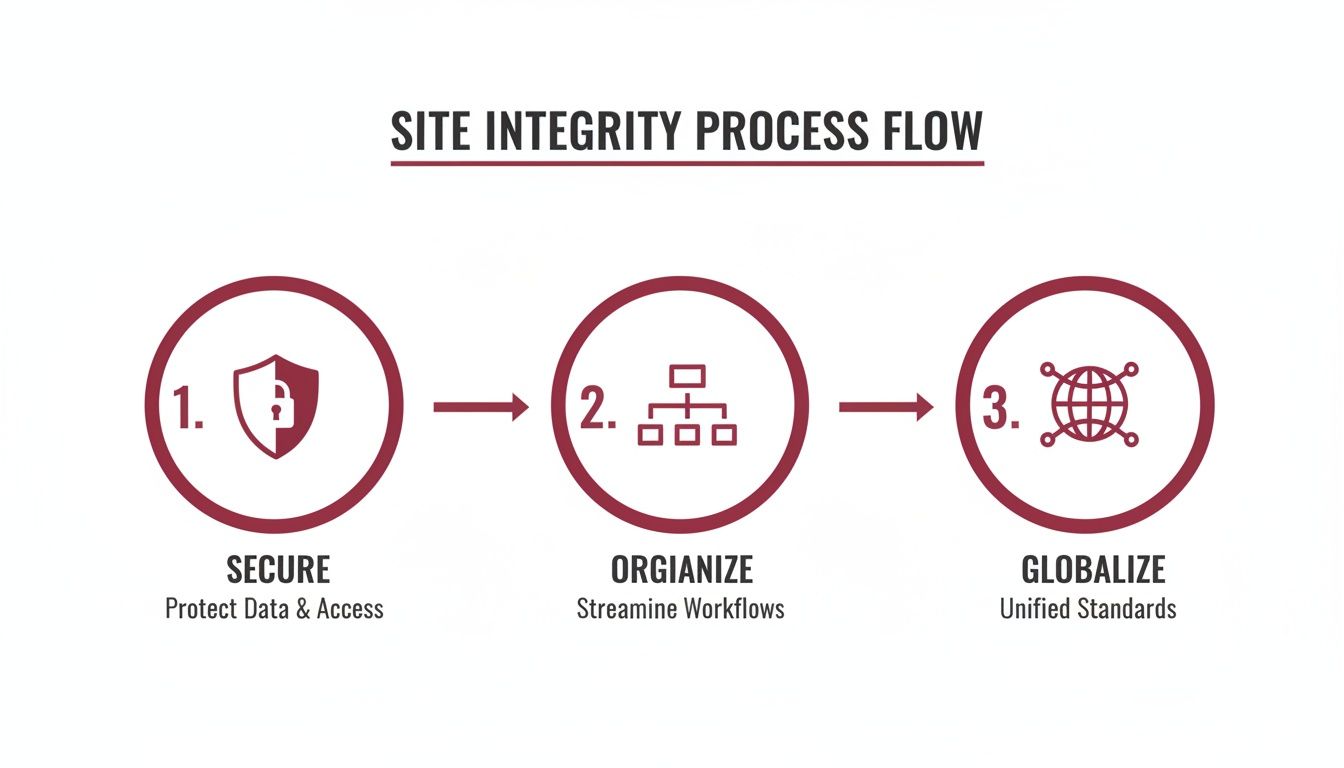
As you can see, the process begins with securing the foundation. From there, you organize your content logically, and only then do you consider expanding to global markets.
Recommended Technical SEO Audit Toolkit
To execute this effectively, you'll need the right tools for the job. No single platform does everything, so building a small, curated toolkit is the best approach. Here’s a look at some of the essential tools recommended for each phase of the audit.
| Audit Phase | Primary Tool | Alternative/Supporting Tools |
|---|---|---|
| Crawling & Indexing | Screaming Frog SEO Spider | Sitebulb, Deepcrawl, Ahrefs Site Audit |
| On-Page & Content | Surfer SEO | Clearscope, Frase.io |
| Site Performance | Google PageSpeed Insights | GTmetrix, WebPageTest |
| Backlinks & Authority | Ahrefs | Semrush, Majestic |
| Analytics & Monitoring | Google Search Console | Google Analytics 4, Bing Webmaster Tools |
This combination provides everything you need to conduct a thorough, data-driven audit without being overwhelmed by too many subscriptions.
Communicating Findings to Stakeholders
Now for what might be the most underrated skill in technical SEO: communicating with non-SEOs. You can uncover the most brilliant insights, but if you cannot explain them to your boss, your client, or the development team, they will never be implemented. Your report must translate technical jargon into business outcomes.
Instead of saying, "We have a high LCP time," reframe it in terms they understand: "Our slow page speed is likely costing us an estimated $X in sales per month because customers are abandoning their carts out of frustration."
See the difference? You have just connected a technical metric directly to the bottom line.
For every recommendation, your report needs to clearly state the problem, the solution, the resources required for the fix, and the expected business outcome. When you can link a poor indexing rate to missed market opportunities or a security flaw to a potential loss of customer trust, you demonstrate the immense value of your work. This is how you get the buy-in and the budget to turn your audit into action.
Common Questions About Technical SEO Audits
It's completely normal to have a few questions when diving into the more technical side of SEO. Let's address some of the most common ones we hear from Australian business owners and marketing managers.
How Often Should I Run a Technical SEO Audit?
Think of it like a car service. For most websites, a deep, comprehensive technical audit once a year is a smart move. This is your major service, where you check everything from top to bottom.
However, you wouldn't wait a full year if you heard a strange noise, right? That's why a quick "health check" or mini-audit is a good idea every quarter. You should definitely perform one after any significant changes, like a site redesign, platform migration, or a massive content overhaul. And, of course, keeping a daily eye on Google Search Console is non-negotiable for catching problems as soon as they arise.
Can I Just Do a Technical SEO Audit Myself?
You can certainly get started on your own. Free tools are great for flagging some of the more obvious issues. The real challenge, however, lies in diagnosing the deeper, more complex problems related to crawling, rendering, and structured data.
This is where an expert comes in. A full audit requires not just sophisticated tools but also the experience to interpret the data, connect the dots between seemingly unrelated issues, and build a strategic roadmap that actually makes a difference. It is easy to miss something critical if you don’t know exactly what you are looking for.
What's the Single Most Important Part of an Audit in 2026?
That's a tough question, as everything is interconnected. But if I had to pick one thing to focus on for 2026, it would be your site’s readiness for AI-driven search.
This goes beyond just being fast and easy for Google to crawl. It’s about having perfectly implemented structured data (Schema). This is the code that helps AI models truly understand the context of your content. Getting this right is your ticket to being featured in things like AI Overviews, which is becoming crucial as more searches result in zero clicks.
Ready to build a rock-solid foundation for your website? At Anitech, our expert team provides in-depth technical SEO audits tailored to the Australian market, ensuring your site is optimised for long-term growth. Get your free consultation today at https://anitech.au and start building a foundation for sustained success.