Search Engine Optimisation, or SEO, is a fundamental digital marketing strategy focused on improving your website's visibility in search engine results pages (SERPs) on platforms like Google. Essentially, what is SEO? a complete guide is the process of making your site more appealing for specific searches, driving a continuous stream of unpaid, or 'organic', traffic directly to your digital doorstep.
So, What Exactly Is Search Engine Optimisation?
Let's break it down with an analogy. Imagine Google is the world's largest library, and you've just published a groundbreaking book. SEO is the art and science of ensuring the head librarian features your book on the most prominent, eye-level shelf. When a reader enters seeking information on your topic, your book is the first one they encounter—not hidden in some dusty, forgotten corner. You achieve this prime placement through meticulous strategy, not by paying for an advertisement in the library's window.
In simpler terms, search engine optimisation encompasses the entire suite of techniques and strategies you employ to make your website more attractive to search engines. When a user types a query into Google, sophisticated algorithms sift through billions of web pages to find and deliver the most relevant, high-quality answers. SEO is how you communicate to these algorithms that your content is the premier choice for that user's search intent.
Why It Matters for Australian Businesses
The importance of SEO in today's competitive digital marketplace cannot be overstated. The Australian SEO industry has expanded into a $1.5 billion sector, with an impressive annual growth rate of 12%. This figure highlights a landscape of intense competition, where nearly every business is vying for the same organic search traffic. You can discover more insights about the Australian SEO landscape to understand why it's a critical investment for sustainable business growth.
Without a robust SEO strategy, your business remains effectively invisible to the millions of potential customers searching for your specific products or services every day. You might offer the best service in the nation, but if you're not on the first page of Google's search results, you might as well not have an online presence.
Organic Visibility: The Ultimate Business Asset
Climbing the search engine rankings through effective SEO provides a dependable, long-term source of high-quality website traffic. This is fundamentally different from paid advertising strategies like Search Engine Marketing (SEM) or Pay-Per-Click (PPC), where your visibility disappears the moment you stop paying. The organic rankings you meticulously build through consistent SEO work continue to deliver value and results over the long haul.
SEO is more than just getting clicks; it's about attracting the right kind of clicks. By lining up your website with what people are actively searching for, you tap into an audience that's already interested in what you do.
This is a game-changer because it builds credibility and trust. Users naturally trust organic search results more than paid advertisements, viewing them as more authentic and authoritative. Securing a top position on Google is like receiving a powerful endorsement from the search engine itself, signalling to users that you are a trusted leader in your field. This trust translates directly into higher engagement, more qualified leads, and ultimately, tangible business growth.
The Three Pillars of Modern SEO
Every effective SEO strategy, one that delivers tangible results and withstands the test of time, is constructed upon three foundational pillars: On-Page SEO, Off-Page SEO, and Technical SEO. You cannot focus on one and expect success. True, sustainable growth is achieved by mastering the synergy between these three components to create a powerful online presence that appeals to both your target audience and search engine algorithms.
Let's use an analogy. Imagine your website is a new book you've just written.
On-page SEO represents everything inside the book – the quality of the writing, the chapter titles, the table of contents, and the clarity with which you present your ideas.
Off-page SEO is your book's reputation in the wider world. It's the glowing reviews from esteemed critics, the citations in other popular books, and the word-of-mouth buzz that generates conversation.
Technical SEO is the quality of the printing and binding. Is the text legible? Are the pages in the correct order? Can the librarian (Google) easily locate it, understand its subject matter, and place it on the appropriate shelf for readers to discover?
Let’s break down what each of these really means for your business.
On-Page SEO: Creating Content That Ranks
On-page SEO encompasses all the actions you take directly on your website to communicate to search engines what your content is about and why it deserves to rank highly. This is the area where you have the most direct control. The objective is to make your web pages as relevant, valuable, and user-friendly as possible.
This involves more than just skillful writing; it's about strategically optimising every element on the page.
Here’s what that looks like in practice:
- Keyword Optimisation: This involves strategically integrating your target keywords into the most crucial areas of your page, such as the title tag, main headings (H1, H2s), the meta description, and naturally within the body of the text.
- High-Quality Content: You must create genuinely helpful, well-researched, and comprehensive content that completely addresses the searcher's query. The aim is to be the definitive answer on the internet for that topic.
- Title and Header Tags: Your page title is your first impression in the search results—make it compelling! Subsequently, use a clear hierarchy of headers (H1 for the main topic, H2s for sub-topics) to structure your content, making it easily scannable for both users and search engine crawlers.
- Internal Linking: Linking to other relevant pages on your own website is a powerful tactic. It helps Google discover more of your content and understand the relationships between your pages, forming a topical cluster of expertise.
- Image Optimisation: Using descriptive filenames (
sydney-plumber-fixing-leaky-pipe.jpginstead ofIMG_1234.jpg) and writing informative alt text for your images helps Google understand the visual context of your page and improves accessibility.
At its core, on-page SEO is about crafting a five-star experience for both your human visitors and search engine bots.
Off-Page SEO: Building Authority and Trust
While on-page SEO is about what's on your site, off-page SEO pertains to all activities that occur away from your website to build its authority and reputation. For the most part, this comes down to one crucial element: backlinks.
Think of backlinks as votes of confidence from other websites. When a respected, high-authority site links to your content, it’s essentially telling Google, "Hey, this page is legit and trustworthy." The more of these high-quality "votes" you get, the more your own authority grows.
However, it’s not just about links. A broader spectrum of signals contributes to your off-page reputation.
Common off-page SEO strategies include:
- Link Building: This is the active process of earning links from other websites. It can be achieved by creating exceptional content that people naturally want to share, writing guest articles for other industry blogs, or through digital public relations campaigns.
- Brand Mentions: Even when another site mentions your brand without a direct link, Google often interprets it as a positive signal of authority.
- Social Media Marketing: While social media metrics like "likes" are not direct ranking factors, an active social media presence exposes your content to a wider audience. This can lead to increased traffic, more shares, and consequently, more opportunities for natural backlinks.
- Online Reviews: For any local business, positive reviews on platforms like your Google Business Profile are invaluable. They build trust with potential customers and directly influence your visibility in local search results.
A robust off-page strategy signals to search engines that you are a recognized and respected authority in your industry.
Technical SEO: Ensuring a Solid Foundation
Finally, we have technical SEO. This is the bedrock upon which your entire strategy is built. It involves ensuring your website's infrastructure is configured so that search engines can efficiently find, crawl, and index your pages without any technical impediments. If your technical SEO is flawed, even the most brilliant content and authoritative backlinks will not be enough to achieve top rankings.
This diagram helps visualise where the three pillars fit within a broader search marketing plan, separating the ongoing organic efforts from paid advertising.
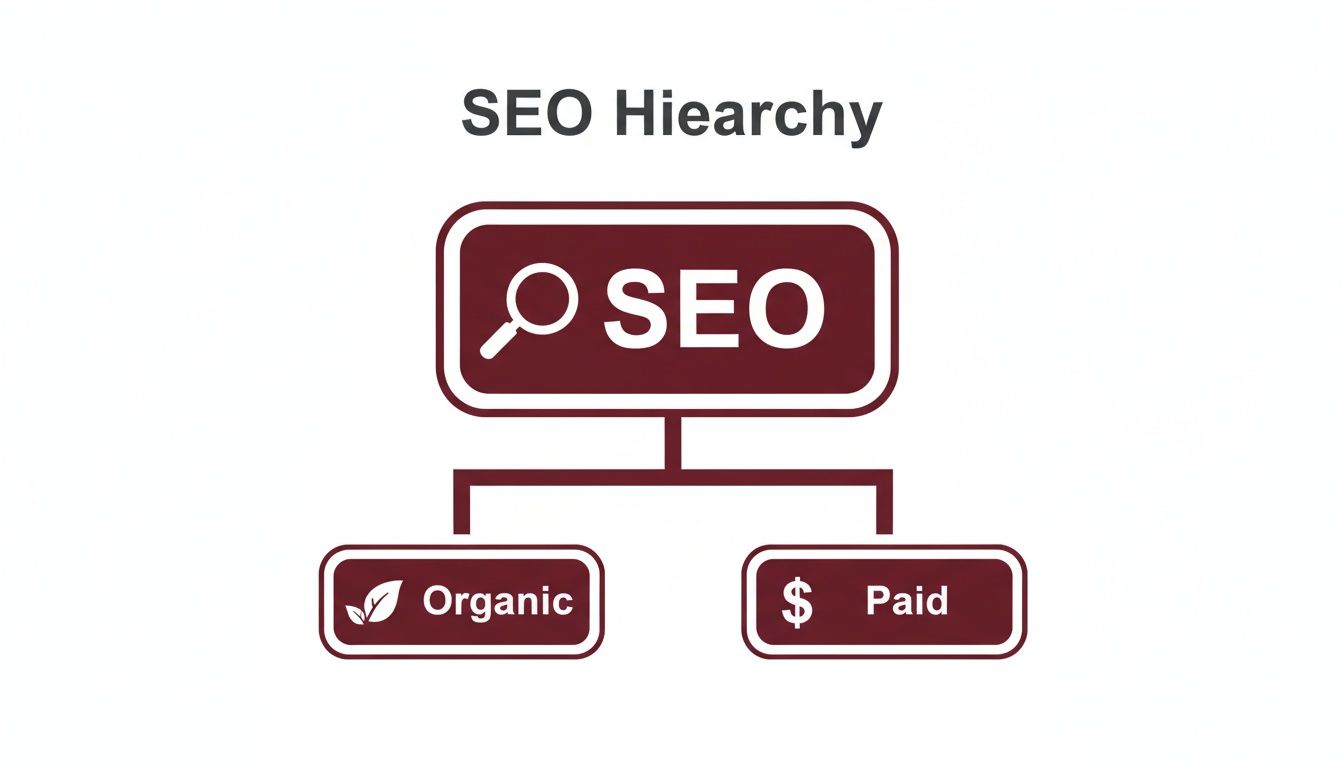
As you can see, the three pillars form the engine of your organic growth, which is essential for long-term, sustainable traffic that you don't have to pay for with every click.
Key technical SEO checkpoints include:
- Website Speed: Users expect fast-loading websites. Page speed is a confirmed ranking factor, and a responsive, snappy site enhances user experience and reduces bounce rates.
- Mobile-Friendliness: The majority of searches in Australia now occur on mobile devices. Your website must be fully responsive and provide a seamless experience on any screen size.
- Site Architecture: A clean, logical site structure is crucial. It helps users navigate your site intuitively and allows search engine crawlers to easily understand the hierarchy and relationships between your pages.
- XML Sitemaps: This is essentially a roadmap of your website that you provide to Google. It lists all your important URLs to ensure they are discovered and indexed during a crawl.
- Crawlability and Indexability: This involves ensuring there are no technical barriers (like incorrect robots.txt directives) preventing search engines from accessing and adding your pages to their massive database (the index).
By mastering these three pillars—on-page, off-page, and technical—you build a complete, powerful, and resilient SEO strategy. If one pillar is weak, the whole structure becomes unstable.
Finding the Right Keywords to Attract Customers
Effective SEO doesn't begin with writing content; it begins with listening. Before you type a single word, you need to understand your customer's mindset and identify the exact words and phrases they use to find solutions online. This is the core purpose of keyword research. It’s less about speculation and more about data-driven investigation, forming the bedrock of any successful SEO strategy.

Ultimately, you're trying to align your offerings with what people are actively searching for. Thorough keyword research ensures the content you create directly answers their questions, solves their problems, and meets them at their specific stage of the customer journey. It’s how you attract not just any visitors, but the right ones—those most likely to convert.
Understanding Search Intent: The Why Behind the What
Simply identifying a popular keyword is not enough. The real secret to success lies in understanding search intent—the why behind a search query. You must determine what a person is actually trying to accomplish when they type something into Google.
Think of it this way, intent generally falls into three buckets:
- Informational Intent: The user is in research mode. They are looking for answers, guides, or explanations. Examples include searches like "how to unblock a drain" or "what are the benefits of cloud accounting".
- Navigational Intent: The user already knows their destination and is using Google as a shortcut. Searches like "Anitech login" or "Facebook" are prime examples.
- Transactional Intent: The user is ready to make a purchase or take a specific action. They're ready to buy, book, or sign up. These searches often include commercial keywords like "buy," "price," or "for sale," such as "buy iPhone 15 online" or "emergency plumber Sydney cost".
Matching your content to user intent is paramount. A hard-sell product page will instantly alienate someone seeking information. Conversely, a lengthy "how-to" guide will frustrate a user who is ready to make a purchase immediately.
From Broad Terms to Long-Tail Gold
It's tempting to target broad, high-volume keywords, often referred to as "head terms." Consider a one-word search like "shoes." While it receives a massive amount of search traffic, it's incredibly competitive, and the user's intent is ambiguous. Does the searcher want to buy shoes, learn about their history, or simply browse images? It's impossible to know.
The real opportunity, especially for small and medium-sized businesses, lies in long-tail keywords. These are longer, more specific search queries. They have lower search volumes individually, but their intent is crystal clear.
A person searching for "buy waterproof men's hiking boots size 11 Australia" is a world away from someone just typing "boots." They know exactly what they want, and they're much, much closer to making a purchase.
These long-tail phrases are your golden ticket. They are typically less competitive, making it easier for you to rank on the first page. More importantly, they convert at a much higher rate because you are providing the precise solution to a user's very specific problem.
Building Your Keyword Strategy
A proper keyword strategy is not just a disorganized spreadsheet of terms. It's a structured plan that dictates what content to create and for whom. It brings order to the chaos and ensures that every article, blog post, and service page has a clear and defined purpose.
Here’s a straightforward way to get started:
- Brainstorm Seed Keywords: Begin by listing the broad topics related to your business. If you run a local bakery, these might include "cakes," "sourdough bread," "wedding cakes," and "pastries."
- Expand with Keyword Tools: Input these seed keywords into tools like Google Keyword Planner, Ahrefs, or Semrush. These platforms will generate hundreds of related keyword ideas, complete with search volume data and competition metrics.
- Analyse and Prioritise: Now, organize this extensive list. Group keywords by topic and, most importantly, by search intent. Focus on the long-tail keywords that demonstrate clear informational or transactional intent and are a perfect match for your products or services.
- Map Keywords to Content: Start assigning specific keywords to different pages on your website. Your homepage might target a broader business term, while your product and service pages should target those specific, transactional phrases. Blog posts are the ideal format for answering all those informational "how-to" and "what is" questions you've identified.
When you build your content plan around keywords, you replace guesswork with strategy. You begin to systematically create valuable assets that attract qualified traffic, build your authority, and guide potential customers directly to your business.
How to Build Authority with Strategic Link Building
If technical SEO is your website’s foundation and on-page SEO is the quality of the house you build on it, then off-page SEO is your reputation in the neighbourhood. The biggest part of that reputation comes down to link building – the art and science of acquiring hyperlinks from other websites to your own.
To Google, these links are essentially votes of confidence or citations.
Think of it in an academic context. A research paper that is cited by dozens of other well-known, respected studies is instantly perceived as a credible and authoritative source. Conversely, a paper that is never referenced, or is only mentioned by obscure sources, lacks the same level of authority. Backlinks function in precisely the same way for your website.
The more high-quality, relevant sites that link to you, the more authority you accumulate in Google’s eyes. This authority is a critical component of the ranking algorithm and is essential for securing top positions in the search results.
White-Hat vs Black-Hat Link Building
It is crucial to understand that not all links are created equal. You must distinguish between 'white-hat' strategies, which are ethical, sustainable, and approved by search engines, and 'black-hat' tactics, which are risky shortcuts that can lead to severe penalties, including complete de-indexing from Google.
Black-hat tactics, such as purchasing thousands of low-quality links from spammy websites, might provide a temporary boost in rankings. However, it is a high-risk gamble that almost invariably results in a penalty, often causing your rankings to vanish overnight. Effective, long-term SEO is about earning links through merit, not attempting to manipulate the system.
The golden rule of modern link building is simple: create something worth linking to. The real goal is to earn links naturally because your content is so genuinely useful, insightful, or interesting that other people want to share it with their audience.
Effective White-Hat Link Building Strategies
Building a strong, natural backlink profile is a marathon, not a sprint. It requires consistent effort and patience, but the reward is a robust and sustainable ranking that endures over time. Here are some of the most effective white-hat link-building methods:
- Create "Linkable Assets": This is the foundation of any successful link-building campaign. It involves producing exceptional content that people in your industry will naturally want to reference and link to. Examples include original research reports, comprehensive guides, free online tools, or visually appealing infographics.
- Guest Posting on Reputable Blogs: Writing a genuinely valuable article for a respected website in your niche is an excellent way to earn a high-quality backlink and introduce your brand to a new, relevant audience. The primary focus must be on providing real value, not simply on acquiring a link.
- Broken Link Building: This clever tactic involves identifying broken links on other websites (links that point to a "404 Not Found" page). You can then contact the site owner, politely inform them of the broken link, and suggest they replace it with a link to a similar, relevant, and working resource on your own site. It’s a win-win situation.
- Reclaiming Unlinked Brand Mentions: Occasionally, other websites will mention your business name without including a hyperlink. You can use tools to monitor these mentions, then send a friendly email requesting that they convert the mention into a clickable link. You'd be surprised how often this works!
Building high-quality links is a time-consuming and often complex process. For many Australian businesses, working with specialists who know the ins and outs of ethical outreach is the fastest way to get results. You can learn more about professional backlink services to see how a structured campaign can seriously lift your website's authority. By sticking to these white-hat strategies, you'll build a powerful, sustainable backlink profile that Google will reward for years to come.
Winning with Local and E-commerce SEO
SEO is not a one-size-fits-all strategy. The playbook that works for a national software company will fall flat for a local Melbourne cafe or a Sydney-based online clothing store. To achieve meaningful results, you must tailor your SEO approach to your specific business model. Two of the most critical specialisations are local SEO and e-commerce SEO.
For countless Australian businesses, success is not about reaching the entire country; it's about becoming the preferred choice for customers in their immediate vicinity. This is where local SEO excels. It is the practice of optimising your online presence to capture local search queries like "best coffee near me" or "emergency plumber in Brisbane".
The opportunity here is massive. A staggering 46% of all Google searches have local intent, yet many Australian businesses are not optimised to capture this traffic. It's a goldmine for those willing to invest the effort, especially when considering that the top search result captures nearly 30% of all clicks. You can read the full analysis on Australian local search behaviour to see just how crucial that top spot is.
Dominating the Local Search Landscape
The absolute cornerstone of local SEO is your Google Business Profile (GBP). This is the free profile that appears in Google Maps and the "map pack" at the top of local search results. Having a fully optimised GBP is not just advisable; it's non-negotiable for local success.
Here’s how to turn it into a customer magnet:
- Claim and Verify: First and foremost, ensure your listing is claimed and that every detail is 100% accurate and up-to-date.
- Complete Every Section: Do not skip any fields. Add your services, hours of operation, photos, and a compelling business description. The more comprehensive information you provide to Google, the better.
- Encourage Reviews: Actively encourage your satisfied customers to leave reviews. Positive feedback builds incredible trust and is a significant local ranking signal.
- Stay Active: Use Google Posts to share updates, offers, and news. Engage with the Q&A section to answer customer questions promptly. This demonstrates that you are an active and engaged business.
Beyond your GBP, maintaining consistent NAP (Name, Address, Phone number) information across all major online directories and citations is vital. Inconsistent information can confuse search engines and negatively impact your local rankings.
Optimising for E-commerce Success
For businesses that sell products online, e-commerce SEO presents a unique set of challenges and opportunities. The primary goal is to make your products visible to potential buyers at the precise moment they are ready to make a purchase. This requires a laser focus on optimising your product and category pages.
E-commerce SEO is about creating a seamless path from search query to checkout. It's not just about traffic; it's about attracting traffic that converts into sales.
A well-organized site structure is paramount. Your website must be easy for both customers and search engine crawlers to navigate. A logical hierarchy—from your homepage down to categories and then to individual products—helps distribute ranking authority (or "link equity") throughout your site and makes your entire inventory discoverable.
Key e-commerce SEO tactics include:
- Product Page Optimisation: Each product page needs a unique, keyword-rich title, a compelling meta description, high-quality images with optimised alt text, and a detailed, persuasive product description.
- Category Page Optimisation: Treat your category pages as powerful landing pages. Optimise them with relevant keywords and helpful content that guides shoppers and improves user experience.
- Structured Data (Schema Markup): Implementing schema markup for products allows Google to display rich snippets in search results, such as price, availability, and review ratings. These enhanced listings grab attention and can significantly boost your click-through rate.
- Filtering and Faceted Navigation: While features like filtering by size or colour are excellent for user experience, they can create technical SEO issues like duplicate content. It's crucial to manage this correctly using techniques like canonical tags to avoid penalties from Google.
To help you see the difference more clearly, here's a breakdown of where the focus lies for each type of SEO.
Local SEO vs E-commerce SEO Focus Areas
| Focus Area | Local SEO Priority | E-commerce SEO Priority |
|---|---|---|
| Primary Goal | Drive foot traffic and local service calls. | Drive online sales and revenue. |
| Key Platform | Google Business Profile (GBP) is critical. | The website's e-commerce platform is central. |
| Keywords | "Near me," "in [city]," "[suburb] plumber." | "Buy [product name]," "[brand] shoes," "red dress size 12." |
| Content | Location-specific pages, blog posts about local events. | Detailed product descriptions, category guides, reviews. |
| Link Building | Local directories, community sponsorships, local press. | Product reviews from bloggers, industry publications. |
| Technical SEO | Consistent NAP, mobile-friendliness, local schema. | Site speed, structured data for products, crawlability. |
As you can see, while they share the same SEO foundations, the day-to-day tactics are quite different.
Whether you're a local service provider or a national online retailer, tailoring your strategy is the key to unlocking what SEO can truly do for your business.
Preparing for the Future of Search with AI
SEO has always been a dynamic field, but the current disruption driven by Artificial Intelligence is the most significant transformation we've ever witnessed. Search engines are rapidly evolving from simple lists of links into sophisticated "answer engines." This is not a minor adjustment; it is a fundamental shift that necessitates a new approach to strategy, moving beyond a narrow focus on keywords to proving genuine authority and expertise (E-E-A-T: Experience, Expertise, Authoritativeness, and Trustworthiness).
Generative AI, which powers the informational summaries appearing at the top of Google (Search Generative Experience or SGE), is completely changing how users access information. This is a massive development for Australian businesses. In fact, Australia is a world leader in AI search adoption, with an average of 1.42 queries per person. As of April, a staggering 12.7 million Aussies are using AI tools—a 109% increase in just one year.
What's the impact? Around 65% of searches now end without a single click, because the AI-powered summary provides the answer directly on the results page. You can find more eye-opening Australian search trends here to see just how urgent it is to adapt.
In this new landscape, creating deep, genuinely helpful, and expertly written content is not just a good practice—it's essential for survival. Your new objective is to become the primary, trusted source that AI models rely on and cite in their generated answers.
Optimising for Voice and Conversational Search
AI summaries are not the only game-changer. Voice search is another powerful force reshaping the SEO landscape. Millions of people now verbally ask questions to smart speakers and mobile assistants, using natural, conversational language.
Users are less likely to type "best pizza Sydney" into a search bar. Instead, they say, "Hey Google, what's the best pizza place near me that's open now?" To appear in these results, your content must align with this natural, conversational style.
Here’s how you can start shifting your content strategy:
- Think in Questions: Structure your content around answering the real questions your customers are asking. Frame your headings as questions, such as "How Much Does SEO Actually Cost?"
- Write Like a Human: Abandon corporate jargon and adopt a clear, natural tone. Write as if you're having a one-on-one conversation with your ideal customer.
- Go After Long-Tail Keywords: Voice searches are almost always longer and more specific. These detailed, long-tail keywords are absolute gold for voice search optimisation.
- Use Structured Data: By adding schema markup to your site, you provide search engines with a clear roadmap to your content. This makes it far easier for them to extract your information for a voice search answer or a featured snippet.
When you start optimising for conversational queries, you’re doing more than just preparing for voice search. You're also creating content that’s perfectly formatted to be picked up for AI-generated answers and featured snippets.
Ultimately, the future of search is about providing the best, most direct, and most authoritative answer to a user's question. The businesses that focus on creating high-quality, well-structured, and easily digestible content will be the ones that thrive in the age of AI.
Got Questions About SEO? We've Got Answers.
Even after diving into the basics, it’s completely normal to have a few questions rattling around. Let’s tackle some of the most common things business owners ask when they’re starting to get serious about search engine optimisation.
How Long Until I See SEO Results?
This is the quintessential question, isn't it? The honest answer is that SEO is a long-term investment, not a quick fix. Think of it less like a sprint and more like building a strong, enduring foundation for your business.
While you might observe some positive initial movements within the first few months, tangible, impactful results—such as securing coveted first-page rankings for your primary keywords—typically take between 6 to 12 months to materialize. Various factors, including the competitiveness of your industry, the current technical health of your website, and the consistency of your SEO efforts, all play a significant role. It’s like planting a tree; it requires time and consistent nurturing, but the reward is stable, lasting growth.
Should I Do SEO Myself or Hire an Agency?
You can certainly get your hands dirty with the fundamentals of SEO. Learning how to perform basic on-page optimisation and write high-quality content are incredibly valuable skills for any business owner, and it’s a fantastic place to start.
However, if you are looking to achieve significant results more quickly and efficiently, engaging a specialist agency is often the more strategic move. An agency possesses the deep-seated experience, professional tools, and dedicated time that most business owners simply cannot afford to spare. This frees you up to focus on what you do best—running your business—while experts handle the intricate work of crafting and executing a strategy designed to drive real growth.
An SEO agency doesn’t just tick boxes. They build a strategic roadmap that lines up with your business goals, helping you sidestep costly mistakes and get ahead of the competition much quicker.
What's the Difference Between SEO and SEM?
This is a common point of confusion, but the distinction is actually quite simple. The easiest way to think about it is that Search Engine Marketing (SEM) is the overarching discipline, and SEO is a crucial component of it.
SEM encompasses both paid and organic marketing activities on search engines:
- SEO (Search Engine Optimisation): This is all about earning your visibility. It's the art and science of getting your site to rank naturally in the unpaid search results.
- PPC (Pay-Per-Click): This is where you pay for ad placements, typically the ones you see right at the top of Google’s results.
Put simply, with SEO you earn your traffic, and with PPC you buy it. A comprehensive digital marketing strategy often leverages both for maximum visibility.
Ready to stop guessing and start growing your organic traffic? The expert team at Anitech builds data-driven SEO strategies that deliver measurable results for Australian businesses. Book your free consultation today!